Showing posts with label bread. Show all posts

Wednesday, 4 August 2021

Hungering for bread

 1st August: Exodus 16:2-4, 9-15 and John 6:24-35
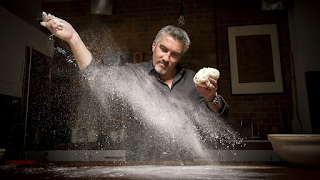

Paul Hollywood image BBC


Paul Hollywood has become known at the ‘King of Bread’ by fans of the Great British Bake Off. It takes a lot to impress him in terms of taste and technical skill - and the coveted Hollywood handshake is a rarity in bread week. 


For all the exotic flavour combinations on show, Paul himself talks about the simplicity and nostalgia of baking: the taste and smell evokes memories of childhood, community and comforts. Civilisation, he says elsewhere, is ‘built around wheat, around people’s settling down and not being nomadic.’


No wonder then that the Israelites long for Egypt: for the time when they were able to eat their fill of bread. It seemed to them that forced labour was compensated for by the sensory delights of bodies and food. 


They’d have been content to die there. Now, in the wilderness, they were unsettled and hungry; hungry and vulnerable. 


In the wilderness, in their vulnerability they see only the prospect of death: they complain and cling to nostalgia of the old ways. Perhaps we recognise that longing. 


They hunger for life, for comfort, for bread; but life was nomadic, relentless, unpredictable. The congregation complained. 


The Lord hears this complaint.

The Lord speaks to Moses.

Moses speaks to Aaron.

Aaron speaks to the congregation of the Israelites.


In their hunger and vulnerability, the Lord does a new thing.

That new things is a gift of bread from heaven.
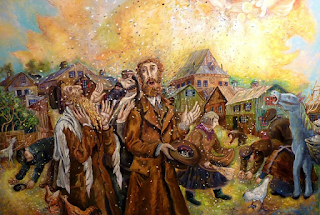


Manna from Heaven - Original by Alexander Kanchik


What is it? They ask. It is the bread that the Lord gives.


This bread rains down from heaven and settled on the wilderness as the dew lifted. Fine. Flaky. Fragile.


And in those gathered fragments hunger is satisfied; it is a practical gift of physical food.


More than that: in these fine, flaky, fragile fragments, the faithful God calls a people back to faithfulness.


In this substance they find sustenance: but it is just enough.


No selfish storing up; no greedy gathering of too much; no excessive consumption.


It is enough for hunger to be satisfied; for complaining to turn to gratitude; for vulnerability to become community.


There is grace. It is enough.  Day by day.


Loaves and Fishes - John August Swanson original


Jesus too had looked upon a crowd with rumbling stomachs and grumbling words: in compassion he responded to that hunger and vulnerability and took what was offered - blessed it and broke it. 


He gave it to them, and they ate their fill; they had enough.


Fragments are collected up and baskets are filled. 


But they wanted more: they look for him.


When they find him, he points them beyond the meeting their physical needs to a deeper longing.


He points them beyond the food that perishes, to the food that fills our stomachs and leaves us wanting more.


He points them to the food that endures for everlasting, abundant and eternal life.


He points to himself: the one who is God’s eternal word; the one who is flesh of our flesh. 


Believe in me, he says; believe in the one sent to you because of God’s love for this world.


They know the story. 


They jump in with their own telling of the story of fine, flaky and fragile bread.
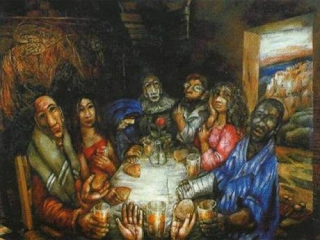


Sieger Köder 


Jesus listens. Yes, he says, you’re right about Moses. You’re right about the way a faithful God calls people back to faithfulness with these gathered fragments.


But he says, there is more: there is more than eating your fill; there’s  more than nostalgia for the old ways.


There is more than the bread shared that day: which smelt so fresh and filled their stomachs; but which will go stale and mouldy. 


This more than is the true bread from heaven: God’s own son.

This more than is the living bread: giving life to the world.


This bread is known to us in the fine, flaky, fragile fragment which we break and snap, bless and share at every communion.


For there, in that place, we receive a fragment of Christ’s body to be united as Christ’s body.


The body that was bruised and bled; died and rose to new and eternal life. In communion we are draw near to this gracious and fragile life. 


In that place, the fragments of our lives, our stories, our hungers and our vulnerabilities are gathered up; they become more than the sum of their parts.


There is communion in this. As the bodies within one body we are fed; where we learn to hunger for God; where we learn to love each other as God loves us.


Our faithful God calls us into faithful communion in this way: through the giving of himself in fragility that our fragments might be made one.


So we pray that our bodies may be revived; that the body of Christ might be revived. That we might be strengthened in the Spirit; that we might hunger for God’s ways; that we might meet others in their vulnerability. 


With open hearts might we touch and taste and see how gracious our Lord is. For what is fragile and fragmented is the stuff that makes for communion. Amen.


© Julie Gittoes 2021

Thursday, 15 June 2017

Come, eat my bread


A sermon preached at Guildford Cathedral on the feast of Corpus Christi: Genesis 14:18-20; 1 Corinthians 11:23-26; John 6 51-58.  The refrain ‘Come, eat my bread’ is a translation of Homo quidam by Thomas Tallis. Preaching on the Eucharist in the light of bread - what we waste, buy, lack and give - is particularly poignant in the light of the catastrophic fire at Grenfell Tower. 

Come, eat my bread - because everything is ready!

Toasted, it’s a breakfast staple. It’s the main component in a sandwich lunch.


Garlic bread, ciabatta, sourdough, rye: taken, broken and shared over dinner, perhaps with a word of grace.

Bread is the epitome of ordinary. But, from the days of Melchizedek, when combined with a glass of wine, bread is an expression of blessing, celebration, conviviality, peace and fellowship. 

Yet, in the face of this abundance,  32% of bread purchased in the UK is thrown away. That’s 4.4 million tonnes of edible food wasted as1000s queue at food banks. 

Bread is the stuff of painful paradoxes: we buy too much because we fear running out; but a cheap commodity is easily discarded.   The factory “white-sliced” competes with the artisan or homemade loaf for time, cost, energy, skill and taste.   


Is it that we’ve lost touch with the process of making bread? 

Have we lost respect for this ordinary, life-sustaining food?  

Do we squander this gift of creation and work of human hands?

Everything is ready.  Come,  eat my bread.


The bread we break tonight - this fusion of flour, kneading, resting and baking - is a sacred mystery.  We take ordinary bread so seriously, that through the power of the Spirit it becomes more than. More than material stuff - a gift of grace, of Christ’s presence with us - and in us.

Yes, this bread is blessed, broken and shared by human hands; Yes, this bread is placed into human hands to be touched, taken and eaten.  And yet, in this wonderful sacrament the King of kings has given himself to us for heavenly food.


On Maundy Thursday, we entered into the solemnity of betrayal, denial and death; tonight we enter with thanksgiving into the deep joy of Christ’s nearness to us and his promise to be with us for evermore.  

Every Eucharist is a repetition - but it’s never the same.  Paul wrote to the Corinthians reminding them of what he had received and passed on to them: that Jesus took the blessing and breaking of bread, and imbued it with a new reality. 


Even before those words were written down, Christians - followers of the way - had broken bread together. It’s not only a command ‘do this’ - it is relationship ‘this is my body, my blood’. It’s more than memorial, it’s proclamation. It’s not just what we hear, it’s who we are: ‘The body of Christ’.

Come, eat my bread and drink the wine I have mixed for you.

‘Was ever another command do obeyed?’, wrote the liturgist Gregory Dix. 

Today, in prisons, parishes, homes, hospitals, universities and refugee camps; at weddings and confirmations, at a death bed in hours of darkness and as rays of light breakthrough our Lady Chapel window. 

Over centuries in trenches, monasteries, slums, portacabins and palaces; in the face of persecution and influence, on the edges of the known world.  And Sunday by Sunday by unremarkable Sunday from Melbourne to Cairo, Beijing to Oslo, Guildford to Mexico City. 

Come, eat my bread.

This pattern of ‘non-identical repetition’ is like the continuity and difference in a Bach fugue or Jazz improvisation. The liturgical repetition ‘do this’ is just the beginning. This great feast of Corpus Christi directs our attention to Christ with us so that we might be sent out to be his body. 

Our communion with God and one another is renewed in this wonderful sacrament.  Heaven and earth touch; divisions cease; we glimpse the peace of God’s Kingdom. For a moment our alleluias resound with saints and angels.

This night we extend the moment of communion - my seconds, by minutes -  to ponder with reverence, praise and wonder ‘for with blessing in his hand, Christ our God to earth descended, our full homage to demand’.  But what we see, what we honour, is who we are. The Body of Christ.  

As we process with beauty and honour, with music and song, with rose petals and footsteps, we remember that Christ is with us - reigning over heaven and earth. That is our ultimate reality.  We reverence Christ’s nearness in ordinary bread, on steps looking out over the community. There we are challenged and inspired to walk in his steps, on this earth, as a pilgrim people. 


Yes, the profound mystery and wondrous reality is that ‘Word-made-flesh, true bread he taketh by his word his flesh to be’. But the equally profound and wondrous reality is that we have been grafted into Christ. By the power of his Spirit we are to both know within us and also show forth in our lives, the fruits of redemption. 

What that looks like has been demonstrated by St Clement's Church - and others - which have opened their doors in response to the fire at Grenfell Tower.  To those who have no bread, they said ‘come’.  ‘Come’ find refuge, breakfast, consolation; ‘come’ bring toiletries, clothes and food; ‘come’ pray, rest and know that you are not alone - in the immediate catastrophe and in the long term. 

In the power of the Spirit, may we too show forth God’d healing and reconciling love; may we too be with others as Christ is with us: in the mundane and in the crisis; in celebration and sorrow; in abundance and in need.

Jesus said, ‘I am the living bread’. The bread that he gave for the life of the world was his flesh.   

Come, eat that bread.
Everything is ready.
Come.


© Julie Gittoes 2017