A sermon for All Saints Sunday Evensong.
The author Tracy Chevalier, writes that when she is researching a new novel, she often does what her characters do [she explores this in The Guardian]
In preparation for Girl with a Pearl Earring - about the Dutch artist Johannes Vermeer - she took a painting class.
For her latest novel, A Single Thread, set in the 1930s, she learned some needlepoint, the craft of her heroine Violet Speedwell.
Violet is making cushions and kneelers and during her summer holidays walks between the cathedral cities of Salisbury and Winchester.

Chevalier also undertakes the literary pilgrimage as she begins the editing process. As she walks, she sees sights which would have been familiar to Violet - the prisons and the hospitals.
She notices the moments where life mirrors art: the place where Violet and Chevalier planned to sit, but where other walkers have already bagged the spot.
She notices how very different life and art can be: the post-war suburbs the changed cropping patterns and the real-life layout of an imagined pub.
The novelist’s way echoes the desire to walk ancient footpaths and increasing popularity of cathedral pilgrimage sites. There is a desire to make connections and to make sense; to belong in a way which extends beyond the present moment.
Yesterday’s Guardian listed some of the well-trodden and lesser known paths: St Finbarr’s Way; the Welsh Camino of St Cadfan; the ways of St Hilda, St Augustine and St Duthac. The ways the saints trod across Cornwall and Northumbria as well as the way to Walsingham, home to England’s Nazareth.
No wonder Dixe Wills opens her article with the words of Blake’s famous hymn, Jerusalem: And did those feet… a hymn which we will sing this evening.
Blake’s words invoke an ancient mythology that Jesus’ walked these mountains and pastures.
And yet the feet of God’s saints have walked upon this land; and the body of Christ still moves step by step through streets and woodlands.
To walk is to move at the pace of the Gospel: to walk that land takes time and risks interruption; place is measured by the human stride; we notice things, the changes and continuities.
This evening we gather as friends, as brothers and sisters, as strangers and pilgrims here on earth.
We gather to pause to be caught up in this interlude of praise and prayer. We bring with us the longings and fears that mark our faces; the hopes and sorrows that shine in our eyes.
We celebrate that light shining forth in the lives of people across the generations who lived and died in deep attention to God and to others. In the power of the Spirit, they bore witness to the love of God made manifest in Jesus Christ.
We do not know all these saints by name. Yet the brightness of lives and their faithful prayers inspire us; their commitment challenged injustice and revealed the hope of a better world. We too are called to make known the glory of God's Kingdom.
The Saints we celebrate placed trust in God; they lived in and for his love - at moments of decision, moments of tenderness, moments of loss; in moments of contemplation and in the work the undertook.
Theirs is a holiness rooted in God’s love and forgiveness; a holiness that inspires and raises us up; it offers mutual encouragement.
Hebrews presents a list of very human saints: judges, kings, and prophets - those who sought justice, righteousness and mercy. Gideon and Barak wrestled with doubts. Samson relied on his immense strength and was seduced by beauty. Jephthah and David wavered in faithfulness to God seeking their own gratification with dire consequences.
Yet, God's Spirit restored them; they learnt courage, humility and wisdom. Alongside them are the men and women who are unnamed and unknown to us, but who walk with us as God’s pilgrim people.
In them we find hope; for God works through us despite our weakness. They are commended for their faith, not their goodness. In them, something of the light of God shines forth. They are our companions. They inspire us to persevere when we waver or feel overwhelmed.
Like them, we are to look to Jesus. He is a pioneer because in him, death is defeated; he is the perfecter of faith; he is our hope. In his life, death and resurrection God’s Kingdom breaks in.
Isaiah's vision is inspirational; but for it to become a reality we have to embrace the challenge of aligning our lives, our world with God's new creation. Through the Spirit, that same power is at work in us as we run the race set before us.
Isaiah speaks of the promise of new heavens and a new earth. Jerusalem is to be a joy and its people a delight. Hopes will be realised and blessings will be poured out on all people. No more distress, suffering, tears and death; no more exploitation and destruction.
Instead God draws all things to himself in stability, refreshment and peace. Our singing of Jerusalem is not an exercise in nostalgia or triumphalism. It can be something rather more hopeful and disruptive.
Blake names the darkness and brutality that marks our landscape; and also a hope that heaven will touch earth. Beneath the text of his poem, he wrote a verse from Numbers: "Would to God that all the Lords people were Prophets"
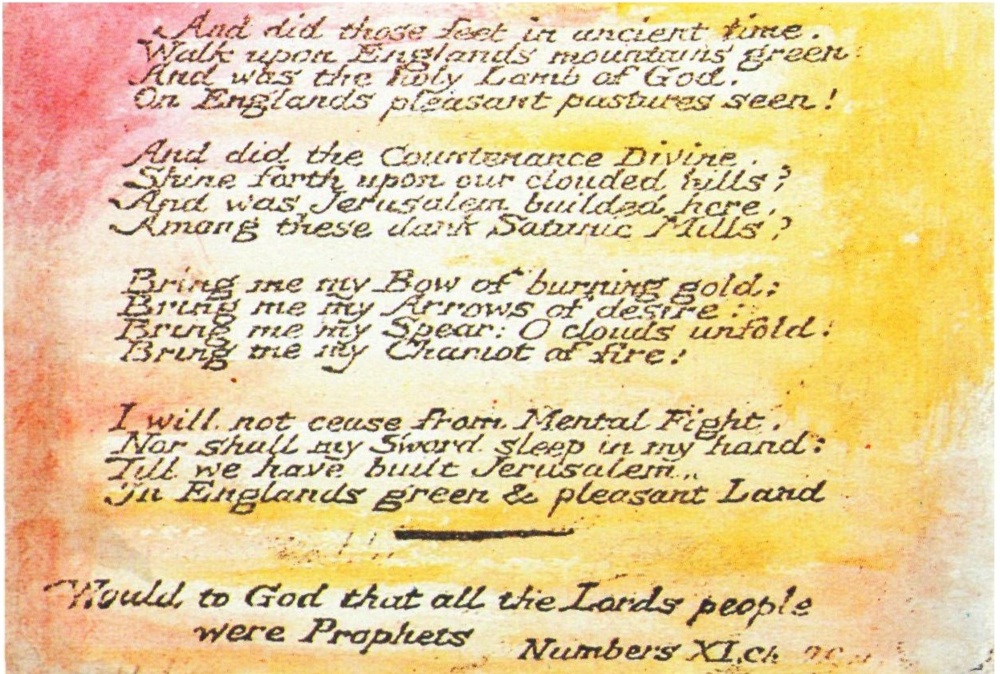
And perhaps that the bows and arrows, the shield and chariot are invoking: a spiritual armour which equips us to fulfil God’s purposes in the world.
Each Evensong, we hear the honest cries of the psalmist; we hear the prophetic call to justice in Mary's song; we hear Simeon rejoice in the light of Christ. Worship inspires us to build trust, to seek justice, to cultivate patience, to learn forgiveness. Worship inspires with the beauty of holiness; holding the curious, the fearful, the joyful and the brokenhearted in abundant love.
As God's saints, we are not called to random acts of goodness but to intentional acts of witness. Giving an account of the hope that is in us; the hope that creation will be renewed; that the signs of God's Kingdom are made known in love, justice and compassion. We do that in the power of the Spirit praying within us; inspiring us; filling us with joy and delight, compassion and wisdom.
We are to embody Isaiah's vision - walking in the world as God's saints. Be passionate, generous, forgiving encouraging and prophetically defiant.
© Julie Gittoes 2019