Showing posts with label All Saints. Show all posts

Sunday, 6 December 2020

You, we, they: are blessed!

 All Saints: 1 John 3:1-3 and Matthew 5:1-12. The series of images I drew on in worship, and which inspired the sermon, are by the artist Hyatt Moore and can be found hereThey make up a beautiful and moving series and it is worth reading the story of how they came to be produced.
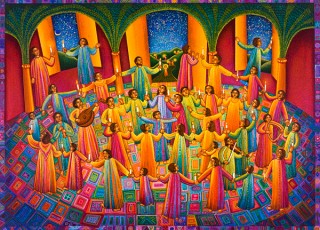


Celebration© 2014 John August Swanson | Eyekons


All Saints: See what love the Father has give us, that we should be called children of God.


In her brief statement yesterday, +Sarah talked about our calling to bring hope and light; as we face new restrictions, we are called to keep the flame of faith burning. 


To pray that the Spirit will kindle in our hearts that flame of love, for our own generation yes; but for those to come. And we do that in unity with all those who have gone before us.  


In some ways, that calling is to embrace an alternate reality: for to love as God loves will as one writer puts it ‘chaff against the present reality’. 


Although what we hope for is yet to be fully revealed, we are to commit to entering that reality now. 


With all the saints, we are invited to step into the light.


It is about wanting to know the heart of God; and to see God’s kingdom come.


Jesus goes up goes up the mountain to teach his disciples. These are are people who have already encountered and responded to him. But on that hillside the crowds overhear. They too glimpse this alternative reality - life under God’s loving and just reign.


The words that Jesus speaks are full of blessing; but they also demand a commitment. 


Transformation is possible when we step into the light of God. 


In the words we hear today, hard circumstances and  are transformed into blessing.

In these words we hear, acts of service are named as a blessing.

Words blessing human life. 


These blessings - the beatitudes - are more than instructions. They are as much painting this new world; describing and lending colour to this alternative reality. 


As one person said, they are a ‘report from the other side of radical commitment for those who have entered into life within God’s community of love and justice’.


Jesus declares a blessing on those who’re protected under the law of love - the bereaved, the poor, those seeking and longing for justice. 


Jesus declares a bless on those who seek to fulfil the law of love; showing mercy and building peace; those who bear the cost of radical love in enduring persecution. 


And often there will be a rub; a sharp edge; because we love the world, because God loved the world, we pray for grace to serve in need and protest when needed.


There are implications to our desire to live under the reign of God.
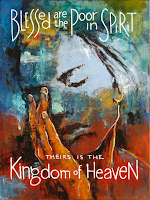


Blessed are the poor in spirit: theirs is the kingdom of heaven:

The uncertain; the curious;

Those who’re struggling; 

The overburdened or under-occupied.

The wearied; the anxious.

Those with a glimmer of hope.


You, they, we: are blessed.
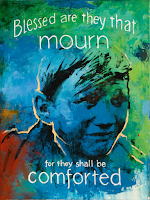


Blessed are those who mourn:  they will be comforted:

Those who face death day by day;

those who’ve wept for loved one;

those who've loved and lost, and keep loving.

Those who’ve laboured in love from cradle to grave.

Those who are holding it together for the sake of someone else;

Those who don’t get over it; those who wait with them.


You, they, we: are blessed.
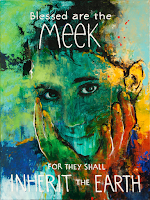


Blessed are the meek: they will inherit the earth:

The unnoticed; the silent ones.

The ones whose bodies we do not see.

The homeless, jobless, seeker;

The sofa surfer and self-doubting;

The hopeful ones; 

Those persisting with acts of kindness.


You, they, we: are blessed.


Blessed are those who hunger/thirst for righteousness: they will be filled:

The refugee and migrant; those courageously seeking a new life;

Those who give away generously; those who receive in need;

The accused and imprisoned; the advocate and volunteer;

The fostered and adopted; the high-achiever and all rounder; the one who gets by;

Those longing for safety; and making the world safer.
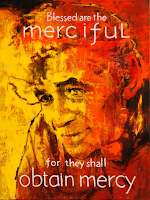


Blessed are the merciful: they will receive mercy:

The teachers and the medics; the social workers and the nurses;

The rubbish collectors and hospital porters. 

The parts of ourselves we don’t give away, or reveal.

The overlooked the over stretched;

The patient time-takers; the persistent care-givers.

Those who speak out and speak up.

Those who hear.


You, they, we: are blessed.
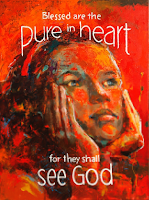


Blessed are in heart: they shall see God.

The searching; those who thirst and wait.

The dreamers and the visionaries; 

The radicals and the writers; 

The artists and the environmentalists;

Those who show their needs and pray.


You, they, we: are blessed.
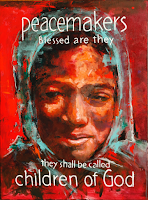


Blessed are the peacemakers: they shall be called children of God.

Those who seek for peace; 

who live to serve, who love to set free;

who give that others may live.

The bridge builders; reconcilers; 

Those who embrace conflict as creative;

Those who strive with hope not fear.


You, they, we: are blessed.


Blessed are the persecuted: for theirs is the kingdom of heaven.


When one’s life is characterised by the attributes highlighted in the beatitudes, two things are assured: blessedness on the one hand and persecution on the other. 


Blessed are those who are persecuted; for the faith or ethnicity, gender or sexuality; for their commitment justice and peace.


You, they, we: are blessed.


In a way, the beatitudes turn the world upside down. The promise the good news being lived out in relationship. 


The alternative reality the present, these blessings are balm to our souls: comfort for the grief stricken; the hope of justice, the longing for peace.


We are invited to live this reality - in a world where the poor are still oppressed, where violence stalks the streets and where consumption harms our planet.


The pastor and writer, Anna Case-Winters frames that invitation in a series of questions:

What gestures will we offer that accompany these words? What commitments will we make? What risks will we take? what dreams will we dream?


In all our days; in all our ways - may we see God and see God’s kingdom.

Blessed to bless - that God’s will is done.

Kindling a flame of love and faith.

Being light and hope.


© Julie Gittoes 2020


Thursday, 14 November 2019

And did those feet?


A sermon for All Saints Sunday Evensong.

The author Tracy Chevalier, writes that when she is researching a new novel, she often does what her characters do [she explores this in The Guardian]

In preparation for Girl with a Pearl Earring - about the Dutch artist Johannes Vermeer - she took a painting class.

For her latest novel, A Single Thread, set in the 1930s, she learned some needlepoint, the craft of her heroine Violet Speedwell. 

Violet is making cushions and kneelers and during her summer holidays walks between the cathedral cities of Salisbury and Winchester.  


Chevalier also undertakes the literary pilgrimage as she begins the editing process. As she walks, she sees sights which would have been familiar to Violet - the prisons and the hospitals.

She notices the moments where life mirrors art: the place where Violet and Chevalier planned to sit, but where other walkers have already bagged the spot. 

She notices how very different life and art can be: the post-war suburbs the changed cropping patterns and the real-life layout of an imagined pub.

The novelist’s way echoes the desire to walk ancient footpaths and increasing popularity of cathedral pilgrimage sites. There is a desire to make connections and to make sense; to belong in a way which extends beyond the present moment.

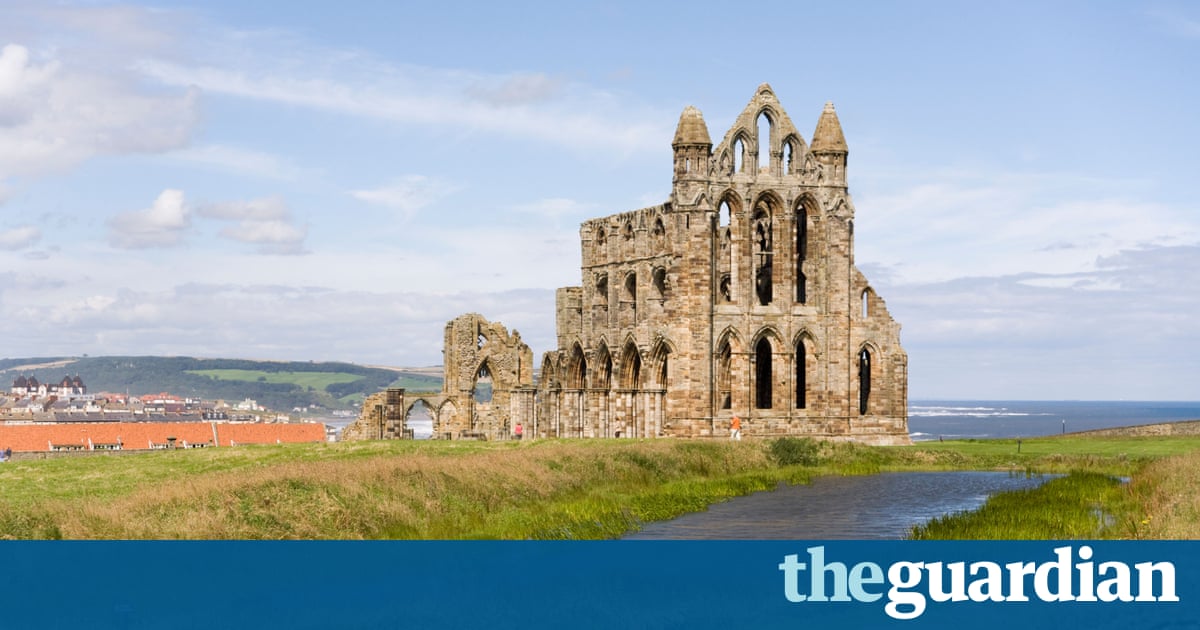
Yesterday’s Guardian listed some of the well-trodden and lesser known paths:  St Finbarr’s Way; the Welsh Camino of St Cadfan; the ways of St Hilda, St Augustine and St Duthac. The ways the saints trod across Cornwall and Northumbria as well as the way to Walsingham, home to England’s Nazareth.

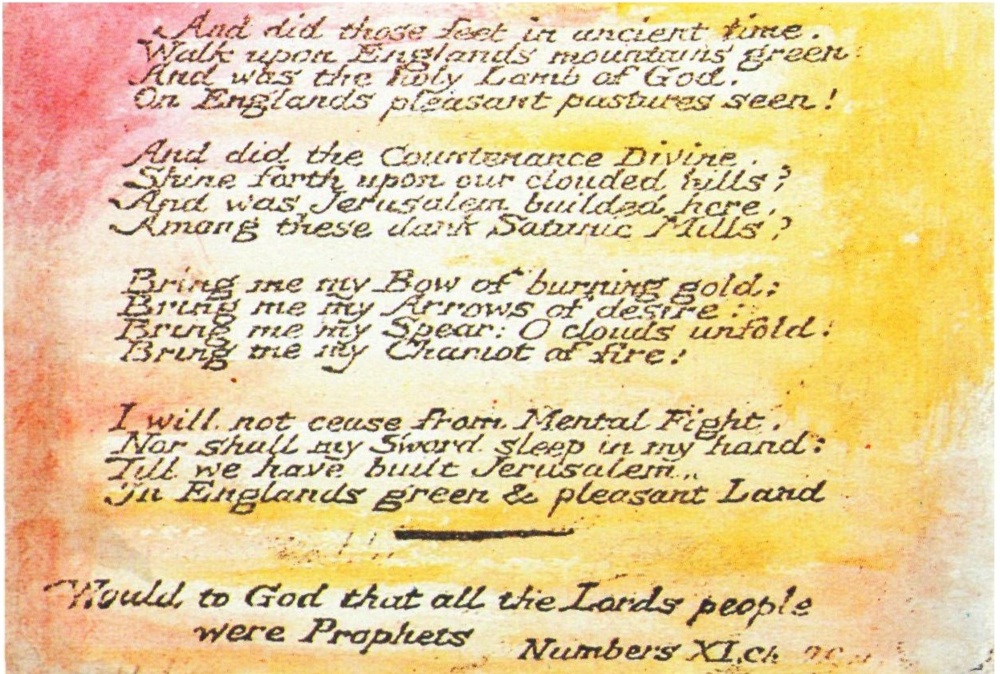
No wonder Dixe Wills opens her article with the words of Blake’s famous hymn, Jerusalem: And did those feet… a hymn which we will sing this evening.

Blake’s words invoke an ancient mythology that Jesus’ walked these mountains and pastures.

And yet the feet of God’s saints have walked upon this land; and the body of Christ still moves step by step through streets and woodlands.

To walk is to move at the pace of the Gospel: to walk that land takes time and risks interruption; place is measured by the human stride; we notice things, the changes and continuities.

This evening we gather as friends, as brothers and sisters, as strangers and pilgrims here on earth.  

We gather to pause to be caught up in this interlude of praise and prayer.  We bring with us the longings and fears that mark our faces; the hopes and sorrows that shine in our eyes. 

We celebrate that light shining forth in the lives of people across the generations who lived and died in deep attention to God and to others.  In the power of the Spirit, they bore witness to the love of God made manifest in Jesus Christ.   

We do not know all these saints by name. Yet the brightness of lives and their faithful prayers inspire us; their commitment challenged injustice and revealed the hope of a better world. We too are called to make known the glory of God's Kingdom.

The Saints we celebrate placed trust in God; they lived in and for his love - at moments of decision, moments of tenderness, moments of loss; in moments of contemplation and in the work the undertook.

Theirs is a holiness rooted in God’s love and forgiveness; a holiness that inspires and raises us up; it offers mutual encouragement.

Hebrews presents a list of very human saints: judges, kings, and prophets - those who sought justice, righteousness and mercy.  Gideon and Barak wrestled with doubts. Samson relied on his immense strength and was seduced by beauty. Jephthah and David wavered in faithfulness to God seeking their own gratification with dire consequences.  

Yet, God's Spirit restored them; they learnt courage, humility and wisdom.  Alongside them are the men and women who are unnamed and unknown to us, but who walk with us as God’s pilgrim people.  

In them we find hope; for God works through us despite our weakness.  They are commended for their faith, not their goodness.  In them, something of the light of God shines forth.  They are our companions. They inspire us to persevere when we waver or feel overwhelmed.  

Like them, we are to look to Jesus. He is a pioneer because in him, death is defeated; he is the perfecter of faith; he is our hope.  In his life, death and resurrection God’s Kingdom breaks in. 

Isaiah's vision is inspirational; but for it to become a reality we have to embrace the challenge of aligning our lives, our world with God's new creation. Through the Spirit, that same power is at work in us as we run the race set before us.

Isaiah speaks of the promise of new heavens and a new earth. Jerusalem is to be a joy and its people a delight.  Hopes will be realised and blessings will be poured out on all people.  No more distress, suffering, tears and death; no more exploitation and destruction. 

Instead God draws all things to himself in stability, refreshment and peace.  Our singing of Jerusalem is not an exercise in nostalgia or triumphalism. It can be something rather more hopeful and disruptive. 

Blake names the darkness and brutality that marks our landscape; and also a hope that heaven will touch earth. Beneath the text of his poem, he wrote a verse from Numbers:  "Would to God that all the Lords people were Prophets"


And perhaps that the bows and arrows, the shield and chariot are invoking: a spiritual armour which equips us to fulfil God’s purposes in the world. 

Each Evensong, we hear the honest cries of the psalmist; we hear the prophetic call to justice in Mary's song; we hear Simeon rejoice in the light of Christ.  Worship inspires us to build trust, to seek justice, to cultivate patience, to learn forgiveness.  Worship inspires with the beauty of holiness; holding the curious, the fearful, the joyful and the brokenhearted in abundant love.

As God's saints, we are not called to random acts of goodness but to intentional acts of witness.  Giving an account of the hope that is in us; the hope that creation will be renewed; that the signs of God's Kingdom are made known in love, justice and compassion.  We do that in the power of the Spirit praying within us; inspiring us; filling us with joy and delight, compassion and wisdom.

We are to embody Isaiah's vision - walking in the world as God's saints.  Be passionate, generous, forgiving encouraging and prophetically defiant.

© Julie Gittoes 2019

All Saints - life at walking pace

All Saints Eucharist: Daniel 7:1-3, 15-18, Ephesians 1:11-23 and Luke 6:20-31


Pilgrim’s progress is not a byeline you expect to see in a weekend paper; but yesterday’s Guardian did just that devoting pages to ancient footpaths and pilgrimage sites.

St Finbarr’s Way; the Welsh Camino of St Cadfan; the ways of St Hilda, St Augustine and St Duthac. The ways the saints trod across Cornwall and Northumbria as well as the way to Walsingham, home to England’s Nazareth.

No wonder Dixe Wills opens her article with the words of Blake’s famous hymn, Jerusalem: And did those feet…

And the feet of God’s saints have walked upon this land; and the body of Christ still moves step by step through streets and woodlands.

To walk is to live at a pace where we notice what is around us; where we risk being drawn into conversation with others on the way.

Today we give thank for the saints; for the great cloud of witnesses who have gone before us in our earthly walk of faith.

Across the generations, these men and women have sought to reflect the love of God by their teaching and their actions; by the way they’ve built others up; and by the way they’ve sought to make known the justice and compassion of God’s Kingdom.

They’ve kindled a flame of faith in us and in this land. They are our family. Some of them will be people who encourage or provoke; for some we will have great personal affection or devotion; others will be unknown, but for a name.

We are to follow them - to follow their example with boldness and with joy - as pilgrims here on earth.  Their lives witnessed to the life and hope of the Gospel, often in very practical ways. 

Some were called to administration and others offered hospitality; some sought justice for the poor and oppressed others were renowned for their wisdom and teaching. Some exercised power and influence in high office; others sought to be a blessing in homes and communities.

They are our inspiration as we work out that reality in ourselves and within the networks or relationships we inhabit. 

Today’s readings set out the patterns and habits which shape this life together. There is challenge and creativity in the words we hear.  

The words of scripture remind us that God was in Christ reconciling the world to Godself; in the power of the Spirit, the lives of the saints echoed that hope, shining as lights in the world. 

In our own generation, we are called to be lights in our own generation. And that can sometimes feel like a burden or pressure; that we are not good enough to fulfil that calling.

Perhaps then we can take encouragement from the words of Rassie Erasmus - the head coach of the Springboks. He describes the pressures of life in South Africa - the problems of employment or crime. 

Then he talks about ruby as a privilege rather than a burden he says: Rugby shouldn’t be something that creates pressure on you, it should be something that creates hope.

What if we were to substitute the word faith or church or discipleship for rugby: being a Christian shouldn’t be something that creates pressure on your, it should be something that creates hope.

To continue the rugby analogy, that doesn’t mean talking about it: it means living it, playing well and working together for a common aim. 

Our Gospel reading leaves us in doubt about the challenge of living in such a community. Jesus' teaching about blessing and woes are memorable. They are challenging and edgy. Jesus is laying the foundations of a renewed community - reaching out to the curious and already committed.

This is a community that exists among and for the most disadvantaged. Jesus is addressing himself to those who find themselves up against it; and those who’re passionate for change. He addresses himself to those who are looking for hope; and those who are under pressure.

This is a manifesto for all the saints: to hunger and thirst for righteousness; to be with poor, the hungry and the grief stricken. 

When we gather together around the altar, we are united with them in praise and pray; members of one body; transcending time and place.

But this gathering is but an interval in the scattered life of the church. For we will be sent out to love and serve; send out to walk in the world. Walking through Brent Street and The Boroughs into offices and schools, shops and concert halls, hymns and parks. 

As we walk, what do we notice and with whom do we meet?

Blessed are the motherless; the alone; those who haven’t got over it yet. Blessed are the street cleaners and health care assistants; blessed are underrepresented, the unemployed; the teenager who are anxious. 

Blessed are those seeking refuge and dreaming of a better life; blessed are those who campaign and keep others safe. Blessed are those who challenge the bullies; and those who show mercy and comfort. Blessed are those who weep and laugh; blessed are those who embrace and nurse.

The challenge to us resounds in our community of faith. Woe to us when we lack generosity or gratitude; woe to us when we court popularity.  And just when we get to the bit where we think we can relax and be comfortable, Jesus says, even in the face of insult, excessive demands and all that makes us defensive, we are to love. 

Our identity in Christ flows from our baptism and is deepened in prayer and praise. Our identity is nourished in sharing this sacred feast of bread and wine - the bond of our communion with Christ. Here the Spirit is poured out on us afresh. Here we are caught up in a process of transformation. Here we are renewed and inspired. From here we are sent out to live in faith and hope and love, as lights in the world. 

Wouldn't it be amazing if it could be said so us: we've heard of your faith and your love of others. For Paul reminds the Ephesians that the Spirit in them is a little bit of heaven now. He tells them to live  lives as God's people in a world which is imperfect and in need of transformation. 

If Luke reminds us that the gospel is about social, religious, economic and political justice; Paul reminds us that a church called to risk is called to pray. For a spirit of wisdom and enlightenment. Such wisdom is an awareness of a God and his will for our lives. The love of God is the beginning of wisdom. 

This wisdom enables us to see the world differently: to be attentive and response to the cries we hear and the needs we see. The words of Daniel speak of a time of great upheaval and tensions between the nations; he speaks of terror and uncertainty, and yet he also reaches out the hope and promise of God in the midst of disruption. 

The hope we share is not wishful thinking but an awareness that creation is being drawn together in Christ; we walk this land, we walk ancient paths and create new pilgrim ways.

Those paths are marked by the same love, justice and compassion those who walked before us. Our walking in this land is rooted in the love of our gracious God who in Christ is revealed as redeemer and through Spirit opens our eyes to grace. 

We, as saints among saints, are called to mirror the eternal dance of mutual love of the Trinity. Delighting in God and his creation, no one should feel worthless. 

In the smallest of fragments of bread we taste and see the fullness of God. Through the relative smallness of our lives and gestures, we share that fullness.

We are drawn into the company of God's faithful and flawed people. We rely on the Spirit to strengthen us.  At the point at which we face death, when dreams and fears are laid bare, new life breaks through. Perhaps all the saints remind us of that too. 

As we struggle with systems that oppress and show compassion for the marginalised and face mistrust with love, we won't be defeated. All things under Christ's  feet; he is the head over all things for the church; which is his body - the fullness of him who fills all in all. 


He is the fullness of God. We are in Christ. Empowered by the Spirit let us with all the saints in light shine as lights in the world. To the glory of God.

© Julie Gittoes 2019