Showing posts with label blessing. Show all posts

Saturday, 19 February 2022

The human heart: blessings and woes

A sermon preached on 13th February 2022, 3rd before Lent; Jeremiah 17:5-10, 1 Corinthians 15:12-20 and Luke 6:17-26


Ahead of Valentine’s Day, Good Housekeeping published 72 supposedly “swoon-worthy love quotes”; “the perfect message for your Valentine”. Inspiration is taken from Barak Obama and Leo Tolstoy, Maya Angelou and Jane Austen, from Shakespeare, Madonna, the Song of Songs, and Mother Theresa.


Who knows if the compiler of these “swoon-worthy” quotes, printed against red-bubble-hearts, would have given thought to the religious hinterland to some of those lines. 


But we know, love can bring blessing and woe: yes, love is full of hope and bravery; tenderness and consolation; but, its risky and a life-long labour; there are too many broken hearts in the world, as Jason Donovan sang in 1980-something.


No complier of valentine’s day quotes would turn to Jeremiah, though perhaps his words about the human heart are recognisable too.


First, who can even begin to understand the human heart?


Second, we know the ways our hearts can turn away from loving - loving God, self and neighbour.


Finally, we trust that hearts can be turned outwards in love - that God will search us out, know us and see the fruit of all our doings.


When Jesus came to stand with the crowd on the ‘level place’, he opens up our hearts by speaking a litany of blessings and woes: they’re not words of advice per se; they’re not offering judgement even; but they do weigh our hearts by exploring the truth of how life works. 
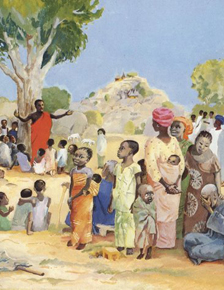


Jesus Mafa Project


It’s easy to slip into guilt or romanticism about these words; but I wonder if we can step into this radical topsy-turvy kingdom today.  Unlike Matthew, Luke doesn’t soften these sayings by saying hunger for righteousness, rather than hunger;  or poor in spirit, rather than poor.  


He’s amplifying where God’s heart is in places of need  or sorrow, and saying something about the transience of our wealth and privilege. He reminds us that our common human dignity reaches across comfort and discomfort; it doesn’t sanitise hunger and poverty, for moments before this passage Jesus is revealing the abundance of God’s care in healing and compassion.


As we hear them sayings of blessing and woe, as we learn them, say them or enact them, we might have our hearts searched, turned or changed too.


The American monk, Brendan Freeman, says this: “[The Beatitudes] draw our hearts out of themselves into a new way of understanding our lives…they are deliberately incomplete.  They await the inclusion of our lives.  Each person fills in the blank spaces with the details of his or her own life situation.”


Blessings and woes are part of the fabric of human life: it is where we all live - in our homes, work places, schools and communities.  The line between empty and full, tears and laughter is a thin one; we cross it because of one crisis or one act of kindness. 


As Jack Monroe has highlighted in her work on food poverty: we all notice the increase in the cost of living but it effects those on low incomes most. When we invest in early interventions and support for children and families, they are more likely flourish at school and attain their potential.


Blessings and woes are woven into the life of the church. We are all members of Christ’s body - when one mourns, our hearts ache; when on is rejoicing we share in the overflow of their gladness. 


When one member is wounded, we bleed too. As Lord Boateng reminded the Church of England’s General Synod that racial justice is all about Jesus. He said ‘love is not as soft as sentiment but as strong as strategy, we will wash your feet but sometimes we will hold your feet to the fire’.


If blessing and woe can happen to us all - and if we, as a Body, are hurt by the wounds of another member - perhaps Jesus’ words are not heard as condemnation but as invitation: an invitation to open our hearts in love. 


Our calling is perhaps to acknowledge the tensions and to listen carefully to the other; to let go of our own self-sufficiency, and receive the gift of another. As the writer and preacher Barbara Brown Taylor puts it: ‘Much of the power of the Beatitudes depends on where you are sitting when you hear them.  They sound different from on top than they do underneath.’
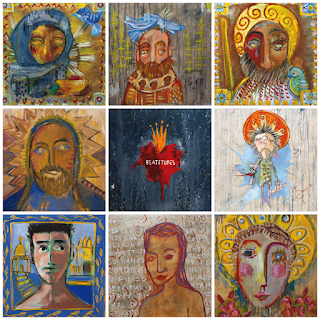

Beatitudes: S. Garrard


At different points in life, we might hear the challenge; at other points here the hope. The words are the same; they sound different.


Hearing these familiar words in The Message translation highlights that:

You’re blessed when you’ve lost it all.

God’s kingdom is there for the finding.

You’re blessed when you’re ravenously hungry.

Then you’re ready for the Messianic meal.

You’re blessed when the tears flow freely.

Joy comes with the morning.

But it’s trouble ahead if you think you have it made.

What you have is all you’ll ever get.

And it’s trouble ahead if you’re satisfied with yourself.

Your self will not satisfy you for long.

And it’s trouble ahead if you think life’s all fun and games.

There’s suffering to be met, and you’re going to meet it.


Is it comfortable to hear the woes, not at all: it reminds us that all that we have is temporary, fragile. Is it easy to hear the blessings, not always: yet they reminds us of the hope of consolation and the possibility of change.  


Are the beatitudes comfortable, no: but the do help us understand the human heart. Is this teaching costly, yes it is: but it is a way of turning our hearts to wards God, ourselves and our neighbour in love. Is there a risk of domesticating these words - always: and yet, as we take them to heart, God is with us searching us out and seeing the first fruits of all our doings.


Cutting across the woes and blessings is a word about the treatment of God’s prophets. Blessed when challenging those in power; in trouble when they flattered them. Blessed when speaking uncomfortable truths; in trouble when courting popular opinion. 


Jesus walked that way himself: it cost him his life and breath and yet, death was not the final word. As Paul reminds us, our hope is in our risen Lord. He is the first fruit of God’s kingdom breaking in - in our blessings and woes, in comfort and in grief. 


May we walk this way in love: our hearts open.


In the words of John O’Donohue:

May we live this day

Compassionate of heart,

Clear in word,

Gracious in awareness,

Courageous in thought,

Generous in love.


© Julie Gittoes 2022


Sunday, 6 December 2020

You, we, they: are blessed!

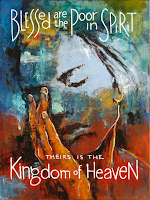
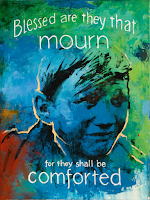
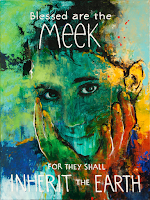
 All Saints: 1 John 3:1-3 and Matthew 5:1-12. The series of images I drew on in worship, and which inspired the sermon, are by the artist Hyatt Moore and can be found hereThey make up a beautiful and moving series and it is worth reading the story of how they came to be produced.


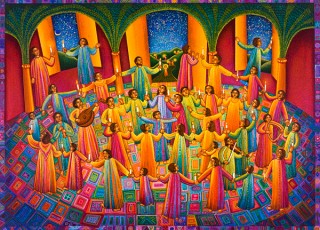
Celebration© 2014 John August Swanson | Eyekons


All Saints: See what love the Father has give us, that we should be called children of God.


In her brief statement yesterday, +Sarah talked about our calling to bring hope and light; as we face new restrictions, we are called to keep the flame of faith burning. 


To pray that the Spirit will kindle in our hearts that flame of love, for our own generation yes; but for those to come. And we do that in unity with all those who have gone before us.  


In some ways, that calling is to embrace an alternate reality: for to love as God loves will as one writer puts it ‘chaff against the present reality’. 


Although what we hope for is yet to be fully revealed, we are to commit to entering that reality now. 


With all the saints, we are invited to step into the light.


It is about wanting to know the heart of God; and to see God’s kingdom come.


Jesus goes up goes up the mountain to teach his disciples. These are are people who have already encountered and responded to him. But on that hillside the crowds overhear. They too glimpse this alternative reality - life under God’s loving and just reign.


The words that Jesus speaks are full of blessing; but they also demand a commitment. 


Transformation is possible when we step into the light of God. 


In the words we hear today, hard circumstances and  are transformed into blessing.

In these words we hear, acts of service are named as a blessing.

Words blessing human life. 


These blessings - the beatitudes - are more than instructions. They are as much painting this new world; describing and lending colour to this alternative reality. 


As one person said, they are a ‘report from the other side of radical commitment for those who have entered into life within God’s community of love and justice’.


Jesus declares a blessing on those who’re protected under the law of love - the bereaved, the poor, those seeking and longing for justice. 


Jesus declares a bless on those who seek to fulfil the law of love; showing mercy and building peace; those who bear the cost of radical love in enduring persecution. 


And often there will be a rub; a sharp edge; because we love the world, because God loved the world, we pray for grace to serve in need and protest when needed.


There are implications to our desire to live under the reign of God.


Blessed are the poor in spirit: theirs is the kingdom of heaven:

The uncertain; the curious;

Those who’re struggling; 

The overburdened or under-occupied.

The wearied; the anxious.

Those with a glimmer of hope.


You, they, we: are blessed.


Blessed are those who mourn:  they will be comforted:

Those who face death day by day;

those who’ve wept for loved one;

those who've loved and lost, and keep loving.

Those who’ve laboured in love from cradle to grave.

Those who are holding it together for the sake of someone else;

Those who don’t get over it; those who wait with them.


You, they, we: are blessed.


Blessed are the meek: they will inherit the earth:

The unnoticed; the silent ones.

The ones whose bodies we do not see.

The homeless, jobless, seeker;

The sofa surfer and self-doubting;

The hopeful ones; 

Those persisting with acts of kindness.


You, they, we: are blessed.


Blessed are those who hunger/thirst for righteousness: they will be filled:

The refugee and migrant; those courageously seeking a new life;

Those who give away generously; those who receive in need;

The accused and imprisoned; the advocate and volunteer;

The fostered and adopted; the high-achiever and all rounder; the one who gets by;

Those longing for safety; and making the world safer.


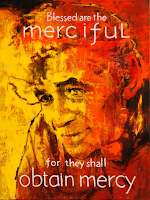
Blessed are the merciful: they will receive mercy:

The teachers and the medics; the social workers and the nurses;

The rubbish collectors and hospital porters. 

The parts of ourselves we don’t give away, or reveal.

The overlooked the over stretched;

The patient time-takers; the persistent care-givers.

Those who speak out and speak up.

Those who hear.


You, they, we: are blessed.


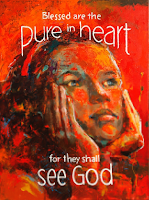
Blessed are in heart: they shall see God.

The searching; those who thirst and wait.

The dreamers and the visionaries; 

The radicals and the writers; 

The artists and the environmentalists;

Those who show their needs and pray.


You, they, we: are blessed.


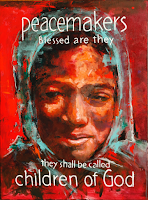
Blessed are the peacemakers: they shall be called children of God.

Those who seek for peace; 

who live to serve, who love to set free;

who give that others may live.

The bridge builders; reconcilers; 

Those who embrace conflict as creative;

Those who strive with hope not fear.


You, they, we: are blessed.


Blessed are the persecuted: for theirs is the kingdom of heaven.


When one’s life is characterised by the attributes highlighted in the beatitudes, two things are assured: blessedness on the one hand and persecution on the other. 


Blessed are those who are persecuted; for the faith or ethnicity, gender or sexuality; for their commitment justice and peace.


You, they, we: are blessed.


In a way, the beatitudes turn the world upside down. The promise the good news being lived out in relationship. 


The alternative reality the present, these blessings are balm to our souls: comfort for the grief stricken; the hope of justice, the longing for peace.


We are invited to live this reality - in a world where the poor are still oppressed, where violence stalks the streets and where consumption harms our planet.


The pastor and writer, Anna Case-Winters frames that invitation in a series of questions:

What gestures will we offer that accompany these words? What commitments will we make? What risks will we take? what dreams will we dream?


In all our days; in all our ways - may we see God and see God’s kingdom.

Blessed to bless - that God’s will is done.

Kindling a flame of love and faith.

Being light and hope.


© Julie Gittoes 2020


Monday, 1 July 2019

Blessing that gives life

I missed +Philip North’s interview on Radio 4 yesterday morning; but I was able to read a transcript. Safeguarding is of vital importance within the life of the church. It is about policies, procedures, training and recruitment. It is also about how we change a culture - which involves teaching and preaching about abuse of power, coercion/control, as well as naming what forgiveness, blessing and mercy look like (as well as what they’re not!). 

It involves understanding what might trigger memories of trauma; it means not colluding with authority and silencing survivors.  It means attending to what unfolds within IICSA; and praying for all involved in that process. The challenge and calling of being a safe church a theme in my final sermon at Guildford Cathedral; and I’m addressing it now in one of my first at Hendon.

This is the text from Evensong - although the final section is notes, because I spoke without a script at that stage, before ending with a prayer which reminds us that our human character is refined and shaped by coming into the presence of God


When I was a child, I waited for my mind to grow, for my experiences to accumulate and my choices to solidify, taking shape into the likeness of a person. That person, or that likeness of one, had belonged. I was of  that mountain, the mountain that had made me.

So writes Tara Westhover towards the end of her memoir entitled Educated

It’s more than a coming-of-age story; it’s more than a so-called misery-lit of a tough childhood. It’s an episodic narrative family and identity; it meditates on memory, blurred by violence and the silence that followed it.

It’s set in Idaho part of the heartland of America, yet socially on the edge and economically fragile.

The mountain of which she speak is known as the Indian Princess: the weather, the seasons and Westhover’s home lie in its shadow.

This domestic realm is shaped by other shadows: the shadows of struggling to make a living out of scrap metal; the rejection of modern medicine; the framework of fundamentalist religion; and the disengagement from schooling.

The human shadows loom large: the prophetic imaginations of a father and his tendency it mania and depression; a mother who defers to his authority whilst seeking some sort of independence through essential oils and unlicensed midwifery; the brooding violence of a brother, which is terrifying in its volatility and its predictability.

It is compelling and heart-wrenching, eloquent in its compassion; it's about determination and dislocation; it’s about finding redemption, yes, though a learning and finding a voice. Westhover calls it an education - this child waiting for her mind to grow; waiting for her selfhood to take shape. She muses on the transformation, the process of letting go of guilt, and the separation from parents.

The catalyst for such a separation came down to years of spiritual control and manipulation which culminates with her father saying, 'I will offer, one final time, to give you a blessing’.

She writes of his burning conviction, but what for him is mercy is actually loss of self. She describes the way the silence in the room settled, undisturbed and oppressive. And knowing all that has gone before, the cycles of fear and control, she says to her father, ‘I love you, but I can’t’. 

The refusal of his power over her is the true blessing; the mercy is seen in retaining custody of her own mind.

To receive a blessing is a gift of knowing that we are precious in the sight of God: that we are beloved, accepted and valued.

The blessing that God wishes, to bestow on us is a word of life and of purpose. 

And yet, as Westhover’s memoire reveals, in human hands words of blessing withheld or threatened deny life and love and purpose.

This is complicated and painful territory. 

Some of you may have heard +Philip North talking about the church’s complicity with abuse and the silence covering it up; of his words calling for a spirit of repentance and a review of structures. He and many others are calling for a change of culture away from unhealthy deference to clergy, especially in senior positions. 

Instead perhaps we might think in a prophetic and pastoral way about how we listen to and treat survivors of abuse; how we recognise the fruit of power exercised with maturity for the sake of the vulnerable; and to imagine what it is to bless and be blessed - not out of fear or control, but to bring life, mercy and wholeness.

The themes of authority and the nature of blessing flow through this evenings texts too. And perhaps we can find hope and courage through the way in which they reflect both the complexity of our human relationships and the grace of God at work in the world.

Jacob and Esau are twins whose relationship is fraught and contested from the very beginning. They wrestled with each other in their mother’s womb. Esau was born with Jacob clutching at his ankle. 

Their mother Rebekah had received a vision or prophecy that the elder would indeed serve the younger - that God’s blessing would be worked out through character and calling undercutting sibling hierarchy.

Prior to the passage heard this evening, Esau had given away his birthright - the promise of blessing - for the sake of a bowl of stew. Returning famished from the field, he acts impulsively and recklessly. 

Esau was, however, his father’s favourite. Perhaps that’s why Isaac attempts to reset the natural order of blessing privately. Jacob, on the other hand, was Rebekah’s favourite. Perhaps that is why she conspires in encouraging Isaac’s deception.

What is unleashed at a family level is weeping and fury. It is Esau who stays at home whilst Jacob flees his murderous wrath. He leaves behind the inheritance - an inheritance that was insecure at a human level, and yet assured by God’s promise.  

Do read on in Genesis to discover the path that leads to the reconciling of brothers and to the outworking of blessing through subsequent generations. A blessing which takes us to Joseph, through slavery and exodus to freedom in the Promised Land.

Our second reading takes us to the fulfilment of blessing in Jesus Christ. Mark gives us a glimpse into the complication of ‘home-coming’. Jesus had grown up in a Nazareth - a place as marginal perhaps as Westhover’s Idaho in terms of population and social/economic impact. 

But it was his home. Having spent time teaching and preaching around Galilee and Capernaum, he returns with his disciples. 

No doubt news of his ministry has drifted back to the hill country; and now, having relied on hearsay, those who have known Jesus since infancy, childhood and into adolescence get to see for themselves. They extend a preaching invitation to the local lad who’d gained with a growing reputation.

They are astounded: by the wisdom they here; and by the power of his words.

But astonishment turns to offence: they stumble over the fact that they know him. 

It’s a bit like cognitive dissonance: how can this be; we know him? Their assumptions and authority colluded against seeing the love that gives life.

Some were healed: their faith revealing what familiarity hid from others; life flowing from trust in power in words of liberation and blessing. 

God’s ways of blessing reach out into our incomprehension and puzzlement; our astonishment and fear. 

We are blessed; and we have a responsibility to be a blessing.

That means taking seriously our commitment to safeguarding within this church community; valuing the work of our children's champion and safeguarding office; begin aware of signs of abuse or neglect amongst children and vulnerable adults.

We do this not only to meet the highest standards that the world expects of us; but also to express the values of the kingdom including what is just and merciful. +Philip talked about changing a culture. That includes being aware of triggers and listening to stories; of not silently colluding with abuse of authority.

To be blessed and to be a blessing to others is about enabling people to fulfil their potential - for their true selves to take shape in ways which are about flourishing and life. Coming before God in worship, in penitence and faith, reminds us that our character is formed by encountering the refining presence of God. We need to be courageous in seeking the welfare of others.

I end with word by Francis of Assisi which reminds us of God's holiness; and inspires us to reflect that character:

You are holy
You are holy, Lord, the only God and your deeds are wonderful.
You are strong, you are great.
You are the most high, you are alright.
You, holy Father, are King of heaven and earth.
You are three and one, Lord God, all good.
You are good, all good, supreme good, Lord God, living and true.
You are love, you are wisdom
You are humility, you are endurance.
You are rest, you are peace.
You are joy and gladness, you are justice and moderation.
You are all riches, and you suffice for us.
You are beauty, you are gentleness.
You are our protector, our are our guardian and defender.
You are courage, our are our have and our hope.
You are our faith, our great consolation.
You are our enteral life, great and wonderful Lord.
God almighty, merciful Saviour. Amen.

© Julie Gittoes 2019


Tuesday, 25 December 2018

Crying out in song

The text of a sermon preached at the Cathedral Eucharist on Advent 4 - reflecting on the ubiquity of Christmas songs and the way that music can hook us back into childhood memories or cultivate a sense of community. It's Mary's song which takes centre stage. It's family words challenge us to think about the cries of our world and our part in singing God's song of justice. The readings were Micah 5:2-5a, Hebrews 10:5-10, Luke 1:39-45 [46-55 sang by the choir]

December is the season, more than any other month of the year, when our lives accompanied by a communal soundtrack. The Christmas classic is as ubiquitous as tinsel, mince pies and festive jumpers.


Supermarkets set the ‘Christmas vibe’ as play the sentimental schmalz of Bing Crosby’s ‘White Christmas’, and the harmless cheese of Chris Rea ‘Driving Home for Christmas’; the Jackson 5 accompanies the last minute trolly dash with the up beat ‘Santa Claus is coming to town'; we leave to the bell-chimes of Wizzard's ‘I wish it could be Christmas every day’.

On an overcrowded, late running last train, there’s a spontaneous sing-a-long of Mariah Carey’s ‘All I want for Christmas is you’, enthusiasm turning to awkwardness when no one knows all the words; church choirs and music groups gather in their local pub for beer and carols, weaving Slade’s ‘Merry Christmas’ alongside ‘O come all ye faithful’. 

Perhaps we lift the needle to play the old vinyl of Elvis’ ‘Blue Christmas’; or, like me, find ourselves catapulted back to our childhood as Bonny M sing ‘Mary’s boy child’. 


Why do these songs get under our skin? Setting aside our inner music critic, they tap into our memories and emotions. When it’s cold outside, Christmas songs remind us of home; of warmth of friendship and community.  

But there’s complexity too. The songs which put a smile on our face are also the ones which express our loneliness and or the personal heartbreak of  Wham’s ‘Last Christmas’.  Others convey and urgency of protest; weaving together hope for change and calls for action. 

The Band Aid single ‘Do they know it’s Christmas time?’ remains as challenging as it was in 1984. Simon LeBon sings  ‘But when you're having fun / There’s a world /outside your window /And it's a world of dread and fear’. Can we feed the world?

Music is fundamental to celebration but what we sing shapes our hearts and minds. Our scriptures are full of songs of praise and gratitude, lament and protest; justice and hope; they express our human responses and invoke the promises of God’s Kingdom.

Today we are drawn into the intimacy of a precious moment between two women; a moment which has been taken up in our own songs and praise. The angel greeted Mary as full of grace; Ave Maria, gracia plena. Now Elizabeth calls forth blessing; Benedicta tu. Blessed are you; blessed is the child you carry.


Mary journeyed from Nazareth to the remote hill country to give and receive kindness and affection. These woman in their first and second trimesters, share the same hopes and anxieties; the same physical changes and sensations of pregnancy. And in the midst of the expected gift of life, there is immense delight, excitement and energy. 

Elizabeth and her unborn son are responding not only to the presence of a beloved younger woman. The Spirit is moving in the face of human recognition to prompt them to rejoice in presence of God. John leaps in utero at the nearness of Jesus in Mary’s womb. There is awe and wonder, joy and dignity. The name of their Lord is on their lips; promises of God are being fulfilled. 


But words of blessing and trust, fulfilment and joy are not the end point. For on Mary’s lips, words of praise and gratitude overflow into a song of hope and radical change. 

We make her declaring our own as we sing or say the Magnificat every day at Evensong: Mary gives thanks for what God has done for her and she expresses God’s generosity towards her. But she goes on to draw out the consequences for the world. The one whose name is holy will make known mercy from one generation to another. And mercy is revealed in deliverance from poverty, exploitation and domination. 

Mary - this determined, trusting, courageous and joyful woman - makes her own the voice of the prophets. The poor are lifted up and the rich sent away empty; the hungry are filled with good things and the powerful are brought down.  

Her song is a powerful declaration of what salvation looks like: relationships are transformed, imaginations are renewed and resources are redeployed.  This song calls us to embody the compassion and justice of God; the flourishing of the whole of creation is a promised fulfilled in the pursuit of equity.

We are to make Mary’s song our own - committing ourselves to feed the world and banish fear; embracing the lonely, vulnerable and fearful; challenging those gifted with economic and social capital. 

The prophet Micah denounced dishonesty in business and superficial religion; he challenged the abuse of power and the exploitation of the poor.  He looked forward to a time of peace - when we could set aside our reliance on military might and the false gods of wealth.

And foretold that this work of redemption would begin in a small place; in a city which was home to a small clan. In Bethlehem, this marginal place, blessed Mary will go into labour. In this city her firstborn child - God’s own beloved Son - is born. 

Peace breaks in in the cries of an infant; in a babe at his mother’s breast.

Blessing is found in the fruit of Mary’s womb.

We are blessed by God’s love dwelling with us in flesh of our flesh. 

We bless as we become receptive to that gift, and channel that love.

Our world cries out for that gift of peace and love: a world of universal credit and food banks; a world of environmental degradation and refugee crises; a world of homelessness and zero hours contracts.

Our world cries out:
His name was Gyula Remes: aged 43, a Hungarian national working as a chef’s assistant; there was no space for him in a hostel. He died at Westminster Tube Station. 

Cries are heard:
The baby has no name yet, rescued at two days old from a boat carrying 311 migrants off Malta. The mother is only 23; fleeing in hope of a better future; trusting in the immediacy of medical assistance. 

We cry too:
Like Mary, we sing songs of praise and protest, hope and vision. We make her joyful song about God’s with boldness and tenacity.

We respond to cries: singing increases our capacity to act; the Spirit strengthens us to seek justice, compassion and peace. We commit to Mary’s manifesto of struggle and change with hope and courage. 

The body Mary carries in her body is God with us. That body will teach and heal, console and provoke. That body will be beaten, mocked and lifted up on a cross. That dying body destroys death and brings new life. In broken bread, we are fed, restored and strengthened by his body; we become his body, receiving dignity and purpose.

We sing out in places of vulnerability and fear; we stand in solidarity with suffering and anxious. As his body we cry out for those seeking healing and hope; we act of those seeking justice and peace. May our lives be blessings of love.


© Julie Gittoes 2018