Showing posts with label vulnerability. Show all posts

Wednesday, 4 August 2021

Hungering for bread

 1st August: Exodus 16:2-4, 9-15 and John 6:24-35
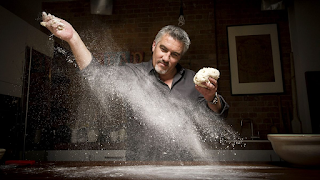

Paul Hollywood image BBC


Paul Hollywood has become known at the ‘King of Bread’ by fans of the Great British Bake Off. It takes a lot to impress him in terms of taste and technical skill - and the coveted Hollywood handshake is a rarity in bread week. 


For all the exotic flavour combinations on show, Paul himself talks about the simplicity and nostalgia of baking: the taste and smell evokes memories of childhood, community and comforts. Civilisation, he says elsewhere, is ‘built around wheat, around people’s settling down and not being nomadic.’


No wonder then that the Israelites long for Egypt: for the time when they were able to eat their fill of bread. It seemed to them that forced labour was compensated for by the sensory delights of bodies and food. 


They’d have been content to die there. Now, in the wilderness, they were unsettled and hungry; hungry and vulnerable. 


In the wilderness, in their vulnerability they see only the prospect of death: they complain and cling to nostalgia of the old ways. Perhaps we recognise that longing. 


They hunger for life, for comfort, for bread; but life was nomadic, relentless, unpredictable. The congregation complained. 


The Lord hears this complaint.

The Lord speaks to Moses.

Moses speaks to Aaron.

Aaron speaks to the congregation of the Israelites.


In their hunger and vulnerability, the Lord does a new thing.

That new things is a gift of bread from heaven.
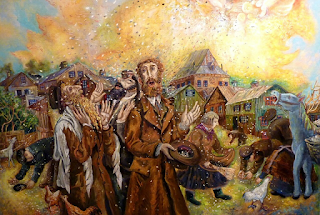


Manna from Heaven - Original by Alexander Kanchik


What is it? They ask. It is the bread that the Lord gives.


This bread rains down from heaven and settled on the wilderness as the dew lifted. Fine. Flaky. Fragile.


And in those gathered fragments hunger is satisfied; it is a practical gift of physical food.


More than that: in these fine, flaky, fragile fragments, the faithful God calls a people back to faithfulness.


In this substance they find sustenance: but it is just enough.


No selfish storing up; no greedy gathering of too much; no excessive consumption.


It is enough for hunger to be satisfied; for complaining to turn to gratitude; for vulnerability to become community.


There is grace. It is enough.  Day by day.


Loaves and Fishes - John August Swanson original


Jesus too had looked upon a crowd with rumbling stomachs and grumbling words: in compassion he responded to that hunger and vulnerability and took what was offered - blessed it and broke it. 


He gave it to them, and they ate their fill; they had enough.


Fragments are collected up and baskets are filled. 


But they wanted more: they look for him.


When they find him, he points them beyond the meeting their physical needs to a deeper longing.


He points them beyond the food that perishes, to the food that fills our stomachs and leaves us wanting more.


He points them to the food that endures for everlasting, abundant and eternal life.


He points to himself: the one who is God’s eternal word; the one who is flesh of our flesh. 


Believe in me, he says; believe in the one sent to you because of God’s love for this world.


They know the story. 


They jump in with their own telling of the story of fine, flaky and fragile bread.
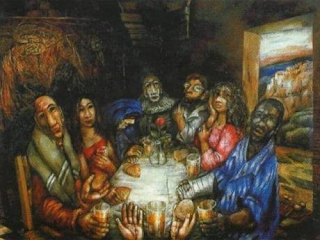


Sieger Köder 


Jesus listens. Yes, he says, you’re right about Moses. You’re right about the way a faithful God calls people back to faithfulness with these gathered fragments.


But he says, there is more: there is more than eating your fill; there’s  more than nostalgia for the old ways.


There is more than the bread shared that day: which smelt so fresh and filled their stomachs; but which will go stale and mouldy. 


This more than is the true bread from heaven: God’s own son.

This more than is the living bread: giving life to the world.


This bread is known to us in the fine, flaky, fragile fragment which we break and snap, bless and share at every communion.


For there, in that place, we receive a fragment of Christ’s body to be united as Christ’s body.


The body that was bruised and bled; died and rose to new and eternal life. In communion we are draw near to this gracious and fragile life. 


In that place, the fragments of our lives, our stories, our hungers and our vulnerabilities are gathered up; they become more than the sum of their parts.


There is communion in this. As the bodies within one body we are fed; where we learn to hunger for God; where we learn to love each other as God loves us.


Our faithful God calls us into faithful communion in this way: through the giving of himself in fragility that our fragments might be made one.


So we pray that our bodies may be revived; that the body of Christ might be revived. That we might be strengthened in the Spirit; that we might hunger for God’s ways; that we might meet others in their vulnerability. 


With open hearts might we touch and taste and see how gracious our Lord is. For what is fragile and fragmented is the stuff that makes for communion. Amen.


© Julie Gittoes 2021

Sunday, 3 March 2019

Living radiance

A sermon preached at the Cathedral Eucharist on the Sunday before Lent - a Sunday when we reflect on the transfiguration, radiance in the midst of darkness.  We're given a glimpse of the radiance of God's glory in Christ Jesus; we're called to live out that radiance in the power of the Spirit. Such living radiance is treasure in earthen vessels; it is courageous and vulnerable. The readings were Exodus 34: 29-35; 2 Corinthians 3:12-4:2; Luke 9: 28-36

Last Saturday, Olivia Colman - star of Rev, Peep Show and Broadchurch - won an Oscar for her role  in The Favourite.


Beyond Colman’s tears, laughter and raspberry blowing; beyond the dazzling radiance of the red carpet, it has been a difficult few years for the Oscars.  Its reputation has been knocked by campaigns such as #MeToo and #OscarsTooWhite.  Viewing figures are declining; there are commercial pressures from Netflix; and our cinematic tastes are becoming more independent, international and diverse. 

But film itself remains compelling.

As the distinguished American critic Roger Ebert once wrote [What makes a masterpiece? The Guardian]: ‘We live in a box of space and time. Movies are windows in its walls. The allow us to enter other minds, not simply in the sense of identifying with the characters… but by seeing the world as another person sees it’.

In the collective safety of the cinema, we share something like an out of body experience. Characters engage us emotionally; their stories enlarge our imaginations; prejudices and assumptions are challenged. The unreality of the performance conveys something real.

During this years Oscars, Bradly Cooper and Lady Gaga left their seats - unannounced - to sing “Shallow”, their award-winning duet from A Star is Born. There followed faced days of speculation that they were actually in love. It was so real yet so unreal.

It’s what they do, as one critic put it [Rhik Samadder inThe Guardian]: ‘it’s acting. They are actors, acting at a ceremony that showcases the best acting’. It demands personal connection, technical discipline and an awareness of cameras. 

They embodied a transformative moment as they had done on set, repeatedly.


The intensity of their gaze embody lyrics and character; lyrics which embody the questions about our own human character:

Tell me something, girl / Are you happy in this modern world?
Or do you need more? / Is there something else you're searching for?

Tell me something, boy / Aren't you tired tryin' to fill that void?
Or do you need more? / Ain’t it hard keeping it so hardcore?

Those questions aren’t confined to the movies: this modern world, is one of relationships, uncertainty, anxiety and opportunity, and we still ask - what are we searching for?  

We love and grieve; we find ourselves alone, together; trying to fill the void, we form habits and routines; but it’s hard to be self-reliant. Do we need something more?

Today’s Gospel is a quasi-cinematic moment: a window in space and time.

It is a moment of embodied transformation: which reframes all our questions, longings and fears. 

The veil is lifted. We see the dazzling glory of God.

A glimpse of glory to sustain us through the darkness; a glimpse of how things really are.

Here is grace and truth: made flesh.

Here is commandment and prophecy: fulfilled.

Here is love divine, all loves excelling.


Our first reading reminds us that this momentary glimpse of glory is rooted in a longer story. 

Moses is transfigured when he received the Law. Being in the presence of God transforms his appearance; his face shines so brightly that people are afraid. 

Yet the one who spoke with God is called to speak. 

By virtue of the gift of the commandments to love, his hearers are drawn into a new relationship: a covenant of promise and commitment. Personal transformation leads to transformation of a people; this transformed people are called to transform the world. 

Transformation by the light of God, is to radiate outwards as a blessing of love. But human beings tend to seek a less demanding or costly way. 

Our human hearts need to be reminded of love’s implications. Commandment is followed by prophetic challenge to love mercy and to seek the welfare of the most vulnerable. 

The transfiguration of Jesus echoes this earlier glimpse of God’s glory.The presence of Moses and Elijah remind us of the law of love and the prophetic cry for justice.

But this moment of transfiguration is more than a feint echo. It is excessive, abundant and intense. This light is no reflected glory. This light comes from within.

The light which calls all things into being has become flesh of our flesh.
The love that beats at the heart of all things, radiates from a human face. 

This moment of glory is not the end. 

Moses and Elijah are talking about “Jesus’ departure”. This new Exodus, this new act of liberation, will be accomplished in Jerusalem, in his body on the cross. 

This Exodus will be a moment of glory. 

Moses led a people from oppression and slavey to freedom.

Jesus liberates all people from all that wounds and diminishes, from all that controls or exploits. By his suffering, death and resurrection, Jesus breaks the power of sin. Through him, even death itself, that ultimate void, has now more power over us. 

We are recalled to this moment of transfiguration - of seeing Jesus as who is - on the cusp of our journey through Lent. 

Perhaps we can identify with Peter in his desire to hold onto this splendid and radiant vision. Perhaps we share his reluctance to descend to the mundane world; to avoid walking the way of the cross. 

This moment is no less real for being brief.


This is a glimpse of hope to sustain us in times of darkness. 

The echoes of that light and glory are reflected as we break bread and pour out wine.  Paul, when he writes to the Corinthians, speaks a lot about a community formed in this way; through acts of remembrance which shape our future, second by second. 

He speaks of freedom and of a refusal to lose heart. He speaks of being transformed and of letting go of that which is shameful.  He speaks of a ministry which is a living radiance. 

In this modern world, what are we searching for? 

Are we trying to fill a void, or do we need more? 

This Lent, consider what daily habits might be most fruitful for us in response to those questions: may they be things which make us more receptive to God’s love, in prayer and scripture; seeing ourselves in God’s light as penitent, restored and recalled.

May they be habits which make us more open to needs of the other in generosity and service; may we use our freedom to embody God’s radiant love by being courageous in our vulnerability and compassionate before the vulnerability of others.

As we partake of the gifts and hospitality of this table, we see afresh the radiance of God in the face of Jesus. 

Radiance in the wafer thin fragility of what we bless and break, take and eat. 

Radiance in the body of Christ: this is my Son, my Chosen, listen to him.

Radiance as we perceive him; as we are strengthened to suffer with him; as we are changed into his likeness, from glory to glory.

Radiance as we who eat this bread are sent to reflect Christ’s risen life in word and deed; acting with boldness in the power of the Spirit.  Amen.


© Julie Gittoes 2019

Saturday, 10 September 2016

Help!

This is a text of a sermon preached at Evensong on Sunday 4 September: the readings were Isaiah 43:14-44:5; John 5:30-end.  Perhaps it's because as a cathedral we are in the midst of a period of refurbishment of the building and disruption to familiar patterns of life, that the 'key' to these passages seemed to me to be 'help'. Whatever our situation or season of life, there are moments when we cry out (silently perhaps) for help: to God, to others or within our own hearts. To help and be helped, takes us to the depth of our humanity - where in love and vulnerability we re-learn patters of dependence and freedom.  May the cries of our hearts be heard.

My help cometh even from the Lord; who hath made heaven and earth.

Help!

A single word which signals so much about our human condition: we make life easier for one another when we help out with ordinary household chores; we might improve a situation by offering help in the form of mentoring, feedback or other assistance. Help is woven into our discourse about our common life: Help for heroes and help to buy; helplines to smooth out glitches in our hi-tech lives - fixing our broadband or rescheduling a flight; helplines staffed hour by hour to offer confidential support in the face of abuse or mental distress.

Help!

It echoes in so many registers: commanding, pleading, longing and crying.


There's an intimacy to language of help. It reveals our vulnerability; our co-dependence. It undercuts our self-sufficiency, our omni-competence. Perhaps The Beatles were right: when we were younger, we 'never needed anybody's help in anyway; but now these days are gone, [we're] not so self assured. Now [we] find [we've] changed out mind and opened up the doors'.

It can be offered instinctively, yet it's hard to ask for.  Perhaps there's a fear of been refused; or being manipulated. But as life changes; when we feel insecure, giving and receiving help can be transformative. When we're feeling down; when we appreciate someone being round. 'Help me get my feet back on the ground, won't you please, please help me'.

Lennon and McCartney sing if needing somebody; not just anybody; but for the psalmist, that desire finds a very precise focus.  Regardless of age or circumstance; help is rooted in the Lord. More than that, it an expression of faith which acknowledges that the Lord is the one who preserves life itself.

Isaiah also expresses words of hope rooted in the conviction that God is our help. He addresses a community in exile; a people who'd confronted the consequences of the failure to walk faithfully in the ways of the Lord. Help for them takes the form of healing, salvation, liberation and restoration.  It's profoundly intimate and radically transformative.

'Thus says the Lord who made you, who formed you in the womb and will help you': do not fear; sins and shortcomings are blotted out; the spirit is poured out in blessing. A new thing comes into being. God is our help. Don't be afraid. God is with them. God is with you. God is with us.

That with-us-ness of God in the person of Jesus is the ultimate expression of God's help. John's Gospel uses the ordinary stuff of water, bread, light, wine to express the abundance of such love. John recounts Jesus descriptions of himself as a good shepherd and the true vine. We hear of conversations with a teacher of the law under the cover of darkness and a Samaritan woman in the glare of the midday sun. He piles on the images and metaphors to such an extent that the disciples say at one point - perhaps with a hint of sarcasm - that Jesus is speaking plainly.

The passage we hear tonight, is perhaps one where we, like the disciples, struggle to make sense: yet, this monologue tells us both who Jesus is and also reminds us of our need for help.

To set it in context, this passage comes at the end of a chapter full of life and transformation; a chapter full of challenge and controversy. In the first place, Jesus offers help to some of the most dispossessed, broken and rejected people in Jerusalem. He brings healing to the sick - including a paralysed man who's been crushed by despair; who has no one to help him.

Jesus healed him - telling him to take up his bed and walk. He helped him. He gave him new life.

He did so on the sabbath day: a day when people were invited to rest and give time to God.  Those in positions of power and privilege were disturbed and angered by what they saw - a man carrying his mat. They had so narrowly interpreted the law that rather than rejoicing in this sign of freedom, the Pharisees condemned it as work. Jesus' response was to help them too: to explore with the nature of God's work with them; to reveal that he and his heavenly Father were working to bring life. In love for them, Jesus begins with what they know: the scriptures, the law of Moses.

Jesus is one with us; he is one with God. He is perfect communion with God. He is the beloved Son, doing all that his Father wills. Life and love flows from them. Our help comes from God who made heaven and earth; who formed us in the womb; who dwelt among us.

Jesus enters into conversation to help them. He sees their fear and their hardness of heart; he names their prejudice and rigid interpretations. It's as if he invites them to respond at a deeper level - attending to the new thing springing forth. Jesus points them to the glory of God at work in him; and therein lies the challenge.

We, just as much as the Pharisees, can get caught up in a chain reaction revealing our own fears and prejudices. Like them, there are times when we seek our own glory or turn in on ourselves; times when we cling to our certainties and miss the grace of God bubbling up in the unexpected places. Yet when we risk response to God, drawing on divine help, we share in the depth of love; becoming channels of help. We proclaim the transformed life of the kingdom.

May the Spirit kindle in us a desire to cry out for help to the one who in Christ, reveals life and love. Or, as Jean Vanier put it:

Jesus came to heal us.
He is calling us
to come out from behind the barriers built up
around our vulnerable hearts
so that we may have life and give life.


© Julie Gittoes 2016