Showing posts with label Communion. Show all posts

Wednesday, 4 August 2021

Hungering for bread

 1st August: Exodus 16:2-4, 9-15 and John 6:24-35
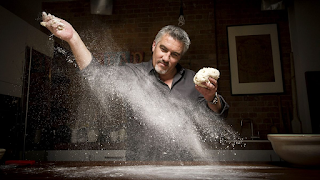

Paul Hollywood image BBC


Paul Hollywood has become known at the ‘King of Bread’ by fans of the Great British Bake Off. It takes a lot to impress him in terms of taste and technical skill - and the coveted Hollywood handshake is a rarity in bread week. 


For all the exotic flavour combinations on show, Paul himself talks about the simplicity and nostalgia of baking: the taste and smell evokes memories of childhood, community and comforts. Civilisation, he says elsewhere, is ‘built around wheat, around people’s settling down and not being nomadic.’


No wonder then that the Israelites long for Egypt: for the time when they were able to eat their fill of bread. It seemed to them that forced labour was compensated for by the sensory delights of bodies and food. 


They’d have been content to die there. Now, in the wilderness, they were unsettled and hungry; hungry and vulnerable. 


In the wilderness, in their vulnerability they see only the prospect of death: they complain and cling to nostalgia of the old ways. Perhaps we recognise that longing. 


They hunger for life, for comfort, for bread; but life was nomadic, relentless, unpredictable. The congregation complained. 


The Lord hears this complaint.

The Lord speaks to Moses.

Moses speaks to Aaron.

Aaron speaks to the congregation of the Israelites.


In their hunger and vulnerability, the Lord does a new thing.

That new things is a gift of bread from heaven.
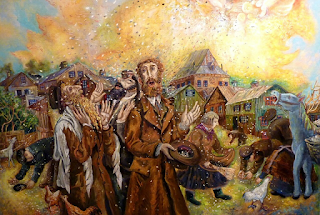


Manna from Heaven - Original by Alexander Kanchik


What is it? They ask. It is the bread that the Lord gives.


This bread rains down from heaven and settled on the wilderness as the dew lifted. Fine. Flaky. Fragile.


And in those gathered fragments hunger is satisfied; it is a practical gift of physical food.


More than that: in these fine, flaky, fragile fragments, the faithful God calls a people back to faithfulness.


In this substance they find sustenance: but it is just enough.


No selfish storing up; no greedy gathering of too much; no excessive consumption.


It is enough for hunger to be satisfied; for complaining to turn to gratitude; for vulnerability to become community.


There is grace. It is enough.  Day by day.


Loaves and Fishes - John August Swanson original


Jesus too had looked upon a crowd with rumbling stomachs and grumbling words: in compassion he responded to that hunger and vulnerability and took what was offered - blessed it and broke it. 


He gave it to them, and they ate their fill; they had enough.


Fragments are collected up and baskets are filled. 


But they wanted more: they look for him.


When they find him, he points them beyond the meeting their physical needs to a deeper longing.


He points them beyond the food that perishes, to the food that fills our stomachs and leaves us wanting more.


He points them to the food that endures for everlasting, abundant and eternal life.


He points to himself: the one who is God’s eternal word; the one who is flesh of our flesh. 


Believe in me, he says; believe in the one sent to you because of God’s love for this world.


They know the story. 


They jump in with their own telling of the story of fine, flaky and fragile bread.
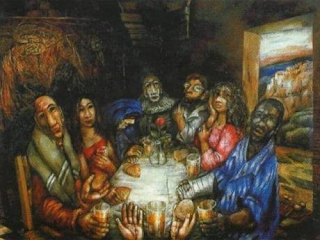


Sieger Köder 


Jesus listens. Yes, he says, you’re right about Moses. You’re right about the way a faithful God calls people back to faithfulness with these gathered fragments.


But he says, there is more: there is more than eating your fill; there’s  more than nostalgia for the old ways.


There is more than the bread shared that day: which smelt so fresh and filled their stomachs; but which will go stale and mouldy. 


This more than is the true bread from heaven: God’s own son.

This more than is the living bread: giving life to the world.


This bread is known to us in the fine, flaky, fragile fragment which we break and snap, bless and share at every communion.


For there, in that place, we receive a fragment of Christ’s body to be united as Christ’s body.


The body that was bruised and bled; died and rose to new and eternal life. In communion we are draw near to this gracious and fragile life. 


In that place, the fragments of our lives, our stories, our hungers and our vulnerabilities are gathered up; they become more than the sum of their parts.


There is communion in this. As the bodies within one body we are fed; where we learn to hunger for God; where we learn to love each other as God loves us.


Our faithful God calls us into faithful communion in this way: through the giving of himself in fragility that our fragments might be made one.


So we pray that our bodies may be revived; that the body of Christ might be revived. That we might be strengthened in the Spirit; that we might hunger for God’s ways; that we might meet others in their vulnerability. 


With open hearts might we touch and taste and see how gracious our Lord is. For what is fragile and fragmented is the stuff that makes for communion. Amen.


© Julie Gittoes 2021

Sunday, 17 January 2016

Embrace

The text of a sermon preached at Guildford Cathedral on Sunday 17th January. In the midst of Epiphanytide, we focused our attention on the wedding at Cana - a celebration of human love and commitment; the first of Jesus' signs recorded by John.  Preaching on this theme in the context of Primates2016 was challenging and I am very much aware that I am on a journey in relation to how we live in Communion.  Recognising we're called by the one Spirit, to witness to the love of God made manifest in Jesus Christ, yet worshipping and living in radically different contexts. I find myself drawn to a hopeful, challenging, irenic place.  That's costly. It expresses both a range of loves and relationships; it risks a bigger vision of God's Kingdom.  I keep thinking of my late supervisor Dan Hardy - renowned for saying 'it's more complicated than that'.  However, at this point I cannot give up hope for reconcilation, deepening trust and mutual affection. The readings were 1 Corinthians 12:1-11; John 2:1-11. The conversation afterwards was stimulating, honest and somehow  oriented to God's future.

The opening airport scene of Love Actually is full of moments of loving recognition: Regardless of age, gender, ethnicity, sexuality, health or status human love is poured out in hugs, kisses, embraces. From Heathrow to Guildford Station, we've all been there: waiting, scanning the crowd, glimpsing love.


The Prime Minister, played by Hugh Grant, says: 'Whenever I get gloomy with the state of the world, I think about the arrivals gate at Heathrow Airport. General opinion's starting to make out that we live in a world of hatred and greed, but I don't see that. It seems to me that love is everywhere.  Often it's not particularly dignified or newsworthy, but it's always there...'

To embrace expresses the risk and vulnerability of love - you stand, arms flung wide; waiting and hoping that the other will respond. You embrace, enfolded for a moment in wordless affection. That's but the beginning. For embrace then means letting go, stepping back, moving on. Embracing whatever might unfold.

Embrace risks openness to the other: the lonely, ostracised and busy; the self-sufficient, judgemental and weary. As a Communion, we face most acutely the hope and  pain of being in relationship: the desire to maintain conversation and build trust, the deep hurt  of alienation and the depth of our difference.  Today's  Gospel  of overwhelming abundance meets us in this broken middle.

Jean Vanier in his poetic and prophetic commentary on John, describes marriage as a covenant of love a 'sign of sacred union, enfolded in love, that enables people to grow in forgiveness, tenderness, kindness and compassion'.  Having recently contributed a chapter to a book that seeks to think again about marriage, the fruitfulness of such exclusive intimacy is, I think, important precisely because it looks beyond the bonding of human sexuality.


Jean Vanier: Drawn into the Mystery of Jesus through the Gospel of John 

That bonding becomes a sign of a love that is radically "more than".  Marriage is a public and inclusive relationship which can be a sign of the abundance of love that cannot be possessed but only given.  The paradox is that as two become one, space is created for a third - and for many others - in hospitality, compassion, generosity. Things extend beyond the couple into a multiplication of love.

Cana is about wine in abundance.  Vast quantities of water are transformed.  The ordinary becomes excellent.  It is enjoyed when the guests have already had plenty to drink.  But this generosity and abundance comes from a place of lack.

The party is in full swing, noone is paying attention to the potential crisis of grumbling guests and an embarrassed couple. One person does notice. It is Mary who pays attention. It is Mary who trusts Jesus. Their exchange is opaque. But perhaps it alerts us to the deep awareness that what is about to happen is not merely the alleviation of a potential social disaster; rather it is sign of the breadth and depth of love, actually.

Yes, this is about abundance of life and joy, which increases our capacity to receive, and therefore give, even more love.

Yes, it is a glimpse of our ultimate reality when God's love will be all in all.

Yes, it reveals our deepest desires to be known and loved.

But, when does this abundance manifest itself?

When the wine runs out, when there is nothing left, transformation occurs.

When we are most vulnerable, most wounded, most broken, most fearful, love is there.

When we lack everything, when hopes are crushed, in the face of terrible loneliness, the anguish of exclusion, even there is love.

When others seek to dominate or control, when the vanities of power, ambition or moral superiority come to the fore, when fragmentation seems all but inevitable; may be love is there.

When walking together seems impossible and mutual affection inexpressible; perhaps love is especially there.

When the cost of our loving is painful, when those who love face prejudice and violence, and when our own lack of love falls short: there, most generously, is love.

None of us can be written out of this story of abundant love.

To return to Jean Vanier, 'our desire for love is not a hoax, awakening in us a thirst for an unattainable, infinite, eternal love that can be quickly crushed by the limits and brokenness in us all. We are not cheated of love; love is possible'.

If this is our ultimate hope, how do we move forward when at a human or institutional level we feel cheated?

In part the answer lies in the moment we see Mary with her son our saviour in the final chapters of John. Jesus' hour has come. The consumption of excellent wine at a wedding reveals the abundance of God's love; the water and blood flowing from his pierced side, reveals the depth and cost of that love.

This is glory: the refusal to refuse to love.

At this Eucharist we are caught up in that - continuing to break bread; continuing to partake of one cup.  We do so in a fearless hope that this is not the end. Just as water was turned into rich wine, so the poverty of our human nature is transformed by the riches of his grace. It is only in the renewal of our lives that God's glory breaks through. And not in the renewal of our  lives alone, but those of our brothers and sisters in America, Pakistan, Nigeria, Australia and Mexico.

On Friday, Michael, the Presiding Bishop of The Episcopal Church said: 'The pain for many will be real. But God is greater than anything. I love Jesus and I love the church. I am a Christian in the Anglican way. And like you, as we have said in this meeting, I am committed to 'walking together' with you as fellow Primates in the Anglican family'.

May we remain committed to walk together, bearing the pain, hope and bewilderment.  May we walk together because the marginalised need the prophetic; the persecuted need visionaries; the proud need the humble. As in marriage, so in the church, love is abundant. The more it gives, the more it receives, in order to give.

Radical love cannot be an exclusive club; it has to be an inclusive witness.

In washing feet, the Primates stayed together.  Perhaps what Archbishop Justin has risked in reconciliation, is the possibility of the transformation of the Anglican Communion - where fear and rejection will be replaced by trust and affection, where reproach will be transfigured by grace.

Paul reminded the fragile and fractious Corinthian church  'No one can say "Jesus is Lord" except by the Holy Spirit'. More than ever, we need the affirmation of the varieties of gifts, service and activity; of wisdom, knowledge and healing.


©  Julie Gittoes 2016