Showing posts with label Holy Spirit. Show all posts

Wednesday, 31 July 2024

Somewhere over the rainbow

 Easter 4 - 21 April  2024: Genesis 7:1-5, 11-18, 8:6-18, 9:8-13; Acts 4: 5-12 and John 10:11-18


Eva Cassidy, Frank Sinatra, Pink and Rufus Wainwright are amongst those who’ve covered Judy Garlard’s Oscar winning song from The Wizard of Oz. 

Somewhere over the rainbow

way up high


A song about wishing upon a star and dreaming of dreams coming true; of blue skies and trouble melting like lemon drops.

Somewhere over the rainbow… 

there’s a land that I heard of 

once in a lullaby.
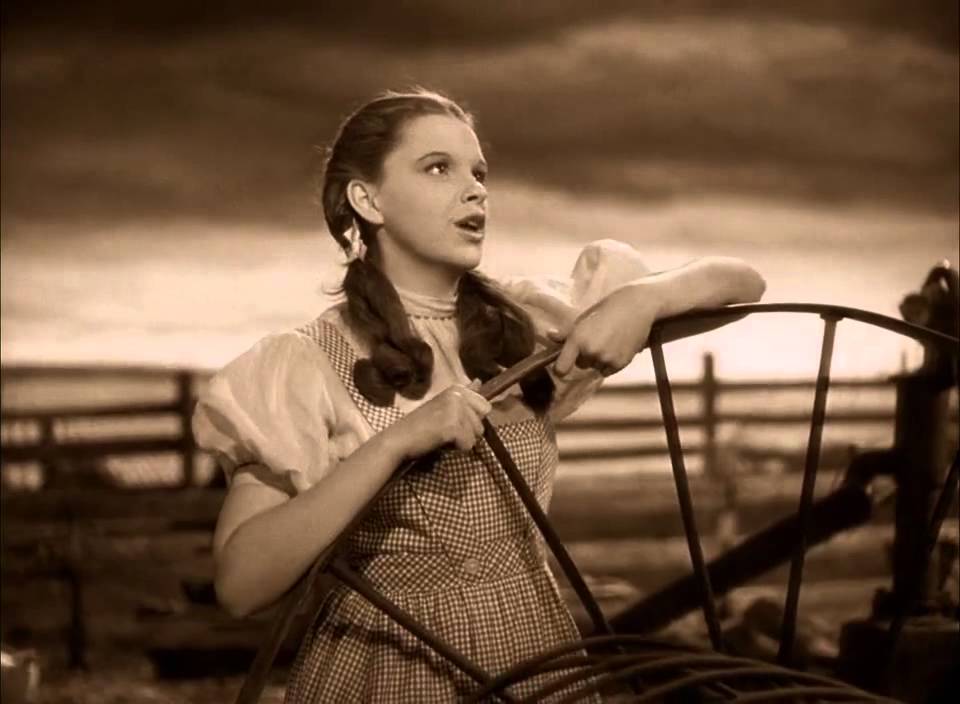

A still from film of Judy Garland in The Wizard of Oz (1939)

In the film, Dorothy wonders out loud to her dog Toto if there’s ‘someplace where there isn’t any trouble’ and concludes that there must be; but that it’s far, far away. She wants to get away from Kansas and, as the lyricist Yip Harburg put it, ‘she had never seen anything colorful in her life except the rainbow’. 


And so, the famous song was born: a song which, depending on who sings it, evokes hope or sadness:

If happy little bluebirds fly

beyond the rainbow

why, oh, why can’t I?


Our first reading today ends with a rainbow set in the clouds - as a sign for future generations of God’s covenant with the earth, humanity and all living creatures. 


Until that point, Noah and his companions may have identified more with the words of a little known intro that Garland only sang once. In a 2009 cover, Jewel all but whispers it: 

When all the world is a hopeless jumble

and the raindrops tumble all around

heaven opens a magic lane.


Raindrops tumbling, pouring and flooding. The hopeless jumble of a world destroyed by human greed, ambition and carelessness. The waters and the ark become an icon of that ‘magic lane’; a way of safety. There are no bluebirds beyond the rainbow; but a raven flying to and fro before it. And the dove - returning once, and then a second time with an olive leaf, before flying free.


There is a promise of a world beyond the rainbow - of restored relationship and renewed hearts; of hope, justice, mercy and righteousness; of love embodied and enacted - fully, faithfully. 


It is no lullaby, designed to soothe us to sleep; the promise of a world that evaporates when we awake. 


Instead it is a vision of the world as God intends it to be; a world that our hearts long for.


Yet, like the judges judging Peter and John, power and its misuse can create dividing lines. Lines that evaluate others based on their status as social or economic status: based on health, gender, sexuality, ethnicity, education, age. 


No wonder that the rainbow has become a sign of liberation and equality! It is a sign of hope, forgiveness and life - it stands against the destruction of life, and for the commandment to love God and neighbour as ourselves.


The alternative is literally deathly.   When human beings are evaluated as socially or economically useful, we see not only division and competition. At its extreme something  life-limiting and life-denying is unleashed. As Matthew Parris wrote last month in a world of inputs and outputs, some lives - the vulnerable,  frail or elderly - are worth less than the energy of the young or more nimbler. 


His column on assisted dying was published on Good Friday.


An irony which highlights the radically alternative view which we hear running through our scriptures: a pulse of love that carries us through life and breaks the bonds of death; a pulse of love that speaks of communion, healing, compassion and peace.


God set that bow in the sky as a promise that the world would not be destroyed; that the response to our tendency to selfishness or harm would not be a deathly waterflood.  When we see the colour of that bow, caught as sun hits rain clouds, we are reminded of an alternative view of humanity; and of God’s ways of loving.


In Jesus, God became one of us - flesh of our flesh. Jesus is love with us, laying down his life for us. In John’s Gospel, he describes himself as the good shepherd. It’s an image that evokes the shepherding of Moses and David before they responded to God’s call to be agents of freedom or leadership. 


It reminds us that God is the true shepherd - gathering together and  binding up, leading by still waters; taking us through the valley of death to a rich banquet.  


Jesus, the good shepherd, knows us and we know him. However much we wrestle with doubts, fears, distractions - we are reminded that we belong to God and each other; that we are known and loved. 


Jesus contrasts himself with the hirelings - who do not have our interests or wellbeing at heart: those who attention and love is thin and unsafe; who abandon others in the face of danger because they do not want to carry the cost of life together. 


Instead Jesus lays down his life for us - rescuing us from death and inviting us to look after others in the flock. He calls us - and others we may not see as part of our flock, but who are known and beloved. 


When Peter speaks to those judging him in Acts - his story is an improvisation on this narrative of love he has known and witnessed; the love that recalled him from denial to renewed faith; the love that invited him to feed the sheep.


That love was known in Jesus of Nazareth: crucified by human beings, raised by God. 


In him, claims Peter, is the power to heal the broken. The one who was rejected is the cornerstone, the one on whom we can build life, together; the one who enacts a different social order.  


His words create a moment of silence. A silence that is broken: the judges judge the judged - a tragedy that means they miss an opportunity to rebuild their own lives. They do not see the good news of the judgement made by God in Christ - the burden of sin condemned and released; life given over instead to the generous and peaceable movement of the Spirit. 


We and every disciple come to this palace of sacrifice and abundance: receiving the gifts of God in bread and wine; remembering the story we are called to improvise on in our lives. Here, we are invited to connect our faith to the world's need - to echo the divine love for creation.


Here we are fed, rested and carried by the good shepherd who’s boundless love assures us that we belong and invites us to follow. 


How will we share the love of a shepherd who is patient, bold, determined: long nights and dangerous days in the pastures and the mud? It is an invitation to share goodness in the valleys and wild places of the world, amongst the wolves and with the flock.   


Somewhere over the rainbow is now.

That place that we’ve heard of is here.


© Julie Gittoes 2024


Sunday, 24 May 2020

I say a little prayer for you

The text of two reflections shared at our online worship via zoom.


Reflection One
The moment I wake up
Before I put on my makeup
I say a little prayer for you.
The words of Aretha Franklin’s song resonate; because in one way prayer is the most natural instinct when we love another person. When we care about our communities; when we hear the cries of the world. The moment we wake up - before we put on our makeup or get dressed - we say a little prayer.
At a human level, Aretha’s words are full of longing: she expresses the intimacy of the one she loves having a place in her heart; the sense that love transcends space and time; and the honesty that separation brings heartache. 
Prayer is something we are exploring and making our own in familiar and perhaps new ways in this lockdown. Finding habits, places and words to say a little prayer. 
Prayer is holding all our love; and abiding in love.
It’s a way of being that is honest, tender, hesitant, raw.
Prayer is an act of resistance: lament, praise, protest, gratitude.
It comes from our heart and changes our hearts.

And today we hear Jesus praying. Praying for those he loves. Praying to his Father. Praying with the disciples. 
Jesus had washed their feet and shared a meal; he had encouraged them to believe and to trust; he’d promised them an advocate and guide and counsellor, the Spirit who’d lead them in truth and send them out as witnesses. He invites them to abide in love, just as he abides in his Father’s love.  
He prays for them - they are drawn into the intimacy he shares with his Father. 
Forever and ever, you’ll stay in my heart
And I will love you.
Perhaps the disciples hold in their hearts the hope that they’d never part; echoing Franklin’s little prayer, that:
To live without you
Would only mean heartache for me.

Ascension - Laila Shawa
With the lives of his disciples on his mind, Jesus also prays for himself.
He speaks of glory and life. He asks the Father to glorify him; using his death to give eternal life. 
This glory reveals the depths of God’s love for the world; this glory reveals the cost of love that reaches out, arms outstretched on the cross, to draw us back to Godself.
This glory is revealed in a love that overcomes death to restore life. Life that is full of mercy and forgiveness and compassion. 
And this is eternal life, abundant and full: it is to know God.
It is to come near; to rest in the intimacy and wonder of that; to know the joy of being belovéd and precious. 
This life: to know that whatever our flaws and frailties, dreams and desires we are held in love. As we breath, God says:
Forever and ever, you’ll stay in my heart
And I will love you.
What must it have felt like to have overheard those words; to be prayed for with such tenderness and concern.
To be prayed for isn’t to be talked about: it is to be known, taken seriously and held. To be known in love; to be heard in life; to be held in trust. 
Would the disciples have remembered this prayer as Jesus’ body - marked by wounds and glorious is life - now ascends to heaven? 
Did they remember in their anguish at death and joy at new life, that Jesus prayed for them: that he gave thanks that they had received him - his name, his life, his love and his work?
As they looked up, with questions on their lips, did they remember that Jesus prayed for them: for their joy and their unity?
As they ask: is this the time when you will restore the kingdom to Israel? Do they remember that Jesus is honest about the opposition they’ll face; that he prays too for those who will come to believe through their words and deeds?
At this moment of parting, do they remember that Jesus in his prayer for them promised the Holy Spirit - the comforter, advocate and guide? 
For now Jesus is no longer in the world, he promises that this prayer will be fulfilled. The power of the Spirit will be at work in them - breath by breath - as they witness to the fire of his transforming love.
For the love in which they abide; the love in which we rest; is a love that heals and transforms.
They stand -watching, gazing and looking up. 
They are consumed by the spectacle - yet watching undermines the possibility of continuing the journey. At this moment of loss they are invited to go forward in faith.
This moment of Jesus’ departure marks a moment of transition; of waiting; of preparation and of prayer. 
For a new order is about to begin. Our humanity abides with Jesus and the power of his Spirit abides with us: and we wait for it; we wait for it in prayer. For it is that Spirit that will enable us to speak and act for the kingdom Jesus brings. 
It is is a kingdom of new life and hope; it is rooted in what they remember and comes into being through their witness. 
But for now they are to devote themselves to prayer.
The moment they get up and return, they say a little prayer:
Forever and ever, you’ll stay in my heart
And I will love you.

Reflection Two
Pray: It’s an interesting group; this gathering of those called upon to pray, as Jesus did.
There are the disciples who’d walked the land with Jesus; some of the women who’d watched at waited, last at the cross and first at the tomb. Mary is there - with her other children. 
Perhaps she is remembering that time of waiting in hope and prayer when, overshadowed by the Spirit, she said yes to being the God-bearer.
And now she prays with those who’d followed the one she’d carried in her womb: as now they prepare for an unknown future.
They wait and pray in a particular place: like us, shut in; like us, confined to world that is smaller or more limited; like us, they see around them life that is fragile and wounded.
But it is from this particular place that they will be sent out into the world. We like them are invite to wait and pray.
We pray: come down, O love divine: kindling in our hearts thy holy flame; come love divine, illumine our path; come, Holy Spirit, dwell within us.
In this prayer, each creature will be claimed as a site of love divine.
The American theologian Willie Jennings, calls this: the revolution of the intimate.
If our heart is warmed by this Spirit, then it is a spark that lights hundreds of fires.
Fires of prayer in our own homes, where we are equipped and inspired for the tasks entrusted to us; where we seek to reflect the character and values of patience, kindness,  justice; of self-control, joy and hope.
Fires of public worship and witness: finding ways of gathering online, sharing hope on social media; looking at how our churches can be once again places of safety and sanctuary.  
Fires of social transformation as we engage with vision and imagination in bringing people out of poverty; seeking a system of education and justice that works for all irrespective of race or gender or age or class; a cultural life that inspires and binds together; ensuring that there is dignity for those in frontline services, and those who depend on them.


Women Kneeling in Prayer - George Henry Broughton
To pray, like the disciples, that we might be open to the Spirit is discomforting and transformative. This vision is part of the witness we share with the apostles. 
The Cuban-American theologian Justo González writes that the Book of Acts is: a call to Christians to be open to the action of the Spirit, not only leading them to confront failures and practices in society that may need to be subverted, put perhaps even leading them to subvert or question practices and values within the Church itself.
We only need to glance at news paper headlines to see how urgently need to confront such failures and practices; subverting selfish exceptionalism and seeking the common good. 
As we pray, we make way for the Holy Spirit to touch human flesh and create in us new hearts; new hearts committee to a transformed world. 
I pray, as we learn to pray with and for each other, alone and together, that we will discern how we serve Hendon in the months and years ahead. That each of us will know the task entrusted to us - using our skills and our work, leading us perhaps to do a new thing that we didn’t dare imagine.
As we pray, with clasped hands we are united with Christ - we abide with God - as the Spirit allows us to become fully ourselves. This is life. George Herbert - poem.
Ever thine: Aretha sang about her human love: 
The moment I wake up
Before I put on my makeup
I say a little prayer for you.
Beethoven, centuries earlier, expresses a similarly intense and devoted to love to an unknown woman. Mourning her loss and longing of a life together.  
And perhaps it those words of a faithful, loving and restless human heart that become the grounds of our deepest and most heartfelt prayer. For in the power of the Spirit, we can pray: Ever thine. Ever mine. Ever us.

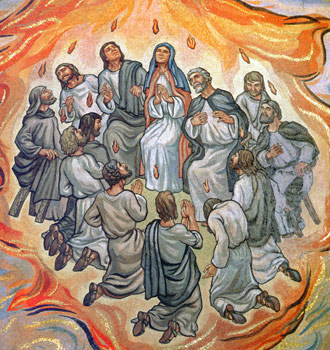
An artist's depiction of a scene from the Pentecost appears in the Cathedral Basilica of St. Louis in the city of St. Louis
Let us devote ourselves to prayer; let us discern the tasks to which we are called. Let us be open to the action of the Spirit; confronting failures and kindling fires of change.
Forever and ever, you’ll stay in my heart
And I will love you.

© Julie Gittoes 2020

Saturday, 19 January 2019

Grit, determination and passion

This list the text of a sermon preached at the Cathedral Eucharist on 13 January 2019. Opening the Saturday papers, there was a lot of comment on Andy Murray - his career, physical pain, achievements, character as he contemplated giving up competitive tennis.  

It sparked reflections about the weight of expectation he faced and how we sit lightly to 'success'. How this related to Jesus' Baptism was in part about the divine embrace of human flesh, but also the power of the Spirit. Given the Cathedral's dedication to the Holy Spirit, it resonated too with T. S. Elliot's Four Quartets - the ground of our beseeching.  

However, as well as remembering Murray win his first Wimbledon title, I was calling to mind the moment I heard about the Dunblane massacre - an attack on a school where Andy and his brother were pupils. There is underpinning this sermon something about trauma, resilience and redemption. The texts were Isaiah 43:1-7, Acts 8:14-17 and Luke 3:15-7, 21-22

In the summer of 2013, 17.3 million viewers watched tuned in to the Wimbledon final.

Many more, like me, listened on Radio 5 Live.

The duration of the Men’s Singles Final outlasted the journey time from Guildford down the A281 to Alford Church. Sitting in the car park, Evensong drew closer; waiting with baited breath for those three words: game, set and match.  Followed by the name: Andy Murray. 

And he cried - having squeezed out every last drop of talent in pursuit of victory.


And six years later,  he cried - the excruciating pain of his body is telling him to stop.

Journalists reach for cliches - speaking of blood, sweat and tears. They remind us of the gangly kid who became a sporting icon; the fierce competitor who would sulk and swear; the shy man with a dry wit and the conviction to challenge misogyny in tennis.

Like Jeremy Bates, Tim Henman and Greg Rusedski before him, Murray carried a weight of expectation: every time he stepped on to court, the people questioned in their hearts whether he might be the one; whether he might be the first British man to win Wimbledon since Fred Perry.

His role of honour is quantified in singles titles, Olympic medals, weeks at number one and being named as Sports personality of the Year. His greatness, if you like, is in the headline: the grit, determination and passion at the limit of endurance.

In the realm of sport, that weight of expectation never ends. Rankings are determined match by match. Greatness is a glittering prize; elusive and subject to judgement.

The words of Andy Bull’s tribute point to a different metric of greatness; to Murray’s character. Of the man who sold the red Ferrari and kept his VW Polo, he writes: It is rare enough for a sportsman to be so successful, much rarer still for one to be so unaffected by his success. 

Perhaps being unaffected by success will enable expectations to morph into legacy, mentoring and a new pattern of life.

Today we John the Baptist had found himself in the spot light; he carries a weight of expectation that he will be the one. The one who brings freedom; who’ll triumph in the name of God.  

He remains unaffected by the crowds, taking no claim of greatness for himself. 

Instead he continually points beyond himself; to the one who is to come.

By baptising with water, he has set the scene and prepared the way. 

His words sting with the rebuke to those who abuse power; and captivate those longing for new life. He invites all who hear him to turn back to God: to open their hearts, to change their lives, to expect something - or rather someone - more.  

That expectation is met in the one who comes and stands alongside us - embodying the fullness of God’s love in the frailty of our our flesh.

In the moment of his own baptism, Jesus is revealed as God’s Son; revealed in the physicality of the moment. In this moment of prayer. 


In baptism, the divine embrace of human flesh is declared. 

The voice of his heavenly Father declares Jesus’ identity and authority as Son; the power of the Spirit though which the work of our rebirth is completed is revealed. 

Jesus is the one who restores dignity to our humanity by being with us: his baptism is a sign of the way in which the world is reclaimed, healed, transformed and blessed by the Word of God made flesh. 

In him, our expectations are subverted and fulfilled. Greatness and success are re-defined. In him, we see God’s ways at work - persistently, gently, fiercely turning us away from death and toward life.

With a passion as strong as fire, Jesus calls us back from all those things which serve as substitutes for life lived with God: the desire for control over others or the desire to be at the centre of the crowd; the reliance on what we have to define who we are; the way we might chase multiple glittering prizes which leave us empty or unfulfilled.

With a fire of unquenchable love, Jesus restores to us the dignity and calls us into a community which reflects life lived with God: where we are loved; where we are supported; where we find wisdom and joy; where we can be vulnerable; where hospitality bubbles up.

And some days, it feels as if we are still waiting for that to be made real; still waiting to be noticed or heard; still waiting for expectations to be met; still waiting for our purpose to become clear; still waiting for radical love to extend its reach.

And the gift we are waiting for is nearer to us than we know; it is for us, our name and our charism. At a Cathedral Church dedicated to the Holy Spirit, dare we pray and call upon power from on high?

We are to pray as the apostles did in Acts: that the Spirt might descend to renew in our flesh, the reality of that divine embrace; to see that love stretching forth over one another. 

In our waiting and praying,  our bodies yield to this gift of love divine.

As one theologian [Willie Jennings: Acts] puts it: God will draw near and give lavishly in an intimate space created by bodies and created for bodies. 

To pray in this way expresses our longings; our desire to liberated from fear or failure; our need for love to be move loving.

As T. S Elliot puts it:
And all shall be well and 
All manner of thing shall be well
By the purification of the motive
In the ground of our beseeching. 

Our beseeching is met in the promise of being beloved. 

The intimacy of this echoes the words of Isaiah fulfilled in Christ: in him, we are called by name and redeemed; in the Spirit we are created and recreated; formed and reformed.  

In the assurance of such love, our motives and actions are purified; the chaff burnt away. In the assurance of such love, we are called to bring healing and hope to others.


It is through the intimacy of created bodies that God’s love is made known in the world: in Christ, God’s very self is given for us, defeating death and turning us towards life.

That life and light and love, is breathed through the world by the Spirit blowing where it wills: provoking, creating, protesting, healing, crying out. 

That Spirit is poured out on us today: on broken bread and outpoured wine becoming for us Christ’s body; on hearts and minds receptive to challenge and desiring blessing; on our bodies however energetic, frail, bruised or beautiful. We who are many become one body - living, breathing and moving in the world. 

May we live with grit and determination, passion and endurance - listening to what the Spirt might be saying to us in the words and music of our worship; in the papers we read and the people we meet. What might the Sprit be saying?


In the words of Elliot (text):

With the drawing of this Love and the voice of this
     Calling
We shall not cease from exploration
And the end of all our exploring
Will be to arrive where we started
And know the place for the first time.
Through the unknown, remembered gate
When the last of earth left to discover
Is that which was the beginning;
At the source of the longest river
The voice of the hidden waterfall
And the children in the apple-tree
Not known, because not looked for
But heard, half-heard, in the stillness
Between two waves of the sea.
Quick now, here, now, always—
A condition of complete simplicity
(Costing not less than everything)
And all shall be well and
All manner of thing shall be well
When the tongues of flame are in-folded
Into the crowned knot of fire
And the fire and the rose are one.

© Julie Gittoes 2019

Tuesday, 15 May 2018

Sing praise!

Having enjoyed singing 'alleluias' from the tower of Guildford Cathedral at midday, this is the text of a sermon preached at the Ascension Day Eucharist: the texts were Daniel 7:9-14, Acts 1:1-11, Luke 24:44-53
and the anthem 'God is gone up' (Finzi).


The view from the the top of the tower!

God is gone up with a triumphant shout:
The Lord with sounding trumpets’ melodies:
Sing praise, sing praise, sing praise, sing praises out.

In a little while we will hear Finzi’s sitting of those awesome words (here sung by Wells Cathedral Choir)

From the organ’s dramatic fanfare, this anthem is thrilling in its magnificence: songs of praise resound, echoing the trumpets’ melody.  With every breath they take, our choir sing praises out. 

We hear these heart-cramping notes which echo heavens rapturous melody.  Sing praise. 

Their words blend with the organ’s voice more to enravish, as they this tune sing. Sing praises out.

Sing praise.
God is gone up with a triumphant shout. 
Sing praises out.

Finzi holds us in the intensity of rapturous praise as our lips acknowledge God’s glory. He calls us back to song.

But Edward Taylor, the poet who wrote the text, invites to stand alongside the disciples; to ponder another question. The question which was perhaps on their minds as they stood gazing upwards:

Art thou ascended up on high, my Lord,
And must I be without thee here below?

But the point of today’s celebration is that we are not left without: as our risen Lord ascends to the heaven in order that we might be united with him always.

Over the last forty days, we have recalled the resurrection appearances: moments when Jesus was in a particular place, with some of his followers for a finite period of time.  As Luke records, Jesus had opened their minds to understand the scriptures.

This is reality: The one who suffered and rose from the dead has power over death itself.  He has called disciples by name, broken bread with them, invited their touch, spoken words of peace and blessing.  

And now, as they were watching he is lifted up; hidden from their sight. 

How great the temptation to stand looking up; to see this spectacular moment as an ending or as a loss.
Rather it is both the fulfilment and expansion of love.


The one who this day ascends to heaven, is Lord of time and space.  In the words of Daniel - to him is given dominion, glory and kingship.  

This heavenly reign reveals scope of God’s love across all dimensions of the cosmos: it doesn’t undermine our agency as human creatures; but it does relativise the exercise of our freedom and authority.  

Our creaturely vulnerability and competitiveness is drawn into a new reality:  an expanding circle of blessing of merciful judgement and reconciling love. 

Our risen and ascended is Lord is now present to all people, in all places, forever.

Today, we assured that Jesus will pray for us at the right hand of God. We also receive a promise. Jesus promised his disciples that the power of God will be poured out on them through the Spirit. 

They and we, are called to be witnesses: they will tell the story of this man Jesus, the one who is flesh of our flesh; they will tell the story of this man Jesus, the one in whom the fullness of God is pleased to dwell.

They and we, are witnesses to one who revealed love divine from birth to life; from life to death; from death to risen life.   And now as we rejoice in Jesus journey heavenwards, we like those first disciples are sent to the ends of the earth. 

As the one theologian and preacher, Willie Jennings, puts it: Jesus ascends not only to establish presence through absence, but he also draws his body into the real journeys of his disciples into the world. He goes to heaven ahead of us. He goes with and ahead of his disciples into the real places of this world.

The span of our journeys will vary. From our homes we are sent out into real places, places that are particular to us: to the places of work and service, of tribulation and rejoicing; of struggle and refreshment; of waiting and praying; of family and stranger; of excitement and loss. 


We are sent to places we do not expect and perhaps cannot imagine; sent even those places where we fear to tread.  And there we are to witness, bless and sing praises; sing praises out.

Finzi captures the lyricism of Taylor’s devotional poem - fusing words and music into a compelling glimpse of heaven. But the decision to set it as our communion motet roots that vision the most ordinary and intimate of all the real places in this world: in food and fellowship.

For here in bread and wine Jesus gives himself to us. The king of glory enters in. Our risen and ascended Lord makes our bodies the site of his visitation. We become what we touch and taste and see: the body of Christ.  

Today we begin ten days of waiting - a novena of prayer before Pentecost. Let us pray for the Spirit to renew, refresh, empower and equip us that we might witness to God’s love on real journeys and real places.

God is gone up with a triumphant shout:
The Lord with sounding trumpets’ melodies:
Sing praise, sing praise, sing praise, sing praises out.

Alleluia!


© Julie Gittoes 2018