Showing posts with label life. Show all posts

Thursday, 1 August 2024

Overflow of life

 Sunday, 30th June: Wisdom 1:13-15, 2:23-24, 2 Corinthians 8:7-end and Mark 5:21-end


God does not delight in the death of the living.


Bold and hopeful words from the Book of Wisdom: God creates that living things might exist.


The created order is drawn into this pattern of generativity - of creativity - that is wholesome: good, healthy, virtuous, fruitful.


Part of what it is to me made in the image and likeness of God is to carry within us this light of hope; this desire of wholeness; the longing of immortality.


Such gifts given freely in love - an act of divine creativity without compulsion. 


Envy crept into the world: a fear of scarcity and lack; selfishness shaping our desires; what we want rather than what others need.


In the world as we know it, our hearts can be turned inwards towards, away from others and God. And yet, we know that the first impulse of light and love is there. 


In commandments shaping and guiding our loves: to honour and bless, to seek what is just and merciful, beautiful and true.


When hearts turned away from commandments, prophets called us back, helping us reimagine a more whole and wholesome future.


When hearts turned away from love, God’s word dwelt among us: loving us in flesh of our flesh.


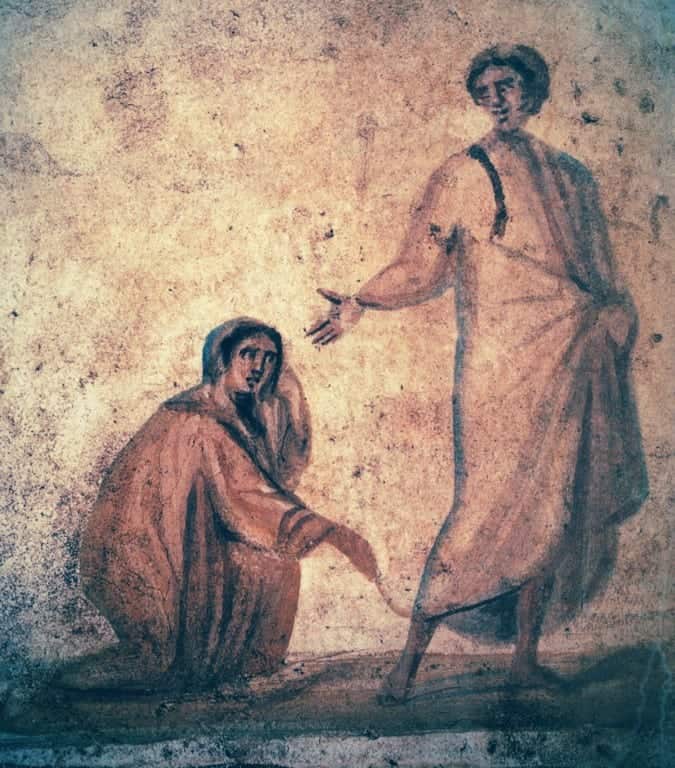
Image from the catacombs in Rome


In today’s gospel reading, Jesus is radiating this love in ways which raise up and restore; bringing healing and wholeness; taking the sting of death and restoring life. 


We know what it's like to be in the midst of a crowd: at stations  and festivals, in stadiums and marches, watching the Euros or dancing at the Eras tour.


Today Jesus encounters two children of God: two daughters - one who’d been suffering for as long as the other had been alive; one facing death barely as life had begun. 


Twelve long and yet fleeting years.


The father of the young girl is a person of power and influence, he falls at Jesus’ feet, laying all his authority and anxiety before him. He pleads for health and life. 


The older woman has no such public status. She is marginalised and invisible - crouching near the ground, she creeps along amidst the moving feet of the crowd. 


Like many perimenopausal women, she’d sought out medical advice to no avail; she’d spent her money on possible cures and treatments, yet the symptoms and bleeding would not stop. 


She had heard of Jesus: a healer, a teacher; a story-teller.


Amidst the robes, sandals and dust she reached out and touched the hem of his garment. The smallest gesture, a fragment of fabric.


Then she felt the moment that her flow of blood stopped.


He too felt it. Felt the flow of power from him towards another. 


That moment of intense and intentional longing was not just another body in the crowd. He sees her. He raises her up. 


Her healing is holistic: she is made whole and restored to social life and belonging; she is able to tell the whole truth of her life, her body, her shame, her hope. She becomes a witness to that movement of God’s love in him; he praises her faith. 


Perhaps now she can take - or retake - her place community. Healing does not restore to her youthfulness and fertility; but it does restore her to that place of wise elder; to a life that is generative in the care and support she gives to others, to the memories of faith she carries.


How must Jairus have felt as he watched this moment of disruption, or interruption? Watching not as the man of authority but as the anxious parent. 


How must he have felt when the news reached him that the journey was now in vain; hope of healing lost to him. He need not trouble this teacher.


Jesus though invites him to move from fear to trust. He invites him to step aside from the competition and wailing, from the crowds and mocking laughter. 


In him is made real the words of Wisdom: God does not delight in the death of the living. She is not dead, he says, but asleep.


That same power that flowed to stem a flow of love now flows to restore the breath of life. Talitha cum. 


He takes her hand. He invites her to get up. She stands and walks. 


Jesus is the one who brings the radiating energy of life and love; who moves fear to faith; who builds trust and restores hope. This healing is an invitation into the wholesome life of generativity. 


Such generativity - such a life giving move - is directed to the needs of others. For Paul, as he proclaims the good news of Jesus who brings life out of death, who breaks the bonds of the grave, this means attending to those in need, on the margins.


For him the grace of God brings unity, a reconciling love. A love that extends across difference and disagreement in practical support. In his case across Jewish and Gentile communities. 


The wholesome death-defying life that he commends is about generosity in the face of affliction. The only competition is an eagerness to give - abundance and need are in a reciprocal relationship: no one having too little or too much.


We too should be eager to share in this overflow of life. 


© Julie Gittoes 2024

Wednesday, 31 July 2024

Somewhere over the rainbow

 Easter 4 - 21 April  2024: Genesis 7:1-5, 11-18, 8:6-18, 9:8-13; Acts 4: 5-12 and John 10:11-18


Eva Cassidy, Frank Sinatra, Pink and Rufus Wainwright are amongst those who’ve covered Judy Garlard’s Oscar winning song from The Wizard of Oz. 

Somewhere over the rainbow

way up high


A song about wishing upon a star and dreaming of dreams coming true; of blue skies and trouble melting like lemon drops.

Somewhere over the rainbow… 

there’s a land that I heard of 

once in a lullaby.


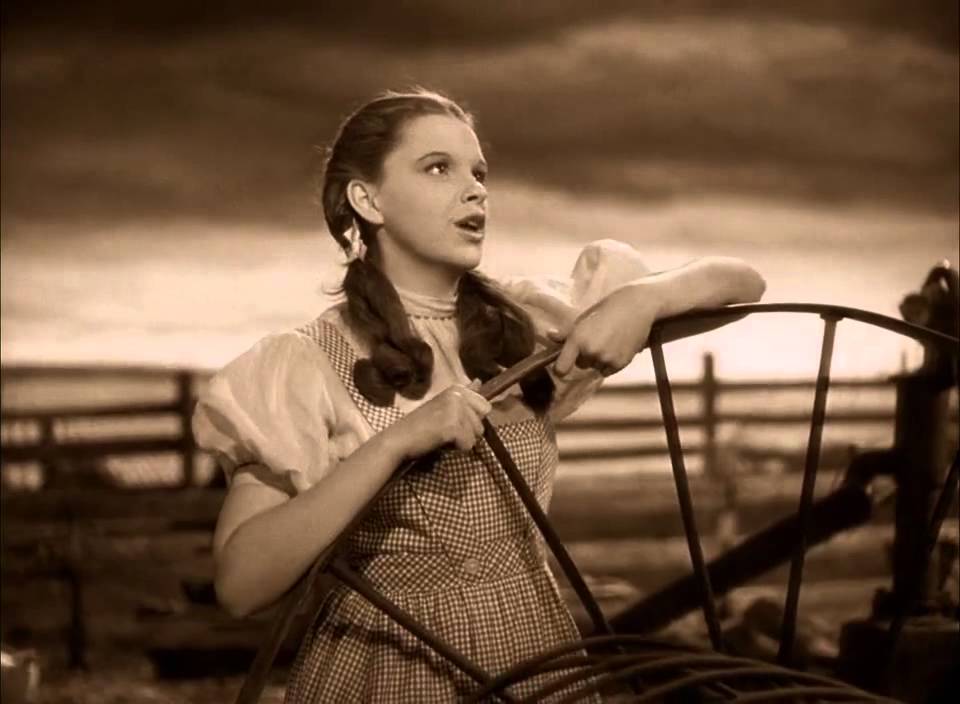
A still from film of Judy Garland in The Wizard of Oz (1939)

In the film, Dorothy wonders out loud to her dog Toto if there’s ‘someplace where there isn’t any trouble’ and concludes that there must be; but that it’s far, far away. She wants to get away from Kansas and, as the lyricist Yip Harburg put it, ‘she had never seen anything colorful in her life except the rainbow’. 


And so, the famous song was born: a song which, depending on who sings it, evokes hope or sadness:

If happy little bluebirds fly

beyond the rainbow

why, oh, why can’t I?


Our first reading today ends with a rainbow set in the clouds - as a sign for future generations of God’s covenant with the earth, humanity and all living creatures. 


Until that point, Noah and his companions may have identified more with the words of a little known intro that Garland only sang once. In a 2009 cover, Jewel all but whispers it: 

When all the world is a hopeless jumble

and the raindrops tumble all around

heaven opens a magic lane.


Raindrops tumbling, pouring and flooding. The hopeless jumble of a world destroyed by human greed, ambition and carelessness. The waters and the ark become an icon of that ‘magic lane’; a way of safety. There are no bluebirds beyond the rainbow; but a raven flying to and fro before it. And the dove - returning once, and then a second time with an olive leaf, before flying free.


There is a promise of a world beyond the rainbow - of restored relationship and renewed hearts; of hope, justice, mercy and righteousness; of love embodied and enacted - fully, faithfully. 


It is no lullaby, designed to soothe us to sleep; the promise of a world that evaporates when we awake. 


Instead it is a vision of the world as God intends it to be; a world that our hearts long for.


Yet, like the judges judging Peter and John, power and its misuse can create dividing lines. Lines that evaluate others based on their status as social or economic status: based on health, gender, sexuality, ethnicity, education, age. 


No wonder that the rainbow has become a sign of liberation and equality! It is a sign of hope, forgiveness and life - it stands against the destruction of life, and for the commandment to love God and neighbour as ourselves.


The alternative is literally deathly.   When human beings are evaluated as socially or economically useful, we see not only division and competition. At its extreme something  life-limiting and life-denying is unleashed. As Matthew Parris wrote last month in a world of inputs and outputs, some lives - the vulnerable,  frail or elderly - are worth less than the energy of the young or more nimbler. 


His column on assisted dying was published on Good Friday.


An irony which highlights the radically alternative view which we hear running through our scriptures: a pulse of love that carries us through life and breaks the bonds of death; a pulse of love that speaks of communion, healing, compassion and peace.


God set that bow in the sky as a promise that the world would not be destroyed; that the response to our tendency to selfishness or harm would not be a deathly waterflood.  When we see the colour of that bow, caught as sun hits rain clouds, we are reminded of an alternative view of humanity; and of God’s ways of loving.


In Jesus, God became one of us - flesh of our flesh. Jesus is love with us, laying down his life for us. In John’s Gospel, he describes himself as the good shepherd. It’s an image that evokes the shepherding of Moses and David before they responded to God’s call to be agents of freedom or leadership. 


It reminds us that God is the true shepherd - gathering together and  binding up, leading by still waters; taking us through the valley of death to a rich banquet.  


Jesus, the good shepherd, knows us and we know him. However much we wrestle with doubts, fears, distractions - we are reminded that we belong to God and each other; that we are known and loved. 


Jesus contrasts himself with the hirelings - who do not have our interests or wellbeing at heart: those who attention and love is thin and unsafe; who abandon others in the face of danger because they do not want to carry the cost of life together. 


Instead Jesus lays down his life for us - rescuing us from death and inviting us to look after others in the flock. He calls us - and others we may not see as part of our flock, but who are known and beloved. 


When Peter speaks to those judging him in Acts - his story is an improvisation on this narrative of love he has known and witnessed; the love that recalled him from denial to renewed faith; the love that invited him to feed the sheep.


That love was known in Jesus of Nazareth: crucified by human beings, raised by God. 


In him, claims Peter, is the power to heal the broken. The one who was rejected is the cornerstone, the one on whom we can build life, together; the one who enacts a different social order.  


His words create a moment of silence. A silence that is broken: the judges judge the judged - a tragedy that means they miss an opportunity to rebuild their own lives. They do not see the good news of the judgement made by God in Christ - the burden of sin condemned and released; life given over instead to the generous and peaceable movement of the Spirit. 


We and every disciple come to this palace of sacrifice and abundance: receiving the gifts of God in bread and wine; remembering the story we are called to improvise on in our lives. Here, we are invited to connect our faith to the world's need - to echo the divine love for creation.


Here we are fed, rested and carried by the good shepherd who’s boundless love assures us that we belong and invites us to follow. 


How will we share the love of a shepherd who is patient, bold, determined: long nights and dangerous days in the pastures and the mud? It is an invitation to share goodness in the valleys and wild places of the world, amongst the wolves and with the flock.   


Somewhere over the rainbow is now.

That place that we’ve heard of is here.


© Julie Gittoes 2024


Monday, 7 November 2022

A matter of life and (beyond) death

3rd Sunday before Advent: Job 19: 23-27a, 1 Thessalonians 2:1-5, 13-end and Luke 20: 27-38


In an interview last month, Bill Nighy said: “I think about death 35 times a day”; he continues “I know it’s gonna happen, but I think that maybe at the last minute somebody might make an exception”


It's an apt and fascinating remark given his latest film called Living in which he plays Mr Williams, a widowed civil servant in post-war County Hall who’s been given 6 months to live. At that moment he realises that he’s not been living fully, but literally shuffling paper, deferring decisions, sticking to his routine.


Film still


When Mr Williams reflects on what he’d say when he’s called to meet his maker, he expresses the mortal prognosis we all share. He decides to get something done; to express gratitude and kindness; to find space for wonder, playfulness and song; to leave a modest legacy of social justice. 


It’s an extraordinary and exquisite performance: every movement understated; every gesture refined; every word a whisper; every emotion restrained. It’s increasingly joyous - shot through with humanity and hope. 


If you can see it, do; it might well be a cinematic parallel to the question in today’s Gospel. The Sadducees were asking a question about what happens when we are called to meet our maker; but doing so from the starting point of their own scepticism. 


They turn talk of life after death into an absurdist riddle exaggerating the human concerns of this life: marriage and family life, death and childlessness, law and legacy.  


Jesus does not respond on their terms. Resurrection cannot be grasped in earthly terms; their imagination is limited and makes God too small. They approach the question through hypotheticals rather than faith. 


As one commentator puts it: “To speak of God as a living God, the Bible means not merely that God is real or alive, but that God, as the beginning of Genesis makes clear, is the very source of life. Therefore, God is just as capable of raising people from the dead as of giving life.’  


This divine life is different from human life; resurrection life is different from lives lived from birth to death. Of course we have questions but we can’t resolve them in simply human terms. Resurrection takes us beyond the logics of bio-medical and physical realities; instead Jesus’ life, death and resurrection, the story of Easter, invites us to stretch our imaginations.


Part of what  Jesus’ response to the Sadducees reveals is that resurrection speaks of liberation and the reversal of human injustice. Our scriptures place widows within the realm of God’s preferential option for the most vulnerable; yet here she is treated like chattel, a possible means of continuing the family line.  Even her grief and loss is, in this instance, amplified and abstracted for the sake of debate.


For those longing for all those longing for consolation and peace, resurrection is a radical hope. Given our human experience of anxiety, loneliness, disappointment; those times when love is met with unkindness or control; and also the inevitability of our mortal prognosis,  then this hope is a matter of life and death, as well as life beyond death.


For Jesus, and in the letters, we see marriage as an earthly institution for the good of human beings - goods of faithfulness, mutual comfort and not just family life but the building up of community through generosity and compassion. It is a good commended alongside being single - through choice, circumstance and calling - as we seek to live in love of God and neighbour.


Resurrection is the entering into an eternal love - where there is no more suffering, crying, pain or death. Being caught up in such a depth of love can bring comfort; whilst here and now we treasure our earthy ways of loving. Loves which are fragile and tender, imperfect and evolving; the love of friends and siblings, parents and spouses.


In Jesus, we see love divine made perfect in our human weakness. He takes up his cross, bears the weight of our capacity to wound and be wounded. He takes all that separates us from God and others to his final breath. Like a seed, his life is buried in the ground, dying to bring forth new and abundant  life.


In him, love has the final word; in him all things are restored to Godself. Love’s redeeming work is done - where thy victory, o grave?


Jesus invites us to walk this way. To take up the cross in this life - and follow the way of new life. There we find love in community and intimacy beyond any human loving.  In Thessalonians we hear of several dimensions of this life.


There is the hope of being gathered together in this universal, peaceable, consoling love. Hard though it is to conceive, poets such as John Donne have given us a vision of life beyond darkness, dazzling, silence and noise of one equal light, one equal music.


There is also the lived reality of life on earth shaped by this heavenly hope: we are assured that God loves us in Christ Jesus; we are assured of salvation, the promise of healing and making whole; we are also assured of the Spirit being at work in us. So we hold onto eternal comfort, this good hope; but we also commit to the work of comforting the hearts of others, of strengthening them in what we say or do.


In Living Mr Williams finds his own way of putting into practice this purpose. Around him, we see others wanting to order their own lives - for the good of community or for self-interest, the blossoming of love or the shuffling of papers, expressing gratitude and sharing food.


As we gather to celebrate this Eucharist, we come in gratitude to share heavenly food in earthly bread. We eat for the laying aside of self-interest and the good of community. Here we pray that love blossoms making strangers, friends. Here there is sacrifice and joy, mystery, wonder and hope. Here our grief, pain and betrayals are transformed as we become restored penitants. 


Here we are recalled to serve a Kingdom where no-one belongs to another; but where all are beloved of God. Here in a way, the patriarchy of the Sadducees' trick question dies. Before we eat together, we pray ‘thy kingdom come’. We pray that the radical hope of the gospel might make us free to live for others in love. 


We serve the God of the living. The great I AM who was and is and is to come. The one who makes all things new and whole and alive. The one who invites us to repent and grow and flourish.  In the power of the life-giving Spirit, we serve a living and loving God who came near to us in Christ Jesus.


Like Bill Nighy we know that death is going to happen; but we trust in a rather more radical exception than mere continuation; the exception is life eternal offered through God’s merciful and loving judgement. So we can declare, like Job, with confidence: I know that my redeemer lives and that we shall see our God here on earth and in the world to come. 


© Julie Gittoes 2022


Sunday, 10 May 2020

Hearts: troubled and embraced

The texts of two reflections shared on during our zoom worship this morning. Thinking about parting conversations, being enfolded by, and letting go in, love and the ways in which our lives are drawn into God's story.  The thing about an embrace is that it is risky - we have to wait with outstretched arms for the other to respond; but for an embrace to be an embrace, we have to let go as we open our arms again. May we enfold and bless in our communities. The texts were Acts 7:55-end and John 14:1-14.

Reflection One

Like many folk, I’ve found the BBC’s adaption of Sally Rooney’s bestselling novel Normal People to be utterly compelling. 

The ending however, is about a letting go. 
A parting conversation. 
Looking back on misunderstandings, triumphs, disappointments, failures in communication. 
These have been troubled hearts. 


A still from the BBC's adaption of 'Normal People'

And Connell says:  I wouldn’t even be here if it wasn’t for you. And Marianne contemplates this new life that’s been made possible.  

They emerge from the shadows of loneliness; hearts troubled by being unloveable beat with purpose. One person has shaped another; the other has marked them with love. 

They’ve had a place in each others lives and hearts; they still do. They’ve grappled with questions of truth, trying to find their own way and are embarking on a new phase of life.

I wonder if the disciples, as we encounter them today, feel a bit like that too. Partly despondent and uncertain. In the midst of this parting conversation, do their minds drift back to that moment of calling? The time when the stepped out of boats and looked to a broader horizon?


Fishers of Men - Michael Dudash

 Did they perhaps recall other meals? The familiarity of the home of Mary, Martha and Lazarus; the seats amongst the religious leaders; the intense debate and the way Jesus would turn an observation into a new parable, a story to re-tell. How many of our deepest relationships and most memorable moments have been over a meal?


Jesus walking with his disciples - unknown

And there would have been conversations along the way. The one to one discussions; the opportunity to ask Jesus something away from the crowd; the moments of rebuke when they’d started to disagree.  We will have our own recollections of those we love and those who’ve had an impact on us:  genuine love and kindness; the colleague who inspired us; the person who held us close when we cried. 

Yet now, all those things are cast in a different light; conversations now are under a shadow. This is a farewell conversation. He’s talked of love. Again and again he says this commandment is made new. Love. But it isn’t cheap. 

Jesus washes his disciples feet - unknown

Some parting words we anticipate and script: the leaving do or the exit interview. Others we sit lightly too, aware that it might be the end: graduation days, the house moves, the lengthening gaps of time between calls. Yet every day holds that possibility of last words: things we can’t say; don’t say; the things we dismiss, cling to or only really hear long after the last breath. 

This conversation is one which shaped lives and imaginations; which has been dwelt on and lived with. A parting conversation which says: love allows you to do great things.

Now what does he say, the one who’d asked them what they were looking for and invited them to see? He says don’t let you hearts be troubled. He says trust me. Believe in God. He says there’s a place for you; and I’ll come to you. He says, after feet are washed and before bread is dipped, he says you already know all this.


The Lord's Last Supper - Okaybabs Studio

But the questions around this table are real and intense: we don’t know, how can we? Show us the Father, then it’ll be fine. The hearts of these disciples are troubled, perhaps our are too. And yet even in this movement Jesus stretches their imaginations. Their belief, their hope, their trust is not just in him as an end in itself; it’s not a personal possession. It is a more radical gift. Something greater will emerge as these troubled hearts embrace new life.

In Jesus, God chooses to dwell with us; to have a place with us. In the midst of grief, uncertainty and all that troubles our hearts, Jesus invites us to place our trust in God; to abide, with him, near the heart of the Father. We are held in this eternal embrace. 


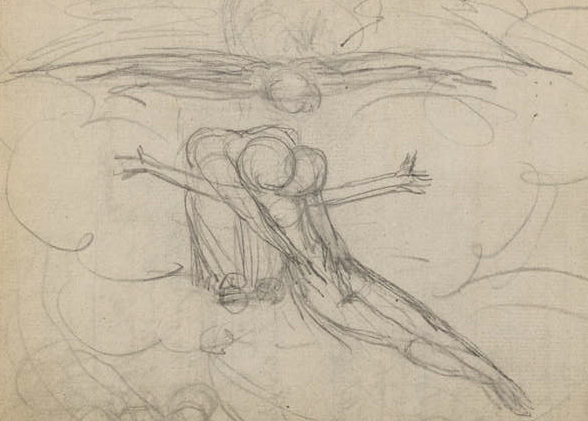
William Blake

Yes, we trust that when earthly life is over, we will have a place at home with God, in whose image we are made. But here and now, in troubless days; in days of possibility, we have a place too. A place amidst homes and colleagues; churches and communities.

A place where new life is made possible, even when - especially when - there is sickness, disruption and death; even when we have let go of all that is familiar. In this letting go, we are embraced by a love that opens our hearts; by a love that gives us a share in God’s story. 

We will explore that in a moment through Stephen’s story woven into God’s story.

Let not your hearts be troubled. 

Reflection Two

We know that in our human experience, moments of letting go can be hard and messy. As adults, we experience the nervousness and courage of a toddlers first steps: when we say yes to a job; when we say I do to a loved one; when children move out; or when we empty a parental home. And there will be many more ‘letting gos’: moment by moment, when we resist the urge to cling on tightly to what we know in order to do a new thing.
Banksy

Our reading from Acts tells us of Stephen: of his letting go of life in order to gain life. He is enfolded in love. Earlier in Acts, we hear how he is one of those who is committed to care for some of the most vulnerable.  He is one of those deacons, filled with the Spirit, who with wisdom and compassion to a great work.  They take on the great work of enabling many bodies to become one body. Hope and struggle are bound together as resurrection life, life in abundance, breaks into the ordinary and intimate, the domestic and the public. 

Stephen reminds us that we live in what Willie Jennings calls ‘the tight space between faith and fear’. Wherever we are placed - at home or at work, in our daily activity and times of isolation, it is the nearness of the Spirit that prevents faith being overcome by fear. The Spirit that Jesus promises in his parting words enables us to imagine the embrace of Jesus;  and embrace that enfolds our deepest longings and enables us to embrace a new way of life. 

The Questions: We will have our own questions; uncertainty about finding the way; needing others to point us in the right direction; allowing us to trust the compass point, the GPS of God’s love.  We are enfolded love so that our lives are unfolded in love. Rachel invited us to sit with one particular question last week: where do we find abundant life, even in lockdown.

The Way: It’s a journey. Yes, Jesus is our way; he walks with us; guiding us behind and before. It takes time; and the process of placing one foot in front of the other changes us. In the 2010 film, The Way, Martin Sheen’s character experiences this change on the way to Santiago in Spain. A pilgrimage route walked by thousands, each one carrying hopes, griefs, expectations; yet the personal, as the film reveals, cannot be contained. On this way, the lives and loves of others change us.

The Truth: Jesus promises to be our guide; to be with us on path to the place he is going - through life and death to life eternal.  Jesus reveals the truth of God’s love: in all its depth and breadth. Jesus reveals the truth of our human condition - in all its contradictions and confusion, its potential and beauty. Light shines in the darkness - attracting us back to the truth of love.


The Baptism of Christ with Dove - Daniel Bonnell

The Life:  The way, truth and life of Jesus is to reconcile all things in love. That is our ultimate reality.  In laying down his life for us, Jesus goes to the depths of the grave and reveals the power of the resurrection. It is perhaps this image of baptism that speaks also of the power of this new life.

We see in Stephen the embrace of this new life.  Like him, may our hearts be set on the world to come; like him, may we sow seeds of new life on earth. Stephen has become a story teller: it’s a story with Jesus at its centre; a story of God, the great I AM, in the midst of all things - past, present and future. In the moment we heard today, Stephen is able to witness to the way, the truth and the life; he is enfolded by the Spirit. As he speaks the Spirit speaks; he point us to the love of God revealed in Jesus. 

Let not your hearts be troubled; I have prepared a place for you; I am the way, the truth and the life. Those things are about love: consoling, reimagining, embracing, convicting, cherishing. 

Stephen has found his way to the truth of this love; and through his life, so will Saul. That figure, lurking in the shadows of hatred will become that great witness, Paul.

Our human bodies reflect something of this way of life. Jesus taught his disciples to love. God’s Spirit is at work in us - when we show compassion and kindness, when we show hospitality and friendship. We are to walk this way; embrace this truth; discover this new life. We are called - like Stephen and Saul, Thomas and Philip.

For a long time, Christian Aid has adopted the slogan: we believe in life before death.  Like Stephen may we perform with grace and power the story of  Jesus.  This Christian Aid week may our gestures reveal the divine life made flesh. 


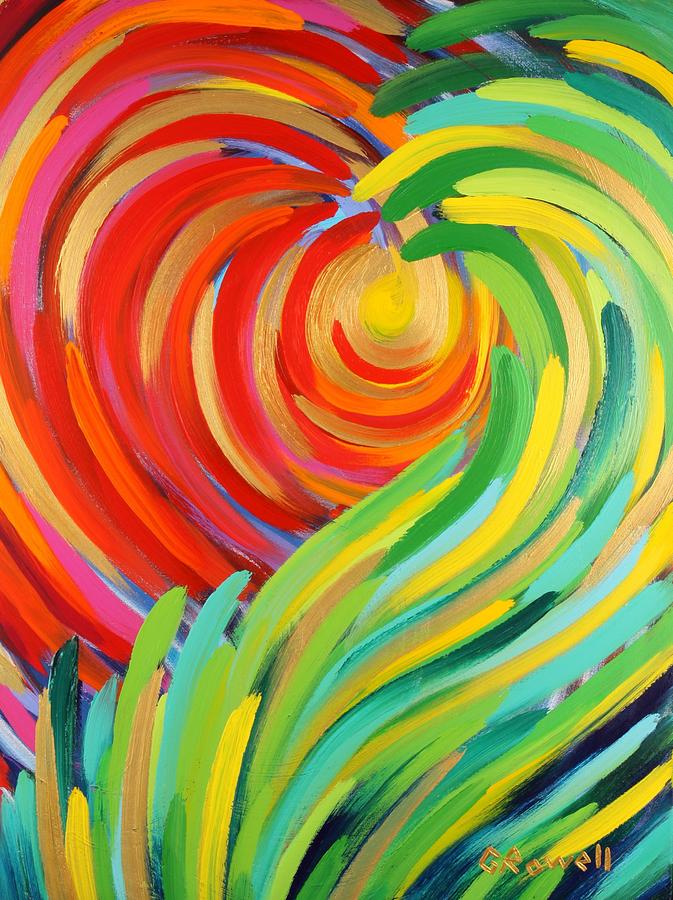
Heart of God - Gary Rowell


©  Julie Gittoes 2020


Sunday, 29 March 2020

Passion Sunday

Passion Sunday

We adore you, O Christ, as we bless you,
for by your holy cross you have redeemed the world

TODAY is Passion Sunday. As we move towards the end of Lent, our focus turns to the cross. It is such a familiar symbol to us - we wear it as a treasured item of jewellery, it adorns our churches and we remember that in baptism we too are marked with the sign of the cross.  For Christians, the cross becomes a sign not only of Jesus’ suffering and God being with us in ours; but it also points to life and hope, healing and redemption. 

The word ‘passion’ conjures up perhaps intense feelings or energy, strong convictions or a deep commitment to an interest, hobby or person. In this season, passion is the lens through which we see afresh the depth of God’s love for us. Love that is a profound commitment to be with us in the midst of suffering and death. 

We enter into this time of our Lord’s passion, acutely aware of the reality of illness and death due to the Coronavirus; and perhaps aware of our own vulnerability too. Our readings take us to a place of dry bones and to a tomb. Perhaps they allow us both to acknowledge our reality, along with the pain of separation; may they also give us hope - there will be connection and life again; for love is stronger than death.  

To focus on Christ’s Passion increases our capacity to be compassionate.  As today’s post communion prayer says, what we do for our brothers and sisters we do also for God. Sometimes that means sharing in or being with them in intense emotion. Many people are weeping today, and in today’s Gospel, Jesus also weeps. Pope Francis has called today the “Sunday of Tears”

Today, we make space and time in our own homes to pray and to reflect on the readings for this Sunday.  This is a journey for all of us; together we will be learning how to pray for, support, encourage and care for each other.

As well as the readings and short reflections, I have also included to images: one from the Jesus MAFA which was an art project based in Cameroon; the other an image taken from the Methodist Art Collection. 

As we read, alone or in company, we might want to use an ancient practice called ‘lectio divina’ or divine reading. First, read the text slowly - aloud or silently - and notice what word or phrase holds your attention. Then, sit with that word or phrase in silence. Read the text again and then reflect on what the Spirit might be prompting you to think about or do.

We begin with today’s prayer for the day - which ‘collects’ together the themes at the heart of this Passion Sunday.

The Collect

Most merciful God, 
who by the death and resurrection
of your Son Jesus Christ delivered and saved the world:
grant that by faith in him who suffered on the cross
we may triumph in the power of his victory;
through Jesus Christ your Son our Lord,
who is alive and reigns with you,
in the unity of the Holy Spirit,
one God, now and forever

You might want to read all three texts before reflecting; or focus on one, perhaps coming back to others over the day or week ahead. Note that the Gospel is quite a long passage; so you may want to focus on that, or return to during the day/week.

Ezekiel 37:1-14

The hand of the Lord came upon me, and he brought me out by the spirit of the Lord and set me down in the middle of a valley; it was full of bones. He led me all round them; there were very many lying in the valley, and they were very dry. He said to me, ‘Mortal, can these bones live?’ I answered, ‘O Lord God, you know.’ Then he said to me, ‘Prophesy to these bones, and say to them: O dry bones, hear the word of the Lord. Thus says the Lord God to these bones: I will cause breath to enter you, and you shall live. I will lay sinews on you, and will cause flesh to come upon you, and cover you with skin, and put breath in you, and you shall live; and you shall know that I am the Lord.’

So I prophesied as I had been commanded; and as I prophesied, suddenly there was a noise, a rattling, and the bones came together, bone to its bone. I looked, and there were sinews on them, and flesh had come upon them, and skin had covered them; but there was no breath in them. Then he said to me, ‘Prophesy to the breath, prophesy, mortal, and say to the breath: Thus says the Lord God: Come from the four winds, O breath, and breathe upon these slain, that they may live.’ I prophesied as he commanded me, and the breath came into them, and they lived, and stood on their feet, a vast multitude.

Then he said to me, ‘Mortal, these bones are the whole house of Israel. They say, “Our bones are dried up, and our hope is lost; we are cut off completely.” Therefore prophesy, and say to them, Thus says the Lord God: I am going to open your graves, and bring you up from your graves, O my people; and I will bring you back to the land of Israel. And you shall know that I am the Lord, when I open your graves, and bring you up from your graves, O my people. I will put my spirit within you, and you shall live, and I will place you on your own soil; then you shall know that I, the Lord, have spoken and will act, says the Lord.’

Romans 8:6-11

To set the mind on the flesh is death, but to set the mind on the Spirit is life and peace. For this reason the mind that is set on the flesh is hostile to God; it does not submit to God’s law—indeed it cannot, and those who are in the flesh cannot please God.

But you are not in the flesh; you are in the Spirit, since the Spirit of God dwells in you. Anyone who does not have the Spirit of Christ does not belong to him. But if Christ is in you, though the body is dead because of sin, the Spirit is life because of righteousness. If the Spirit of him who raised Jesus from the dead dwells in you, he who raised Christ from the dead will give life to your mortal bodies also through his Spirit that dwells in you.

John 11:1-45

Now a certain man was ill, Lazarus of Bethany, the village of Mary and her sister Martha. Mary was the one who anointed the Lord with perfume and wiped his feet with her hair; her brother Lazarus was ill. So the sisters sent a message to Jesus, ‘Lord, he whom you love is ill.’ But when Jesus heard it, he said, ‘This illness does not lead to death; rather it is for God’s glory, so that the Son of God may be glorified through it.’ Accordingly, though Jesus loved Martha and her sister and Lazarus, after having heard that Lazarus was ill, he stayed two days longer in the place where he was.

Then after this he said to the disciples, ‘Let us go to Judea again.’ The disciples said to him, ‘Rabbi, the Jews were just now trying to stone you, and are you going there again?’ Jesus answered, ‘Are there not twelve hours of daylight? Those who walk during the day do not stumble, because they see the light of this world. But those who walk at night stumble, because the light is not in them.’ After saying this, he told them, ‘Our friend Lazarus has fallen asleep, but I am going there to awaken him.’ The disciples said to him, ‘Lord, if he has fallen asleep, he will be all right.’ Jesus, however, had been speaking about his death, but they thought that he was referring merely to sleep. Then Jesus told them plainly, ‘Lazarus is dead. For your sake I am glad I was not there, so that you may believe. But let us go to him.’ Thomas, who was called the Twin, said to his fellow-disciples, ‘Let us also go, that we may die with him.’

When Jesus arrived, he found that Lazarus had already been in the tomb for four days. Now Bethany was near Jerusalem, some two miles away, and many of the Jews had come to Martha and Mary to console them about their brother. When Martha heard that Jesus was coming, she went and met him, while Mary stayed at home. Martha said to Jesus, ‘Lord, if you had been here, my brother would not have died. But even now I know that God will give you whatever you ask of him.’ Jesus said to her, ‘Your brother will rise again.’ Martha said to him, ‘I know that he will rise again in the resurrection on the last day.’ Jesus said to her, ‘I am the resurrection and the life. Those who believe in me, even though they die, will live, and everyone who lives and believes in me will never die. Do you believe this?’ She said to him, ‘Yes, Lord, I believe that you are the Messiah, the Son of God, the one coming into the world.’

When she had said this, she went back and called her sister Mary, and told her privately, ‘The Teacher is here and is calling for you.’ And when she heard it, she got up quickly and went to him. Now Jesus had not yet come to the village, but was still at the place where Martha had met him. The Jews who were with her in the house, consoling her, saw Mary get up quickly and go out. They followed her because they thought that she was going to the tomb to weep there. When Mary came where Jesus was and saw him, she knelt at his feet and said to him, ‘Lord, if you had been here, my brother would not have died.’ When Jesus saw her weeping, and the Jews who came with her also weeping, he was greatly disturbed in spirit and deeply moved. He said, ‘Where have you laid him?’ They said to him, ‘Lord, come and see.’ Jesus began to weep. So the Jews said, ‘See how he loved him!’ But some of them said, ‘Could not he who opened the eyes of the blind man have kept this man from dying?’

Then Jesus, again greatly disturbed, came to the tomb. It was a cave, and a stone was lying against it. Jesus said, ‘Take away the stone.’ Martha, the sister of the dead man, said to him, ‘Lord, already there is a stench because he has been dead for four days.’ Jesus said to her, ‘Did I not tell you that if you believed, you would see the glory of God?’ So they took away the stone. And Jesus looked upwards and said, ‘Father, I thank you for having heard me. I knew that you always hear me, but I have said this for the sake of the crowd standing here, so that they may believe that you sent me.’ When he had said this, he cried with a loud voice, ‘Lazarus, come out!’ The dead man came out, his hands and feet bound with strips of cloth, and his face wrapped in a cloth. Jesus said to them, ‘Unbind him, and let him go.’

Many of the Jews therefore, who had come with Mary and had seen what Jesus did, believed in him. 


Art Source: JESUS MAFA

Reflections

It might be that one of the most powerful lines in today’s readings is also the shortest. In the Gospel of John we read: “Jesus began to weep.” We might want to begin there; beginning in the middle of the story we hear. A story in which Jesus is set within a network of relationships: the debates with his disciples; the intimacy of close friendship; the wider community of the Jews. At the heart though is a tomb; the tomb of a dear friend. So he weeps.

Pope Francis speaks of today as the “Sunday of Tears”: it is also a day when we see Jesus confront death. The compassion of the tears identifies with us; but Jesus is not overcome by the darkness and finality of a tomb. Instead he confronts it: naming the pain of separation, the disruption of loss, the chaos of grief and giving us a glimpse of what is to come. That in his own passion he will confront, wrestle with and overcome death itself.

Jesus restores life to Lazarus. He restores life to the household of Mary and Martha. The stench of grief and decay is dispelled. They receive back what they thought they had lost. How might they have felt?  How might Lazarus have felt? 

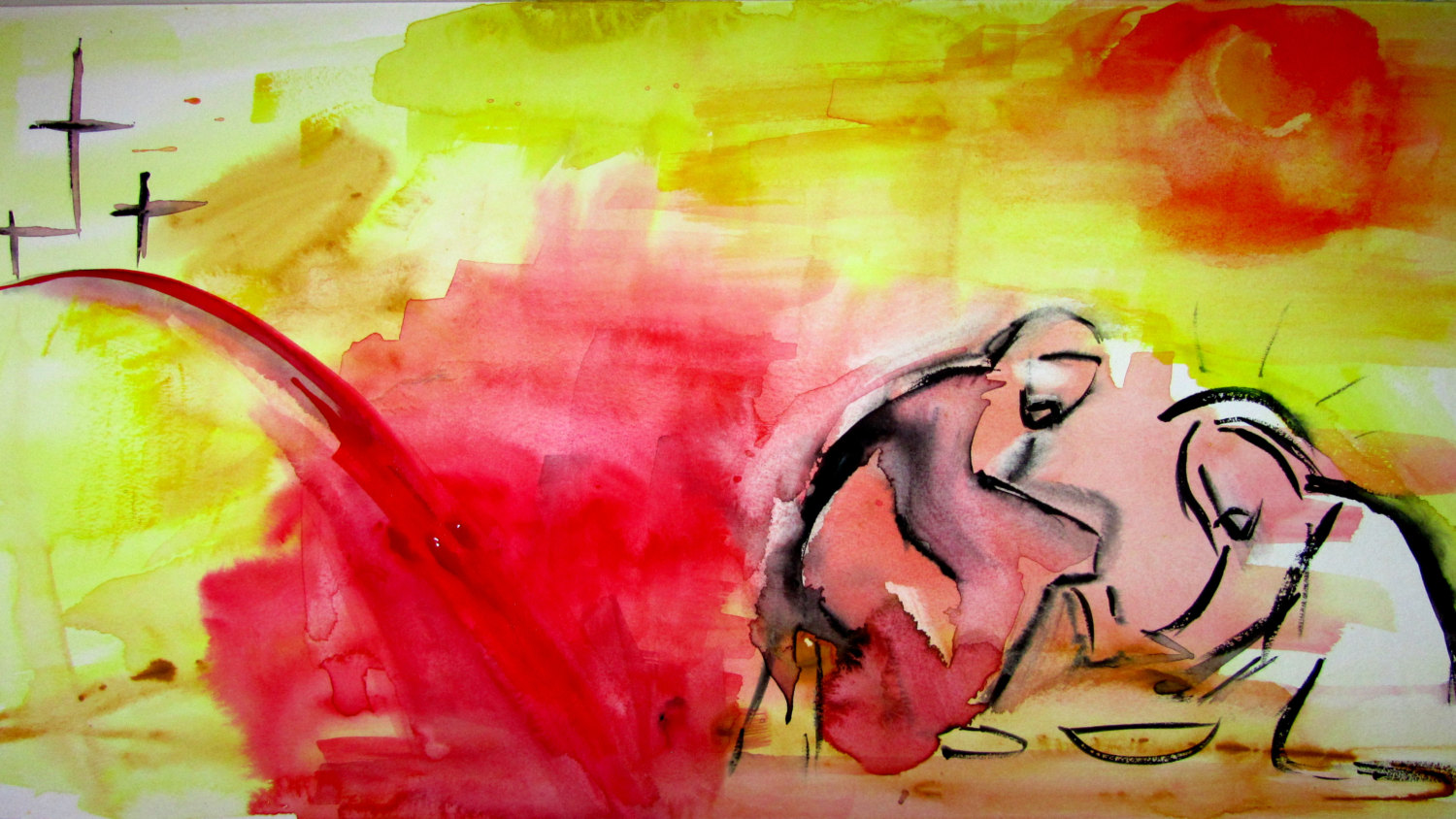
The Jesus MAFA project captures something of joy and freedom and new life. This is the first-fruit of something greater and perhaps Riley’s image captures something of the mystery of that. For yes, Lazarus will still die to this world; but Jesus, in his Passion will defeat sin, suffering and death. 

This story gives a foretaste of that new creation; a new reality is beginning to break in. We are invited to receive it and to share it. But first we must enter into Jesus’ Passion. In our own households, in our own networks of love and care, will share some of the same vulnerabilities and questions of that home in Bethany; might we also be receptive to the love and life and hope Jesus brings. 

Martha expresses this trust in an eternal future - of life in abundance - when she speaks of the resurrection; but she and her sister glimpse something of that breaking into human history, into the disruption of grief that they carry.  Perhaps this new life is as disruptive as death itself. Certainly those in positions of power feel threatened by it. 

We see this life that really is life in the compassion of Jesus tears; in the restoration of a brother to his siblings; we will see it again in the passion of Jesus as he descends from cross to grave. And there too we might wait and weep. 

We wait trusting that this life that really is life will burst forth. Romans 8 is one of my favourite passages of Scripture. In today’s reading, we hear Paul exploring this new life. The life of the Spirit dwelling in us.  Rather than being preoccupied with the needs of the flesh, we are invited to please God, seeking all that is righteous. 

It is life that opposes and overcomes all that diminishes others; it resists the violence of injustice; it strips away claims to status and power; it reveals our vulnerabilities and also our dependence on others.  As it does so it reveals the gift of God’s Kingdom - where the need for justice and mercy and compassion

Some are re-naming today as the Second Sunday of Corona-tide.  For all the challenges, fears and disruption; amidst the very tangible nearness of illness, grief and death; are we also seeing new life in this shared experience of passion and suffering?

We are seeing a renewed commitment to public service. We witness the numbers offering to be NHS volunteers, the applause echoing around our streets as we showed appreciation for those working safe. There are renewed discussions about a citizens income; a review of universal credit and the resourcing of all that builds up our society.

We’re travelling less and perhaps consuming less. Streets are setting up WhatsApp or Facebook groups to connect those in need with those able to help; we are making more time to speak to those we cannot see. The loss of physical touch is hard; keeping our distance feels strange; but perhaps at a deep level we are relearning a collective body language of both passion and compassion. 

One day we will this season of isolation will end. One day we will be able to hug one another again. One day we will look back on this season of grief and pain and the nearness of death; and we will give thanks for the small things we’ve given or received, with love. Even now, as we break bread, may we know what really matters: a depth of love given for us in Jesus Christ. 

For now it may feel as if the seeds of that are buried in the ground. Some of you may be planting vegetables, perhaps for the first time; trusting that as those seeds die, they will take root and bring a modest yet rich harvest. Others of us may be watching tree blossom and flowers budding with a new delight. God’s Kingdom too might be hidden, but will spring forth in new ways. 

Ezekiel’s vision gives us a very vivid image for this new body language. It seems to the prophet that God’s people are forgotten - their bones lie scattered. He sees an absence of God when there is great need; it is a scene of lifelessness and fragmentation. It seems as if hope is lost. 

Yet this desolation is not the end either: the Lord declares ‘I will put my spirit within you, and you shall life’. May this be our prayer for our communities and our households, for our government and our creative industries; for NHS staff and those supplying food; for businesses and free-lancers.  May there be life.

Perhaps we might pray especially for those who are anxious and unwell; those who are facing death and having to mourn in ways that are very different in this lockdown season. May they know that they are loved; that there is compassion in their suffering; may they find life and hope.  Pray that they and we may know the breath of life; God’s holy and healing Spirit. 

Is this a season where the Spirit does make our dry bones live; where we are released from our tombs. What might it mean for us to be set free - to praise God but also to seek the justice of God’s Kingdom?

© Julie Gittoes 2020

Prayers

Lord Jesus Christ,
you have taught us 
that what we do for the least of 
our brothers and sisters
we do also for you:
give us the will to be the servant of others
as you were the servant of all,
and gave up your life and died for us,
but are alive and reign,
now and for ever. Amen.


John Reilly - The raising of Lazarus (Methodist Art Collection)