Showing posts with label good news. Show all posts

Monday, 26 August 2024

Lord, to whom can we go?

 August 25 2024: Joshua 24:1-2a, 14-18, Ephesians 6:10-20 and John 6:56-69


Marc Anderson, an American entrepreneur, wrote an essay on artificial intelligence in which he said this: ‘I am here to bring good news: AI will not destroy the world, and in fact may save it’. [The Guardian Magazine, 24 August 2024: why we should fear AI by Yuval Noah Harari]


Those words may well leap out of us: good news and salvation.


The stuff of hope and healing, justice and joy shifting from the realm of creator to the creation’s creation. 


Image from Y N Harari's webpage for Nexus


For many of us, AI is the impact of Chat GPT and concerns about how to assess essays; or perhaps the worry of a takeover of humanly imaginative endeavours, leaving us with the mundane tasks we’d hoped to jettison. 


Rather than seeing AI development as a risk that we should fear, Anderson  regards it as ‘a moral obligation that we have to ourselves… to our future.’


Others sound a more cautionary note. 


For example, in his book Nexus the historian Yuval Noah Harari looks at the flow of information from the stone age, through the Bible to early modern history to today’s rise in popularism. As he examines the relationship between information and truth, he addresses the choices we face when confronted with non-human intelligence. 


How will digital empires impact on our freedom and security he asks? Can we find a hopeful middle ground rooted in shared humanity?


We have always faced such choices: about freedom and agency, power and “powers”. Today’s readings offer wisdom and insight into where we are to find good news and the hope of salvation.


The book of Joshua follows on from Moses’ parting words and begins to trace the history of God’s people as they settled in the promised land. Part of the story includes the mistakes that were made; the things that led to a time of exile - for example worshipping other gods, failing to show compassion and mercy to the vulnerable, seeking human rather than divine rule, exploitation rather than justice. 


All this is told with the benefit of hindsight. We glimpse one moment when mistakes are named and faithfulness to God is restored.


The challenges and difficulties of present circumstances are named. The promises, which may have faded from memory, are recalled. The bigger story of freedom and protection is retold. 


Remembrance leads to recommitment. Reverence of God leads to service of others. 


Faithfulness overtime relies on such moments of renewal: acknowledging what’s gone wrong, recalling moments of blessing with hope, and being intentional about our own priorities or actions - in worship and compassion.


That movement is not always easy. 


Last week we were immersed in reflecting on the living bread - and our need to be fed. We recognised that this bread gets inside us and changes us. Yet today, we are confronted by a critical moment of choice.


‘This teaching is difficult, who can accept it?’ says one of those who were following and learning from Jesus. In response, Jesus continues to hold out the promise of his words which give spirit and life. He continues to hold out the promise of his very self.


He also looks around him and asks his own question: ‘Do you also wish to go away?’  Do you go, holding on to the offence; or do you want to choose life this day?


Peter’s response is equally direct and from the heart:  ‘Lord, to whom can we go? You have the words of eternal life.’ 


It is a choice which comes from relationship - just as Joshua and the people recommitted out of their remembrance of being beloved. Peter speaks out of being fed and made whole, forgiven and challenged, taught and embraced. He speaks out of being known and loved. 


We know that Peter will still run into misunderstandings; his ego will sometimes get in the way, his boldness will tip into denial. Yet he will also grow in faith - he will run to the empty tomb. He will be recalled, by name, to love and service by his crucified and risen Lord.


In this moment, though, he longs for and reaches out for the intimacy of continuing and deepening relationship with Jesus: of being fed by enriched bread, the bread of life.  


In him we glimpse something of the process of faith and faithfulness. Peter continues: ‘We have to believe and know that you are the Holy One of God.’  His commitment is rooted in relationship - in abiding in Jesus. He has come to believe as trust grows mingled with knowledge and experience. 


Moment by moment we are invited to live as God’s beloved, forgiven, healed and restored children. We are reminded that God has already chosen us, loves us. And therefore we are invited to choose God’s love in return. By the power of the Spirit, we continue to abide in this love.


Such choosing and abiding is a gift: individually and collectively. This teaching, this commitment, is hard but also life-giving.  


This is good news and salvation: hope and healing, justice and joy offered by creation’s creator.  Offered as Jesus places himself in human hands - reconciling the world to Godself as he is lifted up on the cross.


Good news and salvation is offered to us as we take the body of Christ into our hands; being fed by the bread of life, so that our lives might reflect his love.  We eat and live. Sustained in times of strength and weakness. Serving others out of that same well-spring of limitless love; using our influence, time, resources to bring life to others.


So we come back to the choices we make about our freedom and agency, power and the powers of the world. Our freedom is a great gift of God to creation yet we are so often pulled in different directions; our hearts divided over the desires and opportunities we should pursue. 


In Ephesians, those struggles are named - including the external influences and forces at work in the world. Perhaps we might add the technological to the cosmic powers we have to confront.  How do we seek after truth rather than controlling information; or respond with caution to tech that we do not understand, for the sake of our moral obligation to creation?


In response we hear of the ‘armour of God’: a visual and memorable shorthand for what God already provides for us as we navigate our world; day by day we choose to be clothed in them.  These are things which enable us to hold onto the hope of our shared humanity: reshaping our imagination; being creative with grace; seeking freedom rather than exploitation. 


The list begins with truth - the life and love of God revealed in Jesus and at work in us through the power of the Spirit. We are invited to a life not of self-righteousness but one built on right relations; we are to take as shoes whatever makes for walking in ways of peace. All that protects us - the good news of salvation - is obtained in Jesus' life, death and resurrection. To whom can we go? He has the words of life!


The sword is of the Spirit, the word of God: the daily choice of choosing life and hope, joy and peace, justice and compassion.  The creator’s gift of salvation to creation - mediated by human lives. As we remember God’s saving acts at this Eucharist, proclaiming the mystery of the gospel, may our faith and faithfulness be renewed in worship and service. 


© Julie Gittoes 2024

Wednesday, 31 July 2024

Somewhere over the rainbow

 Easter 4 - 21 April  2024: Genesis 7:1-5, 11-18, 8:6-18, 9:8-13; Acts 4: 5-12 and John 10:11-18


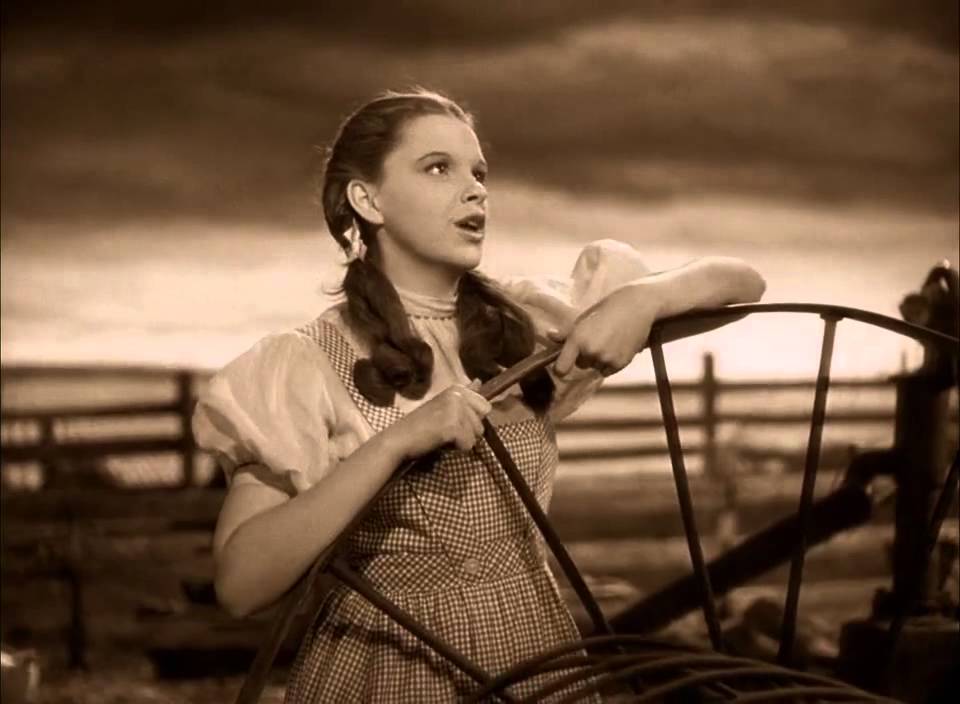
Eva Cassidy, Frank Sinatra, Pink and Rufus Wainwright are amongst those who’ve covered Judy Garlard’s Oscar winning song from The Wizard of Oz. 

Somewhere over the rainbow

way up high


A song about wishing upon a star and dreaming of dreams coming true; of blue skies and trouble melting like lemon drops.

Somewhere over the rainbow… 

there’s a land that I heard of 

once in a lullaby.


A still from film of Judy Garland in The Wizard of Oz (1939)

In the film, Dorothy wonders out loud to her dog Toto if there’s ‘someplace where there isn’t any trouble’ and concludes that there must be; but that it’s far, far away. She wants to get away from Kansas and, as the lyricist Yip Harburg put it, ‘she had never seen anything colorful in her life except the rainbow’. 


And so, the famous song was born: a song which, depending on who sings it, evokes hope or sadness:

If happy little bluebirds fly

beyond the rainbow

why, oh, why can’t I?


Our first reading today ends with a rainbow set in the clouds - as a sign for future generations of God’s covenant with the earth, humanity and all living creatures. 


Until that point, Noah and his companions may have identified more with the words of a little known intro that Garland only sang once. In a 2009 cover, Jewel all but whispers it: 

When all the world is a hopeless jumble

and the raindrops tumble all around

heaven opens a magic lane.


Raindrops tumbling, pouring and flooding. The hopeless jumble of a world destroyed by human greed, ambition and carelessness. The waters and the ark become an icon of that ‘magic lane’; a way of safety. There are no bluebirds beyond the rainbow; but a raven flying to and fro before it. And the dove - returning once, and then a second time with an olive leaf, before flying free.


There is a promise of a world beyond the rainbow - of restored relationship and renewed hearts; of hope, justice, mercy and righteousness; of love embodied and enacted - fully, faithfully. 


It is no lullaby, designed to soothe us to sleep; the promise of a world that evaporates when we awake. 


Instead it is a vision of the world as God intends it to be; a world that our hearts long for.


Yet, like the judges judging Peter and John, power and its misuse can create dividing lines. Lines that evaluate others based on their status as social or economic status: based on health, gender, sexuality, ethnicity, education, age. 


No wonder that the rainbow has become a sign of liberation and equality! It is a sign of hope, forgiveness and life - it stands against the destruction of life, and for the commandment to love God and neighbour as ourselves.


The alternative is literally deathly.   When human beings are evaluated as socially or economically useful, we see not only division and competition. At its extreme something  life-limiting and life-denying is unleashed. As Matthew Parris wrote last month in a world of inputs and outputs, some lives - the vulnerable,  frail or elderly - are worth less than the energy of the young or more nimbler. 


His column on assisted dying was published on Good Friday.


An irony which highlights the radically alternative view which we hear running through our scriptures: a pulse of love that carries us through life and breaks the bonds of death; a pulse of love that speaks of communion, healing, compassion and peace.


God set that bow in the sky as a promise that the world would not be destroyed; that the response to our tendency to selfishness or harm would not be a deathly waterflood.  When we see the colour of that bow, caught as sun hits rain clouds, we are reminded of an alternative view of humanity; and of God’s ways of loving.


In Jesus, God became one of us - flesh of our flesh. Jesus is love with us, laying down his life for us. In John’s Gospel, he describes himself as the good shepherd. It’s an image that evokes the shepherding of Moses and David before they responded to God’s call to be agents of freedom or leadership. 


It reminds us that God is the true shepherd - gathering together and  binding up, leading by still waters; taking us through the valley of death to a rich banquet.  


Jesus, the good shepherd, knows us and we know him. However much we wrestle with doubts, fears, distractions - we are reminded that we belong to God and each other; that we are known and loved. 


Jesus contrasts himself with the hirelings - who do not have our interests or wellbeing at heart: those who attention and love is thin and unsafe; who abandon others in the face of danger because they do not want to carry the cost of life together. 


Instead Jesus lays down his life for us - rescuing us from death and inviting us to look after others in the flock. He calls us - and others we may not see as part of our flock, but who are known and beloved. 


When Peter speaks to those judging him in Acts - his story is an improvisation on this narrative of love he has known and witnessed; the love that recalled him from denial to renewed faith; the love that invited him to feed the sheep.


That love was known in Jesus of Nazareth: crucified by human beings, raised by God. 


In him, claims Peter, is the power to heal the broken. The one who was rejected is the cornerstone, the one on whom we can build life, together; the one who enacts a different social order.  


His words create a moment of silence. A silence that is broken: the judges judge the judged - a tragedy that means they miss an opportunity to rebuild their own lives. They do not see the good news of the judgement made by God in Christ - the burden of sin condemned and released; life given over instead to the generous and peaceable movement of the Spirit. 


We and every disciple come to this palace of sacrifice and abundance: receiving the gifts of God in bread and wine; remembering the story we are called to improvise on in our lives. Here, we are invited to connect our faith to the world's need - to echo the divine love for creation.


Here we are fed, rested and carried by the good shepherd who’s boundless love assures us that we belong and invites us to follow. 


How will we share the love of a shepherd who is patient, bold, determined: long nights and dangerous days in the pastures and the mud? It is an invitation to share goodness in the valleys and wild places of the world, amongst the wolves and with the flock.   


Somewhere over the rainbow is now.

That place that we’ve heard of is here.


© Julie Gittoes 2024


Sunday, 29 October 2017

Light in darkness: comedy, cognitive dissonance and the gospel

Following this morning's sermon, and a comment I made about the inappropriate Radio 4 'joke', I was drawn back to the way in which comedy (as a craft) shines light into the dark places of our minds. That's very different from off the cuff jokes by those in positions of power and influence. It also set me wondering why the crowd were enraged by Jesus' teaching in the synagogue.  A vision of God's Kingdom demands a practical outworking of a preference for the poor; but it also demands that we cannot silence voices naming the abuse of power. The readings were: Isaiah 55:1-11 and Luke 4:14-30


Christ Preaching in the Synagogue at Nazareth. 14th c. fresco 
Visoki Decani Monastery, Kosovo


Jesus, filled with the power of the Spirit, returned to Galilee.

He was praised by everyone.

He said: ‘Today this scripture has been fulfilled in your hearing.’ 

All spoke well of him and were amazed at the gracious words that came from his mouth.

They were filled with rage.

They drove him out of the town

Luke’s Gospel is crafted with an artistry which paints a vivid image of God’s Kingdom and reveals the depths of human hearts.  The combination disrupts the status quo and creates space for fruitful response. 

But dynamics of acceptance and offence in this evening’s passage are intriguing: what is it that makes Jesus’ hearers so enraged?

Perhaps - in a slightly risky move - the world of comedy can offer a way in. 

The late Bill Hicks, an observational comic and satirist once said: ‘the best kind of comedy to me is when you make people laugh at things they’ve never laughed at, and also take a light into the darkened corners of people’s minds, exposing them to the light’.


This is what the gospel does too. It exposes us to the light; revealing our inner most thoughts and assumptions.

It’s what Jesus does - not through comedy but through prophetic judgement.  The dynamics between the synagogue and a comedy gig might seem far stretched. However, in both cases people gather with some sense of shared expectation - to be inspired, comforted or entertained. Some might want their ‘world view’ to be reinforced; others might expect provocation and challenge.  

When Jesus went to his home town, he went to synagogue as we might expect.  He stood up to read. He began to teach; to speak of the fulfilment of scripture in and through him.

What had the gathered community expected? An endorsement of their way of life or their values; a shared interpretation of the law?  Might he have something to say about the threat posed by the occupying Roman forces? May be they wanted to bask in the fame of a local lad ‘made good’. When Scripture is read, do they - do we - expect a light to shine in the dark corners of our minds?

In a book entitled Jesus Through Middle Eastern Eyes, the scholar Kenneth Bailey writes: ‘no attempt is made to shape his message along the lines of their agenda. In bold and uncompromising terms Jesus announces his ministry of proclamation, justice advocacy and compassion to be inaugurated by himself, as the anointed one of God’.  

There can be no doubt that Jesus is the Messiah: God in the midst of us declaring that this is the year of the Lord’s favour.  The good news of salvation comes into our midst - familiar words are heard afresh. 

It starts with good news for the poor. It radically de-centres our understanding of power by empowering voices from the edge. It entails the recovery of sight - seeing things how they really are. Dark corners are exposed to the light. 

A priest in Liverpool, Ryan Cook, expressed this in a Tweet: ‘The preferential option for the poor calls us to make decisions with a preference for how it affects the poor, positively or negatively’.

This turns the concept of “kingdom" into something we can live, express and quantify.  It’s a compelling vision for witness and the pursuit of justice flowing from divine compassion. It sets in train an approach to mission which relies on mutual dignity: the one who brings freedom to captives sends them sending forth to free the oppressed.

So why the angry response?

Because perhaps he does not soften the radical message for the home crowd. Justice and compassion means that we can’t cling to power and privilege; it demands authenticity and a vulnerability. This Kingdom flourishes by the grace of God, not human control, and has space for all who yearn to be fed. 

Jesus illustrates the universality of the good news he brings by setting before them the examples of a Syrian general and a widow from Sidon. Not only is Jesus expressing equality of men and women - something which echoes throughout Luke’s Gospel - but he’s also demonstrating that grace is available to all, Jew and Gentile. We, like them, are to trust and obey. 

Light has shone in the dark places of their minds and we are exposed to that same light. 

Will we seek to chase it away, rushing to a cliff edge of our own design or will we begin our own risky walk of trust and obedience for the sake of God’s Kingdom?

Here I want to return to comedy as a means of shining light into the dark places of our minds. It’s risky but necessary. In part because Today Programme ‘joke’ troubled me greatly; and we need to pay attention to the reactions it’s generated.  

There is undoubtedly a dark side to comedy - Jimmy Carr’s work, for example.  Alongside his wordplay and silly or even whimsical jokes, he's someone who tackles taboo subjects. He’s provoked no shortage of outrage.  But he says that he’s ‘obsessed by cognitive dissonance - the idea that you can make people laugh and be disappointed in themselves for laughing at the same time. Or be disgusted at the same time’.  


Does such ‘cognitive dissonance’ become a means of revealing the scandal of any abuse of power? Does it reveal how easily we can be complicit in words and actions which dehumanise others?

Is Carr’s goal to generate a laugh despite themselves? Interestingly, no, that’s not his motivation. Or is it that as a clown he is able to expose the dark places of our minds, forcing us face the truth; making us think and act differently - somehow taking it more, not less, seriously?

The now infamous ‘clumsy joke’ reveals that when it comes to power, those who have it are often unaware of how much power they wield; or the extent of cultural collusion in what they say; or the way it silences the voices of others. Their influence can be readily co-opted to dehumanise, rather than used to challenge and transform attitudes. 

When Jesus proclaims the nearness of God’s Kingdom, may be the rage is a fearful reaction to the cognitive dissonance of light shining in the dark. May be its a failure to realise that justice and compassion is not a zero sum game - to extend the reach of God’s love does not mean there’s less of it; but it does demand that we allow it to change the status quo.

If we take the time to ask what really matters or what we could change, we catch a glimpse of the vision spelt out in Isaiah, fulfilled in Jesus and at work in our world through the Spirit. The book 200 Women by Karen Scott, previewed in today’s Observer Magazine, does just that.


The words that appear are: justice; solidarity love; respect; action; ubuntu - the dignity of every person.

Those sounds like kingdom practices. Jesus’ teaching will continue to challenge us. Let us pray that more may hear and respond to that message of justice and compassion, of freedom and preference for the poor. Responding not with rage but with imagination and faith. For God says to all, listen, come, eat and live.

May light shine in the dark places of our minds: for my thoughts are not your thoughts, nor are your ways my ways, says the Lord.

May we be exposed to the light of Christ: returning to the Lord who will have mercy and abundantly pardon. By the power of the Spirit, may God’s word bear fruit in and through us, for the sake of the Kingdom.


© Julie Gittoes

Wednesday, 26 July 2017

He was called James

Last night I had the very great pleasure to preach at Evensong at the opening of the Endellion Summer Festival. This year it fell on the Feast of St James - so I was grappling with how we think about this example of being called by name to share good news, in the context of the a living community celebrating the gift of music.  Added to that, the texts were both complex and challenging in their different ways: first the stark warnings of a prophet (Jeremiah 26:1-15) and the immediacy of James’ response to Jesus (Mark 1:14-20).  In the end, calling and good news resonated through the text - and I managed to sneak in a reference to the other “James”… the indie rock band and their famous anthem ‘Sit Down’ releases  in 1989!


St Endellion Church

He saw James.
James, with his brother in their boat.
Sitting together mending the nets.

Mending nets demanded skill and patience: checking, untangling, knotting; nibble fingers handling needles; four hands holding the weight and tension.  It’s a scene which still plays out along our coastline. So mundane and time consuming we’d hardly notice it; we barely see.

And there Jesus saw him. 
Really saw him.
The fisherman: gazed upon;
by one who is God with us.


Guido Reni - Saint James the Great

He was called James.
James was called. 

He left his father and followed.
James listened, witnessed and asked a favour.
He questioned, doubted and was weighed down with sleep.
James believed, followed and fished for people.
Sharing life transforming good news made him apostle, martyr, saint.

If you Google “St James” you discover a boutique hotel, royal palace and a wealth management group; numerous schools, hospitals and a creative media company which, according to its website, injects a ‘thrill into a tailor made message’. St James’: a crown estate - a market like no other - food, fashion, lifestyle, art and events.


And in all these places, men, women, young and old, are engaged in tasks which demand skill and patience: planning lessons, cleaning offices, fulfilling ambitions, asking questions, making beds, welcoming diplomats, shaping campaigns, resisting sleep, cooking meals, managing wealth, suturing wounds, seeking work, creating art.

And God sees them; sees us.
We are seen with all our questions, passions, exhaustion and potential 
Like James, we are called by name.
By name we are called. 
Called to follow and listen, believe and share good news.
To see others as we are seen; and to see lives transformed by love. 

This is good news.

This news is, in the words of Rowan Williams, ‘a message about something that altered the climate in which people live, changing the politics and the possibilities; it transforms the landscape of social life’.  

Mark’s Gospel expresses possibility and transformation by with urgency: moments of amazement and ordinariness punctuated by the words kai euthys  ‘and immediately’. The universal scope of this good news is told in a series of intimate encounters. Today we glimpse James at the beginning of a journey. He spent the next days, months, years enfolded by good news. Good news he proclaimed. 

Good news that God’s beloved Son stood came to us in the midst of our longing, frailty and need for forgiveness. He taught with authority - revealing scope of God’s love in parables about sowers, seeds, lamps and yeast. He sought solitude as he prayed in a deserted place; he fed thousands on a hillside and taught thousands more on seashores and synagogues.  


Eugene Delacroix: Christ Calming the storm

Jesus stilled the storm and brought peace to the troubled mind.  Lepers, paralytics, the deaf, the blind and a woman with haemorrhages knew his healing power; he restored a little girl to life.  Fishermen, religious leaders, children, a tax collector and a Gentile women followed him in faith. 

He showed how God’s law of sabbath rest enabled human kind to flourish; he challenged the rich and ambitious, to serve God’s Kingdom; and treasured the widow’s mite. Jesus radically extended our understanding of kinship - all who love mercy are his mother, sister and brother.  

In him, love divine plumbs the depths of humanity.  

A close companion betrayed him; another denied him; a woman poured out lavish oil to anoint him. Bread is broken and wine is poured; tears, sleep, arrest and trial. Hosanna becomes crucify. At a moment of utter forsakenness a centurion sees God’s Son. And at an empty tomb risen life bursts forth. 

This is good news: God’s Kingdom breaks in, transforms and empowers; in our daily tasks, our journeys and our resting places. In all this is the love of God sees us as we are. Like James we are addressed by name and invited to turn and respond. Follow me!

New possibilities lie ahead; we are co-workers in this Kingdom. Transformation unfolds as we love God with all that we are; with every fibre of our being; voices, gestures, heart and mind; loving neighbour as ourself.  

The speed of James’ response is remarkable: can we imagine letting go of the equivalent of nets, family, boat and crew?  What could be so compelling that we leave familiar rhythms behind? 

And yet, we are here - we’ve stepped aside from our regular round of commitments and responsibilities to join with this living, festival community.

Do we recognise in the pull of this place of pilgrimage, something that James might have seen in Jesus? A longing for the opportunity to reconnect and reflect;  for encouragement, joy, renewed relationship and spiritual refreshment? 

Richard Hickox described the spirit of this place as something on which ‘we all feed’. He called it a ‘magnet’ as well as a ‘refuge’.  There is something magnetic and irresistible about Jesus too - but it’s not always easy or comfortable.  James found himself re-deploying his trade - a fisherman becoming a fisher of men. 

To be caught by the love of God - to draw others into that abundance - is to find our refuge, our place and our purpose. In creation God gave us freedom to follow or reject love; in Christ that rift is overcome; by the power of the Spirit’s guidance we bear the witness to the good news of that love, bringing healing and wholeness.  

To ‘catch’ people for this Kingdom is joyful and demanding. It means seeing people as they are - being with them as God was with us in Jesus. To take words from another “James”, this time the indie rock band, we are to ‘sit down’; to sit down ‘in sympathy’ with those ‘who feel the breath of sadness’, those ‘touched by madness’ or who ‘find themselves ridiculous’.


When we sit down in love: in the face of fear, or hate or tears, heaven touches earth.  To sit alongside others - to see them as God does - is prophetic. It makes hope and consolation known in the present. 

It’s not easy.

Some days, we’ll sympathise with the reluctant prophet Jeremiah. At a time of political and social upheaval he carries the lonely weight of continuing to speak of the demands of God’s love. Although he was shunned and ill-treated, he was not a defeatist. 

He was persistent in speaking truth to those in positions of authority; calling them to return to listen to God; to avoid the impending disaster by walking in the way of his law of love. 

Even in the darkest times of rebuke, mockery and condemnation, Jeremiah holds on to the hope that God will not abandon him. Nor would God abandon his people - but would touch every human heart. James saw that prophecy come to fulfilment - as Jesus brings a new covenant in his blood; as the Spirit brings new life to the law. 

Jesus saw James.
Like James we are called by name.
By name we are called.
Called to follow and listen, believe and share good news.
To see others as we are seen; and to see lives transformed by love. 
Your music gives voice to that vision with joyful song.

Over the coming days, may you glimpse a new heaven and a new earth. 
May you hear and respond to the heavenly voice declaring that God dwells with us.
Over the coming days, may you find refuge, encouragement, joy and delight.
May the Holy Spirit equip you return home embracing new possibilities.

This is good news.


© Julie Gittoes 2017