Showing posts with label Peter. Show all posts

Monday, 26 August 2024

Lord, to whom can we go?

 August 25 2024: Joshua 24:1-2a, 14-18, Ephesians 6:10-20 and John 6:56-69


Marc Anderson, an American entrepreneur, wrote an essay on artificial intelligence in which he said this: ‘I am here to bring good news: AI will not destroy the world, and in fact may save it’. [The Guardian Magazine, 24 August 2024: why we should fear AI by Yuval Noah Harari]


Those words may well leap out of us: good news and salvation.


The stuff of hope and healing, justice and joy shifting from the realm of creator to the creation’s creation. 


Image from Y N Harari's webpage for Nexus


For many of us, AI is the impact of Chat GPT and concerns about how to assess essays; or perhaps the worry of a takeover of humanly imaginative endeavours, leaving us with the mundane tasks we’d hoped to jettison. 


Rather than seeing AI development as a risk that we should fear, Anderson  regards it as ‘a moral obligation that we have to ourselves… to our future.’


Others sound a more cautionary note. 


For example, in his book Nexus the historian Yuval Noah Harari looks at the flow of information from the stone age, through the Bible to early modern history to today’s rise in popularism. As he examines the relationship between information and truth, he addresses the choices we face when confronted with non-human intelligence. 


How will digital empires impact on our freedom and security he asks? Can we find a hopeful middle ground rooted in shared humanity?


We have always faced such choices: about freedom and agency, power and “powers”. Today’s readings offer wisdom and insight into where we are to find good news and the hope of salvation.


The book of Joshua follows on from Moses’ parting words and begins to trace the history of God’s people as they settled in the promised land. Part of the story includes the mistakes that were made; the things that led to a time of exile - for example worshipping other gods, failing to show compassion and mercy to the vulnerable, seeking human rather than divine rule, exploitation rather than justice. 


All this is told with the benefit of hindsight. We glimpse one moment when mistakes are named and faithfulness to God is restored.


The challenges and difficulties of present circumstances are named. The promises, which may have faded from memory, are recalled. The bigger story of freedom and protection is retold. 


Remembrance leads to recommitment. Reverence of God leads to service of others. 


Faithfulness overtime relies on such moments of renewal: acknowledging what’s gone wrong, recalling moments of blessing with hope, and being intentional about our own priorities or actions - in worship and compassion.


That movement is not always easy. 


Last week we were immersed in reflecting on the living bread - and our need to be fed. We recognised that this bread gets inside us and changes us. Yet today, we are confronted by a critical moment of choice.


‘This teaching is difficult, who can accept it?’ says one of those who were following and learning from Jesus. In response, Jesus continues to hold out the promise of his words which give spirit and life. He continues to hold out the promise of his very self.


He also looks around him and asks his own question: ‘Do you also wish to go away?’  Do you go, holding on to the offence; or do you want to choose life this day?


Peter’s response is equally direct and from the heart:  ‘Lord, to whom can we go? You have the words of eternal life.’ 


It is a choice which comes from relationship - just as Joshua and the people recommitted out of their remembrance of being beloved. Peter speaks out of being fed and made whole, forgiven and challenged, taught and embraced. He speaks out of being known and loved. 


We know that Peter will still run into misunderstandings; his ego will sometimes get in the way, his boldness will tip into denial. Yet he will also grow in faith - he will run to the empty tomb. He will be recalled, by name, to love and service by his crucified and risen Lord.


In this moment, though, he longs for and reaches out for the intimacy of continuing and deepening relationship with Jesus: of being fed by enriched bread, the bread of life.  


In him we glimpse something of the process of faith and faithfulness. Peter continues: ‘We have to believe and know that you are the Holy One of God.’  His commitment is rooted in relationship - in abiding in Jesus. He has come to believe as trust grows mingled with knowledge and experience. 


Moment by moment we are invited to live as God’s beloved, forgiven, healed and restored children. We are reminded that God has already chosen us, loves us. And therefore we are invited to choose God’s love in return. By the power of the Spirit, we continue to abide in this love.


Such choosing and abiding is a gift: individually and collectively. This teaching, this commitment, is hard but also life-giving.  


This is good news and salvation: hope and healing, justice and joy offered by creation’s creator.  Offered as Jesus places himself in human hands - reconciling the world to Godself as he is lifted up on the cross.


Good news and salvation is offered to us as we take the body of Christ into our hands; being fed by the bread of life, so that our lives might reflect his love.  We eat and live. Sustained in times of strength and weakness. Serving others out of that same well-spring of limitless love; using our influence, time, resources to bring life to others.


So we come back to the choices we make about our freedom and agency, power and the powers of the world. Our freedom is a great gift of God to creation yet we are so often pulled in different directions; our hearts divided over the desires and opportunities we should pursue. 


In Ephesians, those struggles are named - including the external influences and forces at work in the world. Perhaps we might add the technological to the cosmic powers we have to confront.  How do we seek after truth rather than controlling information; or respond with caution to tech that we do not understand, for the sake of our moral obligation to creation?


In response we hear of the ‘armour of God’: a visual and memorable shorthand for what God already provides for us as we navigate our world; day by day we choose to be clothed in them.  These are things which enable us to hold onto the hope of our shared humanity: reshaping our imagination; being creative with grace; seeking freedom rather than exploitation. 


The list begins with truth - the life and love of God revealed in Jesus and at work in us through the power of the Spirit. We are invited to a life not of self-righteousness but one built on right relations; we are to take as shoes whatever makes for walking in ways of peace. All that protects us - the good news of salvation - is obtained in Jesus' life, death and resurrection. To whom can we go? He has the words of life!


The sword is of the Spirit, the word of God: the daily choice of choosing life and hope, joy and peace, justice and compassion.  The creator’s gift of salvation to creation - mediated by human lives. As we remember God’s saving acts at this Eucharist, proclaiming the mystery of the gospel, may our faith and faithfulness be renewed in worship and service. 


© Julie Gittoes 2024

Saturday, 6 March 2021

Walking in Crosslight

Second Sunday in Lent: Genesis 17:1-7,15-16 and Mark 8:31-end


In yesterday’s Guardian, Monica Heisey explores what she calls the ‘joyless trudge’ or the British obsession with ‘going for a walk’.  She captures the refrain that perhaps we recognise from our childhood or being amongst friends: Where are we going? On a walk!


In lockdown, walking - without a particular destination in mind - has been a way to exercise, spend time with a friend, get away from the computer screen and relax. Whether it’s on the Heath, at the Welsh Harp or a circuit of Sunny Hill Park, we’re spoilt for choice when it comes to walking 


Yet, Heisey, such activities are aimless - ‘no destination, only journey.’


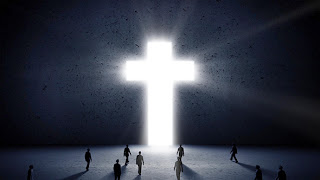
At this early point in Lent we are invited to walk: to walk before God; to walk the way of the cross.


And perhaps, like the journalist, we worry that that can be a joyless trudge; and yet our readings are inviting us to stay with the journey, even when the destination is uncertain or even unpalatable. 


We’re invited to in the way of the cross; and to allow its light to be good news.


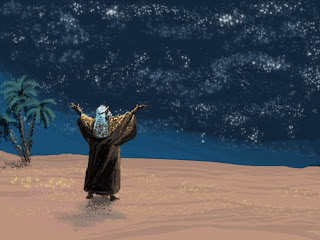
Abraham and Sarah - Marc Chagall


Today we are invited to walk with Abram and Sarai as they face a new beginning. 


The journey begins at an unexpected and unlikely moment. 


Their journey thus far has included the companionship of the life together; but also the reality of childlessness. Whether through choice or circumstance, the social pressures and expectations of parenthood are still recognisable to us today - for men and for women. 


The ‘I am’ of God speaks into this place of ageing at a time when life seems short; when the light of hope grows dim. 


I am God.  I am God inviting you to walk before me. 


To walk with me; to be with me; to be blameless. To let go of shame and fear; of stigma and isolation. And to walk.


To begin a new journey.


Image: artist unknown, found here


This invitation to walk doesn’t have a clear destination; but it full of promise. 


This covenant is exceeds all that Abram and Sarai could count or imagine.


Where life seemed limited, now there is an everlasting covenant.


Where hope grew dim, now there blazes a multitude of possibilities.


One couple, becoming exceedingly numerous.


An old man, an ancestor to a multitude of nations.


An old woman, blessed mother of many peoples.


I am God. Walk before me.


Be blameless: love, trust, hope. Walk.


This is the covenant of God: a commitment to mercy and blessing and life. 


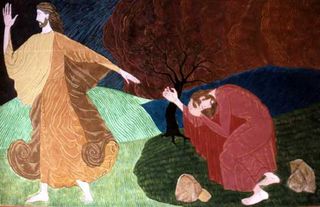
Image here


That commitment to walk in God’s way of love are not always comfortable or straightforward.


Peter discovers that in a painful way today. A few moments before the conversation we hear today, Peter had placed his faith and trust in Jesus - he had declared who he was. 


He named Jesus as Messiah; the I am of almighty God in our midst.


But then Jesus begins to teach the disciples that this way of being with us, of walking with us, would involve suffering. 


He speaks of rejection, suffering and death. 


Peter protests. 


He speaks from the heart.


He speaks out of the human instinct to protect the one he’s chosen to follow, listened to, and place his hope in.


He speaks of the human instinct to hold on to his understanding of what it meant to be Messiah; to the image of saviour as an all-conquering hero.


This is a painful moment. Peter rebukes Jesus because he cannot bear to hear let alone understand what is being said; to register the shock of this suffering love is hard.


It is a painful moment. Jesus rebukes Peter - but also keeping the disciples and each one of us in his gaze. For it is too easy and tempting to set our hearts and minds on human things. 


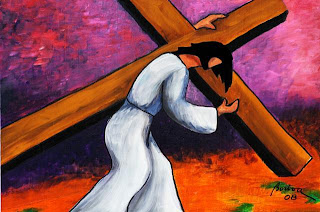
Jesus takes up the cross: image here


Jesus is inviting us to think afresh about the ways of God; about the way God’s very self is revealed in vulnerability.


It is only by focusing on the person of Jesus that a relationship begins; that we can come with our misunderstandings and questions, hopes and desires.


And here, in the company of the one who is God with us, glimpse mercy and truth. Catch the drift of the radical change he brings. 


For  hear we see God at the heart of the world; at the heart of what we experience. God is at the heart of the suffering, pain, confusion and uncertainty. 


God is there and, in the words of Rowan Williams, is transforming it  ‘by the sheer indestructible energy of his mercy’.


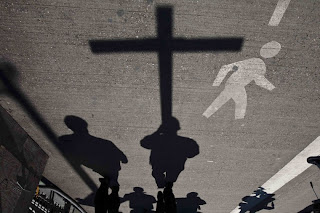
The cross bearers of Holy Week: image source here


Like Peter, we are invited to keep going. However hard it is at times to make sense; however many questions we have, we are called to follow.


To follow the energy of this mercy, and there to find life.


To let go of the dazzling prizes of the world, and to find life.


To recognise the force of God’s love, and to find in it new life.


The God who invited Abram and Sarai to walk before him, is the God who is the ground of our being.


Today, we are invited to see the ways in which Jesus changes what can be said about God. 


If this is where God is - walking the way of the cross -  then God’s love and mercy cannot be overcome or squeezed out by injustice, suffering and loneliness. 


Image from video-hive


Is walking this way a ‘joyless trudge’? No.


Is there no destination, but only journey? No.


This walk, this journey is infused with the light of God’s light.


A steady light that sheds light on the world around us.


A light that calls us to recognise the dignity of every human being; and to trust in the energy of God’s mercy.


Walking in cross light reminds as that in Jesus, God goes to the very heart of human experience; and there, at our weak point, brings life.


Walking in cross light delivers us from the circumstances or choices which bring sorrow; and instead invites us to be part of a story that speaks of good news and a new world.


God comes to the weak point and says this is not the end; comes to the place of sorrow and embraces us; to the place of regret and forgives us. 


We are to walk - remembering God’s tender mercies and loving kindness.

We are to walk - remembering that God’s mercy and love bring life, hope and forgiveness. 


Let us pray to the trice holy God to have mercy on us as we walk in cross light.


Holy God. 

Holy and strong.

Holy and immortal.

Have mercy on us.


 © Julie Gittoes 2021


Sunday, 3 September 2017

Follow me!

This is the text of a sermon preached at Guildford Cathedral Eucharist - 3rd September. Having confessed to my shame of Tolkein being amongst my  'great unread', I rather enjoyed entering into that world (albeit briefly and hopefully not for the final time) when I was visiting friends last week. I couldn't help by engage with some of the resonances between the themes of the readings  [Jeremiah 15:15-21; Romans 12:9-21; Matthew 16:21-27] and the Middle Earth epic.


In a hole in the ground there lived a hobbit. 

For those familiar with J.R.R. Tolkien’s novel, you’ll recall the description of Bilbo Baggins world: Not a nasty, dirty, wet hole, filled with the ends of worms and an oozy smell, nor yet a dry, bare, sandy hole with nothing in it to sit down on or to eat: it was a hobbit-hole, and that means comfort.

For some reason, for a child who loved books, I wasn’t captivated by this world and the adventures about to unfold. As an adult, I remain embarrassed by this confession of the ‘great unread’; a shame which is intensified as the movie franchise also passed me by. 

Until, that is, last week.


The Battle of the Five Armies is the third and final instalment in Peter Jackson’s three-part film adaption based on J. R. R. Tolkien’s The Hobbit. Replete with dragons, orcs, elves and mystical rings, this version of Middle Earth has been described as a ‘colossal technical achievement’; as well as a ‘magnificent,Wagnerian-style finale, full of sound and fury, and with an unexpected emotional kick’.

The visual extravaganza improvises on Tolkein’s text and draws us into a world closer to our own than we might imagine: warring factions and refugees seeking safety; courageous leaders and sacrificial love. 

In Thorin, the leader of the Dwarves, we see someone who is paralysed by despair and paranoia;  by anger at broken promises and an obsession with false idols. Shut away in Lonely Mountain, he places his trust in riches of ‘dragons gold’. 

And yet, as crisis looms he addresses his company saying: I have no right to ask this of any of you… but will you follow me … one last time?

Thorin faces past mistakes and steps up to lead his people, galvanising them in service of their kingdom. We see glimpses of tenacity, humility, loyalty, determination, trust and hope; none of those come without cost.

Follow me!

Today, the Scriptures, which shaped Tolkein too, invite us to face the demands of walking in God’s ways. We hear in Jeremiah something of Thorin’s despair; we hear on the lips of Peter misunderstanding; Jesus’ rebuke re-focuses our life; in Paul’s we confront the practical implications of genuine love. 

Jeremiah is facing disappointment and disaster. He had received God’s word with delight. He hadn’t needed to seek out human merrymaking because he rejoiced in the one who called him by name. Now he faces rejection and persecution; he's wounded and feels deceived by God. He shuns his ‘first love’.


Jeremiah Lamenting: Rembrant 

At this low point of introspection and bitterness, God draws near to him. There he is recalled. 

My word is precious, declare it! I am with you, they people will turn to you! Follow me!

The demands of this calling lie at the heart of the Gospel.

Last week, we were left with a cliff hanger: Peter declared that Jesus is the Messiah and the disciples were instructed not to tell anyone. And now we see why.

Jesus wanted to teach them what being Messiah meant: he wasn’t, as many expected, a triumphant figure, claiming his Kingdom with power and might. Instead glory and victory followed suffering.  In him, God’s love reached out to the depths of agony and isolation, suffering and even death; the victory of that  love would be revealed in resurrection. 

This isn’t the ending Peter expected. He rebukes the one who had rebuked the waves and calmed the storm. Jesus own words of rebuke are harsh; but perhaps that’s the point. He’s jolting Peter - and us - out of our collusion with a human perspective. 

Peter’s vision is shaped by the world’s understanding of power. Jesus is revealing the nature of God’s love, made perfect in the form of a servant. He is also giving a pattern for us to follow.  God’s love can be seen in our humanity; in our weakness not strength; in the face of threats not just opportunities. 


Follow me: obedience to that call involves taking up the cross. It means laying aside all that the world counts as ‘successful’; no longer striving to possess, consume, control or judge.

Our attempts to ‘save our life’ amount to being selfish: preserving our interests and indulgences; placing ourselves at the centre of the world. We could so easily rattle off a list of the petty, seemingly insignificant, moments when we know we’ve nudged what we want to the centre. The fruit of our selfishness might be impatience, greed, jealousy anger, quarrels or indifference.

Instead, losing our lives for the sake of Jesus begins by placing him at the heart of everything - of our lives, our work, our ministry, our friendships, of this cathedral. His love becomes our centre of gravity, pulling us closer. 

In a broken and complex world, loving faithfully, deeply and patiently is very hard indeed. But if we are precious in God’s sight, so is our neighbour - the one we find difficult, who isn’t like us, who is hostile to us. 

At the heart of the Battle of the Five Armies, we grapple with loving our enemy. When the Elf Thranduil turns away from the Dwarves, Tauriel rebukes him saying:  You think your life is worth more than theirs, when there is no love in it? There is no  love in you! At that moment, she takes her personal love of Kili and translates it to love for a people. 

Love that is selflessness makes us more human; and in that fullness we see the love of God with us.  To learn this love we have to follow Jesus; and in following we find life. And in following, God’s kingdom is glimpsed here.

Like Peter and Jeremiah before him, we find ourselves to be transformed. Paul explores what that looks like.  Having described the way in which we are united in Christ, and co-dependent on one another, he says ‘let love be genuine’.  

That is the acid test of our life and ministry in this cathedral - is love being made real amongst us?

Holding fast to the goodness of God’s love s an expression of corporate love which overflows in sincere hospitality to the stranger mutual affection. 


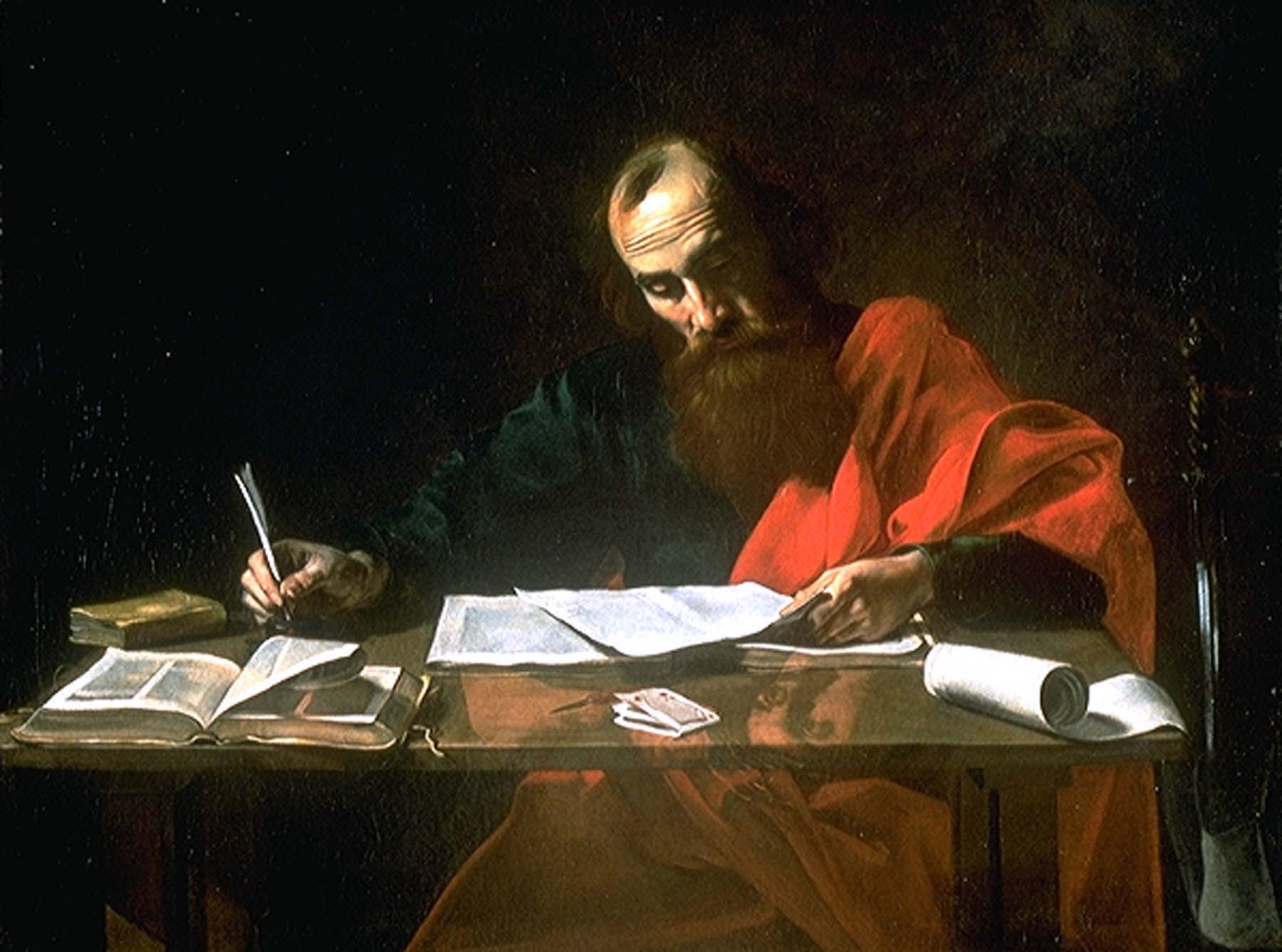
St Paul Writing his Epistles: Valentin de Boulogne 

This love is generous and good; leading to flourishing of the other; this love does not collude with abuse or hurt. Paul recognised the evangelistic impact of our character - of goodness, patience, kindness, self-control and joy.

The language that Paul uses is powerful and dynamic: be eager, earnest, diligent and zealous. There is no drudgery in this vision of life together - rather it is vibrant and animated by the Spirit. Paul’s language also calls us to perseverance - being aware of Christ moment by moment.

In this Eucharist, we like Jeremiah taste the sweetness of God’s word; like Peter we find challenge and forgiveness as we follow Christ; and in the power of the Spirit, the fire of God’s love is re-kindled in us. 

Like Bilbo Baggins, we’re called out of the comfort of our home. In fondness, Gandalf says he’s quite a little fellow in a wide world after all!  Sometimes we too might feel quite little; yet we like Bilbo have potential of learn, love and grow; let’s not underestimate the impact as we are sent as as the body of Christ; walking as a movement of love in the wide world.  

© Julie Gittoes 2017

Saturday, 15 April 2017

Fire and Cock-crow

During a service of readings, reflections and prayer at the foot of the cross at St Andrew's Cobham, we focused around some of the images and themes in John’s Passion Narrative. The text of John Donne’s sonnet series La Corona were  woven into our mediation, rooting the recollection of crucifixion in the mystery of incarnation.

We moved from fire and cock-crow to power and customs; from robe and crown to wood and words; from hyssop and spear to the linen and spices. The section numbers refer to images used during the mediation which are not all re-produced below.


Graham Sutherland - The Deposition
Methodist Modern Art Collection 
https://www.methodist.org.uk/our-faith/reflecting-on-faith/the-methodist-modern-art-collection/index-of-works/the-deposition-graham-sutherland/


At the end of the three hours we left in silence; entering into this time of watching and waiting at the tomb; returning to our own homes. Graham Sutherland’s painting The Deposition reflects the reality of death; of being entombed. 

To quote John Donne's 'Resurrection' in La Corona:
Flesh in that long sleep is not putrified,
But made that there, of which, and for which it was;
Nor can by other means be glorified.

Even those who had cared for Jesus’ body after he’d drawn his last breath, are beginning to slip out of view. And yet, for all the starkness and finality, there is in Sutherland’s work, an almost light. It is neither darkness nor dazzling; a setting sun perhaps; a looking towards the break of day. The body is lifeless, lifelike and life giving. 


Fire and Cock-Crow
[John 18:12-27]


Deign at my hands this crown of prayer and praise,
Weav'd in my low devout melancholy,
Thou which of good, hast, yea art treasury,
All changing unchanged Ancient of days,
But do not, with a vile crown of frail bays, 
Reward my muse's white sincerity,
But what thy thorny crown gained, that give me,
A crown of Glory, which doth flower always;
The ends crown our works, but thou crown'st our ends,
For at our end begins our endlesse rest,
The first last end, now zealously possest,
With a strong sober thirst, my soul attends.
'Tis time that heart and voice be lifted high,
Salvation to all that will is nigh.


1.

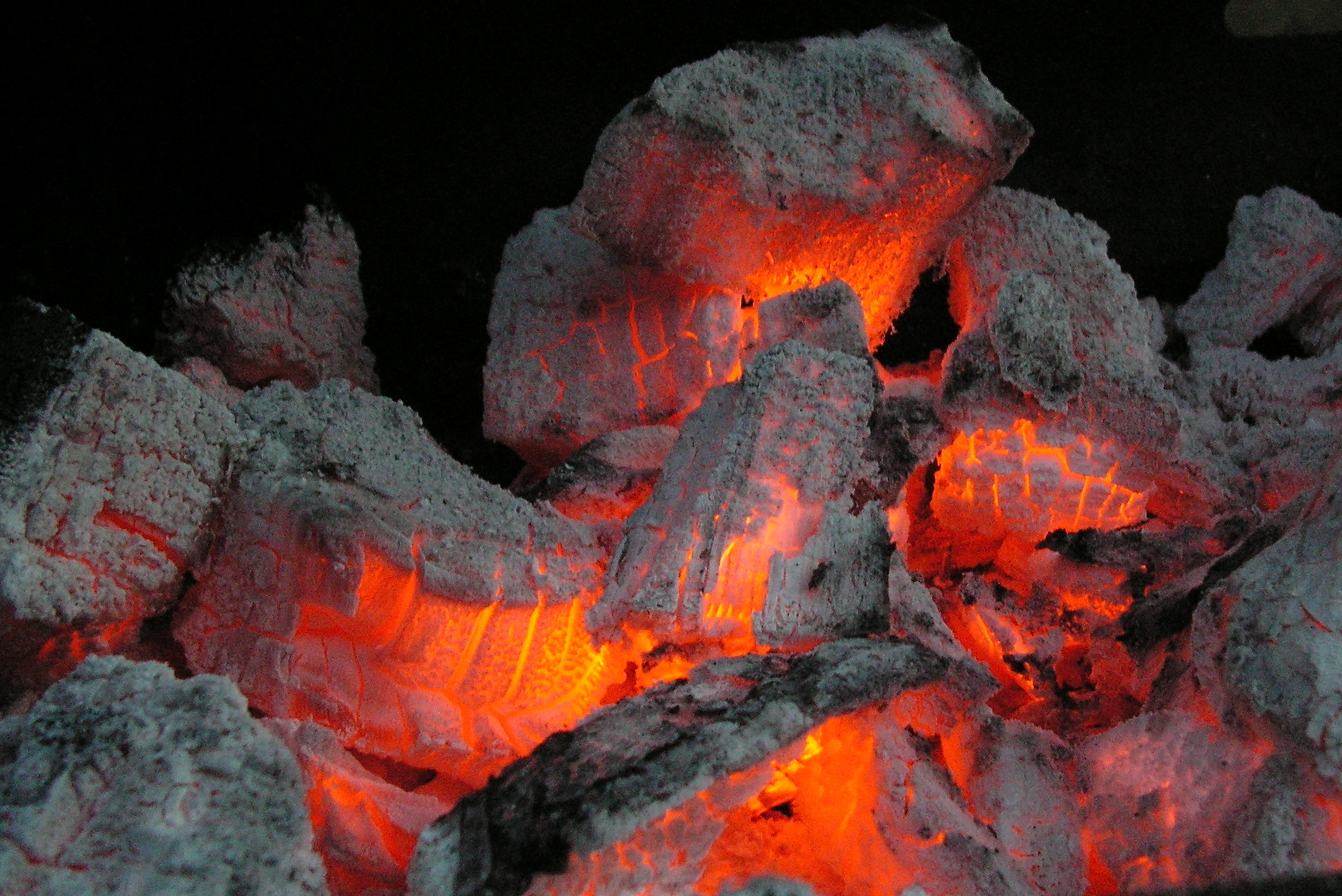
Fires conjure up an atmosphere of ‘togetherness’. Whether it’s making toast on the dying embers of an open fire, the noise and roar of bonfire night or the easy companionable conversations around a camp fire. 

The warmth is literal and relational. 

But there are times when sparks do fly: when we see things only in part against shadows and flickering flames; when the conversation gets heated, more volatile. It might be on a picket line or at a guarded gate that difference, suspicion, protest and disagreement converge. 


2.

Peter is caught up in such a scene of tension: of questioning both inside and outside the gate. 

It was cold. 

The slaves and police, both the men and the women, were warming themselves. 

The desire for warmth draws him out of the shadows; draws him into this unpredictable intimacy by the fire.

A woman catches his eye: are you one of this man’s disciples? Are you not?

I am not.

It’s cold. The question isn’t followed up. They’re too intent on keeping warm. Perhaps wondering what is being said in the court yard; waiting to hear a more intriguing line of questioning.

There in the cold - as they warm themselves - Peter stands together with them. He stands apart from his Lord and teacher. 

I am not.

3.

We cut away from the fire. 

Here Jesus faces  a different line of questioning: about his disciples, about his teaching.

Is it possible that Jesus has caught his eye; is Peter looking across the courtyard?

The one who said “I am”: I am the bread of life, the light of the world and the true vine has spoken openly.

The one who is the way, the truth and the life has said nothing in secret.  All his teaching is a matter of public record.

Ask them, says Jesus. Ask those who heard me.  Accusers and disciples are breathing the same air, sharing the same space.

There, standing in the courtyard, warming himself by the fire, is one who had followed. Peter had seen miracles performed; he’d heard the challenge and hope of the teaching; he’d witnessed the power of love to heal.

A split second after Jesus had spoken, one of the police struck him.
What flashed through Peter’s heart and mind?

Did he have a moment to take in what had happened? Did he gasp or look away?

Jesus mean while calls his accusers out on the injustice they perpetrate: they neither acknowledge what is right nor give evidence for what is wrong.

Accusers and disciple are silent. He’s led away. Bound.

4. 

And Peter stays at the fire, warming himself.

This time, it’s not one voice that asks; not just one finger pointing or one elbow nudging in curiosity.

Now they asked him. Are you not also one of his disciples? Are you? Are you? Are you not also?

I am not, he said. He denied it again.

His words eat away at relationship; they eat away at his identity. 

Something deep inside of him is burnt away. This is no longer a comfortable warmth, protecting against the cold.

As he warms himself, Peter confronts a painful and bitter truth.

Does the fire kindle disappointment or anger, despair or regret?

The questioning doesn’t stop: did I not see you? In the garden? With him?

Again Peter denies it. 

Having denied all that he had scene and heard, he now denies something of his own existence. I wasn’t there. I wasn’t seen at that scene. 

5.

And at that moment, the cock crowed.

He had been there. He denied it. And now he is seen again.

Is this fear?

He’d swung from bold declarations of allegiance to denial - furtive at first; but repeated, sucked into a narrative beyond him and within him.


6. 

And as the cock crowed, he finds that all he’s committed to has crumbled around him.

Peter confronts his own brokenness. 

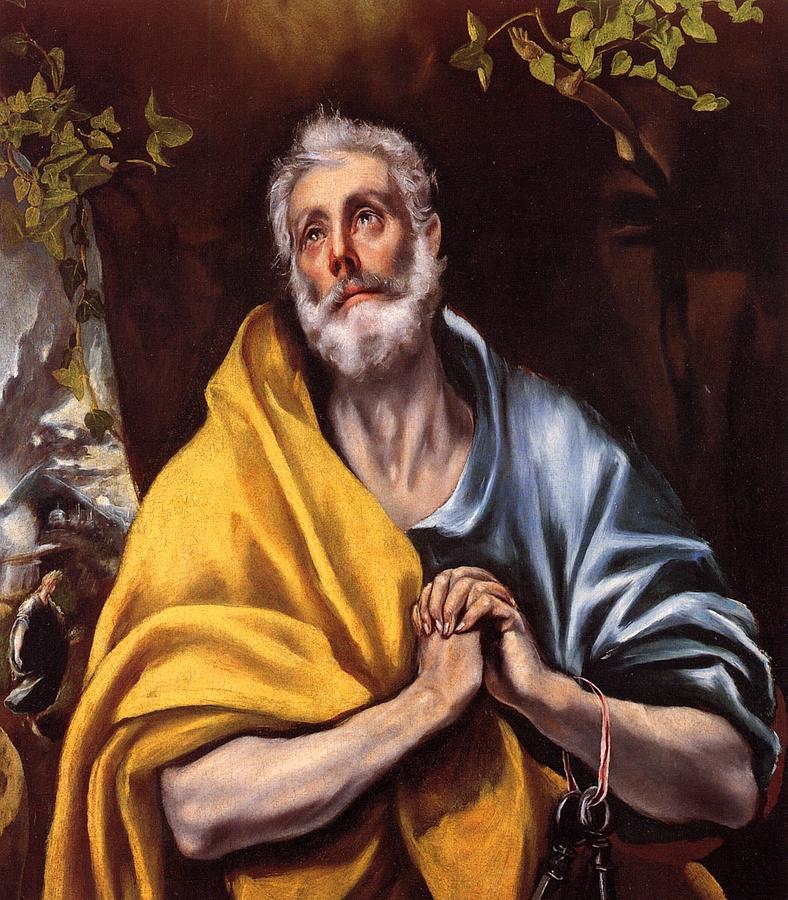
He had been seen in the garden and now sees himself not just in the dying embers of a charcoal fire, but in the breaking dawn.

It is a day that breaks on so many levels.  It reveals the brokenness of those who brutalise and condemn the one who’d restored Lazarus to life; it reveals the brokenness of Peter’s ideals and assertions.

7.

Peter is outside of what we might call his ‘echo chamber’: imprisoned by his own self-image, false idols and certainties.

This more than fear; more like a breakdown.

Yet even at this moment of self-condemnation, Jesus is walking alongside him.

He leads us beyond our false idols and certainties; he meets us in our times of denial and paralysing fear and disintegration. 

His love is utterly self-giving to the point of weakness and vulnerability: it reaches out to us in our hypocrisy and failure. In the midst of our desire for self-preservation, our resistance to change, our need to manage our image… the one who wears a crown of prayer and praise bears those things too.

8.

The one who is ‘all changing unchanging Ancient of days’ takes upon himself a crown not of our prayer and praise, but the crown of thorns.

The one who is God with us, takes on our loneliness and melancholy. 
This is no victor’s crown of leave which fade.
This crown of thorns is a crown of glory.

Our hands and our works are redeemed in him.

Can Peter’s heart and voice be lifted high? Can ours?

In the face of fire and cock-crow salvation is nigh.


© Julie Gittoes 2017