Showing posts with label follow me. Show all posts

Monday, 23 January 2023

Who do you follow?

 Epiphany 3: Isaiah 9:1-4, 1 Corinthians 1:10-18 and Matthew 4:12-23


Who or what do you follow? 


A particular team or band?  A TV series or hobby?A public figure or movement?


Social media relies on followers. Verified accounts and influencers develop a strong brand identity - content, stories, expertise, hashtags, paid partnerships, lifetyles, campaigns. Data and engagement become a form of currency.


Advert - see here

Who or what we follow is important: who we get behind or support, the direction we want to go in. To follow suit isn’t just to show interest or understanding, but to copy or obey. Those things shape us and our communities - for good or ill. 


As human beings get caught up in following and influencing, perhaps these questions from William Du Bois sharpen our minds:


How shall Integrity face Oppression?

What shall Honesty do in the face of Deception?

Decency in the face of Insult?

What shall Virtue do to meet Brute Force?


Du Bois was a sociologist, historian and economist who championed civil rights - the first African-American to earn a doctorate from Harvard. He acknowledged that there were many answers - but also that some met such questions hourly and daily, others once a year or decade.


Today, Jesus invites two sets of siblings to follow him: they let go of their nets and he draws their skills into a new purpose - one which lifts the yoke of burden and breaks the rod of oppression. For in him not only is a kingdom of justice and compassion announced, is embodied and comes near. 


Matthew tells us that Jesus withdrew when he heard of John’s death. In the land beyond Jordan, he walks the way of the sea, in Galilee of the nations.


Before he begins to teach, preach and heal, before he calls disciples to follow, he fulfils the hope of Isaiah. The hope of a light that enlightens, a joy that multiples, a hope that nations and people will be set free.


Isaiah spoke in the face of oppression and exile; now that promise of God’s reign of justice and peace draws near in Jesus, God with us.


He takes up John the Baptist’s call to repentance - a radical change of life and direction that many long for. It is a call which invites us to follow suit - to get behind a movement from anguish to rejoicing. It’s a way which holds onto integrity and virtue, honesty and decency, which refuses to return force or insults with blows.  


The choice faced by Simon, Andrew, James and John is disruptive: and yet they risk the accusation of being irresponsible, foolish or impulsive by responding immediately. There’s no check list of pros or cons, no cost-benefit analysis. 
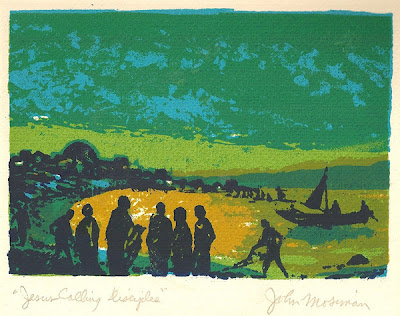


John Mosiman - see here

At that moment, they put something before family and work. They are invited into a new community - all their relationships and obligations are rooted in this deeper peace. 


Others, like them, will also respond to Jesus: touching his garment, kneeling at his feet, asking him questions, sharing broken bread. The wealthy and exploited, the enemy and the outcast, the leaders and the exhausted. Some turn away sad because to follow is too costly; others draw near, giving what they have, because here is life and love.


Jesus invites with power and with compassion. He sees us as we are and knows how to use our gifts. Those who mended and casted nets had a depth of patience, resilience and experience - now he wants to make them fish for people. 


He takes their awareness of their physical limits, their knowledge of water and weather, their attention and their dedication and he says I will make you. I will nurture and challenge, teach and perfect so that you will be who God created you to be. 


They, like us, are invited to bring their whole selves to this way of life. To follow and allow God to work with the stuff of our lives - our skills, experience, learning and memories; the anguish and the hope, the loves and dreams.


The writer Barbara Brown Taylor calls this moment a miracle story because although we might waver or hesitate, it is Jesus who makes the following possible. The God who calls us helps us to follow. In Jesus, God is capturing our imaginations as the hungry are fed, the powerful challenged, the excluded are embraced, the elderly are valued, the young raised up.


This is good news for all: whatever our age or mobility, gender or sexuality, race or occupation. 


It is good news which will make and remake us: there will be cost and blessing, surrender and risk. For this is the way of love which goes to the margins and changes the centre.


The call to us as we follow is what one commentator called a ‘social generosity’. It is a change of direction - transformed thoughts, seeking a different way: doing justice and loving kindness; seeing the fruit of power in generosity, dignity and equity; shaping a common life which rejects hate and division.


Such a way nurtures our integrity, decency, honesty and virtue through the dazzling brightness of God’s light and love. 


It is a dazzling brightness of light and love which confronts oppression, deception, insult and brute force as Jesus bears the weight of that human ill on the cross; and breaks the yoke of its power in resurrection. 


Such a way is what Paul is calling the Corinthians back to: they had allowed arguments and tribal loyalty to divide the body.  He reminds them that the foolishness of the cross stands before our eyes - as God’s love breaks the yoke of oppression.   


We are invited to follow Christ every time we take bread and receive blessing. Those are urgent moments of epiphany and decision - we see who Jesus is. 


That should be good news for every Londoner: love and grace which includes. By the power of the Spirit, may we respond to the light of God’s love and shine with the radiance of Christ day by day - in every act of loving care and resistance.


© Julie Gittoes 2023


Sunday, 3 September 2017

Follow me!

This is the text of a sermon preached at Guildford Cathedral Eucharist - 3rd September. Having confessed to my shame of Tolkein being amongst my  'great unread', I rather enjoyed entering into that world (albeit briefly and hopefully not for the final time) when I was visiting friends last week. I couldn't help by engage with some of the resonances between the themes of the readings  [Jeremiah 15:15-21; Romans 12:9-21; Matthew 16:21-27] and the Middle Earth epic.


In a hole in the ground there lived a hobbit. 

For those familiar with J.R.R. Tolkien’s novel, you’ll recall the description of Bilbo Baggins world: Not a nasty, dirty, wet hole, filled with the ends of worms and an oozy smell, nor yet a dry, bare, sandy hole with nothing in it to sit down on or to eat: it was a hobbit-hole, and that means comfort.

For some reason, for a child who loved books, I wasn’t captivated by this world and the adventures about to unfold. As an adult, I remain embarrassed by this confession of the ‘great unread’; a shame which is intensified as the movie franchise also passed me by. 

Until, that is, last week.


The Battle of the Five Armies is the third and final instalment in Peter Jackson’s three-part film adaption based on J. R. R. Tolkien’s The Hobbit. Replete with dragons, orcs, elves and mystical rings, this version of Middle Earth has been described as a ‘colossal technical achievement’; as well as a ‘magnificent,Wagnerian-style finale, full of sound and fury, and with an unexpected emotional kick’.

The visual extravaganza improvises on Tolkein’s text and draws us into a world closer to our own than we might imagine: warring factions and refugees seeking safety; courageous leaders and sacrificial love. 

In Thorin, the leader of the Dwarves, we see someone who is paralysed by despair and paranoia;  by anger at broken promises and an obsession with false idols. Shut away in Lonely Mountain, he places his trust in riches of ‘dragons gold’. 

And yet, as crisis looms he addresses his company saying: I have no right to ask this of any of you… but will you follow me … one last time?

Thorin faces past mistakes and steps up to lead his people, galvanising them in service of their kingdom. We see glimpses of tenacity, humility, loyalty, determination, trust and hope; none of those come without cost.

Follow me!

Today, the Scriptures, which shaped Tolkein too, invite us to face the demands of walking in God’s ways. We hear in Jeremiah something of Thorin’s despair; we hear on the lips of Peter misunderstanding; Jesus’ rebuke re-focuses our life; in Paul’s we confront the practical implications of genuine love. 

Jeremiah is facing disappointment and disaster. He had received God’s word with delight. He hadn’t needed to seek out human merrymaking because he rejoiced in the one who called him by name. Now he faces rejection and persecution; he's wounded and feels deceived by God. He shuns his ‘first love’.


Jeremiah Lamenting: Rembrant 

At this low point of introspection and bitterness, God draws near to him. There he is recalled. 

My word is precious, declare it! I am with you, they people will turn to you! Follow me!

The demands of this calling lie at the heart of the Gospel.

Last week, we were left with a cliff hanger: Peter declared that Jesus is the Messiah and the disciples were instructed not to tell anyone. And now we see why.

Jesus wanted to teach them what being Messiah meant: he wasn’t, as many expected, a triumphant figure, claiming his Kingdom with power and might. Instead glory and victory followed suffering.  In him, God’s love reached out to the depths of agony and isolation, suffering and even death; the victory of that  love would be revealed in resurrection. 

This isn’t the ending Peter expected. He rebukes the one who had rebuked the waves and calmed the storm. Jesus own words of rebuke are harsh; but perhaps that’s the point. He’s jolting Peter - and us - out of our collusion with a human perspective. 

Peter’s vision is shaped by the world’s understanding of power. Jesus is revealing the nature of God’s love, made perfect in the form of a servant. He is also giving a pattern for us to follow.  God’s love can be seen in our humanity; in our weakness not strength; in the face of threats not just opportunities. 


Follow me: obedience to that call involves taking up the cross. It means laying aside all that the world counts as ‘successful’; no longer striving to possess, consume, control or judge.

Our attempts to ‘save our life’ amount to being selfish: preserving our interests and indulgences; placing ourselves at the centre of the world. We could so easily rattle off a list of the petty, seemingly insignificant, moments when we know we’ve nudged what we want to the centre. The fruit of our selfishness might be impatience, greed, jealousy anger, quarrels or indifference.

Instead, losing our lives for the sake of Jesus begins by placing him at the heart of everything - of our lives, our work, our ministry, our friendships, of this cathedral. His love becomes our centre of gravity, pulling us closer. 

In a broken and complex world, loving faithfully, deeply and patiently is very hard indeed. But if we are precious in God’s sight, so is our neighbour - the one we find difficult, who isn’t like us, who is hostile to us. 

At the heart of the Battle of the Five Armies, we grapple with loving our enemy. When the Elf Thranduil turns away from the Dwarves, Tauriel rebukes him saying:  You think your life is worth more than theirs, when there is no love in it? There is no  love in you! At that moment, she takes her personal love of Kili and translates it to love for a people. 

Love that is selflessness makes us more human; and in that fullness we see the love of God with us.  To learn this love we have to follow Jesus; and in following we find life. And in following, God’s kingdom is glimpsed here.

Like Peter and Jeremiah before him, we find ourselves to be transformed. Paul explores what that looks like.  Having described the way in which we are united in Christ, and co-dependent on one another, he says ‘let love be genuine’.  

That is the acid test of our life and ministry in this cathedral - is love being made real amongst us?

Holding fast to the goodness of God’s love s an expression of corporate love which overflows in sincere hospitality to the stranger mutual affection. 


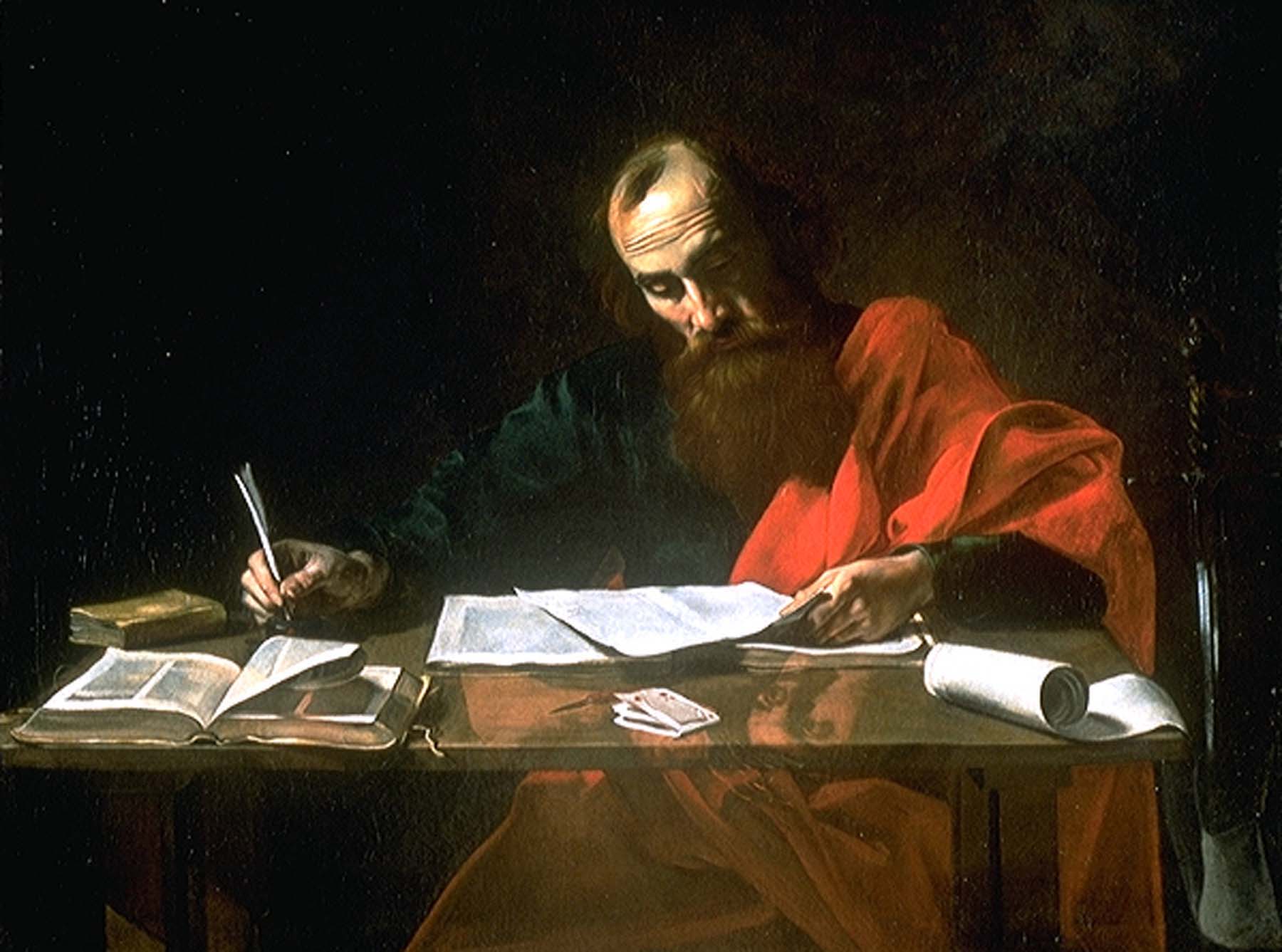
St Paul Writing his Epistles: Valentin de Boulogne 

This love is generous and good; leading to flourishing of the other; this love does not collude with abuse or hurt. Paul recognised the evangelistic impact of our character - of goodness, patience, kindness, self-control and joy.

The language that Paul uses is powerful and dynamic: be eager, earnest, diligent and zealous. There is no drudgery in this vision of life together - rather it is vibrant and animated by the Spirit. Paul’s language also calls us to perseverance - being aware of Christ moment by moment.

In this Eucharist, we like Jeremiah taste the sweetness of God’s word; like Peter we find challenge and forgiveness as we follow Christ; and in the power of the Spirit, the fire of God’s love is re-kindled in us. 

Like Bilbo Baggins, we’re called out of the comfort of our home. In fondness, Gandalf says he’s quite a little fellow in a wide world after all!  Sometimes we too might feel quite little; yet we like Bilbo have potential of learn, love and grow; let’s not underestimate the impact as we are sent as as the body of Christ; walking as a movement of love in the wide world.  

© Julie Gittoes 2017