Showing posts with label Ascension. Show all posts

Saturday, 15 May 2021

A new space

 The text of a sermon preached at St Paul's on Ascension Day. 

The texts were Acts 1:1-11 and Luke 24:44-end


Line of Duty: BBC


Ten days ago, after six seasons, we reached the finale of BBC’s crime drama, Line of Duty.


For years, we’ve been drawn into the quest to find out who “H” is; and the mission to catch bent coppers.


Within minutes of the ending, Twitter was awash with disappointment: was that it? 


There were no dramatic escapes; no last minute heroism; no uncovering of a criminal mastermind; no final and glorious triumph for Ted Hastings and AC-12.


Instead we discover something far more discomforting: we discover the corrosive impact of human greed and incompetence; we see the very human flaws from ambition to collusion, the small incremental actions, or inactions, that creep into any institution. The things we call, in shorthand, sin.


Not everyone found this ending unsatisfactory. 


Why? Well, because perhaps this ending demands something of us: the work of justice and the pursuit of truth, the labour towards what is good is left in the hands of fallible human beings.


Those who work patiently at the detail; those who don’t seek the limelight; those who seek to shine light on every situation and uncover abuses of power; those who persevere despite the setbacks and who are determined to take a second chance; those who nurture friendships with trust, challenge and integrity. There's glimpse of grace and redemption in that. 


We see that in the lives of some of the characters: those who find a safe space where they can build a new life; those who seek support in order to find the courage to carry on; those, like Ted, who both speaks boldly of truth and also confesses his own shortcomings - as he hopes to pass on the baton of honesty.


Perhaps rather than being an ending, the Line of Duty’s finale is inviting us into a new space. A space where effort is required on our part. 


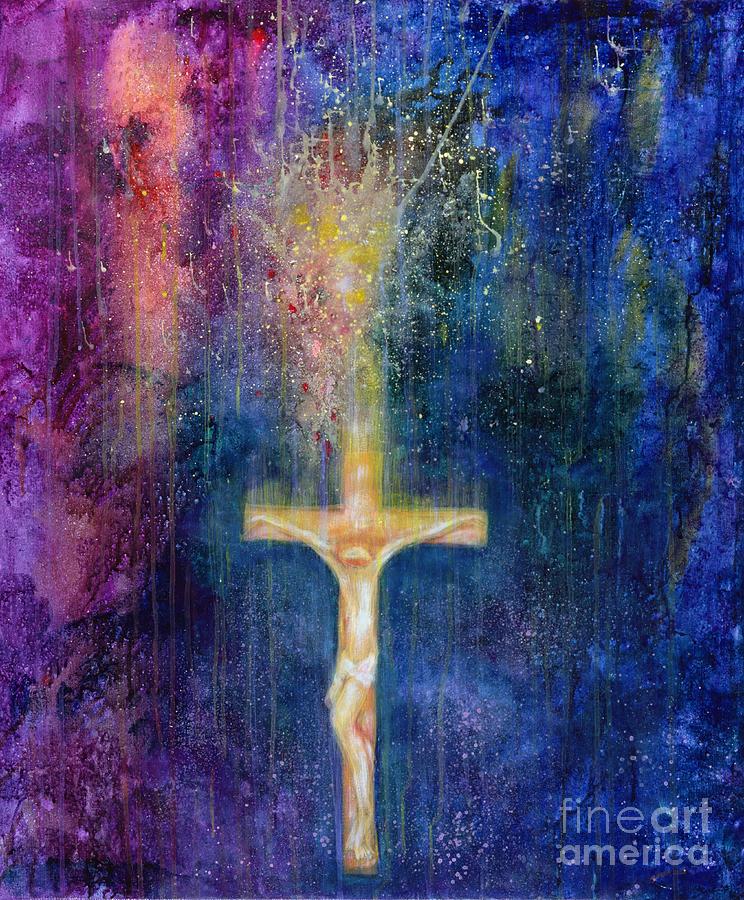
The Ascension: Frederick J Brown


In a way, the words we hear from Luke this evening do the same. In the Gospel bearing his name and in his continued witness in the Acts of the Apostles, he invites us not to dwell on an ending, but to step into a new space. 


A space where we tell the stories of Jesus; where we worship with joy; where we ask questions about God’s Kingdom. A space where we dare to imagine a new future; where we’re honest about the dangers of worldly power; where we seek to build one another up.


A space where we stop gazing upwards and instead open ourselves to the power of the Spirit.


Jesus has been clear in his teaching and his parting conversations, in his prayers and resurrection encounters that he must depart - in order that the disciples might be open to the action of the Spirit. We are invited into that same space that we might be led to new life. 


This life is a labour of seeking and witnessing to God’s Kingdom: inhabiting and nurturing values and practices that are Spirit led; to ways of life that subvert misuse of power and instead enable a labour of love. 


The writer Willie Jennings calls this a ‘revolution’. He calls it a ‘beginning without an end insight’; he describes this as a story of ‘stunning newness’ told by Luke. It is a newness that ‘begins with Jesus. Not an idea, not a principles, not even a memory, but an impossible reality, flesh and blood on the other side of death standing in front of the disciples, alive and well’.


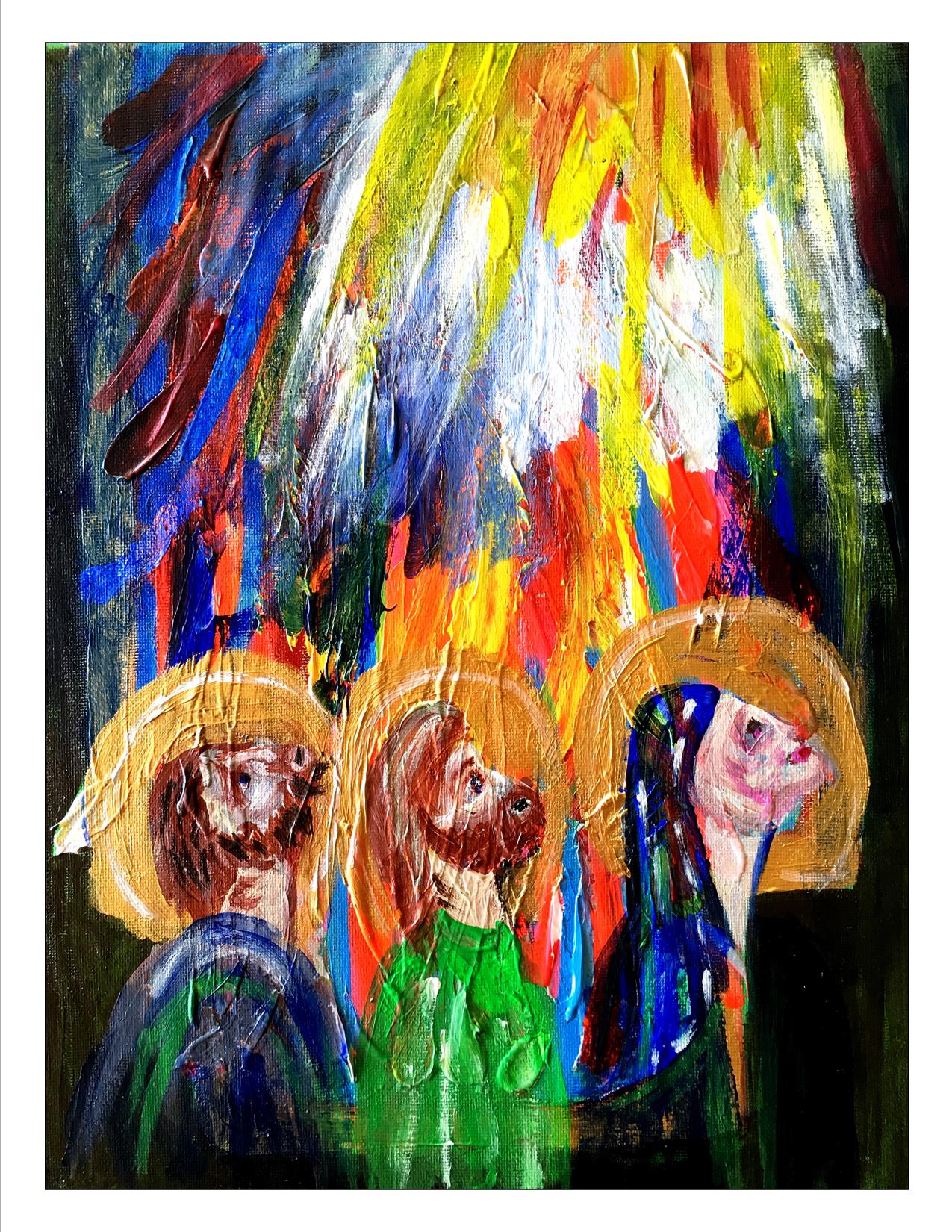
Ascension: Michael Mize


The good news is that this word of life is something we are called to perform, through the power of the Spirit. 


This Ascension Day, speaks of the reign of God - a reign begun in Jesus’ risen and ascended body. He has made possible a new way of speaking about God and about what it is to be human. This new way of faith and hope of love is birthed in us, in our bodies. Bodies that are one in Christ’s body. 


Just as Jesus gave himself in flesh of our flesh, so we, are to give of ourselves. 


We are entering a season, post lockdown and restrictions, were we are beginning again to imagine what it is to be in proximity to others; to draw near to others. 


We know that touch can be a blessing of healing and love and comfort; we also know all too well the ways in which touch can be exploited, distorted and abused. 


And yet, we as the church, are invited to embrace and reach out with a new order of things: it begins in the space - the space where we touch and taste the holy fragility of Christ’s body in broken bread. 


Jesus took break and promised to be with us; we take Jesus in to our hands, and are invited to embrace this new life. 


Ascension Day is not an ending. 


We are not left gazing upwards - with disappointment saying, ‘was that it?’


The Ascension: Peter Rogers


Instead we are invited to wait in a new space: a sort of holding place, waiting for the Spirit.


Waiting in the assurance that we will be changed, strengthen and emboldened. 


We wait in joy and in prayerfulness - attending to God and to the cries of God’s world.


We wait acknowledging our wounds and vulnerabilities, our power and our privilege; we name our hopes and let go our our fantasies.


Today we wait, expectantly.


We pray, hopefully.


Today we make space, in trust. 


We recommit to this labour of love.


Patiently: embracing second chances.


Honestly: creating safe spaces.


This is the hope of the revolution, the newness and the beginning: the Spirit’s work of healing. Amen.


© Julie Gittoes 2021


Sunday, 24 May 2020

I say a little prayer for you

The text of two reflections shared at our online worship via zoom.


Reflection One
The moment I wake up
Before I put on my makeup
I say a little prayer for you.
The words of Aretha Franklin’s song resonate; because in one way prayer is the most natural instinct when we love another person. When we care about our communities; when we hear the cries of the world. The moment we wake up - before we put on our makeup or get dressed - we say a little prayer.
At a human level, Aretha’s words are full of longing: she expresses the intimacy of the one she loves having a place in her heart; the sense that love transcends space and time; and the honesty that separation brings heartache. 
Prayer is something we are exploring and making our own in familiar and perhaps new ways in this lockdown. Finding habits, places and words to say a little prayer. 
Prayer is holding all our love; and abiding in love.
It’s a way of being that is honest, tender, hesitant, raw.
Prayer is an act of resistance: lament, praise, protest, gratitude.
It comes from our heart and changes our hearts.

And today we hear Jesus praying. Praying for those he loves. Praying to his Father. Praying with the disciples. 
Jesus had washed their feet and shared a meal; he had encouraged them to believe and to trust; he’d promised them an advocate and guide and counsellor, the Spirit who’d lead them in truth and send them out as witnesses. He invites them to abide in love, just as he abides in his Father’s love.  
He prays for them - they are drawn into the intimacy he shares with his Father. 
Forever and ever, you’ll stay in my heart
And I will love you.
Perhaps the disciples hold in their hearts the hope that they’d never part; echoing Franklin’s little prayer, that:
To live without you
Would only mean heartache for me.

Ascension - Laila Shawa
With the lives of his disciples on his mind, Jesus also prays for himself.
He speaks of glory and life. He asks the Father to glorify him; using his death to give eternal life. 
This glory reveals the depths of God’s love for the world; this glory reveals the cost of love that reaches out, arms outstretched on the cross, to draw us back to Godself.
This glory is revealed in a love that overcomes death to restore life. Life that is full of mercy and forgiveness and compassion. 
And this is eternal life, abundant and full: it is to know God.
It is to come near; to rest in the intimacy and wonder of that; to know the joy of being belovéd and precious. 
This life: to know that whatever our flaws and frailties, dreams and desires we are held in love. As we breath, God says:
Forever and ever, you’ll stay in my heart
And I will love you.
What must it have felt like to have overheard those words; to be prayed for with such tenderness and concern.
To be prayed for isn’t to be talked about: it is to be known, taken seriously and held. To be known in love; to be heard in life; to be held in trust. 
Would the disciples have remembered this prayer as Jesus’ body - marked by wounds and glorious is life - now ascends to heaven? 
Did they remember in their anguish at death and joy at new life, that Jesus prayed for them: that he gave thanks that they had received him - his name, his life, his love and his work?
As they looked up, with questions on their lips, did they remember that Jesus prayed for them: for their joy and their unity?
As they ask: is this the time when you will restore the kingdom to Israel? Do they remember that Jesus is honest about the opposition they’ll face; that he prays too for those who will come to believe through their words and deeds?
At this moment of parting, do they remember that Jesus in his prayer for them promised the Holy Spirit - the comforter, advocate and guide? 
For now Jesus is no longer in the world, he promises that this prayer will be fulfilled. The power of the Spirit will be at work in them - breath by breath - as they witness to the fire of his transforming love.
For the love in which they abide; the love in which we rest; is a love that heals and transforms.
They stand -watching, gazing and looking up. 
They are consumed by the spectacle - yet watching undermines the possibility of continuing the journey. At this moment of loss they are invited to go forward in faith.
This moment of Jesus’ departure marks a moment of transition; of waiting; of preparation and of prayer. 
For a new order is about to begin. Our humanity abides with Jesus and the power of his Spirit abides with us: and we wait for it; we wait for it in prayer. For it is that Spirit that will enable us to speak and act for the kingdom Jesus brings. 
It is is a kingdom of new life and hope; it is rooted in what they remember and comes into being through their witness. 
But for now they are to devote themselves to prayer.
The moment they get up and return, they say a little prayer:
Forever and ever, you’ll stay in my heart
And I will love you.

Reflection Two
Pray: It’s an interesting group; this gathering of those called upon to pray, as Jesus did.
There are the disciples who’d walked the land with Jesus; some of the women who’d watched at waited, last at the cross and first at the tomb. Mary is there - with her other children. 
Perhaps she is remembering that time of waiting in hope and prayer when, overshadowed by the Spirit, she said yes to being the God-bearer.
And now she prays with those who’d followed the one she’d carried in her womb: as now they prepare for an unknown future.
They wait and pray in a particular place: like us, shut in; like us, confined to world that is smaller or more limited; like us, they see around them life that is fragile and wounded.
But it is from this particular place that they will be sent out into the world. We like them are invite to wait and pray.
We pray: come down, O love divine: kindling in our hearts thy holy flame; come love divine, illumine our path; come, Holy Spirit, dwell within us.
In this prayer, each creature will be claimed as a site of love divine.
The American theologian Willie Jennings, calls this: the revolution of the intimate.
If our heart is warmed by this Spirit, then it is a spark that lights hundreds of fires.
Fires of prayer in our own homes, where we are equipped and inspired for the tasks entrusted to us; where we seek to reflect the character and values of patience, kindness,  justice; of self-control, joy and hope.
Fires of public worship and witness: finding ways of gathering online, sharing hope on social media; looking at how our churches can be once again places of safety and sanctuary.  
Fires of social transformation as we engage with vision and imagination in bringing people out of poverty; seeking a system of education and justice that works for all irrespective of race or gender or age or class; a cultural life that inspires and binds together; ensuring that there is dignity for those in frontline services, and those who depend on them.


Women Kneeling in Prayer - George Henry Broughton
To pray, like the disciples, that we might be open to the Spirit is discomforting and transformative. This vision is part of the witness we share with the apostles. 
The Cuban-American theologian Justo González writes that the Book of Acts is: a call to Christians to be open to the action of the Spirit, not only leading them to confront failures and practices in society that may need to be subverted, put perhaps even leading them to subvert or question practices and values within the Church itself.
We only need to glance at news paper headlines to see how urgently need to confront such failures and practices; subverting selfish exceptionalism and seeking the common good. 
As we pray, we make way for the Holy Spirit to touch human flesh and create in us new hearts; new hearts committee to a transformed world. 
I pray, as we learn to pray with and for each other, alone and together, that we will discern how we serve Hendon in the months and years ahead. That each of us will know the task entrusted to us - using our skills and our work, leading us perhaps to do a new thing that we didn’t dare imagine.
As we pray, with clasped hands we are united with Christ - we abide with God - as the Spirit allows us to become fully ourselves. This is life. George Herbert - poem.
Ever thine: Aretha sang about her human love: 
The moment I wake up
Before I put on my makeup
I say a little prayer for you.
Beethoven, centuries earlier, expresses a similarly intense and devoted to love to an unknown woman. Mourning her loss and longing of a life together.  
And perhaps it those words of a faithful, loving and restless human heart that become the grounds of our deepest and most heartfelt prayer. For in the power of the Spirit, we can pray: Ever thine. Ever mine. Ever us.

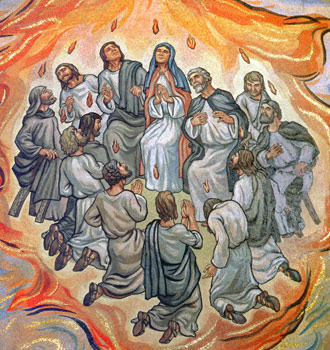
An artist's depiction of a scene from the Pentecost appears in the Cathedral Basilica of St. Louis in the city of St. Louis
Let us devote ourselves to prayer; let us discern the tasks to which we are called. Let us be open to the action of the Spirit; confronting failures and kindling fires of change.
Forever and ever, you’ll stay in my heart
And I will love you.

© Julie Gittoes 2020

Tuesday, 15 May 2018

Sing praise!

Having enjoyed singing 'alleluias' from the tower of Guildford Cathedral at midday, this is the text of a sermon preached at the Ascension Day Eucharist: the texts were Daniel 7:9-14, Acts 1:1-11, Luke 24:44-53
and the anthem 'God is gone up' (Finzi).


The view from the the top of the tower!

God is gone up with a triumphant shout:
The Lord with sounding trumpets’ melodies:
Sing praise, sing praise, sing praise, sing praises out.

In a little while we will hear Finzi’s sitting of those awesome words (here sung by Wells Cathedral Choir)

From the organ’s dramatic fanfare, this anthem is thrilling in its magnificence: songs of praise resound, echoing the trumpets’ melody.  With every breath they take, our choir sing praises out. 

We hear these heart-cramping notes which echo heavens rapturous melody.  Sing praise. 

Their words blend with the organ’s voice more to enravish, as they this tune sing. Sing praises out.

Sing praise.
God is gone up with a triumphant shout. 
Sing praises out.

Finzi holds us in the intensity of rapturous praise as our lips acknowledge God’s glory. He calls us back to song.

But Edward Taylor, the poet who wrote the text, invites to stand alongside the disciples; to ponder another question. The question which was perhaps on their minds as they stood gazing upwards:

Art thou ascended up on high, my Lord,
And must I be without thee here below?

But the point of today’s celebration is that we are not left without: as our risen Lord ascends to the heaven in order that we might be united with him always.

Over the last forty days, we have recalled the resurrection appearances: moments when Jesus was in a particular place, with some of his followers for a finite period of time.  As Luke records, Jesus had opened their minds to understand the scriptures.

This is reality: The one who suffered and rose from the dead has power over death itself.  He has called disciples by name, broken bread with them, invited their touch, spoken words of peace and blessing.  

And now, as they were watching he is lifted up; hidden from their sight. 

How great the temptation to stand looking up; to see this spectacular moment as an ending or as a loss.
Rather it is both the fulfilment and expansion of love.


The one who this day ascends to heaven, is Lord of time and space.  In the words of Daniel - to him is given dominion, glory and kingship.  

This heavenly reign reveals scope of God’s love across all dimensions of the cosmos: it doesn’t undermine our agency as human creatures; but it does relativise the exercise of our freedom and authority.  

Our creaturely vulnerability and competitiveness is drawn into a new reality:  an expanding circle of blessing of merciful judgement and reconciling love. 

Our risen and ascended is Lord is now present to all people, in all places, forever.

Today, we assured that Jesus will pray for us at the right hand of God. We also receive a promise. Jesus promised his disciples that the power of God will be poured out on them through the Spirit. 

They and we, are called to be witnesses: they will tell the story of this man Jesus, the one who is flesh of our flesh; they will tell the story of this man Jesus, the one in whom the fullness of God is pleased to dwell.

They and we, are witnesses to one who revealed love divine from birth to life; from life to death; from death to risen life.   And now as we rejoice in Jesus journey heavenwards, we like those first disciples are sent to the ends of the earth. 

As the one theologian and preacher, Willie Jennings, puts it: Jesus ascends not only to establish presence through absence, but he also draws his body into the real journeys of his disciples into the world. He goes to heaven ahead of us. He goes with and ahead of his disciples into the real places of this world.

The span of our journeys will vary. From our homes we are sent out into real places, places that are particular to us: to the places of work and service, of tribulation and rejoicing; of struggle and refreshment; of waiting and praying; of family and stranger; of excitement and loss. 


We are sent to places we do not expect and perhaps cannot imagine; sent even those places where we fear to tread.  And there we are to witness, bless and sing praises; sing praises out.

Finzi captures the lyricism of Taylor’s devotional poem - fusing words and music into a compelling glimpse of heaven. But the decision to set it as our communion motet roots that vision the most ordinary and intimate of all the real places in this world: in food and fellowship.

For here in bread and wine Jesus gives himself to us. The king of glory enters in. Our risen and ascended Lord makes our bodies the site of his visitation. We become what we touch and taste and see: the body of Christ.  

Today we begin ten days of waiting - a novena of prayer before Pentecost. Let us pray for the Spirit to renew, refresh, empower and equip us that we might witness to God’s love on real journeys and real places.

God is gone up with a triumphant shout:
The Lord with sounding trumpets’ melodies:
Sing praise, sing praise, sing praise, sing praises out.

Alleluia!


© Julie Gittoes 2018