Showing posts with label John the Baptist. Show all posts

Sunday, 22 December 2024

We need joy as we need air

 15 December - Advent 3: Zephaniah 3:14-end, Philippians 4:4-7 and Luke 3:7-18


Today is what’s known as Gaudete Sunday:  a day when we are commanded to rejoice.


It’s why we light a rose-pink candle. It signals a joyous note amidst the purple of penitence and preparation. 


Gaudete in Domino semper: rejoice in the Lord always.


The prophet Zephaniah speaks of singing, shouting, exulting and rejoicing with all our heart and voice.


That might sound a bit bullish when we’re exhausted or fearful; when we’re grieving or just getting by; when our hearts break.


John the Baptist - Jacopo del Casentino


Maya Angelou wrote that: ‘we need joy as we need air. We need love as we need water. We need each other as we need the earth we share.’


Like Zephaniah and Paul, Angelou doesn’t write this out of comfort but from a place of struggle, protest and advocacy. 


They are all aware of the personal burdens and community challenges - and yet glimpse and cling onto something more.


Joy isn’t something that simply happens. It’s not the pursuit of things we think might make us happy, for a while.


We have to choose it. Or notice it. And keep choosing it. And noticing it. 


Without it we can’t breathe. Just as without love, we thirst. 


Even when those #TinyJoys are like whispers not shouts; like breath before the song.


For Zephaniah, joy comes when justice is restored.


Despite the prophet calling out people’s neglect of the commandments of God, and in the face of the trauma of exile,  the presence of God brings new life, a new future. 


Instead of judgement there is overwhelming mercy. 


God comes to us, is in the midst of us: with love. 


This is a cause of celebration - of singing and shouting.


In the face of hurt and fear there is breath and joy. 


In the face of fragmentation and alienation flow the waters of justice and love that renews.


Relationships change - people are gathered up and brought home, healed and stretched, given a future. 


There is justice in place of fear - life together in a different register: as Angelou puts it, ‘we need each other as we need the earth we share.’


Such shouts of joy stand in stark contrast to the words on John the Baptist’s lips: ‘you brood of vipers!’


They are words of judgement: harsh, shocking, blunt. 


He calls us to turn back to God’s love, to repent.


They are words which call forth change and action: to show in our lives the fruit of such repentance, of returning to love. We need such love as we need water. 


The question on the lips of the crowd makes sense: what then should we do?


How are we to live? 


If we turn towards God’s love, if we repent, how then should we live?


In the face of a changing world and when love changes us, how should we act? 


From the wilderness, a voice calls us to us. It calls us home. 


Home to God. Home to ourselves. Home to the places where we live and worship and work. 

We need each other. We are to show love and joy in those familiar places. 


It is in the ordinary habits and patterns  of our lives, that God is near to us. It is in the routine and mundane that we can make a difference. 


Two coats? Give one away.


More food than we need? Share it with others.


We can be generous now. We can be compassionate now. 


We are invited to live our lives. Now. 


John goes on to offer specific advice - to tax collectors, soldiers and religious leaders.


Don’t take more than is owed in tax; don’t use force or threats to supplement wages; don’t be arrogant because of your role or position.  


Perhaps this is what repentance looks like: generosity, justice and contentment. It’s a practical expression of our faith.


The message to the crowd that we all have gifts - gifts more than what we own, but in who we are. 


There is joy and love in this: needs met by human lives. 


This is good news. This is a cause to rejoice, to shout and sing.


All that we have and all that we are is loved and capable of showing love. 


John ends with words that the Messiah will baptise with the Holy Spirit and with fire. 


It’s another stark image. An ear of corn is made up of both the kernel of wheat and the husk of chaff. What is capable of being ground into flour to make life giving bread is gathered up; the husk is inedible, it’s burnt up. 


John and Jesus are dividing human beings against each other - they are reminding us that when we come before the fiery radiance of love. Then the one who knows all the secrets of our hearts will gather us home; and gather up the rich harvests of our attempts to love. 


We are seen and known. Going through a baptism that cleanses, forgives and restores. 


Judgement is good news; it’s an act of love and source of joy. It speaks of right perception and being seen. It speaks of holding on to what is good; of letting go of defences, fears, hurts, failings. 


Joy comes from this honest place of setting aside painful truths - and allowing ourselves to be embraced by love (rather than turning away). 


It’s out of this hope that Paul writes. God is near to us - set aside worries. God is near - be gentle, to others and yourself. God is near to us - pray, give thanks. God is near - rejoice. 


Here we take the fruits of the harvest - the bread from milled grain, the wine from the crushed grape. They become for us food for the journey; drawing us into communion, community. A joyful feast, a love that meets us where we are and helps us bear fruit. 


‘We need joy as we need air. We need love as we need water. We need each other as we need the earth we share.’


© Julie Gittoes 2025


Saturday, 14 December 2024

Location, location, location

 8th December, Advent 2: Malachi 3:1-4, Phhilippians 1:3-11 and Luke 3:1-6


‘Location, Location, Location’. 


Kirsty Allsopp and Phil Spencer are casting for the 25th anniversary series of Channel 4’s primetime property show. 


You know the format: a couple wants to move to a particular area - with a list of requirements (sometimes quite niche) plus a budget (often unrealistic). It’s usually a circle that’s impossible to square without some compromise. 


Location matters to human beings: proximity to friends, family or work; the places we come from or those where we make our home; the kind of lives we live or dreams we have; needs versus ideals, and compromises along the way. 


Location also carries with it ideas of convenience or value; qualities or status; the postcodes regarded as premium and those which raise an eyebrow. 


Today’s readings are all about location, location, location. 


Luke’s words convey a very specific sense of place: in a few lines he gives us a sense of the geopolitical and religious landscape of his day; he locates power in people, roles and places, 


Emperors, governors, rulers and high-priests are all named. But the word of God isn’t being heard in those places of status, influence, wealth or control. 


The hearing of God’s word is located elsewhere: in the remoteness of wilderness, on the margins rather than at the centre. 


It’s quite the juxtaposition: as if Phil and Kirsty had offered the woman looking for a modern city centre flat a remote ancient cottage. 


Wildernesses can be risky places - no safety nets or creature comforts. It’s a place where illusions are shattered, vulnerabilities exposed and priorities re-ordered. 


Perhaps the wilderness also brings a level of release or relief: away from competing demands we can perceive things more clearly; we retreat from pressures in order to return refreshed, renewed. 


In today’s passage, it's in the wilderness that the word of God comes. In the messy and sometimes harsh realities of the world as it is, a message of hope and healing is heard. 


The wilderness is a place of watching and waiting upon God, yes. It is also a place where God calls us to a new place, to be relocated. 


It’s John’s role to locate us. To draw us into an inward movement. His words about repentance - metanoia, turning around. He brings us to the heart of things - and to find there forgiveness, grace and mercy.


He helps us to see the whole landscape: of ourselves and our world. He helps us to see the points of disconnection or estrangement, of selfishness or carelessness. The fractiousness of what we call in shorthand ‘sin’ which undoes creativity and goodness.


John, like the other prophets before him, speaks in such a way that lives can be turned around - realigned with God’s purposes. 


Luke locates him alongside Tiberius, Pilate, Herod - and his voice from the edge contrasts with their dominance and greed. He calls for resources to be diverted - for justice to be enacted. 


Quoting Isaiah, he gives us visual images for what that looks like: valleys, filled; mountains, lowered; crooked, straightened; rough, smoothed. It is a re-imagined world where inequality and oppression are levelled out. 


In this wild place, where John speaks, we can reimagine the landscape; a landscape where all flesh shall see the salvation of God. Advent is in many ways a spiritual ‘location’ where we can hear the word of God in new ways - when we are redirected towards God; where we might be discomforted in order to find comfort. 


The contrasting allegiances Luke sets up invites us to consider what norms we might need to let go of or turn away from: in our lives, in community and online, we encounter persistent cries to consume and accumulate; culture wars which lead to judgmentalism and division; dehumanising indifference towards others or a selfishness that cuts us off from them.


If we’re honest in our self-reflection, we might find some of those cultural or ethical norms creeping into our own hearts too. It might be that instinctive reaction to or avoidance of people not like us; the irritations or misunderstandings that niggle away at us. 


But thankfully that is not the end point of our human condition. We have the opportunity, moment by moment, week by week, to redirect our hearts and minds towards God. To find there the promise of renewal and refreshment - a grace that strengthens us, a mercy that is balm to our wounds and the forgiveness of what is past. 


As we turn, as our lives are recalibrated, we find our hearts opening up to the one who is the source of life and love, the one who makes us whole. We celebrate this hope in baptism - dying and rising with Christ.


The words of the prophet Malachi point us towards God’s love: the imagery he uses of a refiner’s fire or fuller’s soap suggests that renewal comes through testing and cleansing, bringing to light what is precious, what was always there.  


He reminds us that the coming of Jesus, the prince of peace, is good and joyful news. He also reminds us that his coming in love does not leave us unchanged. We are renewed and restored - moving us towards joyful praise and also a faithful obedience as we walk in God’s ways of love. 


Paul gets all this. As he writes out of his own challenging circumstances, his feelings are intense; his gratitude towards others great. 


In his prayer, he piles on adjectives to speak of a love that abounds, overflows, increases more and more. This abundance of love is God’s work brought to completion in human lives. It is a love that holds others in their heart - that seeks after knowledge and understanding, that is courageous and wise. 


It is a love that enables glimpses of Christ-like-ness in us. A love that is located in us. A love that we need to tend and nurture. Here as we break bread, as we are assured of being forgiven, renewed, recalled and blessed, may we share Paul’s joyful and thankful prayer - for each other and for those saints unknown to us. 


© Julie Gittoes 2024


Saturday, 24 December 2022

Are you the one? Finding hope and joy

 Advent 3: Isaiah 35:1-10, James 5:7-10 and Matthew 11:2-11


In 1980, the sitcom Hi-de-Hi! appeared on the BBC. 


After the customary “ping, ping, ping” of the xylophone, Gladys Pugh - played by the late Ruth Madoc - says: ‘Hello campers; rise and shine. It’s a beautiful Maplin morning and we’ve got lots of Maplins’ fun in store for you today’.


Set in a fictional holiday camp, there is an atmosphere of forced amusement and fun. It’s expected that the ‘first laugh of the day’ will be at breakfast, with sports, laughter, games and entertainment filling every minute thereafter. 


Underneath that performed jollity, the entertainers are mainly out of work actors or faded stars and former champions; people out of pace and looking for something more. 


We have reached the third Sunday of Advent - known as Gaudete Sunday, a Sunday of rejoicing. As the liturgical “ping, ping, ping” introduces us to gladness, abundance, blessing and joy, perhaps we have arrived with a sense of unpreparedness, dread, tiredness or overwhelm.


Gladys Pugh’s ‘Hi-de-hi’ demands an Advent type response of rise and shine; wake up be alert. Yet, when we read the newspapers, see the evidence of our own senses, the beautiful mornings are shot through with discontent; the fun or laughter in store is combined with tears. 


And yet, and yet, our readings today allow us to be honest about that reality and tension; they draw us from despair to longing; they renew in our flesh and bones something of the mystery of God’s.


The one who gives us permission to long for joy when we don’t always feel it is John the Baptist.  In him, we see questioning and patience in our waiting; and the conviction to trust the promise that God will come. 


For today, the forerunner sends his disciples to ask Jesus a question: ‘Are you the one?’ And he waits, in prison, for an answer. 


When he lept in his mother’s womb, Elizabeth felt joy, connection and recognition that the child her younger cousin carried was indeed ‘the one who is to come’. 


In the wilderness, he was the one who prepared the way by preaching a message of repentance. His dress and diet were strange and other - yet he was compelling,  inviting others to turn back to God’s ways of justice and love.


Now we find him imprisoned: his seeking after truth and courageous unmasking of abused power  had confined him to the loneliness of a cell He challenged a faithless and unfaithful king; he faces death as a result of a flirtatious whim and vain promises. 


Has it all been for nothing? Or are the stories he’s hearing true? His boldness has given way to uncertainty, his clarity becomes a need for reassurance. So he openly, honestly, bravely turns his despair into longing; he asks that poignant question: ‘Are you the one who is to come, or are we to wait for another?’ 


He asks. He waits. Might his patience give way to gladness; might joyful news strengthen his heart?


Jesus’ response isn’t a simple yes of self-identification. He points to what can be seen, known, talked about, witnessed to. He sends the disciples back to John saying - tell him your stories, for those stories reveal who Jesus is. 


The truth of Jesus emerges in these encounters: in fear and shadows, in whispers and speech, in movement and song. Listen to that, and be glad; may that news strengthen your hearts. As John waits, as we wait, God comes near; the promise of Isaiah is fulfilled. 


We aren’t told how John received the news and stories. Perhaps his joy renewed as relief broke in? Perhaps he saw life beyond his own death as God in Jesus raises up, restores and brings hope.  


We receive those stories today - trusting that Jesus is indeed the one who was to come, who came and will come again. In his words, we find encouragement and a depth of joy that goes beyond the first joke of the day. 


You are blessed, he says, if you don’t take offence at me: even when things are harder or more complicated than we’d imagine, he invites us to stay rather than run, to ask questions rather than quit; to wait patiently for the dawn when it is still dark.


For God is present in both the joy and the pain. There is something sacred about what we are gifted on this gaudate Sunday. We can trust our responses to the world - grief, rage, shock, despair - because those things reveal what needs to change. 


Our experience sharpens our longings and refines our actions - if every second we exist is a gift, is something sacred, we can dare to feel deeply because God is in it; God feels it too. As James wrote, we can allow for patience in sorrow and joy in abundance; we can ask questions and choose to act in a way that sets others free. 


Perhaps in a way John understood real joy. It is not sentimentality or superficiality: it’s not the rise and shine of Maplins’ fun. It is  the depth of assurance that God will come to save us;  that God’s activity is beyond his own circumstances; that life extends beyond the grave and finds completion in God. He has gone ahead of us - knowing that his hope was not in vain, despair to joy. 


Prayer for this Sunday from Christian Aid:


Every second we exist is a gift, 

Gone in a whisper, it will not come again…

So God of us all, we come to you and ask

That you help us unwrap it,

and teach us to share it,

and call us to cherish it - 

this precious life we’ve been given.

There are gifts we can offer each other;

time, forgiveness, consideration…

things we cannot purchase,

but which are priceless.

And there are the lessons

we desperately need to learn -

about love that does what it says,

about concern that changes our behaviour,

about this life that we’ve been given that

explodes in beauty when we understand 

how to give it up.

Every second we exist is a gift.

Gone in a whisper, it will not come again…

When poverty robs our sisters and brothers,

when unfettered power proclaims some lives 

are more important than others, 

when the prophetic voice of those struggling

under the chaos our over-consumption has 

caused, is drowned out, call us to listen,

to learn, to change.

Every second we exist is a gift.

Gone in a whisper, it will not come again.

Your creative, joy-filled love gave us life.

May we share it with the same joy and generosity.


(C)    Julie Gittoes 2022

Thursday, 20 January 2022

Be loved Belovèd

 Baptism of Christ: Isaiah 43:1-7, Acts 8:14-17 and Luke 3:15-17, 21-22


A sermon preached on Baptism of Christ


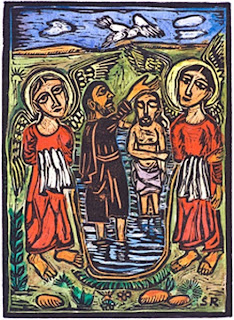
Image: a woodcut by Dr. P. Solomon Raj


You are my Son, the Beloved


The one who nursed upon his mother’s breast as angels filled the air with glory is beloved; the toddler the gift-giving magi sought, is the Son whose family flees to spare him Herod’s wrath.


Today’s epiphany is revealed not by a star but in the river flowing through the wilderness and in the cloudy air broken by a descending dove.


Beloved.


The love and power and majesty of God is here: God is one of us.


Humbly standing in solidarity with us on the same muddy river banks where crowds long to plunge into running waters; repenting, turning again to love, to lay claim to new life. 


The air fizzes with expectation. Hearts wonder if John is the Messiah, the one who is to come. But no, he points to water and to one who will come with more power to forgive.


The Son who will come with Spirt and redeem us from fire by fire.


Here he is named, blessed and made known. The Beloved.

As he prays, God as Three-in-One speaks, pauses and descends to us.

Revealing a single loving heart. 

The only rhyme and pulse of life by which all things are made; 

and now calls us beloved too, that we and all things may be made anew.


Loved. Belovèd. Be loved. Be.


The first moment of Jesus’ public ministry is to draw alongside us.

In our expectation and desperation; in our questioning and our dreaming.

As the poet puts it: ‘the one discharge from sin and error’.

Here he joins us in the waters of creation; the waters crossed on the way to freedom;

He steps into the waters of God’s work in our life.

Water which cleanses, heals, and refreshes.

As the deep waters swirl and run, God’s mercy is heard

in our broken world where we thirst for justice to be restored.

On muddy banks this sin drenched world is sanctified. 


The Beloved call us to be loved.


This goes to the heart, our hearts.

We are all in this together, knowing that human power can alone cannot make whole.

The jealousies and injustices; the fear of lack and want; the pains of our loving and our mortality.

All this, and more; the things we commit or omit; the negligence, fault and loss.

In all that may overwhelm, Jesus comes with the refines art to heal, purify and gather up.

Jesus’s birth reveals God’s loving heart in weakness and vulnerability.

And now, before the Word of God speaks, he quietly steps into the depth of our chaos. 

The one whose family had taken refuge in a foreign land, here continues that costly solidarity.

Here the prophet’s words ring true: do not fear; I have redeemed you.

For in this one, God is with us as we pass through the waters of life and death;

In him no river can overwhelm; no fire consume.

The voice of love names him: beloved; you are mine.

That same voice of love calls to us: you are precious, honoured, you are loved.

Do not fear. 

I am with you.


Be loved, belovèd.


Not because we are perfect or wholly good; but because it is God’s nature to love us.

And there by to heal, make whole and holy.

That is to know a radical solidarity and unity of love, which is the heart of God’s very self.

And thereby for love to be birthed anew in us in these waters.

Even if we cannot remember the moment of our own baptism, just as we cannot recall our birth, the promise remains. 

This is our new identity: baptised, connected, interdependent, made one.

Fed in a wafer thin piece of bread, that is the fulness of love made real in ordinary stuff.

We find ourselves, in Christ, bound to one another and all humanity. 

In this we are set free to love and be loved; to be that love in the world around us.

To create, inspire, work and serve; to teach, nurture, feed and listen.

For in every human inclination and conversation, we are invited to love.

Baptism invites us to find the fire of love in the ordinary.

And there perhaps to glimpse an epiphany, a revelation of God in renewed trust, in completed task, in care given, in being heard and understanding.


You are my Son, the Beloved


Says the voice of the Father’s heart to the Son; that loving heart beats in all things through the Spirit’s work. 

In open hearts and in human touch we respond and receive to that Spirit that kindles light and love in us.

Love and power not embodied perhaps in that descending dove; but made flesh in patient acts of care; in diligent fulfilling of tasks entrusted to us; in the waiting in the mess; in the creation of new relationship.

Beloved is the promise; our identity.

Love is the heart becoming embodied in us.

Here in weakness and vulnerability, our Lord invites us to learn empathy and compassion. 

The challenge is to find this holy love and way of being in our ordinary.

To choose it, embrace it, live it. 

In muddy water and refreshing spring; in water that feels to deep.

We take a deep breath; and take the plunge. 

As Jesus stands with us and prayers at the water’s edge, he embraces all of our humanity. 

He refuses to turn away from shame or scandal, creativity or care.

The voice that made the world came from heaven saying ‘you are my Son, the Beloved’.

This is God in us who makes things new. 

As another poet puts it:

‘He calls us too, to step into that river

To die and rise and live and love forever.’


Beloved. Be loved. Love. 


Let us pray:

Heavenly Father, 

at the Jordan you revealed Jesus as your Son:

may we recognise him as our Lord

and know ourselves to be your beloved children;

through Jesus Christ our Saviour. Amen.

Sunday, 13 December 2020

Who are you?

Something that's neither sermon nor poem; but reflective verse (if that's a thing) for Advent 3. The readings were Isaiah 61: 1-4, 8-11 and John 1:1-6, 19-28


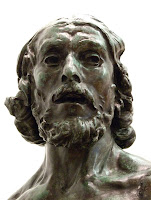
John’s face


Detail of St. John the Baptist Preaching by Rodin at the Museum of Modern Art, July 2007


There was a man sent from God.

His name was John.

This is his testimony, his witness.

It begins with a question. 

Who are you?


This man was sent from God. 

His name was John.

But who was he?

This one who knew who he was not;

who invited all to come to the river.


Other prophets may have addressed kings;

walked in the streets amongst the people;

rebuked them publicly; 

used visuals to make their point;

cried out for justice, mercy and peace.


Instead, this man

goes into the wilderness.

He went and stood on the banks 

of a river,

and waited.


John looks at us:


John the Baptist: Jacob Jordeans (Columbus Museum of Art)


Who are you,

this man who is sent to us:

who looks at us in the wilderness

and breaks the desert silence

with a confession?


He confessed

and did not deny it,

he confessed:

I am not the Messiah.

What then?


Elijah? No.

A prophet? No.

We must have an answer:

who are you?

What do you say about yourself?


This man was sent from God,

to be a voice.

A voice crying out in the wilderness:

Make straight the way;

prepare for the one to come.


John like us:


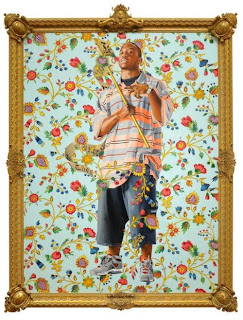
Saint John the Baptist II: Kehinde Wiley (Museum of Art, Duke University)


And is he like us?

Are we to be like him?

Adopting this pose,

knowing who we’re not,

yet knowing whose we are?


Are we drawn by the same thread of love,

the same birth; the same breath?

Through water and wilderness, 

darkness and light,

pointing to the one who is not yet known.


We too are called by name,

each one of us called

to witness, to testify, to confess

the name of the one who is among us

as love.


We’re not dressed in camel’s hair, but in our own clothes.

Yet do the gestures our body language prompt the question?

Who is this God of love 

of whom you speak, to whom you point, 

the one you praise?


John at the river:


Baptism of Jesus 2:  Dr. P. Solomon Raj


John baptises with water,

inviting us to see our need for new birth.

To turn, listen, repent;

to open our hearts to a Kingdom were 

justice and mercy flow.


There was a man sent from God

pointing to the one who 

brings light;

the one standing among us.

Unknown.


This one is coming

of the Father’s love begotten.

Alpha and Omega,

source and ending.

He whom the prophets promised.


John says he’s not worthy

to untie his sandal.

Yet this one stands with us in our humanity.

Love divine in manger and mud, 

wilderness and water.


City:


Graham Holland: photo montage 


John took up the mantle of the prophets;

the greatest and yet the least.

A voice.

Crying out.

Prepare, get ready, listen.


See the light; 

listen to the Lord’s anointed.

Proclaim good news.

Proclaim liberty.

Proclaim the year of the Lord’s favour.


The voice cries:

for the broken-hearted 

for the sick and the grief stricken.

For the ruined, desolate cities 

and fearful generations wanting normality back.


The voice cries:

for love of justice;

for freedom;

for comfort; 

for blessing.


Blooms:


Image detail: David Hockney


For the earth will bring forth new shoots.

Seers, prophets and witnesses 

foretold and confessed:

that of one highly favoured lady, 

Emmanuel, God with us, the Christ was born.


A voice cried out in the wilderness:

for the light of love casting out fear;

the day spring from heaven, the anointed one;

warming hearts, blessing earth;

breathing life, destroying death.


John came to witness to light:

yet the world still weeps;

lives bearing the cost of 

power’s privilege and 

sin’s selfishness and separation.


A voice cries out in the wilderness:

a new day dawns.

He came, he comes, he will come again with justice.

Emmanuel. God with us.

Love’s unbroken thread; to mend a broken earth. 


There is joy in this, 

and comfort’s strength.

Who are you, are we, am I?

But fragile bodies, bearing love in flesh;

Voices, crying; hearts, opening;  hands, repairing.


Spirit-led and refusing to lose hope in what is

just and beautiful, and good and true.


© Julie Gittoes 2020