Showing posts with label generosity. Show all posts

Tuesday, 15 April 2025

The most precious thing

 Sunday, 6 April, Passiontide: Isaiah 43: 16-21, Philippians 3:4b-14 

and John 12:1-8


What is most precious is often most fragile.

Our world, our friendships, every human heart; like a jar of precious perfume. 

In his novel “Alabaster”, Chris Aslan reimagines the story of Mary, Martha and Lazarus. He narrates their shame and sorrow, the freedom they long for and the stigma they face. They hear rumours about a new teacher; someone who might bring hope. 

The jar of pure nard is the most expensive thing they have, but it has not brought them good fortune. When the teacher comes to stay, Maryam smashes it open. 

Her words take us into the tender and provocative moment in today’s gospel:

At the upper room I hurry inside, dripping spikenard all over the carpets, to where the teacher is reclining. Then I take one of his feet and I pour… I’ve never smelled anything like it… It’s rich and warm and a little heady…

The scent fills the room, intoxicating everyone… Spikenard spills everywhere and I pull off my headscarf to use as a mop… my hair falls around me and catches in the liquid, so I use it to wipe his feet as well. 

Spikenard might’ve been a year’s wages; a dowry perhaps. 

No wonder the reaction - assuming scandalous waste rather than abundant generosity. 

Could it not have been sold? Would not the poor have benefitted?

The air fills with fragrance, hands and  feet are drenched in perfume, skin and hair are soaked with oil. 

And Aslan’s Maryam says to the teacher:  “It’s the most precious thing we have”... it’s not enough, I know, but I want to honour you and to prepare you for what’s to come.”

Mary, like our imagined Maryam, dares to love with abundance and holds nothing back - even her own future. 

She faces criticism, scorn and censure for this show of devotion, for the waste.

Yet this outpouring is meeting a different kind of need - it's a fragrance of love which encompasses death, an embodied worship which expresses hope; which gives an unspoken glimpse of resurrection before the pain.

As Maryam holds the teacher’s feet, she thinks ahead: This body will soon be broken and destroyed like this jar. He chooses to do this for us…I start to weep. I wipe and I weep, whispering my adoration. 

Her body is communicating her longing, her worship, her gratitude; her relief, her trust, her sorrow. She sees the brokenness and anticipates burial. 

His feet are washed with oil before he washes the feet of others with water.

A jar is broken in devotion, before his body breaks to heal and restore. 

This is a holy moment: intimate and tender as oil mingles with tears; blessing and sorrow; dignity and honour and grace. 

In describing this chapter in his commenary on, David Ford says the essentials are: being loved by Jesus, loving and trusting Jesus, recognizing who Jesus is, a heart open to the suffering of others, prayer, service, life-giving signs, extravagant attention and generosity. 

We are invited to play our part in this drama of friendship with Jesus. 

Such friendship is the most beautiful thing: it is to be held in the loving gaze of God. 

Our bodies are fully part of our life with God as we offer our whole selves without shame or fear; resisting some of the harsh judgements we make about them.

Embodiment goes to the heart of the incarnation: God’s word dwells with us as we break bread and share wine, weep and find consolation in our tears. 'God's presence and his very self, and essence all divine' as the hymn puts it.

Jesus names the goodness in this moment saying that it is worthy of being remembered - not for its waste but because Mary has dobne a beautiful thing. 

She antipates Jesus’ act of self-giving love by anointing his precious body with the most precious thing she has. She’s not  being cautious or holding back; she lives beyond the metrics of calculation; of growth or exchange. It is a pure gift in response to love.

As Isaiah has promised, God will do a new thing - it springs forth and we are invited to perceive it. He writes of a new way - of fresh waters; he writes of people being formed anew - declaring their praise and adoration. 

Mary’s gift of life and love fill our senses as an act of worship, drawing our attention to God’s love in Jesus: spilling over to forgive, breaking to make whole, lifted up do draw us to Godself. 

In the Eucharist, we are drawn into the abundance of  Jesus’ act of self-giving love. In fragments of bread, a cup of wine and words of blessing, we are made welcome, forgiven, restored and made new. Drawn into communion, our bodies in one body. 

Consider for a moment the things that have sustained us when life has been painful or we’ve found ourselves in turmoil - what comforts us?  Often, it's time with those who love us; the gestures of those who care; the body language that doesn’t count the cost. 

These aren’t merely pragmatic or calculated; not empty platitudes or politeness. They are acts of kindness or creativity that resist the pain of a fragile and finite world - which capture our senses like spring flowers. 

The body language between Mary and Jesus speaks of facing  suffering and death with generosity - sharing all that we have, breaking it open; somehow finding with it a gift of beauty with a fragrance that hangs in the air. 

It is an act of resistance against the grave - death does not win, instead the sacred notes of love rise above it. 

When challenged, Jesus is not suggesting that the needs of the poor do not matter - or that we accept society's inequalities as inevitable. It invites us to worship wiht our whole heart and to be open-hearted with what we have. 

Mary reminds us to love in the moment - aware of what lies ahead for Jesus, she offers comfort and tenderness. The breaking open the jar is a breaking open of her heart with deep gratitude and love. 

We too are to love Jesus without limit; that friendship is the source of goodness, reminding us that we are from love, of love and for love; that we are also to show the same open-heartedness to those who are in need. 

Paul writes of the vindication of unconditional love. He has desecribed the way in which Jesus does not cling to power but empties himself for us. In the light of that, Paul sees his gains as fleeting, counting them as rubbish (a polite translation of the Greek!). 

There is nothing that we can do to attain our own righteousness - it is a gift in Christ by faith. He shared our embodied experience, suffering and death that we might know his resurrection.

Mary responds to the need in front of her - the one who’ll die outside a city wall and be buried in a stranger’s tomb.  She loves what is before her eyes, in her dining room, amongst friends and those who’ll deny or betray love. 

Her body language shows that it is always Jesus we serve when we love those whose need confronts us. Judas faces rebuke rather than blessing for holding back; for thinking in the abstract. 

The perfume is an anticipation of resurrection - it is a glimpse of hope, it is a reminder of beauty and goodness, of extravagance and vulnerability. It is the fragrance of love, broken open and spilling out. 

As Passiontide begins, we are gifted an image of utter generosity; of being present; Jesus between us and judgment; holding nothing back. 

The cross awaits with all its pain and abandonment; but in this moment, one woman chooses to make a gesture that fills the room with the scent of what is possible. That there will be life again. That love will triumph. 

We press on in this way of love, as friends - recognising Jesus and being open-hearted to others; in prayer, service, attention and generosity, that our bodies too might be life-giving signs, broken open in love. The spiritual writer Ignatius says this, may it be our prayer:

Lord my God, when your love spilled over into creation You throught of me. I am from love, of love, for love. Let my heart, o God, always recognize, cherish, and enjoy your goodness in all of creation. Direct all that is in me toward your praise. Teach me reverence for every person, all things. Energize me in your service. Lord God may nother ever distract me from your love. Neither health nor sickness, wealth or poverty, nhonour or dishjonour, long life nor short. May I never seek nor choose to be other than You intend or wish. Amen.


© Julie Gittoes 2025


Sunday, 25 September 2022

Seeing differently

Sunday September 25, 2022: Amos 6:1a, 4-7, 1 Timothy 6:6-19, Luke 16:19-31: a sermon preached at St Mary's and Christ Church


Last week began with words from Archbishop Justin on the nature of loving service, those we remember; whereas those who cling to power and privilege are long forgotten [Her Late Majesty's Funeral].  The week ended with a “mini-budget” and an MP [David Lammy] saying ‘I have a joke about trickle down economics. 99% of you won’t ever get it’. 


It’s a joke which we know isn’t funny. As the psalmist says, we trust in a God who gives bread to those who hunger, and the poor are still waiting for justice.


A sermon isn’t a lesson in economics or Trussenomics.. Rather it is an opportunity to see our world, its systems and priorities through the lens of scripture. The contrast is stark. Today, we hear of the prophet Amos pointing out that weath and revelry pass - alas, he cries, for those who’re at ease, secure, notable and rich - but who are not grieved at the plight of others.


We hear too from Timothy the familiar words said at funerals: taking us to the heart of the human condition ‘we brought nothing into the world, we take nothing out’ Therefore, we are to be content with food and clothing, and take hold of the life that is life. Loving service now - and hope in death, the gate of glory.


Paul warns the younger man Timothy that love of money can supplant love of God and obedience to God’s commandment: hearts turn inwards, swayed by harmful desires; succumbing to greed rather than generosity, comfort rather than compassion. But riches are uncertain and what we have we should be ready to share. 


We know that we are facing a cost of living crisis and that the most vulnerable are already suffering. Putting profit before people and selfishness over stewardship is cruel. As the CEO of the Children’s Society puts it: ‘billions in tax savings for high income earners is going to do nothing to help families bearing the brunt of this crisis’ [from Twitter 24 September]. 


Whatever our capital p  politics, it hurts us to see what God sees; in the words of Amos, we should be grieved at the plight of others. To acknowledge the brokenness and brokenness, the systems of greed and exploitation is part of our call to be capital p prophetic. 


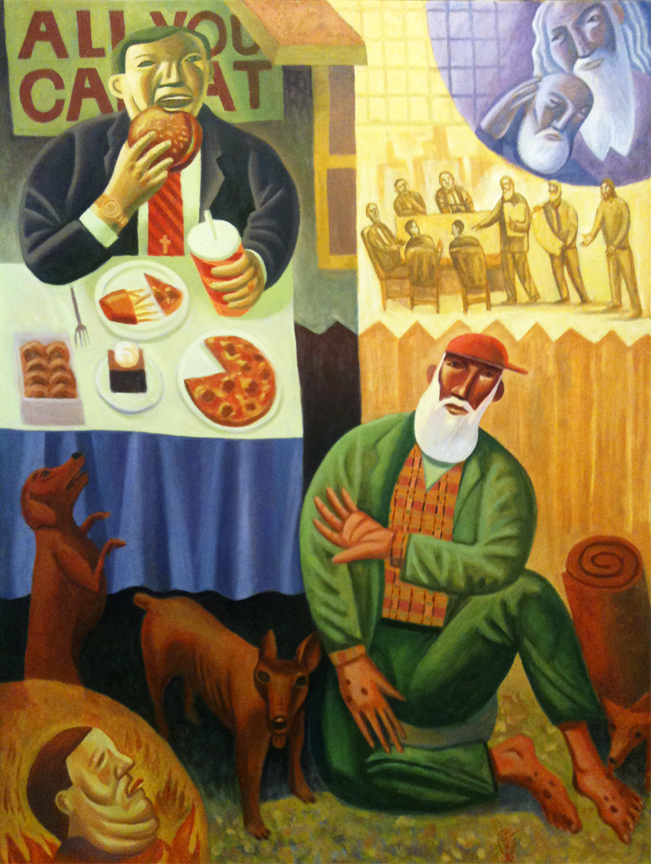
In the parable Jesus tells, the unnamed rich man chooses not see what is in front of him as he feasts sumptuously - he neither acknowledges Lazarus nor alleviates his suffering. Lazarus is visible, human, real; longing for a crumb, consoled by the presence of dogs.


The Rich Man and Lazarus - James Janknegt


In this story, death is the gate of a great reversal: the wealthy, gluttonous foodie thirsts  in agony; the poor man is comforted by Abraham.  There is a chasm  set between them. 


Lazarus cannot be sent to do the richman’s bidding: neither in offering soothing water nor in warning his brothers. The wisdom of Moses and the prophets should be enough for us: love God and neighbour - alas for those who are rich.


There is an urgency to this uncomfortable story: it highlights what’s at stake; strips away the illusion that our choices are endless. It’s a story about wealth, the temptations of riches and the apathy induced by material comfort. It challenges us - whatever our financial position - to see the world as God sees it: to see the reality of suffering,  need and ultimately human dignity.


The richman couldn't not see Lazarus - he may have considered whether he was lazy or ‘deserving’ poor; wondered what led to his circumstances; tossed him spare change occasionally. He may have considered, as he entertained wealthy friends, how to solve ‘the problem’ of street homeless. He may have noticed him, but not truly seen him. 


Jesus invites us to see each other: to recognise our shared humanity, dignity and worth; to see the kinship between us. The one who is God with us, invites us to risk the cost and vulnerability of being in relationship with others; to hear their stories and see in their faces something of our own fear and fragility, indeed our own mortality. 


To see Lazarus, the richman would not only glimpse something of his own fractured dignity; to acknowledge his circumstances, privilege and complicity in the suffering of others. To see would be to admit ‘we bring nothing into the world, we take nothing out’; that to cling to power is to be forgotten; it is to be grieved at the plight of others, to be content with what we have and to share.


One of the refrains of Moses and the prophets is that love of God, true fear and awe of God, is the beginning of wisdom. If we show such reverence - to the one in whom we live and move and have our being - we cannot not have the same reverence for others: our fellow human beings who bear God’s image and indeed the whole of creation. 


We are all impoverished by the incapacity to grieve the plight of others;  by the trading contentment for what we have for craving more than we need; by exchanging short term profit for long term sustainability. 


To see in this way demands personal commitment and collective effort. It means finding ways to reduce or cross the chasm between want and plenty - a chasm we create and reinforce through the policies and politics we choose. It is unsettling because it demands courage and imagination, but Jesus subverts the norms and hierarchies we live by, crossing the chasm of life and death to bring new life.


In the book The Spirit Level  Richard Wilkinson and Kate Pickett argue that inequality has a damaging effect on society: ‘eroding trust, increasing anxiety and illness, encouraging excessive consumption’. Equality, they argue, is better for everyone.  The Joseph Roundtree Foundation called for more research on the policy and tax implications of their work - some of that includes recognition of our interdependence and need for security; reducing stigma and increasing commitment to the common good.


To take hold of life that really is life might mean bearing the burdens of others, being content with what we have and confronting privilege. We trust in a God who crosses over the chasms we construct and maintain - in Jesus we are shown a way of selflessness and loving service. As Archbishop Justin said, we are shown who do follow - losing our lives in order to gain them.


We have everything we need: created and creaturely goodness; the gift of forgiveness and the hope of blessing; we have the life, death and resurrection of Jesus; we have power of the Spirit gathering us together as one. Dare we offer healing love to our world - in what we spend, in how we protest, in what we campaign for, in who we see and who - and what - we serve. Amen.


© Julie Gittoes 2022

Saturday, 24 August 2019

We cannot love without giving

A sermon preached at Evensong  on 18 August: Isaiah 28: 9-22; 2 Corinthians 8:1-9

The missionary Amy Carmichael once said:  “We can give without loving, but we cannot love without giving”.

We can give without loving.

We cannot love without giving.

Amy’s words seemed to resonate with today’s readings; but I realised I knew nothing about her [something of Amy's story].


She had grown up in a wealthy Irish family in the 1860s. Her father owned a flour mill business. She benefitted from the best education money could buy; and enjoyed the finer things of life.

Such comfort and stability did not last. The business began to lose money and eventually closed. The stress and worry took its toll on her father, who became ill and died.  Amy’s schooling came to an abrupt end and she spent a decade helping her mother take care of her younger siblings.

Such a shift in circumstances and status would’ve undoubtedly had an impact on the young Amy. Yet in biographies, it’s not the personal hardships that come to the fore.

Instead there are two stories which are told about her: one was when she and her mother were having tea and biscuits in a restaurant, a little girl had her nose pressed against the window; she was begging and without food. Amy promised that when she grew up she’d give her money to the poor.

The other story captures a moment as she returned home from church. She came across a poor elderly woman carrying a heavy bundle. Along with her two brothers, they helped her along and carried the bundle.  In respectable Belfast, she noticed that she was noticed - the embarrassment and shame of association; the bad weather and the woman’s rags. She described the experience as ‘a horrid moment’; saying they hated doing it.

Just as she passed an ornate Victorian fountain, she heard the words: ‘Gold, silver, precious stones, wood, hay stubble — every man’s work will be made manifest; and the fire shall try every man’s work of what sort it is. If any man’s work abide…”

Having looked around to see who had spoken, she saw only the people looking on at them. Amy was stuck by an intense conviction that this was God’s voice. She shut herself away in her room and the young woman who had an eye for beauty decided to change her priorities.

Her service and witness began with work amongst the millworkers in Belfast and ultimately she became a missionary in India: setting up orphanages to rescue children from temple prostitution.  This single, childless woman became known as Amma, mother, by many. When asked by an aspiring missionary what the life was like, Amy wrote back saying ‘missionary life is a chance to die’.

May of us will be able recount decisive moments or encounters which change the direction of our lives. Some of us might narrate that (often with hindsight) as a sense of calling or vocation. Few of us end up serving with an overseas mission. Yet all of us have a commitment to use the resources entrusted to us for the good of others, not just our own comfort.


According to the Charities Aid Foundation, there are four key reasons why people give: personal values a sense of morals or ethics; belief in a specific cause; faith or religious belief; and finally personal experience.

Those reasons certainly echo with Amy’s life - and perhaps they resonate with us too.

We may feel that there is moral obligation or duty to give back to society; to use what income we have to reduce inequalities elsewhere. Sometimes there is a specific cause close to our hearts - whether that’s a passion for the arts or a commitment to oversees development. 

Within CAF’s secular survey, 71% of those interviewed were able to articulate belief, religious practice or spiritual values as a motivation for their giving. In addition, as in Amy life, there are personal experiences which trigger giving.

When Paul writes to the Corinthians, he is wanting to encourage them to grow into mature and obedient givers. He is nurturing a sustained attitude that connects the gift with relationships. As Amy puts it, it is possible to give without love - because there’s an urgent demand or compulsion. Yet when our lives are rooted and grounded in love, giving is a natural response.

Paul’s reflections on the generosity of the church in Macedonia describes this as being about an act of grace. By doing so, he is changing the way we think about money. To give out love, to give in relationship, is to participate in an economy of gift rather than exchange. It is a sharing in the economy of a gracious and generous and self-giving God.

Recently, Lloyds Bank ran an advert called the M-word. We hear snippets of conversation such as ‘No, we haven’t talked about it openly’ or ‘I prefer to keep it private’ and ‘it’s a touchy subject’. Finally the voiceover says, ‘it’s good to talk about money’.

Paul would have agreed. Over the coming months, we will have to talk about the M-word: about budgets and priorities, planned giving and the common fund. We don’t give in a vacuum. God’s gracious giving is part of the motivation; but identifying the need is the context.

Thinking about money and generosity is challenging at the best of times; but perhaps even more so at present when the Sunday papers are full of fear, suspicion and interpretations of the Brexit narrative. Isaiah roundly attacks the leaders of Israel and Judah for the way in which they’ve misled their people with lies and falsehood and by making treaties with death. Instead he reminds them that their security lies with God.

Paul also trusted in God; but also knew that divine generosity had to take human and practical form. When Jewish converts in Jerusalem find themselves cut off from families or at risk of losing their jobs, Paul sets up a relief fund. Love and generosity take on a systematic form.

Let’s pray for clarity of vision and priorities; for generosity in response to need. 

We can give without loving.


We cannot love without giving.

© Julie Gittoes 2019