Showing posts with label Luke. Show all posts

Sunday, 25 September 2022

Seeing differently

Sunday September 25, 2022: Amos 6:1a, 4-7, 1 Timothy 6:6-19, Luke 16:19-31: a sermon preached at St Mary's and Christ Church


Last week began with words from Archbishop Justin on the nature of loving service, those we remember; whereas those who cling to power and privilege are long forgotten [Her Late Majesty's Funeral].  The week ended with a “mini-budget” and an MP [David Lammy] saying ‘I have a joke about trickle down economics. 99% of you won’t ever get it’. 


It’s a joke which we know isn’t funny. As the psalmist says, we trust in a God who gives bread to those who hunger, and the poor are still waiting for justice.


A sermon isn’t a lesson in economics or Trussenomics.. Rather it is an opportunity to see our world, its systems and priorities through the lens of scripture. The contrast is stark. Today, we hear of the prophet Amos pointing out that weath and revelry pass - alas, he cries, for those who’re at ease, secure, notable and rich - but who are not grieved at the plight of others.


We hear too from Timothy the familiar words said at funerals: taking us to the heart of the human condition ‘we brought nothing into the world, we take nothing out’ Therefore, we are to be content with food and clothing, and take hold of the life that is life. Loving service now - and hope in death, the gate of glory.


Paul warns the younger man Timothy that love of money can supplant love of God and obedience to God’s commandment: hearts turn inwards, swayed by harmful desires; succumbing to greed rather than generosity, comfort rather than compassion. But riches are uncertain and what we have we should be ready to share. 


We know that we are facing a cost of living crisis and that the most vulnerable are already suffering. Putting profit before people and selfishness over stewardship is cruel. As the CEO of the Children’s Society puts it: ‘billions in tax savings for high income earners is going to do nothing to help families bearing the brunt of this crisis’ [from Twitter 24 September]. 


Whatever our capital p  politics, it hurts us to see what God sees; in the words of Amos, we should be grieved at the plight of others. To acknowledge the brokenness and brokenness, the systems of greed and exploitation is part of our call to be capital p prophetic. 


In the parable Jesus tells, the unnamed rich man chooses not see what is in front of him as he feasts sumptuously - he neither acknowledges Lazarus nor alleviates his suffering. Lazarus is visible, human, real; longing for a crumb, consoled by the presence of dogs.
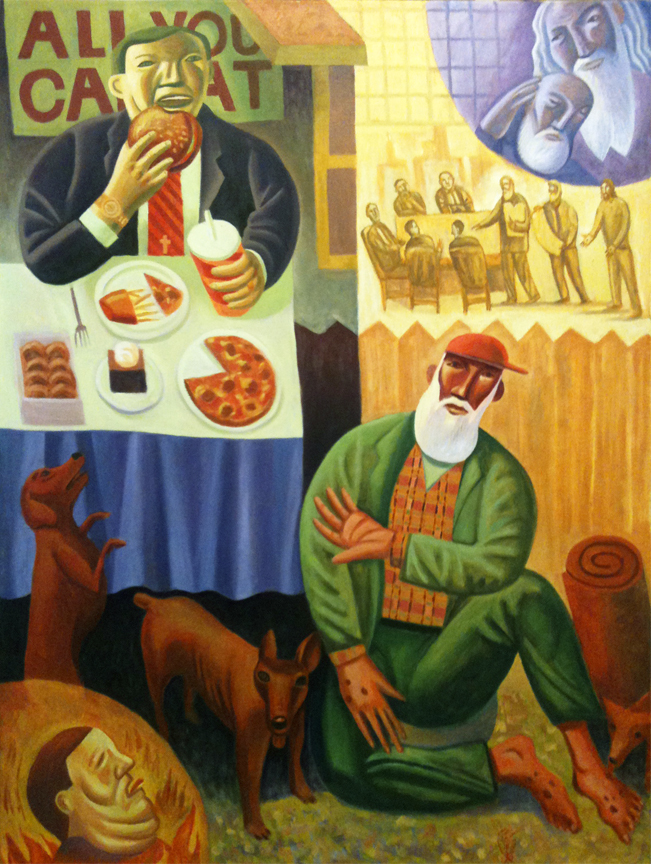


The Rich Man and Lazarus - James Janknegt


In this story, death is the gate of a great reversal: the wealthy, gluttonous foodie thirsts  in agony; the poor man is comforted by Abraham.  There is a chasm  set between them. 


Lazarus cannot be sent to do the richman’s bidding: neither in offering soothing water nor in warning his brothers. The wisdom of Moses and the prophets should be enough for us: love God and neighbour - alas for those who are rich.


There is an urgency to this uncomfortable story: it highlights what’s at stake; strips away the illusion that our choices are endless. It’s a story about wealth, the temptations of riches and the apathy induced by material comfort. It challenges us - whatever our financial position - to see the world as God sees it: to see the reality of suffering,  need and ultimately human dignity.


The richman couldn't not see Lazarus - he may have considered whether he was lazy or ‘deserving’ poor; wondered what led to his circumstances; tossed him spare change occasionally. He may have considered, as he entertained wealthy friends, how to solve ‘the problem’ of street homeless. He may have noticed him, but not truly seen him. 


Jesus invites us to see each other: to recognise our shared humanity, dignity and worth; to see the kinship between us. The one who is God with us, invites us to risk the cost and vulnerability of being in relationship with others; to hear their stories and see in their faces something of our own fear and fragility, indeed our own mortality. 


To see Lazarus, the richman would not only glimpse something of his own fractured dignity; to acknowledge his circumstances, privilege and complicity in the suffering of others. To see would be to admit ‘we bring nothing into the world, we take nothing out’; that to cling to power is to be forgotten; it is to be grieved at the plight of others, to be content with what we have and to share.


One of the refrains of Moses and the prophets is that love of God, true fear and awe of God, is the beginning of wisdom. If we show such reverence - to the one in whom we live and move and have our being - we cannot not have the same reverence for others: our fellow human beings who bear God’s image and indeed the whole of creation. 


We are all impoverished by the incapacity to grieve the plight of others;  by the trading contentment for what we have for craving more than we need; by exchanging short term profit for long term sustainability. 


To see in this way demands personal commitment and collective effort. It means finding ways to reduce or cross the chasm between want and plenty - a chasm we create and reinforce through the policies and politics we choose. It is unsettling because it demands courage and imagination, but Jesus subverts the norms and hierarchies we live by, crossing the chasm of life and death to bring new life.


In the book The Spirit Level  Richard Wilkinson and Kate Pickett argue that inequality has a damaging effect on society: ‘eroding trust, increasing anxiety and illness, encouraging excessive consumption’. Equality, they argue, is better for everyone.  The Joseph Roundtree Foundation called for more research on the policy and tax implications of their work - some of that includes recognition of our interdependence and need for security; reducing stigma and increasing commitment to the common good.


To take hold of life that really is life might mean bearing the burdens of others, being content with what we have and confronting privilege. We trust in a God who crosses over the chasms we construct and maintain - in Jesus we are shown a way of selflessness and loving service. As Archbishop Justin said, we are shown who do follow - losing our lives in order to gain them.


We have everything we need: created and creaturely goodness; the gift of forgiveness and the hope of blessing; we have the life, death and resurrection of Jesus; we have power of the Spirit gathering us together as one. Dare we offer healing love to our world - in what we spend, in how we protest, in what we campaign for, in who we see and who - and what - we serve. Amen.


© Julie Gittoes 2022

Saturday, 27 August 2022

Hold fast to dreams - raise one another up

 Sunday 21 August: Isaiah 58: 9b-14, Hebrews 12: 18-29 and Luke 13: 10:17

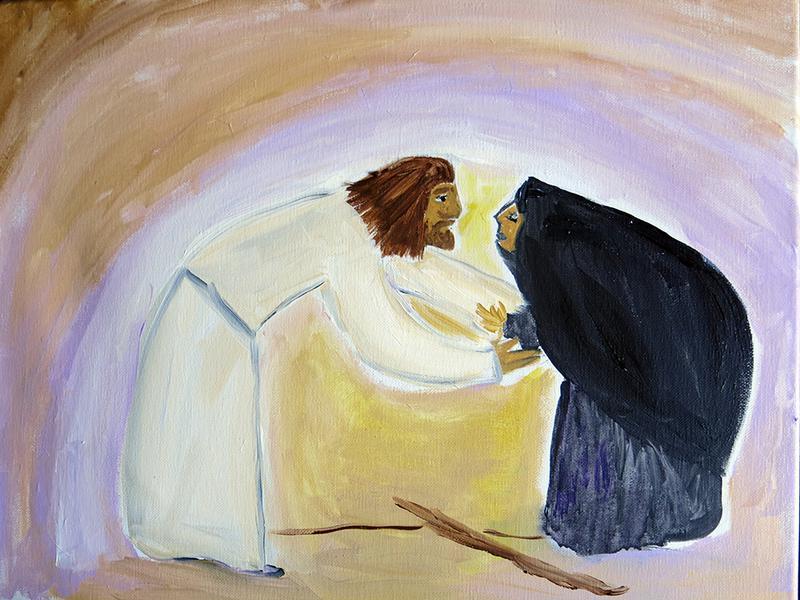
Jesus and the Bent Over Woman
by Barbara Schwarz OP. 2014


Hold fast to dreams

For if dreams die

Life is a broken-winged bird

That cannot fly.


Hold fast to dreams

For when dreams go

Life is a barren field

Frozen with snow.


Words from the poet Langston Hughes:


Perhaps it’s something that poets and prophets have in common: they hold fast to dreams. Perhaps, that’s even more important when the land around us is parched, when sewage gushes into seas and humanity is thirsty. 


They hold fast when we want to see longings of our hearts quenched; they dream when we want to see neighbours unburdened, relationships repaired and our city built up. 


Now we need the poets and prophets; to hold the dreams and not let them die or go. 


We need to learn from them in our dreaming: straining against broken wings and barren fields and frozen hearts so that life, like a bird might fly.


Hold fast to dreams.


Hughes was twentieth-century black American poet who was described has having an ‘anonymous unity with his people’. Avoiding both sentimentality and stereotypes he attends to stories of joy and hardship, money and relationships, work and seeking work.


He wanted to hold fast to a dream: that humanity in all its diversity longed for security. The violation of those things offended his conviction that humanity is possessed of the divinity of God. Yet he hoped - he held fast to a dream - that the world and her people could understand each other. 


Isaiah too is holding fast to a dream. It’s a dream of the establishment of peace and security; of social life flourishing across generations. This is God’s dream.


There’s a poetic rhythm to our translation of the Hebrew: rebuild, raise up and repair. 


Holding fast to a dream speaks to places, people and responsibility: rebuilding the places where people live; raising people up and providing a foundation across generations; repairing the breach, those things which have come under strain, through the work of reconciliation. 


Hold fast to this dream is rooted in the sabbath principal: a revolutionary habit of work balanced by rest and liberation. Isaiah words demand that we refrain from self-interest.


Instead, delight is to be found in removing burdens from others: the yokes that are carried are removed by the provision of food and the satisfying of needs.


We might paraphrase Isaiah as a dream of freedom from all that diminishes human life and access to those things which allow everyone to flourish. 


This is God’s dream for human beings - relationships of support not exploitation; it’s God’s dream for the world - waters refreshing the parched places. 


Then there will be light in darkness.


The Word of God is that light - a light that stoops down into darkness in Jesus.


In the exchange we hear in today’s Gospel, dreams are held fast and made real.


Hold fast to dreams

For if dreams die

Life is a broken-winged bird

That cannot fly.


We know very little about the woman who comes to the synagogue: but imagine for a moment walking in her steps.


Bent over and moving forward, yet seeing only a very little way ahead. 


A world of feet moving around her but without eye contact.


Feeling the heat of the day and cool of the night but not seeing the sun set or moon rise.  The mental and physical labour of each moment; and the isolation of not being seen; of going unnoticed. 


Yet she goes to synagogue; and today a teacher notices her. Jesus breaks off his words and sees her, addresses her; and sets her free. 


His touch relieves the yoke; her body moves in a new way; her perspective shifts; her lips sing God’s praise.


She stood up straight: released from her burdens.


The light breaks in at that moment. The crushed spirit, the hurting body, the lonely soul are met with compassion and restored to community.  The dream of God’s Kingdom breaks in; life is no longer a broken winged bird that cannot fly.


There will be times in our lives when we feel that the yoke of our circumstances weigh us down: financial pressures, grief, loss of agency, illness or injury, isolation.  


May this worshipping community to be palace where we are noticed, beloved, invited, set free.


All of us will know or encounter those who are exhausted, weighed down, marginalised: because of age or ethnicity or sexuality or gender; because of fears about the cost of living, finding a job, passing exams or mental health. 


May this place - and our way of relating day by day - give encouragement, release and dignity. 


God we hold fast to dreams. To God’s dream - a dream that goes beyond a collection of self-interests to the flourishing as humanity as one community, one family. God won’t accomplish it without us; we can’t accomplish it by ourselves. With God we can - and each of us, individually and together, have a part to play in the healing of the world; of setting others free.


That means living some space for God to surprise us. Luke tells us that the leader of the synagogue protested because Jesus stopped teaching, noticed the woman and acted with compassion; he rightly wanted to honour the sabbath, holding the commandments of faith and love. But perhaps like him, we sometimes hold on to what we know and do, that we miss the moment dream becomes reality.


Hold fast to dreams

For when dreams go

Life is a barren field

Frozen with snow.


In Hebrews we’re invited to hold those two things together: our worship and God’s kingdom. In doing so, we honour the hope of sabbath rest and freedom. 


The writer of Hebrews sets out the destination: an unshakeable kingdom. They also plot the the journey thought images that offer security of people and place: a holy mountain, a vibrant city, a diverse gathering and assembling before God. 


Like the woman, we are children of a compassionate God. To be human is to be worthy of love and dignity. 


As we receive the gift and nourishment of the sacrament; as we are touched by words of forgiveness and blessing, may we find ourselves standing upright, set free to praise God. 


As we worship in reverence and awe, may we hold fast to the dream expressed by prophets and poets; the dream of restoration that Jesus brings. May the Spirit move us, equip us, inspire us to restore others to community; to notice those who’re weighed down to respond with compassion. 


In a fearful world, a world where many are denied dignity: hold fast to dreams, heal broken wings, quench parched fields, raise one another up.  Amen.


© Julie Gittoes 2022

Tuesday, 25 June 2019

Being clothed with Christ

Yesterday was my first Sunday at St Mary's and Christ Church: I preached the same sermon in both churches, mindful that as with installing a new piano or organ, I might need to re-voice myself  for a new setting.  Anyway, there's the grace and gift of time and attentiveness. The texts for Trinity 1 were:  Isaiah 65:1-9; Galatians 3:23-29; Luke 8:26-39


I’m not one to dwell on the fashion pages in weekend magazines; and yet I was disappointed that the V&A’s Christian Dior exhibition sold out pretty much as soon as it opened. It traces the impact of one of the 20th century’s most influential fashion houses. Dior’s distinctive silhouettes marking him out as a designer of dreams as a well as dresses. 


Clothing plays a significant part in our sense of self and our social interactions: we dress up and dress down; we dress for comfort and dress to impress. There are trends and codes; preferences and practicalities. 

Clothing can be a celebration of our personalities and diversity. It might communicate role or instil confidence. But there’s a flip side: clothing can makes us feel uncomfortable or self-conscious. We make judgements about status and well-being.

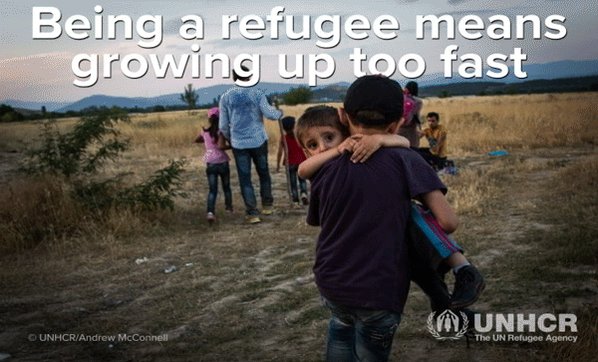
For many millions in our world, it’s the lack of clothing that becomes a marker of displacement. The vulnerability of a hospital gown; kids who dread of school non-uniform days; the needs of rough sleepers; and, in Refugee Week, the desperation and determination of fleeing with the clothes you stand up in.


We don’t have to be Dior to know that our clothing reflects our humanity: our stories, dreams and journeys. We don’t have to go to the V&A to appreciate that our clothing reflects wider cultural dynamics of longing to belong or the impact of trauma, upheaval; the clothing or state of undress resulting from political or economic forces.

In today’s Gospel we encounter a man who is the epitome of such dislocation: he’s suffering from acute mental distress; he’s homeless, naked and at risk. 

He is subject to a dark, oppressive and destructive reality. The name ‘Legion’ perhaps hints at the trauma of witnessing the casual brutality of the Roman occupying forces - whose authority serves as possession, control and exploitation.

Having calmed the storms and fears of the sea, Jesus steps out into this bleak place. The Son of the Most High God goes to the place of violence and injury. God’s love is named and made present in this place; powers of cruelty are called out, expelled. After the stampede, there is calm.


The man is clothed; in his right mind. He sits at Jesus’ feet. He assumes the posture of a disciple; one who wishes to learn and follow. A disciple who is being clothed with the character of God’s love.

Towns people and swine herds alike begin to report what has happened, offering perhaps their own commentary not least on the economic impact of what’s happened. God’s work of calling us into new life and freedom is disruptive. And yet, as Jesus leaves that place, the man is called back to his home. His voice continues to speak of God’s at work in Jesus; of new life in him.

There is blessing in this: there is joy and comfort. 

In a little while, we will break bread together. We will will pray that in the power of the Spirit, ordinary material stuff will become the means by which Christ will draw near to us. In sharing what is broken, we will be made whole. We become what we already are, his body.
In this place, God calls out to us echoing the words of Isaiah: 'Here I am, here I am’.

In faithful love, God reaches out to us despite our tendency to follow our own devices and desires.

In faith, we reach out our hands to receive the gift of life afresh.

For, as Paul reminds the Galatians: we belong to Christ, we are baptised into Christ, we are clothed with Christ.

We are clothed with Christ.  We are one.

Looking beyond outward appearance and status; looking beyond gender, class, ethnicity, sexuality, occupation or health. 

We are clothed with the same garment; we are one.

We are heirs of the promise of life: we have equality and dignity before God.

We might not embody that perfectly here an now. Week by week we name our hurts, our failures and our burdens; week by week we lay claim to the promise of forgiveness, healing and new life.

To be clothed in Christ, is to embrace life and joy, love and hope.

To be clothed in this way doesn’t airbrush out our differences in personality or calling; but it draws those things together for a common purpose.

Our generation is not exempt from the powers which seeks to oppress or control human beings; we aren’t exempt with the struggles with imperfection, addiction and brokenness.

And yet God in Christ meets us in that place; and by the power of the Spirit clothes us in peace.


The descent of the Holy Spirit on the apostles and Mary at Pentecost
© Elizabeth Wang, radiantlight.org.uk

Here we are blessed; and from here we will be sent out.

Together we will listen to God and listen to the cries of our world; over time we will discover together how we are being called to respond to our community; how we might offer sanctuary to others.

We might not feel as if we have much influence within the life of our nation: but we have influence where we live. 

In the power of the Spirit, we are sent back to our homes and workplaces.  We are clothed with Christ, that we might be with others in their distress and in their dreams; in discomfort and determination. 

Being clothed with Christ, we are to reflect the love of God: in patience and joy, creativity and kindness; in generosity and hospitality. In those human-scale gestures our character reflects the love of the God who hears the cries of the world. Amen.

© Julie Gittoes 2019