Monday, 23 January 2023

Who do you follow?

 Epiphany 3: Isaiah 9:1-4, 1 Corinthians 1:10-18 and Matthew 4:12-23


Who or what do you follow? 


A particular team or band?  A TV series or hobby?A public figure or movement?


Social media relies on followers. Verified accounts and influencers develop a strong brand identity - content, stories, expertise, hashtags, paid partnerships, lifetyles, campaigns. Data and engagement become a form of currency.


Advert - see here

Who or what we follow is important: who we get behind or support, the direction we want to go in. To follow suit isn’t just to show interest or understanding, but to copy or obey. Those things shape us and our communities - for good or ill. 


As human beings get caught up in following and influencing, perhaps these questions from William Du Bois sharpen our minds:


How shall Integrity face Oppression?

What shall Honesty do in the face of Deception?

Decency in the face of Insult?

What shall Virtue do to meet Brute Force?


Du Bois was a sociologist, historian and economist who championed civil rights - the first African-American to earn a doctorate from Harvard. He acknowledged that there were many answers - but also that some met such questions hourly and daily, others once a year or decade.


Today, Jesus invites two sets of siblings to follow him: they let go of their nets and he draws their skills into a new purpose - one which lifts the yoke of burden and breaks the rod of oppression. For in him not only is a kingdom of justice and compassion announced, is embodied and comes near. 


Matthew tells us that Jesus withdrew when he heard of John’s death. In the land beyond Jordan, he walks the way of the sea, in Galilee of the nations.


Before he begins to teach, preach and heal, before he calls disciples to follow, he fulfils the hope of Isaiah. The hope of a light that enlightens, a joy that multiples, a hope that nations and people will be set free.


Isaiah spoke in the face of oppression and exile; now that promise of God’s reign of justice and peace draws near in Jesus, God with us.


He takes up John the Baptist’s call to repentance - a radical change of life and direction that many long for. It is a call which invites us to follow suit - to get behind a movement from anguish to rejoicing. It’s a way which holds onto integrity and virtue, honesty and decency, which refuses to return force or insults with blows.  


The choice faced by Simon, Andrew, James and John is disruptive: and yet they risk the accusation of being irresponsible, foolish or impulsive by responding immediately. There’s no check list of pros or cons, no cost-benefit analysis. 
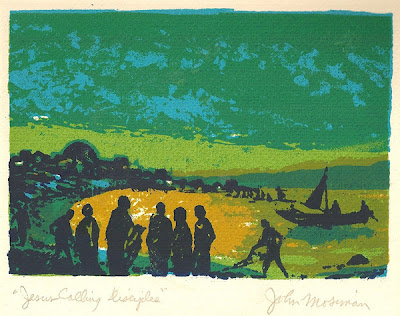


John Mosiman - see here

At that moment, they put something before family and work. They are invited into a new community - all their relationships and obligations are rooted in this deeper peace. 


Others, like them, will also respond to Jesus: touching his garment, kneeling at his feet, asking him questions, sharing broken bread. The wealthy and exploited, the enemy and the outcast, the leaders and the exhausted. Some turn away sad because to follow is too costly; others draw near, giving what they have, because here is life and love.


Jesus invites with power and with compassion. He sees us as we are and knows how to use our gifts. Those who mended and casted nets had a depth of patience, resilience and experience - now he wants to make them fish for people. 


He takes their awareness of their physical limits, their knowledge of water and weather, their attention and their dedication and he says I will make you. I will nurture and challenge, teach and perfect so that you will be who God created you to be. 


They, like us, are invited to bring their whole selves to this way of life. To follow and allow God to work with the stuff of our lives - our skills, experience, learning and memories; the anguish and the hope, the loves and dreams.


The writer Barbara Brown Taylor calls this moment a miracle story because although we might waver or hesitate, it is Jesus who makes the following possible. The God who calls us helps us to follow. In Jesus, God is capturing our imaginations as the hungry are fed, the powerful challenged, the excluded are embraced, the elderly are valued, the young raised up.


This is good news for all: whatever our age or mobility, gender or sexuality, race or occupation. 


It is good news which will make and remake us: there will be cost and blessing, surrender and risk. For this is the way of love which goes to the margins and changes the centre.


The call to us as we follow is what one commentator called a ‘social generosity’. It is a change of direction - transformed thoughts, seeking a different way: doing justice and loving kindness; seeing the fruit of power in generosity, dignity and equity; shaping a common life which rejects hate and division.


Such a way nurtures our integrity, decency, honesty and virtue through the dazzling brightness of God’s light and love. 


It is a dazzling brightness of light and love which confronts oppression, deception, insult and brute force as Jesus bears the weight of that human ill on the cross; and breaks the yoke of its power in resurrection. 


Such a way is what Paul is calling the Corinthians back to: they had allowed arguments and tribal loyalty to divide the body.  He reminds them that the foolishness of the cross stands before our eyes - as God’s love breaks the yoke of oppression.   


We are invited to follow Christ every time we take bread and receive blessing. Those are urgent moments of epiphany and decision - we see who Jesus is. 


That should be good news for every Londoner: love and grace which includes. By the power of the Spirit, may we respond to the light of God’s love and shine with the radiance of Christ day by day - in every act of loving care and resistance.


© Julie Gittoes 2023


Monday, 16 January 2023

Walking by starlight

 Epiphany transferred: Isaiah 60:1-6, Ephesians 3:1-12 and Matthew 2:1-12


The James Webb infrared telescope has been described as a $10 billion gift to the world. It sees the sky at wavelengths of light that are beyond what our eyes can discern. 


Nasa’s senior project scientist was thrilled and relieved after years of hard work.


A machine showing us our place in the Universe; thousands of galaxies in a grain of sand. Images of a ‘stellar nursery’ and a ‘cosmic dance’. 


Human beings have long to scale the heights of heaven or plumb the depths of space - arts and science set on a celestial quest. The desire to know the source of life,  to see beyond where darkness and light are both alike, to know what gives our earthly stardust breath,  to measure the pulse of the very heart of God.  


Today we travel towards our epiphany - the revealing of a mystery and a manifestation of love. 


This is the moment when,  U. A. Fanthrope puts it in her poem BC-AD, 


‘... three

Members of an obscure Persian sect

Walked haphazardly by starlight straight 

Into the kingdom of heaven.’


The love that flung stars into space, causing energy to pulse and atoms to form and life to be breathed into dust was made flesh and dwelt amongst us; perhaps no wonder then that cosmic signs singalled this birth.


Those who contemplated the skies not only followed a star but looked beyond it. They observed and inquired; they searched diligently and found. Then, they were overwhelmed with joy before a child, dependent on parental care and protection. 


There they knelt. There they offered gifts. 


They searched for the love that made us, and found that love with us.


Their worship and adoration left us a sign of who this child was and how he would gather nations to Godself. 


Gold: the marker of authority and kingship, yes; but found with and among us. The one who purifies a people as his own.

Frankincense: the one whom we worship and love beyond all things; opening our hearts in worship and service.

Myrrh: the king of our hearts who loves us to the end, to the grave and beyond; who brings healing to the nations, a new creation.


A mystery has been made known. 


The radiance of which Isaiah spoke breaks in that we might proclaim the praise of the Lord.  For we, with our different races, cultures and languages can seek and rejoice as we are made members of the same body, shares of the same body, as Paul puts it.


He continues saying that this wisdom, rich in variety, is now made known to rulers and authorities. 


The star-gazing wise men encounter one who is used by Rome to maintain order in an occupied land. Herod, like many rulers, rules with the assumption that all things are determined by power. He is fearful and fragile, crafty and yet intrigued; he operates through violence. 


The magi  move beyond him and walk haphazardly, as the poem puts it, into the kingdom of heaven.  For Jesus is the one who embodies God’s very self as a tiny child, as as an adult demonstrates God’s ways with the world.


Adoration of the Magi


Herod is defeated by such a person, movement and kingdom; by those who, in the words of the ethicist Stanley Hauerwas, ‘refuse to believe that violence will determine the meaning of history’. 


This story begins to shape the time we live in too. 


The magi take a different road home for the kingdom of heaven - God’s loving ways reshaping our lives - is a journey. In sleep, their imaginations have already begun to form around a more peaceable way. Their dream reveals to them that the safety and well-being of children, of the most vulnerable, cannot be left to the Herods of this world. 


We need to name that and seek alternatives, different routes for human flourishing, shaped by dreams that counter violence. Hauerwas continues: ‘God has given us gifts of bread and wine to be offered so that the world may know that there is an alternative to Herod’. 


Fed by the body body that we are to become, how can we be part of that alternative?


Perhaps in part, by doing our job; by doing what is entrusted to us - in work, at home, at school, in communities. Allowing our curiosity to be stirred, connections to be made, being attentive to where we find ourselves and acting out of what is possible or purposeful. 


And into that we bring the gift of our whole selves; and we pray that we will find the words and actions to reflect the radiance we see; that as we look around, we will be people who gather together rather than fragment, build up rather than tear down; seek the flourishing of others rather than their survival. As scientists and artists, pragmatists and dreamers, little by little a stellar - heavenly - kingdom will come. We join that cosmic dance.


May we who walk by starlight act with boldness and confidence through faith in God that the world might know a more radiant dawn. For God's love is worldly in focus, cosmic in scope.


© Julie Gittoes 2023


Saturday, 31 December 2022

Faithfuls

Christmas 2022: Isaiah 63:7-9, Hebrews 2:10-18 and John 1:1-14 A Sermon preached at Midnight Mass - from "The Traitors" to 'The Chord". The TV show IS based on games such as ‘wink-murder’ or 'mafia' which has proved popular with youth groups, including our own, for decades. The chord from 'O come all ye faithful' is well known amongst musicians - there are even t-shirts!


I  am a faithful.


Even if you’ve not followed "The Traitors", spoilers, reviews and comments have been all over mainstream and social media, adding a twist to the famous opening line of one of the carols we’ll sing tonight. 


Come on, you faithfuls!


Some players were nominated as traitors and were tasked with “murdering” the other faithful contestants, while the latter had to identify the traitors and “banish” them. 


Unlike the game played in church halls and youth clubs, over £100k was at stake.  Everyone played as a faithful.


There were group challenges and quizzes - building up bonds of friendship, camaraderie  and trust as well as the prize fund. Then there were accusations, theories, eliminations, betrayals; a creeping paranoia and mistrust, prejudices and judgements. 


The finale included cryptic farewells, parting gifts, special pleading and an ultimatum.  Could they all say, I am a faithful? Or would someone have to confess to a game of deceit and manipulation and  divided loyalties, with all the pressure that went with it?


Yes, it was a game - albeit one shot in a fabulous location with ordinary people. 


But games  can reveal the very worst as well as the best of family and friends. If you’re thinking of playing Monopoly, Cluedo or Absolute Balderdash tomorrow, we see the competitiveness, suspicions, duplicity, selfishness and disappointment - as well as, I hope, some magnanimity and laughter. 


O Come; come all ye faithful.


For to be faithful with all its joy, song and exaltation in no way denies the complexity, pain and fractious nature of the world we live in; the personal wounds and the systemic injustices - the greed, betrayals or inequalities, the abused power.


But there is more. To be faithful gives us a different lens on the world: one of hope. 


A hope of resolution; of something more; of outrageous possibility and extravagant love.


It’s a hope we see as human beings turn their hearts outwards to the other - letting go of self-reliance, self-absorption or selfishness. 


As "The Traitors" ended, we were given a glimpse of that in both friendship and forgiveness. To be faithful names the grace of those things. The little acts of kindness; the moments of consolation; the celebration of those fierce loves; the marking of new beginnings; the longevity of human companionship and creaturely companions too. 


It’s a hope we see and hear and receive afresh tonight because of a single Word. A Word made flesh. 


O come, all ye faithful. You are faithfuls. Come and adore the one who is God of God, light of light; very God birthed by Mary - reflecting God’s glory in the fullness of our human condition. 


We come here faithfully; coming to behold and adore Christ the Lord.


Sometime ago, the New York Times published a piece entitled ‘everyone wants to hear this one chord in a Christmas carol. The chord from an arrangement of ‘O come all ye faithful’. 


It is the one known as the “Word of the Father chord” or just “The Chord”: it brings awe, mystery and drama to our worship - full of anticipation as it finally resolves. A startling moment that captures our attention and moves our hearts. 


It is more than a scrumptious harmonic moment. It carries deep meaning and resonance. That final verse which we will sing this happy morning, is a reference to the opening of John’s Gospel read tonight. 


It takes us beyond angels and shepherds. It takes us to the very heart of God - to the love that creates and makes whole; a love that does not let us go, but longs for us to grow in friendship with God and each other. 


The one chord illuminates the one Word: there is a directness and simplicity to this pairing - it demands our attention, draws us into the mystery and intimacy of this love. It holds us there as heaven stoops to earth and raises earth to heaven. 


We are invited to be faithful in ways which are deeply practical. It is about being messengers of peace; rejoicing with those who rejoice; bringing comfort to those who weep. 


To be faith-full is to build community and trust; to restore hope and justice; to nurture understanding, confidence and purpose. That will look different in our homes, workplaces and communities.


However we feel this Christmas we know that the stresses, grief, anxiety, uncertainty and loneliness are real - but that they co-existing alongside the laughter, memories, comfort, opportunities and love.


The Word of the Chord is one who lives to share the sorrows and the joys - who is with us in the darkest hours. It’s a  love that cannot be banished; a love that restores the traitor; a love that calls us to one table, to share one bread - one cup, and serve one world. 


That is grace. And truth. And love. So come, ye faithful. Let us adore him. 


© Julie Gittoes 2022


Saturday, 24 December 2022

Wachet Auf - awake!

 Advent Sunday 2022: Isaiah 2:1-5, Romans 3:11-end and Matthew 24:36-44


In a poem which we will hear in full this evening, entitled ‘Advent Calendar’, Rowan Williams explores this holy season of expectation, in earthy terms.


He will come like last leaf’s fall - with flayed trees and shrouds of leaves; like frost tracing its icy beauty; like dark - with the bursting red December sun before the night sky envelops us. 


Today marks the beginning of  a holy season: one which is startling, not sentimental.  He will come, will come, / will come like crying in the night writes Rowan in the final stanza.


He will come like child yes; he comes like blood, like breaking as Mary labours to give birth. 


Image my own


This child comes, like every new born, disrupting rhythms and routines; this child breaks us open too, bringing the promise of new life to this death-bound world, marked with winds and mist and the star-snowed fields of sky.


In the cantata we’ll hear tonight, Bach draws us into a midnight hour: where maidens wait with lamps lit; where voices from watchtowers call us to awake from sleep and arise to meet the one who will come, will come, will come. 


He will come like a bridegroom; like one who has tenderly sought after his beloved. He will come like one bringing graceful strength and gentle judgement; like one inviting us to share in joy and gladness at a feast. 


The music stretches our imaginations with an emotional pull and a spiritual longing: oh to open our hearts and be alert to embrace the wonder of God; a God who calls us beloved. 


May lamps burn bright to embrace the one who comes: be alert, be prepared; wake from sleep, the Lord comes and will not delay.


In Christ, there is hope for more: not a confidence in the glittering prizes and illusions of this world; the lesser hopes destined to disappoint. This is a hope in victory over death, in loving and merciful judgement, in  new and abundant life. 


It is the kind of hope which gives us courage in the face of present struggles and worries.  He will come, will come, will come; saying beloved, I am here.


Yet our Gospel reading speaks not of labour pains or the cries of childbirth; nor does it speak of lamps, bridegrooms and wedding feasts. 


Instead, we are given a disturbing image of a household being broken into; of the distribution of a stealthy intruder, damage and loss. It challenges our peace and security. 


In part this is the scandal of Christ’s coming - like leaf fall, frost or darkness. He will come in a way that is unexpected. He comes like a child - born to wake us from sleep, to bring life out of death. 


If Bach takes up the imagery of well-trimmed lamps and the foresight to provide extra oil; he also wakes us up - calling us into a season which we do not embrace lightly or selfishly; but with vigilance and faithfulness. 


We are to keep awake; to notice what is going on in our hearts, communities and world. We are to be prepared, responsive, ready. We are to be rested yet alert; trusting in God.


So perhaps the shock of today’s gospel is a challenge to us in a couple of ways.


Are we if not literally asleep, then sleepwalking through life. Are we caught up in busyness or the mundane that we miss the urgency of the moment - moments to console or rejoice, support or love. Wachet auf - sleepers awake - pay attention to what matters.


Jesus doesn’t come in the way we expect - like a child, like a bridegroom and even with stealth. Perhaps we might take that as an invitation to let go of our assumptions and embrace Jesus with joy; knowing that there is no place, no circumstance that is too insignificant, ordinary, complex for God’s love to dwell there.


As we open our hearts in that way - letting go of the pressure to have every detail worked out - we make space for a God who calls us beloved. Sometimes, we have to let go of persistent fears, even the fear of death itself; and the heavy burdens, the many distractions of life or entrenched attitudes about ourselves or others. Those things which get in the way the beauty of God’s desire for us; which stop us loving our neighbours as ourselves. 


If the imagery of being robbed is a startling and disturbing one, perhaps in this way we can set it alongside the new life promised and how we make that present in our interactions now. 


For Paul, living in God’s daylight meant laying aside - being robbed of - what he calls the works of darkness: from quarrelling to drunkenness, debauchery to jealousy. In doing so we begin to make space for God’s ways of peace. We are called to awaken from the rest and refreshment of sleep to be active in offering hospitality and consolation. 


He will come, will come, will come: like leaf’s fall, frost and darkness; he will come like a child, bridegroom and beloved. 


He comes wanting us to be prepared for - and to prepare the way for - a transformed world: today we come to God’s banquet and joyful feast where in bread and wine we are called to light and joy, consolation and love.


Here, and at every Eucharist,  we are taught God’s ways; ways that we might walk in. Ultimately God will come as arbiter and judge over human hearts and between the nations. We pray now that the Spirit, our advocate and guide, will help us begin that work of turning swords into ploughshares, spears into pruning hooks. Laying aside all that does us harm.


Wachet Auf!

Awake!

Be vigilant and faithful!

Be prepared - with lamps brightly lit!

He will come - drawing us into a holy season. 


A season which is startling, not sentimental.


He will come with a birth that leads us through life and death to new life.

Live lightly and intensely, with purpose and love, before we let go of this life; trusting in a greater hope.


This child comes, like every new born, disrupting rhythms and routines; this child breaks us open too, bringing the promise of new life to this death-bound world, marked with winds and mist and the star-snowed fields of sky.


(C) Julie Gittoes 2022

Are you the one? Finding hope and joy

 Advent 3: Isaiah 35:1-10, James 5:7-10 and Matthew 11:2-11


In 1980, the sitcom Hi-de-Hi! appeared on the BBC. 


After the customary “ping, ping, ping” of the xylophone, Gladys Pugh - played by the late Ruth Madoc - says: ‘Hello campers; rise and shine. It’s a beautiful Maplin morning and we’ve got lots of Maplins’ fun in store for you today’.


Set in a fictional holiday camp, there is an atmosphere of forced amusement and fun. It’s expected that the ‘first laugh of the day’ will be at breakfast, with sports, laughter, games and entertainment filling every minute thereafter. 


Underneath that performed jollity, the entertainers are mainly out of work actors or faded stars and former champions; people out of pace and looking for something more. 


We have reached the third Sunday of Advent - known as Gaudete Sunday, a Sunday of rejoicing. As the liturgical “ping, ping, ping” introduces us to gladness, abundance, blessing and joy, perhaps we have arrived with a sense of unpreparedness, dread, tiredness or overwhelm.


Gladys Pugh’s ‘Hi-de-hi’ demands an Advent type response of rise and shine; wake up be alert. Yet, when we read the newspapers, see the evidence of our own senses, the beautiful mornings are shot through with discontent; the fun or laughter in store is combined with tears. 


And yet, and yet, our readings today allow us to be honest about that reality and tension; they draw us from despair to longing; they renew in our flesh and bones something of the mystery of God’s.


The one who gives us permission to long for joy when we don’t always feel it is John the Baptist.  In him, we see questioning and patience in our waiting; and the conviction to trust the promise that God will come. 


For today, the forerunner sends his disciples to ask Jesus a question: ‘Are you the one?’ And he waits, in prison, for an answer. 


When he lept in his mother’s womb, Elizabeth felt joy, connection and recognition that the child her younger cousin carried was indeed ‘the one who is to come’. 


In the wilderness, he was the one who prepared the way by preaching a message of repentance. His dress and diet were strange and other - yet he was compelling,  inviting others to turn back to God’s ways of justice and love.


Now we find him imprisoned: his seeking after truth and courageous unmasking of abused power  had confined him to the loneliness of a cell He challenged a faithless and unfaithful king; he faces death as a result of a flirtatious whim and vain promises. 


Has it all been for nothing? Or are the stories he’s hearing true? His boldness has given way to uncertainty, his clarity becomes a need for reassurance. So he openly, honestly, bravely turns his despair into longing; he asks that poignant question: ‘Are you the one who is to come, or are we to wait for another?’ 


He asks. He waits. Might his patience give way to gladness; might joyful news strengthen his heart?


Jesus’ response isn’t a simple yes of self-identification. He points to what can be seen, known, talked about, witnessed to. He sends the disciples back to John saying - tell him your stories, for those stories reveal who Jesus is. 


The truth of Jesus emerges in these encounters: in fear and shadows, in whispers and speech, in movement and song. Listen to that, and be glad; may that news strengthen your hearts. As John waits, as we wait, God comes near; the promise of Isaiah is fulfilled. 


We aren’t told how John received the news and stories. Perhaps his joy renewed as relief broke in? Perhaps he saw life beyond his own death as God in Jesus raises up, restores and brings hope.  


We receive those stories today - trusting that Jesus is indeed the one who was to come, who came and will come again. In his words, we find encouragement and a depth of joy that goes beyond the first joke of the day. 


You are blessed, he says, if you don’t take offence at me: even when things are harder or more complicated than we’d imagine, he invites us to stay rather than run, to ask questions rather than quit; to wait patiently for the dawn when it is still dark.


For God is present in both the joy and the pain. There is something sacred about what we are gifted on this gaudate Sunday. We can trust our responses to the world - grief, rage, shock, despair - because those things reveal what needs to change. 


Our experience sharpens our longings and refines our actions - if every second we exist is a gift, is something sacred, we can dare to feel deeply because God is in it; God feels it too. As James wrote, we can allow for patience in sorrow and joy in abundance; we can ask questions and choose to act in a way that sets others free. 


Perhaps in a way John understood real joy. It is not sentimentality or superficiality: it’s not the rise and shine of Maplins’ fun. It is  the depth of assurance that God will come to save us;  that God’s activity is beyond his own circumstances; that life extends beyond the grave and finds completion in God. He has gone ahead of us - knowing that his hope was not in vain, despair to joy. 


Prayer for this Sunday from Christian Aid:


Every second we exist is a gift, 

Gone in a whisper, it will not come again…

So God of us all, we come to you and ask

That you help us unwrap it,

and teach us to share it,

and call us to cherish it - 

this precious life we’ve been given.

There are gifts we can offer each other;

time, forgiveness, consideration…

things we cannot purchase,

but which are priceless.

And there are the lessons

we desperately need to learn -

about love that does what it says,

about concern that changes our behaviour,

about this life that we’ve been given that

explodes in beauty when we understand 

how to give it up.

Every second we exist is a gift.

Gone in a whisper, it will not come again…

When poverty robs our sisters and brothers,

when unfettered power proclaims some lives 

are more important than others, 

when the prophetic voice of those struggling

under the chaos our over-consumption has 

caused, is drowned out, call us to listen,

to learn, to change.

Every second we exist is a gift.

Gone in a whisper, it will not come again.

Your creative, joy-filled love gave us life.

May we share it with the same joy and generosity.


(C)    Julie Gittoes 2022

Monday, 7 November 2022

A matter of life and (beyond) death

3rd Sunday before Advent: Job 19: 23-27a, 1 Thessalonians 2:1-5, 13-end and Luke 20: 27-38


In an interview last month, Bill Nighy said: “I think about death 35 times a day”; he continues “I know it’s gonna happen, but I think that maybe at the last minute somebody might make an exception”


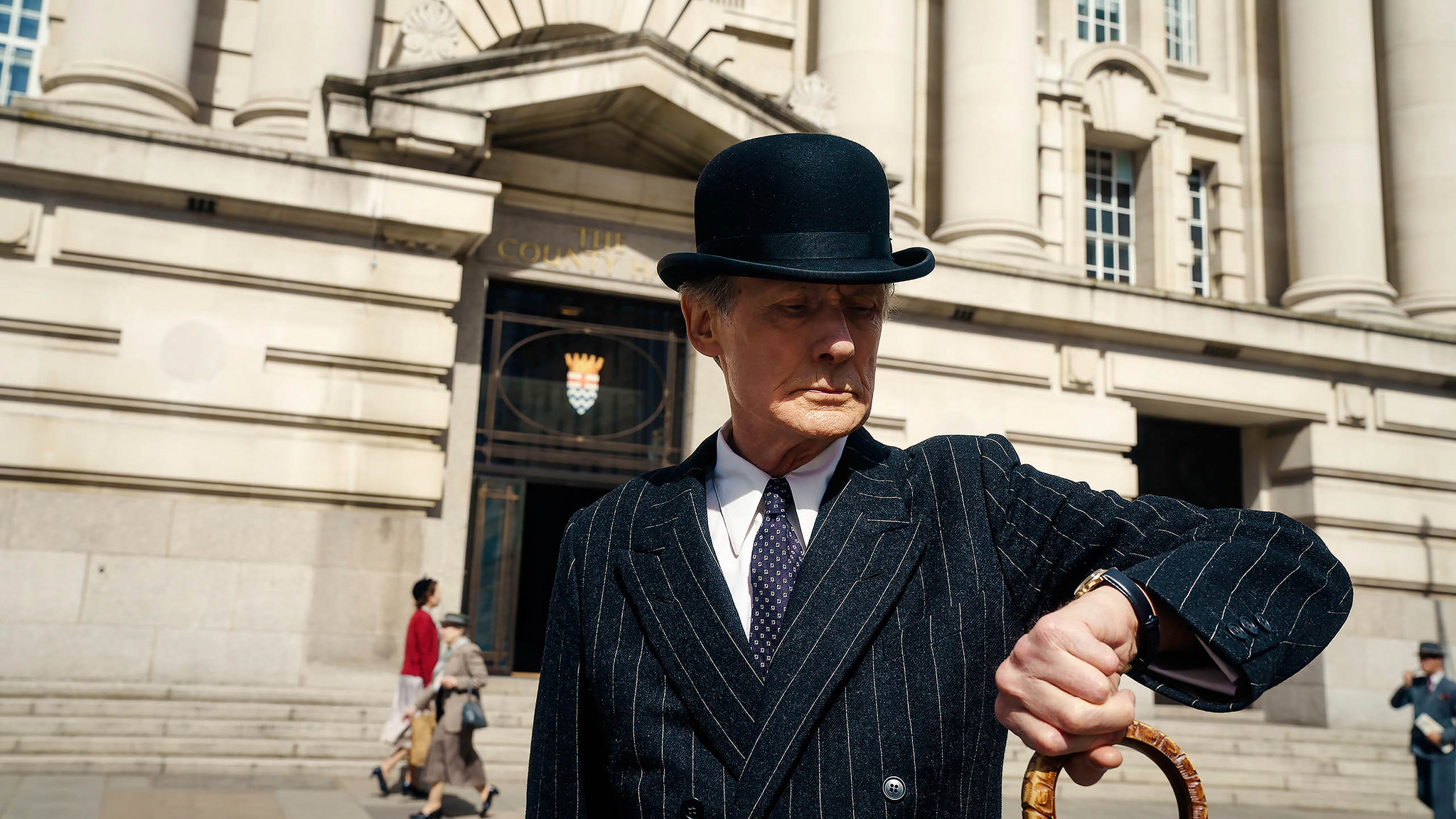
It's an apt and fascinating remark given his latest film called Living in which he plays Mr Williams, a widowed civil servant in post-war County Hall who’s been given 6 months to live. At that moment he realises that he’s not been living fully, but literally shuffling paper, deferring decisions, sticking to his routine.


Film still


When Mr Williams reflects on what he’d say when he’s called to meet his maker, he expresses the mortal prognosis we all share. He decides to get something done; to express gratitude and kindness; to find space for wonder, playfulness and song; to leave a modest legacy of social justice. 


It’s an extraordinary and exquisite performance: every movement understated; every gesture refined; every word a whisper; every emotion restrained. It’s increasingly joyous - shot through with humanity and hope. 


If you can see it, do; it might well be a cinematic parallel to the question in today’s Gospel. The Sadducees were asking a question about what happens when we are called to meet our maker; but doing so from the starting point of their own scepticism. 


They turn talk of life after death into an absurdist riddle exaggerating the human concerns of this life: marriage and family life, death and childlessness, law and legacy.  


Jesus does not respond on their terms. Resurrection cannot be grasped in earthly terms; their imagination is limited and makes God too small. They approach the question through hypotheticals rather than faith. 


As one commentator puts it: “To speak of God as a living God, the Bible means not merely that God is real or alive, but that God, as the beginning of Genesis makes clear, is the very source of life. Therefore, God is just as capable of raising people from the dead as of giving life.’  


This divine life is different from human life; resurrection life is different from lives lived from birth to death. Of course we have questions but we can’t resolve them in simply human terms. Resurrection takes us beyond the logics of bio-medical and physical realities; instead Jesus’ life, death and resurrection, the story of Easter, invites us to stretch our imaginations.


Part of what  Jesus’ response to the Sadducees reveals is that resurrection speaks of liberation and the reversal of human injustice. Our scriptures place widows within the realm of God’s preferential option for the most vulnerable; yet here she is treated like chattel, a possible means of continuing the family line.  Even her grief and loss is, in this instance, amplified and abstracted for the sake of debate.


For those longing for all those longing for consolation and peace, resurrection is a radical hope. Given our human experience of anxiety, loneliness, disappointment; those times when love is met with unkindness or control; and also the inevitability of our mortal prognosis,  then this hope is a matter of life and death, as well as life beyond death.


For Jesus, and in the letters, we see marriage as an earthly institution for the good of human beings - goods of faithfulness, mutual comfort and not just family life but the building up of community through generosity and compassion. It is a good commended alongside being single - through choice, circumstance and calling - as we seek to live in love of God and neighbour.


Resurrection is the entering into an eternal love - where there is no more suffering, crying, pain or death. Being caught up in such a depth of love can bring comfort; whilst here and now we treasure our earthy ways of loving. Loves which are fragile and tender, imperfect and evolving; the love of friends and siblings, parents and spouses.


In Jesus, we see love divine made perfect in our human weakness. He takes up his cross, bears the weight of our capacity to wound and be wounded. He takes all that separates us from God and others to his final breath. Like a seed, his life is buried in the ground, dying to bring forth new and abundant  life.


In him, love has the final word; in him all things are restored to Godself. Love’s redeeming work is done - where thy victory, o grave?


Jesus invites us to walk this way. To take up the cross in this life - and follow the way of new life. There we find love in community and intimacy beyond any human loving.  In Thessalonians we hear of several dimensions of this life.


There is the hope of being gathered together in this universal, peaceable, consoling love. Hard though it is to conceive, poets such as John Donne have given us a vision of life beyond darkness, dazzling, silence and noise of one equal light, one equal music.


There is also the lived reality of life on earth shaped by this heavenly hope: we are assured that God loves us in Christ Jesus; we are assured of salvation, the promise of healing and making whole; we are also assured of the Spirit being at work in us. So we hold onto eternal comfort, this good hope; but we also commit to the work of comforting the hearts of others, of strengthening them in what we say or do.


In Living Mr Williams finds his own way of putting into practice this purpose. Around him, we see others wanting to order their own lives - for the good of community or for self-interest, the blossoming of love or the shuffling of papers, expressing gratitude and sharing food.


As we gather to celebrate this Eucharist, we come in gratitude to share heavenly food in earthly bread. We eat for the laying aside of self-interest and the good of community. Here we pray that love blossoms making strangers, friends. Here there is sacrifice and joy, mystery, wonder and hope. Here our grief, pain and betrayals are transformed as we become restored penitants. 


Here we are recalled to serve a Kingdom where no-one belongs to another; but where all are beloved of God. Here in a way, the patriarchy of the Sadducees' trick question dies. Before we eat together, we pray ‘thy kingdom come’. We pray that the radical hope of the gospel might make us free to live for others in love. 


We serve the God of the living. The great I AM who was and is and is to come. The one who makes all things new and whole and alive. The one who invites us to repent and grow and flourish.  In the power of the life-giving Spirit, we serve a living and loving God who came near to us in Christ Jesus.


Like Bill Nighy we know that death is going to happen; but we trust in a rather more radical exception than mere continuation; the exception is life eternal offered through God’s merciful and loving judgement. So we can declare, like Job, with confidence: I know that my redeemer lives and that we shall see our God here on earth and in the world to come. 


© Julie Gittoes 2022