Sunday, 31 May 2020

I can't breathe - we can't breathe

Two reflections from a service for Pentecost: reflections written in the context of a high number of deaths within the BAME community due to Covid-19, and the impact on the elderly; and the injustice of the treatment of George Floyd. The theme of breath - and whether or not we can breathe - is refracted afresh on the day of Pentecost. Willie Jennings' commentary on Acts has been transformative and challenging - the Spirit leads to revolution of the intimate; it is the sound of the intimate. Reading Marilynne Robinson's Gilead is also striking - can we too be more aware of the stuff going on beneath the surface; plotting the strife but also the power of reconciliation. 

Reflection One


Gilead: During lock down, I’ve picked up Gilead by the American writer Marilynne Robinson. In a slightly contrary way, I’m reading first novel of the trilogy last, after Home and Lilia.  I’m taken back to 1965 as the Rev’d John Ames writing to his young son.

Like all of Robinson’s novels, Gilead is full of an awareness of the stuff going on beneath the surface of life: the joy, guilt, dread and tenderness. She plots the causes of strife in families, communities and the world; she also plots the patterns of forgiveness, the universal healing power of reconciliation and love.

There is, perhaps, as the old song goes, a balm in Gilead, to make the wounded whole.

For her, the human creature is sacred; and the world deserves our attention. Sometimes, writes Ames, I have loved the peacefulness of an ordinary Sunday. It is like standing in a newly planted garden after a warm rain. You can feel the silent and invisible life. 


(Upper Room - Colin Wilbourn): It’s that silent and invisible life that breaks in afresh today: the power of the Spirit which brooded over creation; which overshadowed Mary; which is breathed out in peace; which kindles flames of justice; and which stirs up the revolution of the intimate.

We left the disciples devoting themselves to prayer; sheltering in an upper room; waiting behind closed doors. 

We’ve shared with them in that pulse of prayer - of longing and lament, or resistance and survival. Words woven in our hearts; breathed out on our lips.

And we too wait for the  silent and invisible life of the Spirit to renew, refresh and rekindle. 


(Pixabay/Gerd Altmann): For there is balm in Gilead, to make the wounded whole.

And even when we’re discouraged; when we think our work’s in vain. 

There is balm in Gilead as the Holy Spirit revives our souls again. 

The is balm as Jesus speaks to our fears: peace be with you.

In world where we hear the cry, I can’t breathe; Jesus breathes on us, changes us.

He is called Winston to protect his anonymity.  He’s 89 and wearing a mask; but his breathing is distressing. The palliative care doctor seconded to that ward provides medication to help him relax; his sons in PPE can hold his hand. He’s not a statistic. He’s their best friend, loved and cherished. But his death wasn’t inevitable; his time hadn’t come. Dr Clarke says ‘our society may be endemically unequal, but no-one in Britain is expendable’.

In world where we hear the cry, I can’t breathe; Jesus breathes on us, changes us.

He is called George, George Floyd and the world knows his name. He’s 46; a black man who died beneath a white police officer’s knee.  He was an athlete; a gentle giant; a father; a bouncer who lost his job at a restaurant because of the ‘stay-at-home order’.  His life long friend said ‘he was looking to start over fresh, a new beginning… he was happy with the change he was making. His friend Harris says ‘it’s hard to put faith in this system, a system that you know his not designed for you’.

In world where we hear the cry, I can’t breathe; Jesus breathes on us, changes us.


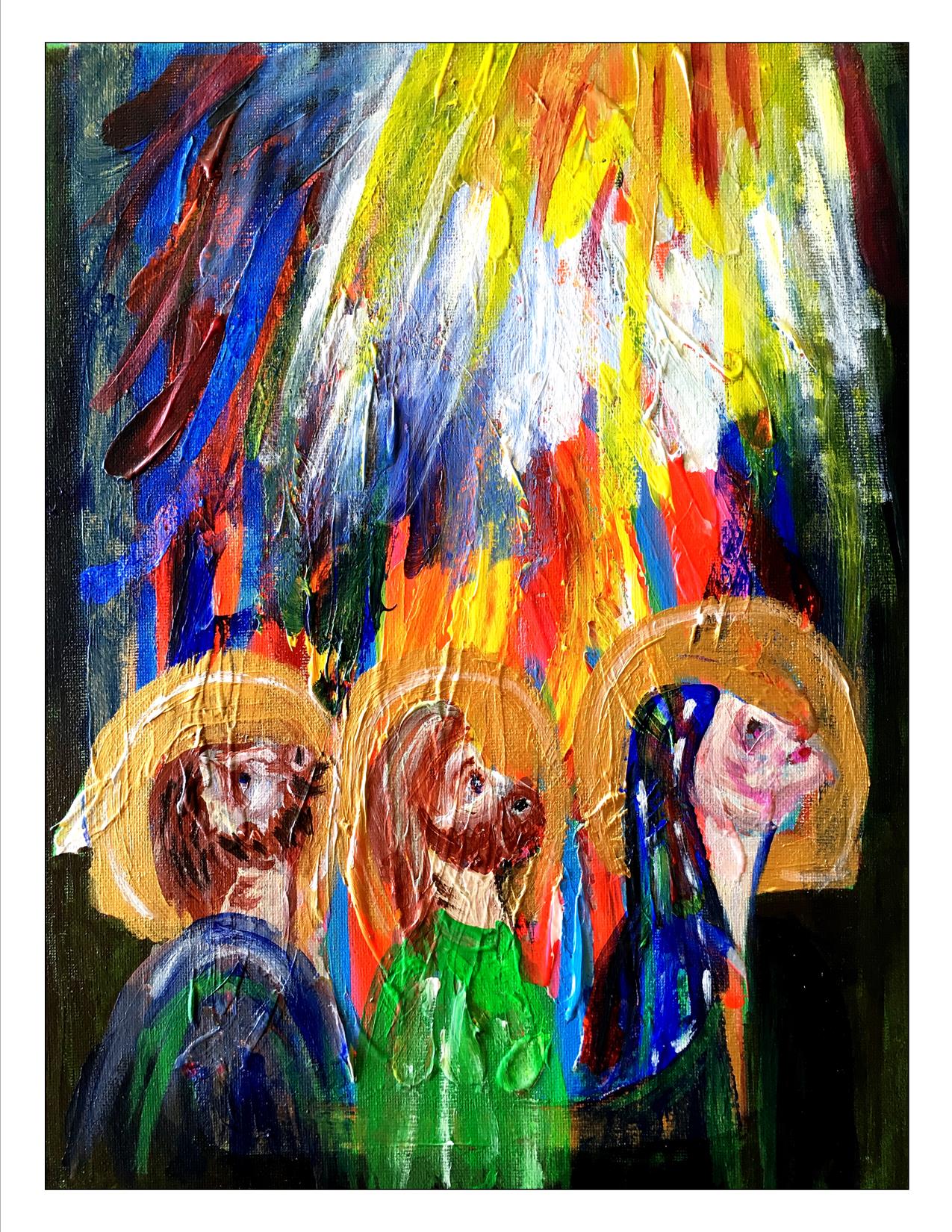
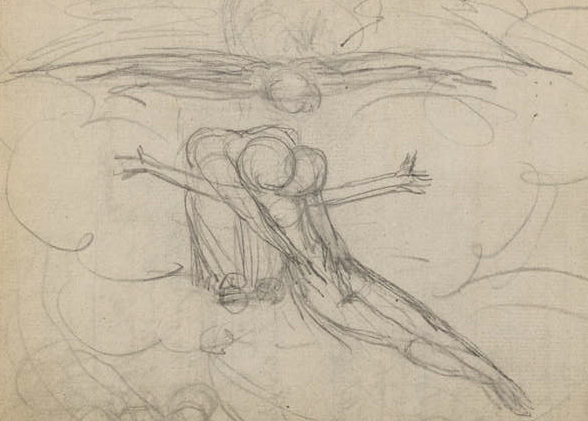
(Descending dove - Jyoti Sahi): Can we be balm in Gilead?  As Jesus breathes on his disciples; as he sends his Spirit on them, on us, we are sent to be witnesses. 

Jesus breathes out: life and joy; the disciples see and believe. 

We are to hear the anguished cries; see the wounded bodies.

For if I can’t breathe, we can’t breathe: Yet as Jesus breathes, our lung capacity increases.

He breathes and the Holy Spirit abides: kindling in their hearts, our hearts, a fire of love; a fire of change. 

Every breath we take, the Spirit sighs within: this is the offer of life; of forgiveness; as we become wounded healers. 

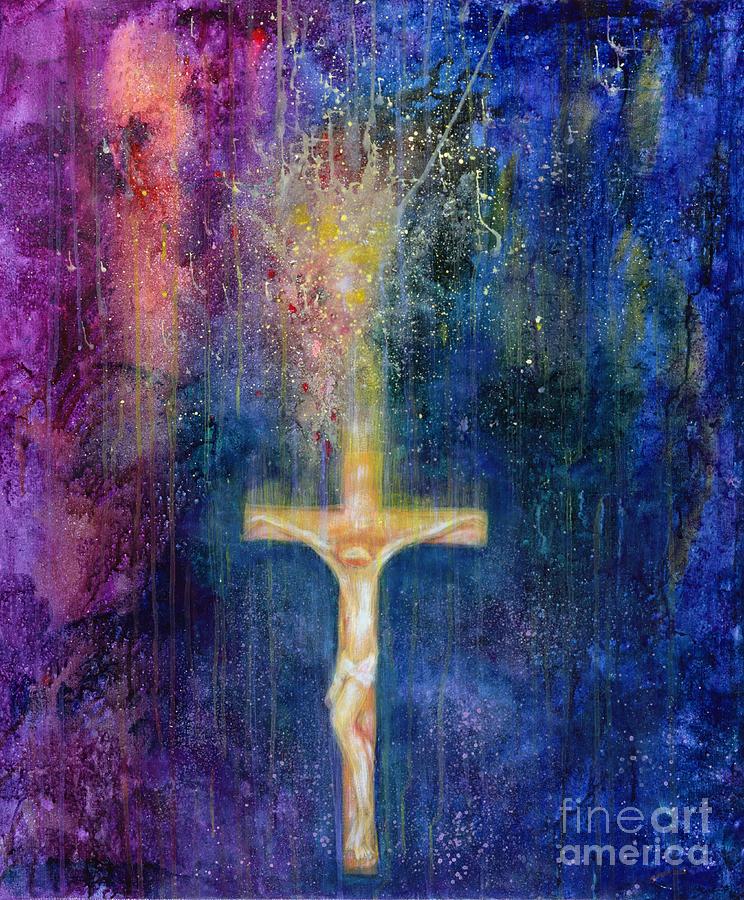
We point to the crucified and risen Lord: the one who offers the world his death, that the world might know his life.  Some will embrace this forgiveness and know the liberation it brings; others will turn away, binding to a past that imprisons.


(Pentecost - He Qi): But we are to recognise this life; turning to it; embracing it; abiding in it. This Holy Spirit comes as comforter, yes; as peace in a hostile world, yes; as balm in Gilead, yes.

It comes not for our own benefit, but to teach us to witness  to the truth of God.

The Spirit speaks of energy and movement; imaginative creativity and prophetic challenge: wind, flame and breath.

The Advocate speaks of peace, comfort and courage; of a presence that guards against loneliness; of the pursuit of wisdom in uncertainty; calling for justice when life is not equal.


(Fire dove clip art): The language of God's love, forgiveness and mercy, is expressed in Jesus physical death and risen life in the body. 

The promised Spirit, the Advocate, continues to guide and inspire us; drawing us more deeply into truth; enabling us to love. It's a risky  and costly pattern of life: speaking with hope rather than colluding with fear; offering compassion not resentment.

Today we celebrate that that is how God communicates with us still: holding, loving, guiding and inspiring with every breath.

This is love: restoring, forgiving, compassionate and transformative.


Reflection Two
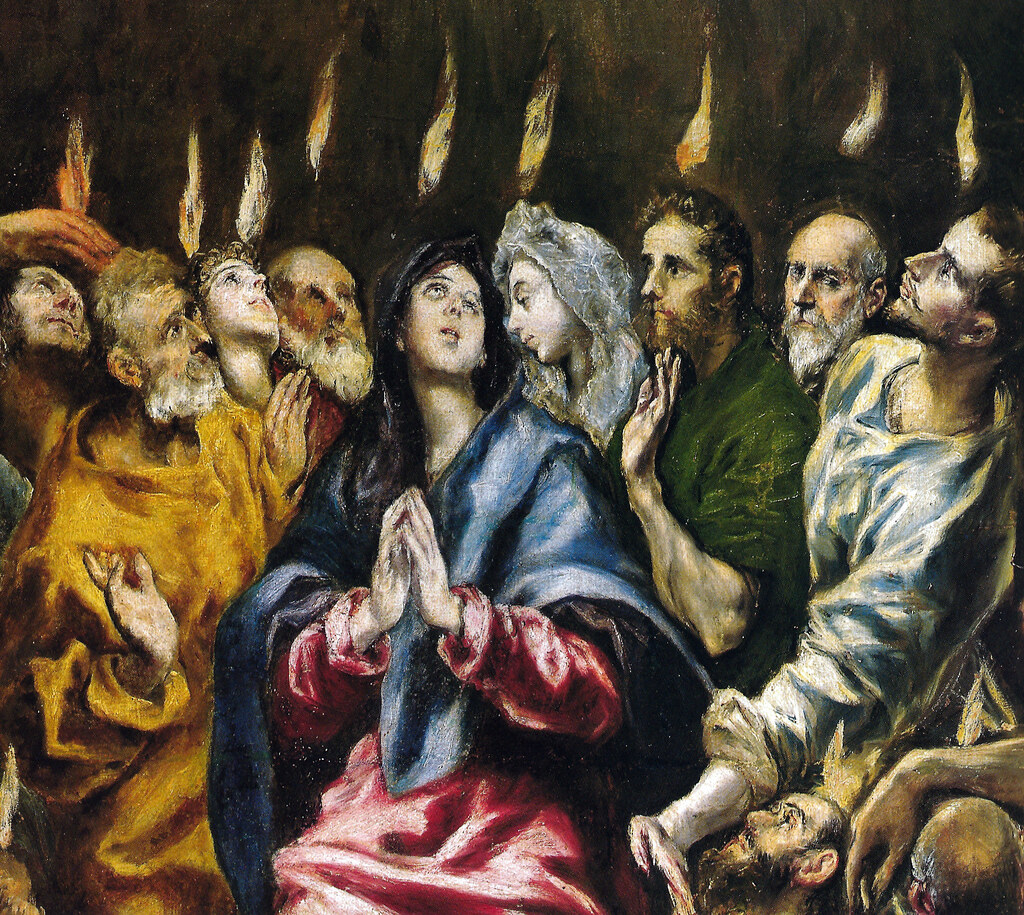


(Pentecost - El Greco):   In world where we hear the cry, I can’t breathe; Jesus breathes on us, changes us.

Today we are caught up in the transmission of a story which is both intensely personal and also cosmic in scope. It's a story which stretches language to the limits of imagination, passion and extravagance: rushing wind, tongues of flame, exuberant speech.

This story reveals the intimacy and power with which God communicates his love for us.  Tongues of flame is a revolution of the intimate (to quote Jennings); the movement of the wind is the sound of intimacy. Our anthem captures the beauty, disruption, bewilderment and hope of this revolution. 

One of the many striking things about this story is that amidst the amazement and questioning, there is a radical home coming; things are joined together; miraculous speech and miraculous hearing. People hear in their native tongue; in the the language of their heart.


(Peter - Michael Buesking): As Peter speaks, a community is broken open and recreated in the Spirit; it is a moment of grace as the Spirit overshadows, broods and inspires. 

Willie Jennings coined the phrase revolution of the intimate; and he describes Pentecost as: This is God touching, taking hold of tongue and voice, mind, heart and body.  Here is untamed grace - subverting our own fantasies of power and vengeance, and kindling something else. 

As Peter speaks, this revolution of the intimate is unleashed by the Spirit. Our ears, mouths and bodies are filled with with this language which frees us from oppression and kindles a shared commitment to hope. 

To speak this spirit-led heart language means learning to submit to the slow process of increasing our vocabulary, committing to practices, understanding the values and gifts of God’s Kingdom. And the more we learn, the more we fall in love with it.

And as we fall in love, we are called to walk a new road as wounded healers: advocates, comforters, prophets and creatives. 
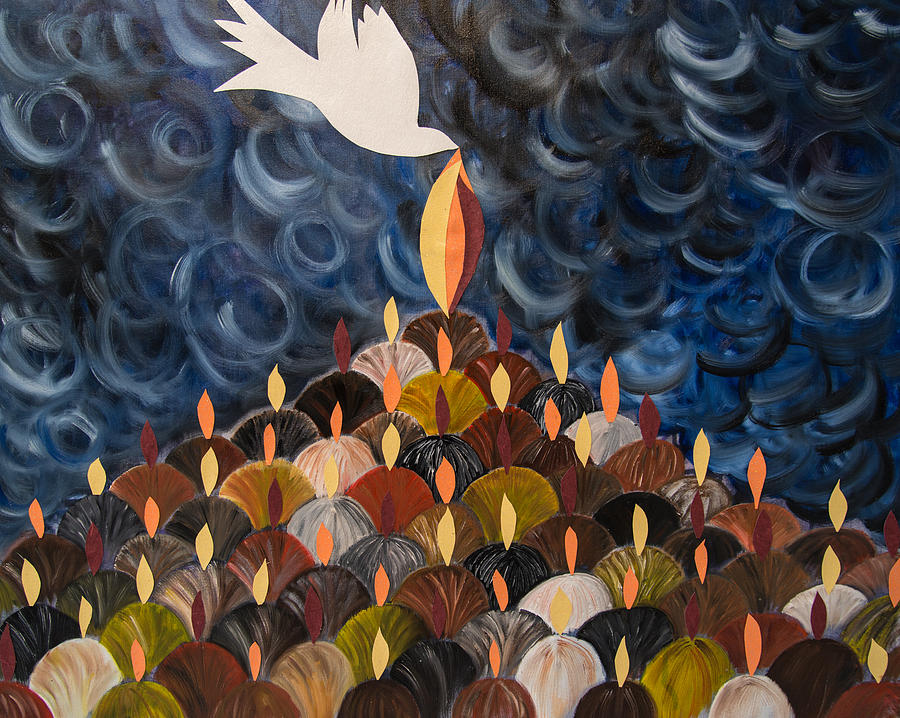


(I will pour out my Spirit on all people - Marianne Gonzales Sims): As Jennings says: speak a language, speak a people. God speaks people fluently. And God wants us to speak people fluently too. 

In world where we hear the cry, I can’t breathe; Jesus breathes on us, changes us. And we speak.

We speak not only in words, but in our body language. As Jennings puts it: this will require bodies that reach across massive and real boundaries, cultural, religious and ethnic.  It is a body language that says: love your neighbour. 

This is, in the words of the prophet Joel that Peter quotes, a new world order. Energised by the spirit, young and old, male and female, slave and free become prophets, dreamers and activities for this new world. 

We pray that the Spirit will ignite in us a holy fire, strengthening us with the gift of faith.
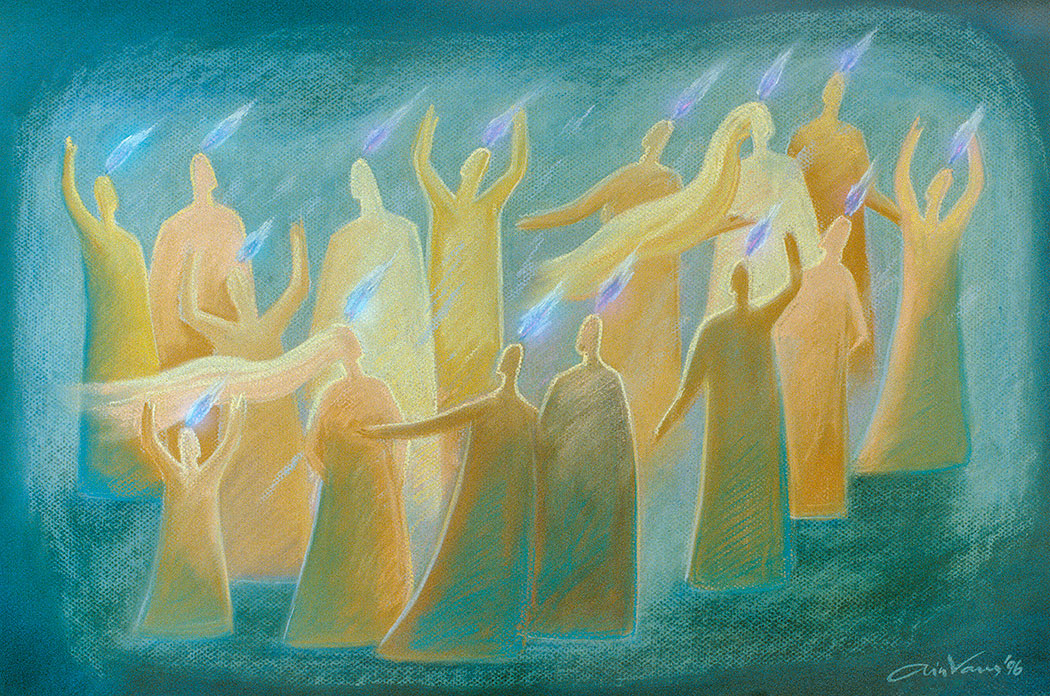


(The day of Pentecost - Ain Vares): We are strengthened because in Jesus, in going to the depths of human despair and alienation, to those places even when we lose ourselves, there is no longer anywhere where God's love is not. Christ's risen life, calls us to new life. In the power of the Spirit, he calls and calls and recalls each of us by name. That Spirit revives us with the breath of love.

This is the promise of abundant life - not just for a few, but for the whole world.  We pray, renew the earth. 

There is a balm in Gilead to make the wounded whole: when we ask not just who has died or who killed them, but what killed them. We hear the protest, seek repentance and hope for a better society. 

When there are disproportionate rates of death in one community - because of age or race - we have to attend to those wounds. And just may be, the spirit will turn them into sites for hope.

There is balm in Gildead to heal the sin-sick soul. 



Jana Skarecky): Today we are presented with a vision for how human beings become channels of such love - to be transmitters or translators; to be embodiments of God's story.

In world where we hear the cry, I can’t breathe; Jesus breathes on us, changes us. And we speak. We act.

Like Marilynne Robinson, we’re to notice the stuff going on beneath the surface of life: the joy, guilt, dread and tenderness; and in our lives plot the patterns of forgiveness, the universal healing power of reconciliation and love.

When we feel discouraged, the Spirit revives our souls. We can be balm in Gilead, as the song puts it: 

If you cannot preach like Peter,
If you cannot pray like Paul,
You can tell the love of Jesus,
And say He died for all.

I can’t breath; we can’t breath.
Jesus breathes; we breathe.
Tell this love.

© Julie Gittoes 2020

Sunday, 24 May 2020

I say a little prayer for you

The text of two reflections shared at our online worship via zoom.


Reflection One
The moment I wake up
Before I put on my makeup
I say a little prayer for you.
The words of Aretha Franklin’s song resonate; because in one way prayer is the most natural instinct when we love another person. When we care about our communities; when we hear the cries of the world. The moment we wake up - before we put on our makeup or get dressed - we say a little prayer.
At a human level, Aretha’s words are full of longing: she expresses the intimacy of the one she loves having a place in her heart; the sense that love transcends space and time; and the honesty that separation brings heartache. 
Prayer is something we are exploring and making our own in familiar and perhaps new ways in this lockdown. Finding habits, places and words to say a little prayer. 
Prayer is holding all our love; and abiding in love.
It’s a way of being that is honest, tender, hesitant, raw.
Prayer is an act of resistance: lament, praise, protest, gratitude.
It comes from our heart and changes our hearts.

And today we hear Jesus praying. Praying for those he loves. Praying to his Father. Praying with the disciples. 
Jesus had washed their feet and shared a meal; he had encouraged them to believe and to trust; he’d promised them an advocate and guide and counsellor, the Spirit who’d lead them in truth and send them out as witnesses. He invites them to abide in love, just as he abides in his Father’s love.  
He prays for them - they are drawn into the intimacy he shares with his Father. 
Forever and ever, you’ll stay in my heart
And I will love you.
Perhaps the disciples hold in their hearts the hope that they’d never part; echoing Franklin’s little prayer, that:
To live without you
Would only mean heartache for me.

Ascension - Laila Shawa
With the lives of his disciples on his mind, Jesus also prays for himself.
He speaks of glory and life. He asks the Father to glorify him; using his death to give eternal life. 
This glory reveals the depths of God’s love for the world; this glory reveals the cost of love that reaches out, arms outstretched on the cross, to draw us back to Godself.
This glory is revealed in a love that overcomes death to restore life. Life that is full of mercy and forgiveness and compassion. 
And this is eternal life, abundant and full: it is to know God.
It is to come near; to rest in the intimacy and wonder of that; to know the joy of being belovéd and precious. 
This life: to know that whatever our flaws and frailties, dreams and desires we are held in love. As we breath, God says:
Forever and ever, you’ll stay in my heart
And I will love you.
What must it have felt like to have overheard those words; to be prayed for with such tenderness and concern.
To be prayed for isn’t to be talked about: it is to be known, taken seriously and held. To be known in love; to be heard in life; to be held in trust. 
Would the disciples have remembered this prayer as Jesus’ body - marked by wounds and glorious is life - now ascends to heaven? 
Did they remember in their anguish at death and joy at new life, that Jesus prayed for them: that he gave thanks that they had received him - his name, his life, his love and his work?
As they looked up, with questions on their lips, did they remember that Jesus prayed for them: for their joy and their unity?
As they ask: is this the time when you will restore the kingdom to Israel? Do they remember that Jesus is honest about the opposition they’ll face; that he prays too for those who will come to believe through their words and deeds?
At this moment of parting, do they remember that Jesus in his prayer for them promised the Holy Spirit - the comforter, advocate and guide? 
For now Jesus is no longer in the world, he promises that this prayer will be fulfilled. The power of the Spirit will be at work in them - breath by breath - as they witness to the fire of his transforming love.
For the love in which they abide; the love in which we rest; is a love that heals and transforms.
They stand -watching, gazing and looking up. 
They are consumed by the spectacle - yet watching undermines the possibility of continuing the journey. At this moment of loss they are invited to go forward in faith.
This moment of Jesus’ departure marks a moment of transition; of waiting; of preparation and of prayer. 
For a new order is about to begin. Our humanity abides with Jesus and the power of his Spirit abides with us: and we wait for it; we wait for it in prayer. For it is that Spirit that will enable us to speak and act for the kingdom Jesus brings. 
It is is a kingdom of new life and hope; it is rooted in what they remember and comes into being through their witness. 
But for now they are to devote themselves to prayer.
The moment they get up and return, they say a little prayer:
Forever and ever, you’ll stay in my heart
And I will love you.

Reflection Two
Pray: It’s an interesting group; this gathering of those called upon to pray, as Jesus did.
There are the disciples who’d walked the land with Jesus; some of the women who’d watched at waited, last at the cross and first at the tomb. Mary is there - with her other children. 
Perhaps she is remembering that time of waiting in hope and prayer when, overshadowed by the Spirit, she said yes to being the God-bearer.
And now she prays with those who’d followed the one she’d carried in her womb: as now they prepare for an unknown future.
They wait and pray in a particular place: like us, shut in; like us, confined to world that is smaller or more limited; like us, they see around them life that is fragile and wounded.
But it is from this particular place that they will be sent out into the world. We like them are invite to wait and pray.
We pray: come down, O love divine: kindling in our hearts thy holy flame; come love divine, illumine our path; come, Holy Spirit, dwell within us.
In this prayer, each creature will be claimed as a site of love divine.
The American theologian Willie Jennings, calls this: the revolution of the intimate.
If our heart is warmed by this Spirit, then it is a spark that lights hundreds of fires.
Fires of prayer in our own homes, where we are equipped and inspired for the tasks entrusted to us; where we seek to reflect the character and values of patience, kindness,  justice; of self-control, joy and hope.
Fires of public worship and witness: finding ways of gathering online, sharing hope on social media; looking at how our churches can be once again places of safety and sanctuary.  
Fires of social transformation as we engage with vision and imagination in bringing people out of poverty; seeking a system of education and justice that works for all irrespective of race or gender or age or class; a cultural life that inspires and binds together; ensuring that there is dignity for those in frontline services, and those who depend on them.


Women Kneeling in Prayer - George Henry Broughton
To pray, like the disciples, that we might be open to the Spirit is discomforting and transformative. This vision is part of the witness we share with the apostles. 
The Cuban-American theologian Justo González writes that the Book of Acts is: a call to Christians to be open to the action of the Spirit, not only leading them to confront failures and practices in society that may need to be subverted, put perhaps even leading them to subvert or question practices and values within the Church itself.
We only need to glance at news paper headlines to see how urgently need to confront such failures and practices; subverting selfish exceptionalism and seeking the common good. 
As we pray, we make way for the Holy Spirit to touch human flesh and create in us new hearts; new hearts committee to a transformed world. 
I pray, as we learn to pray with and for each other, alone and together, that we will discern how we serve Hendon in the months and years ahead. That each of us will know the task entrusted to us - using our skills and our work, leading us perhaps to do a new thing that we didn’t dare imagine.
As we pray, with clasped hands we are united with Christ - we abide with God - as the Spirit allows us to become fully ourselves. This is life. George Herbert - poem.
Ever thine: Aretha sang about her human love: 
The moment I wake up
Before I put on my makeup
I say a little prayer for you.
Beethoven, centuries earlier, expresses a similarly intense and devoted to love to an unknown woman. Mourning her loss and longing of a life together.  
And perhaps it those words of a faithful, loving and restless human heart that become the grounds of our deepest and most heartfelt prayer. For in the power of the Spirit, we can pray: Ever thine. Ever mine. Ever us.

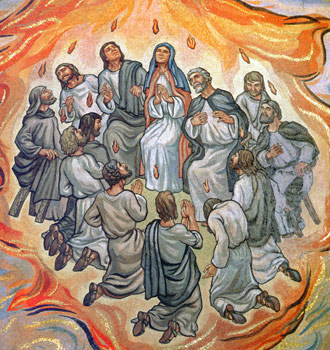
An artist's depiction of a scene from the Pentecost appears in the Cathedral Basilica of St. Louis in the city of St. Louis
Let us devote ourselves to prayer; let us discern the tasks to which we are called. Let us be open to the action of the Spirit; confronting failures and kindling fires of change.
Forever and ever, you’ll stay in my heart
And I will love you.

© Julie Gittoes 2020

Sunday, 10 May 2020

Hearts: troubled and embraced

The texts of two reflections shared on during our zoom worship this morning. Thinking about parting conversations, being enfolded by, and letting go in, love and the ways in which our lives are drawn into God's story.  The thing about an embrace is that it is risky - we have to wait with outstretched arms for the other to respond; but for an embrace to be an embrace, we have to let go as we open our arms again. May we enfold and bless in our communities. The texts were Acts 7:55-end and John 14:1-14.

Reflection One

Like many folk, I’ve found the BBC’s adaption of Sally Rooney’s bestselling novel Normal People to be utterly compelling. 

The ending however, is about a letting go. 
A parting conversation. 
Looking back on misunderstandings, triumphs, disappointments, failures in communication. 
These have been troubled hearts. 


A still from the BBC's adaption of 'Normal People'

And Connell says:  I wouldn’t even be here if it wasn’t for you. And Marianne contemplates this new life that’s been made possible.  

They emerge from the shadows of loneliness; hearts troubled by being unloveable beat with purpose. One person has shaped another; the other has marked them with love. 

They’ve had a place in each others lives and hearts; they still do. They’ve grappled with questions of truth, trying to find their own way and are embarking on a new phase of life.

I wonder if the disciples, as we encounter them today, feel a bit like that too. Partly despondent and uncertain. In the midst of this parting conversation, do their minds drift back to that moment of calling? The time when the stepped out of boats and looked to a broader horizon?


Fishers of Men - Michael Dudash

 Did they perhaps recall other meals? The familiarity of the home of Mary, Martha and Lazarus; the seats amongst the religious leaders; the intense debate and the way Jesus would turn an observation into a new parable, a story to re-tell. How many of our deepest relationships and most memorable moments have been over a meal?


Jesus walking with his disciples - unknown

And there would have been conversations along the way. The one to one discussions; the opportunity to ask Jesus something away from the crowd; the moments of rebuke when they’d started to disagree.  We will have our own recollections of those we love and those who’ve had an impact on us:  genuine love and kindness; the colleague who inspired us; the person who held us close when we cried. 

Yet now, all those things are cast in a different light; conversations now are under a shadow. This is a farewell conversation. He’s talked of love. Again and again he says this commandment is made new. Love. But it isn’t cheap. 

Jesus washes his disciples feet - unknown

Some parting words we anticipate and script: the leaving do or the exit interview. Others we sit lightly too, aware that it might be the end: graduation days, the house moves, the lengthening gaps of time between calls. Yet every day holds that possibility of last words: things we can’t say; don’t say; the things we dismiss, cling to or only really hear long after the last breath. 

This conversation is one which shaped lives and imaginations; which has been dwelt on and lived with. A parting conversation which says: love allows you to do great things.

Now what does he say, the one who’d asked them what they were looking for and invited them to see? He says don’t let you hearts be troubled. He says trust me. Believe in God. He says there’s a place for you; and I’ll come to you. He says, after feet are washed and before bread is dipped, he says you already know all this.


The Lord's Last Supper - Okaybabs Studio

But the questions around this table are real and intense: we don’t know, how can we? Show us the Father, then it’ll be fine. The hearts of these disciples are troubled, perhaps our are too. And yet even in this movement Jesus stretches their imaginations. Their belief, their hope, their trust is not just in him as an end in itself; it’s not a personal possession. It is a more radical gift. Something greater will emerge as these troubled hearts embrace new life.

In Jesus, God chooses to dwell with us; to have a place with us. In the midst of grief, uncertainty and all that troubles our hearts, Jesus invites us to place our trust in God; to abide, with him, near the heart of the Father. We are held in this eternal embrace. 


William Blake

Yes, we trust that when earthly life is over, we will have a place at home with God, in whose image we are made. But here and now, in troubless days; in days of possibility, we have a place too. A place amidst homes and colleagues; churches and communities.

A place where new life is made possible, even when - especially when - there is sickness, disruption and death; even when we have let go of all that is familiar. In this letting go, we are embraced by a love that opens our hearts; by a love that gives us a share in God’s story. 

We will explore that in a moment through Stephen’s story woven into God’s story.

Let not your hearts be troubled. 

Reflection Two

We know that in our human experience, moments of letting go can be hard and messy. As adults, we experience the nervousness and courage of a toddlers first steps: when we say yes to a job; when we say I do to a loved one; when children move out; or when we empty a parental home. And there will be many more ‘letting gos’: moment by moment, when we resist the urge to cling on tightly to what we know in order to do a new thing.
Banksy

Our reading from Acts tells us of Stephen: of his letting go of life in order to gain life. He is enfolded in love. Earlier in Acts, we hear how he is one of those who is committed to care for some of the most vulnerable.  He is one of those deacons, filled with the Spirit, who with wisdom and compassion to a great work.  They take on the great work of enabling many bodies to become one body. Hope and struggle are bound together as resurrection life, life in abundance, breaks into the ordinary and intimate, the domestic and the public. 

Stephen reminds us that we live in what Willie Jennings calls ‘the tight space between faith and fear’. Wherever we are placed - at home or at work, in our daily activity and times of isolation, it is the nearness of the Spirit that prevents faith being overcome by fear. The Spirit that Jesus promises in his parting words enables us to imagine the embrace of Jesus;  and embrace that enfolds our deepest longings and enables us to embrace a new way of life. 

The Questions: We will have our own questions; uncertainty about finding the way; needing others to point us in the right direction; allowing us to trust the compass point, the GPS of God’s love.  We are enfolded love so that our lives are unfolded in love. Rachel invited us to sit with one particular question last week: where do we find abundant life, even in lockdown.

The Way: It’s a journey. Yes, Jesus is our way; he walks with us; guiding us behind and before. It takes time; and the process of placing one foot in front of the other changes us. In the 2010 film, The Way, Martin Sheen’s character experiences this change on the way to Santiago in Spain. A pilgrimage route walked by thousands, each one carrying hopes, griefs, expectations; yet the personal, as the film reveals, cannot be contained. On this way, the lives and loves of others change us.

The Truth: Jesus promises to be our guide; to be with us on path to the place he is going - through life and death to life eternal.  Jesus reveals the truth of God’s love: in all its depth and breadth. Jesus reveals the truth of our human condition - in all its contradictions and confusion, its potential and beauty. Light shines in the darkness - attracting us back to the truth of love.


The Baptism of Christ with Dove - Daniel Bonnell

The Life:  The way, truth and life of Jesus is to reconcile all things in love. That is our ultimate reality.  In laying down his life for us, Jesus goes to the depths of the grave and reveals the power of the resurrection. It is perhaps this image of baptism that speaks also of the power of this new life.

We see in Stephen the embrace of this new life.  Like him, may our hearts be set on the world to come; like him, may we sow seeds of new life on earth. Stephen has become a story teller: it’s a story with Jesus at its centre; a story of God, the great I AM, in the midst of all things - past, present and future. In the moment we heard today, Stephen is able to witness to the way, the truth and the life; he is enfolded by the Spirit. As he speaks the Spirit speaks; he point us to the love of God revealed in Jesus. 

Let not your hearts be troubled; I have prepared a place for you; I am the way, the truth and the life. Those things are about love: consoling, reimagining, embracing, convicting, cherishing. 

Stephen has found his way to the truth of this love; and through his life, so will Saul. That figure, lurking in the shadows of hatred will become that great witness, Paul.

Our human bodies reflect something of this way of life. Jesus taught his disciples to love. God’s Spirit is at work in us - when we show compassion and kindness, when we show hospitality and friendship. We are to walk this way; embrace this truth; discover this new life. We are called - like Stephen and Saul, Thomas and Philip.

For a long time, Christian Aid has adopted the slogan: we believe in life before death.  Like Stephen may we perform with grace and power the story of  Jesus.  This Christian Aid week may our gestures reveal the divine life made flesh. 


Heart of God - Gary Rowell


©  Julie Gittoes 2020