Showing posts with label Pentecost. Show all posts

Monday, 26 June 2023

Whose mother-tongue is love

 Sunday, 28 May 2023 - Pentecost: Acts 2:1-21, 1 Corinthians 12:3b-13 and John 7:37-39


Yn enw’r Tag, y Mab a’r Ysbryd Glân


Dw i’n dysgu Cymraeg ar Duolingo. Dimm da iwan ond dw i’n caru’r gymraeg.

I am learning Welsh on duolingo; not very well but I love welsh.


As a platform, DuoLingo claims to be the world’s number one way to learn a language.


It’s effective, efficient and bite-sized, personalised and gamified to make you love learning; but today we go further than that.


Image from inews


Pentecost takes us deeper in language, speaking and loving; naming our heart’s desire.


It’s about how God speaks and how God longs for us to speak;  expressing the desire of God’s heart.


We move from a few people gathered together in one room, to a multitude gathered from the nations in one city. 


There are no more locked doors or fearful hearts as the Spirit stirs, awakens, consoles and emboldens.


Neither the intimacy of domestic space nor the clamour of the public  square can contain or control this movement of calling, joining, longing in love.  


As Willie Jennings puts it:  Disciples speak in the mother tongues of others, not by their own design but by the Spirit’s desire. The new wine has been poured out on those unaware of just how deeply they thirsted.


Jesus had already named the thirst, that deep thirst for loving-mercy and acceptance. He invites us into an encounter - person to person. He invites us to trust - and to receive. 


In the face of division and dispute, he looks ahead to the giving of the Spirit. In the face of suffering and death, he looks to the horizon beyond resurrection. 


Jesus looks into our hearts and longs for the abundance of the Spirit to revive us with springs of living water. 


We long for it, deep within;  the same Spirit rising up in us as that which brooded over the waters in creation; the same Spirit that overshadowed Mary as God’s Word became enfleshed; the Spirit that came as a breath of peace on the lips of the risen Lord.


Those who had waited in prayer are drawn into God’s action. 


An action that breaks open and enlarges human hearts; that breaks open and enlarges this community.


Jennings calls this sheer act of God a revolution of the intimate. 


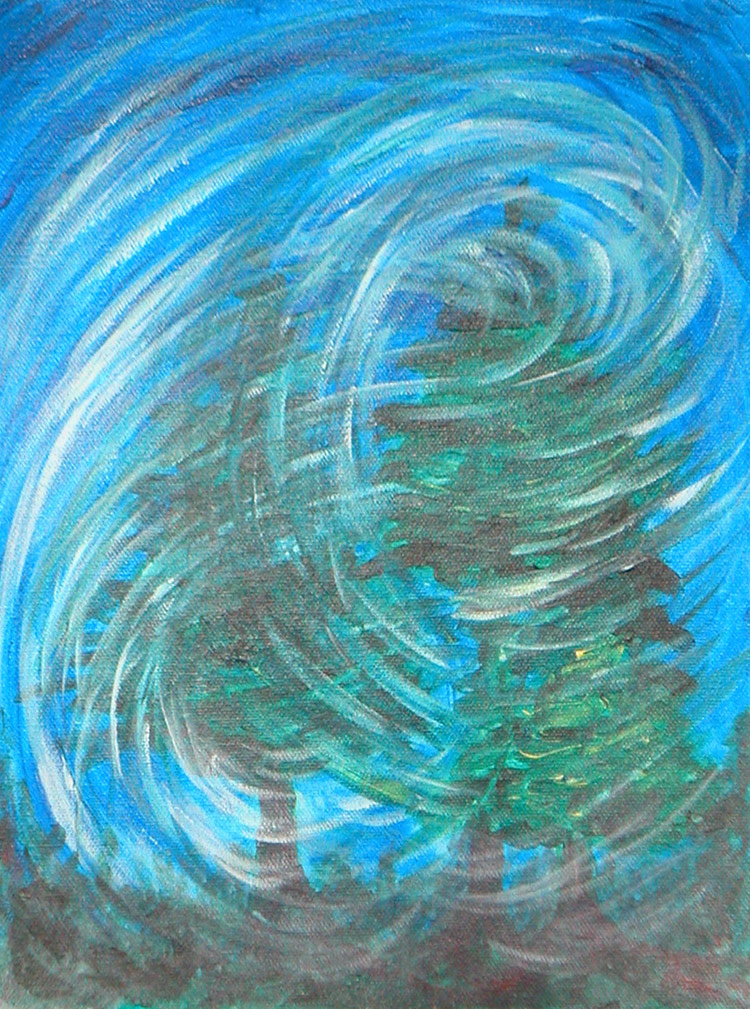
For the absolute power of God is known and felt in the rush of wind; and warmth like a flickering flame. This act of God moves the human heart; the fullness of the Spirit is felt in our most intimate familiar and yet unknowable selves.


This movement of love is known in perhaps the most ordinary aspect of our life; the thing we take most for granted. That is language itself. The words and gestures that bind us together and drive us apart. 


The language that commands and cries out; the familiar expressions of affection; the daily means of relationship; the language of friendship and community; the stuff of praise, prayer and protest becomes the bearer of the fullness of God in the Spirit.


As Jennings puts it:  To speak a language is to to speak a people. 


At one time or another, most if not all of us will have learnt a language other than our mother tongue. We know how slow that can be; and how joyful. Duolingo might be a million miles away from the grammar tables of  school, but it demands the same repetition. 


We learn language out of necessity: to be understood, to work, belong, make a home. We learn out of curiosity: to understand and make connections; out of courtesy and to expand horizons. Unembarrassed, we try; we risk vulnerability; see see the other. In bore da and diolch.


And sometimes, that humbling, patient and demanding process gives way to the sheer love of it: the sounds, the food, the poetry; the culture, traditions and places; the landscapes of places and of our minds. It becomes about people.


Jennings reminds us that:  God speaks people, fluently. And God, with all the urgency that is with the Holy Spirit, wants the disciples of his only begotten Son to speak people fluently too. 


In this there is an undoing of the ways in which mastery of language has become the mastery of people; here we join with God’s work of translating and loving.


‘What does this mean?’ say the crowds, astonished, perplexed and amazed at speech that speaks to their hearts. 


This is the amplification of God’s speech to Israel by the patriarchs and prophets - the commandments to love. To love justly and with mercy.


This is the love that in Jesus Christ goes to the depths of alienation and despair; to the richness of our most tender longings and hopes; to the hidden places of minds; healing wounds, making whole, accepting us in love.


This is the Spirit moving to open hearts to neighbours and strangers; shaping homes, relationships and lives by the fluent movement of love; the Spirit that gives courage, creativity and compassion.

It is this Spirit that enables us to say Jesus is Lord; that enables us to see that in him God reconciled the world to Godself; that in baptism we are drawn into the fullness of life and the possibilities of being drawn together in love.


Paul and Peter echo Joel and the prophets in this extraordinary vision of joining together - across language, ethnicity, age and gender.  The Spirit is being poured out on all flesh - dreams, visions and prophecies find form not only in human language, but human lives.


To be drawn into one body, made up of many members is to see both a rich variety - of gifts, activities and acts of service. 


What does this mean?


It means that the gift of faith is stirred up in us - each using our gifts for the common good.


It means that the church is given over to the Spirit - revived with a breath of love.


It means that in a rich variety of ways - we witness to the love of God revealed in Jesus.


It means that the face of the earth is renewed - with care for creation and hope for all peoples.


This does demand wisdom and knowledge, the ability to heal, reconcile and keep safe; it redirects power from human distortion, abuse and selfishness to divine purposes of the flourishing of all. 


Such power is poured out in the language we speak with our words and our bodies: prayer and thanksgiving, mutual support and blessing. The mother-tongue of love speaks in the body language of broken bread and poured out wine. One body, one flesh, one desire, one God; a variety of embodiments, activities, gifts; for the sake of the common good.


A poem by Malcolm Guite


Today we feel the wind beneath our wings

Today  the hidden fountain flows and plays

Today the church draws breath at last and sings

As every flame becomes a Tongue of praise.

This is the feast of fire, air, and water

Poured out and breathed and kindled into earth.

The earth herself awakens to her maker

And is translated out of death to birth.

The right words come today in their right order

And every word spells freedom and release

Today the gospel crosses every border

All tongues are loosened by the Prince of Peace

Today the lost are found in His translation.

Whose mother-tongue is Love, in  every nation.


Yn enw’r Tag, y Mab a’r Ysbryd Glân


(C) Julie Gittoes 2023

Sunday, 31 May 2020

I can't breathe - we can't breathe

Two reflections from a service for Pentecost: reflections written in the context of a high number of deaths within the BAME community due to Covid-19, and the impact on the elderly; and the injustice of the treatment of George Floyd. The theme of breath - and whether or not we can breathe - is refracted afresh on the day of Pentecost. Willie Jennings' commentary on Acts has been transformative and challenging - the Spirit leads to revolution of the intimate; it is the sound of the intimate. Reading Marilynne Robinson's Gilead is also striking - can we too be more aware of the stuff going on beneath the surface; plotting the strife but also the power of reconciliation. 

Reflection One


Gilead: During lock down, I’ve picked up Gilead by the American writer Marilynne Robinson. In a slightly contrary way, I’m reading first novel of the trilogy last, after Home and Lilia.  I’m taken back to 1965 as the Rev’d John Ames writing to his young son.

Like all of Robinson’s novels, Gilead is full of an awareness of the stuff going on beneath the surface of life: the joy, guilt, dread and tenderness. She plots the causes of strife in families, communities and the world; she also plots the patterns of forgiveness, the universal healing power of reconciliation and love.

There is, perhaps, as the old song goes, a balm in Gilead, to make the wounded whole.

For her, the human creature is sacred; and the world deserves our attention. Sometimes, writes Ames, I have loved the peacefulness of an ordinary Sunday. It is like standing in a newly planted garden after a warm rain. You can feel the silent and invisible life. 


(Upper Room - Colin Wilbourn): It’s that silent and invisible life that breaks in afresh today: the power of the Spirit which brooded over creation; which overshadowed Mary; which is breathed out in peace; which kindles flames of justice; and which stirs up the revolution of the intimate.

We left the disciples devoting themselves to prayer; sheltering in an upper room; waiting behind closed doors. 

We’ve shared with them in that pulse of prayer - of longing and lament, or resistance and survival. Words woven in our hearts; breathed out on our lips.

And we too wait for the  silent and invisible life of the Spirit to renew, refresh and rekindle. 


(Pixabay/Gerd Altmann): For there is balm in Gilead, to make the wounded whole.

And even when we’re discouraged; when we think our work’s in vain. 

There is balm in Gilead as the Holy Spirit revives our souls again. 

The is balm as Jesus speaks to our fears: peace be with you.

In world where we hear the cry, I can’t breathe; Jesus breathes on us, changes us.

He is called Winston to protect his anonymity.  He’s 89 and wearing a mask; but his breathing is distressing. The palliative care doctor seconded to that ward provides medication to help him relax; his sons in PPE can hold his hand. He’s not a statistic. He’s their best friend, loved and cherished. But his death wasn’t inevitable; his time hadn’t come. Dr Clarke says ‘our society may be endemically unequal, but no-one in Britain is expendable’.

In world where we hear the cry, I can’t breathe; Jesus breathes on us, changes us.

He is called George, George Floyd and the world knows his name. He’s 46; a black man who died beneath a white police officer’s knee.  He was an athlete; a gentle giant; a father; a bouncer who lost his job at a restaurant because of the ‘stay-at-home order’.  His life long friend said ‘he was looking to start over fresh, a new beginning… he was happy with the change he was making. His friend Harris says ‘it’s hard to put faith in this system, a system that you know his not designed for you’.

In world where we hear the cry, I can’t breathe; Jesus breathes on us, changes us.


(Descending dove - Jyoti Sahi): Can we be balm in Gilead?  As Jesus breathes on his disciples; as he sends his Spirit on them, on us, we are sent to be witnesses. 

Jesus breathes out: life and joy; the disciples see and believe. 

We are to hear the anguished cries; see the wounded bodies.

For if I can’t breathe, we can’t breathe: Yet as Jesus breathes, our lung capacity increases.

He breathes and the Holy Spirit abides: kindling in their hearts, our hearts, a fire of love; a fire of change. 

Every breath we take, the Spirit sighs within: this is the offer of life; of forgiveness; as we become wounded healers. 

We point to the crucified and risen Lord: the one who offers the world his death, that the world might know his life.  Some will embrace this forgiveness and know the liberation it brings; others will turn away, binding to a past that imprisons.


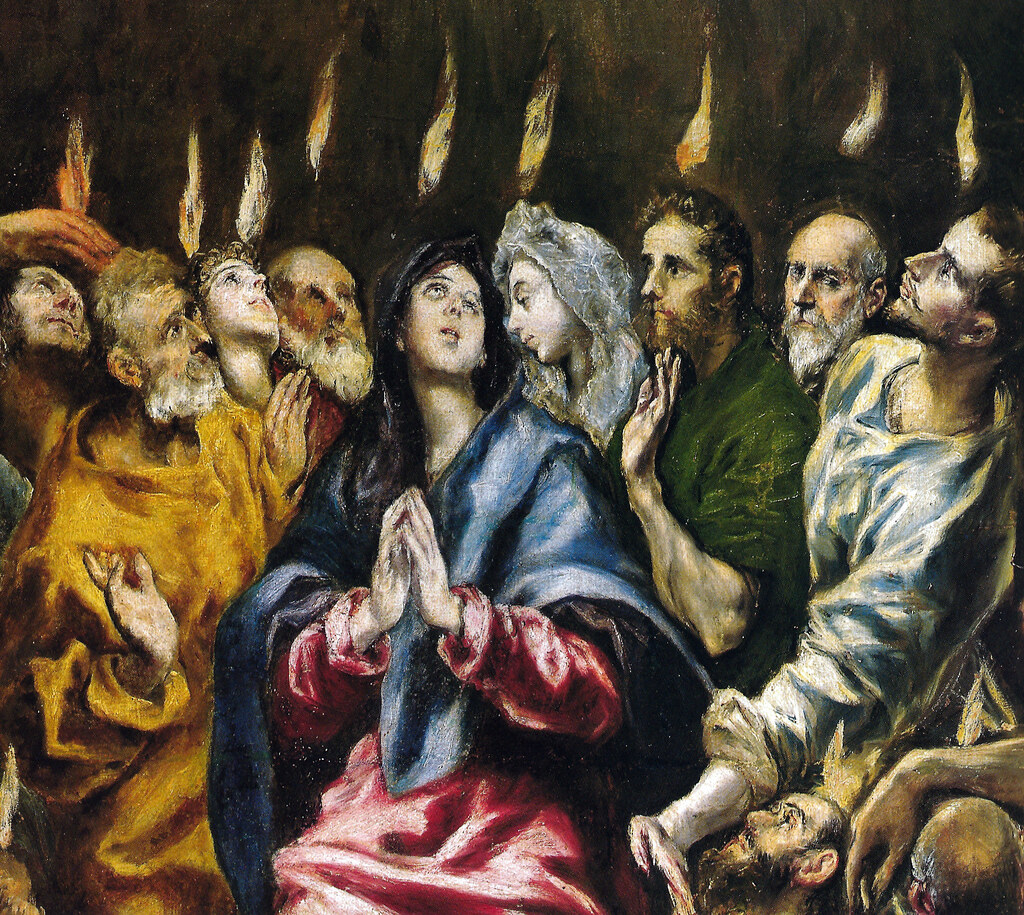
(Pentecost - He Qi): But we are to recognise this life; turning to it; embracing it; abiding in it. This Holy Spirit comes as comforter, yes; as peace in a hostile world, yes; as balm in Gilead, yes.

It comes not for our own benefit, but to teach us to witness  to the truth of God.

The Spirit speaks of energy and movement; imaginative creativity and prophetic challenge: wind, flame and breath.

The Advocate speaks of peace, comfort and courage; of a presence that guards against loneliness; of the pursuit of wisdom in uncertainty; calling for justice when life is not equal.


(Fire dove clip art): The language of God's love, forgiveness and mercy, is expressed in Jesus physical death and risen life in the body. 

The promised Spirit, the Advocate, continues to guide and inspire us; drawing us more deeply into truth; enabling us to love. It's a risky  and costly pattern of life: speaking with hope rather than colluding with fear; offering compassion not resentment.

Today we celebrate that that is how God communicates with us still: holding, loving, guiding and inspiring with every breath.

This is love: restoring, forgiving, compassionate and transformative.


Reflection Two


(Pentecost - El Greco):   In world where we hear the cry, I can’t breathe; Jesus breathes on us, changes us.

Today we are caught up in the transmission of a story which is both intensely personal and also cosmic in scope. It's a story which stretches language to the limits of imagination, passion and extravagance: rushing wind, tongues of flame, exuberant speech.

This story reveals the intimacy and power with which God communicates his love for us.  Tongues of flame is a revolution of the intimate (to quote Jennings); the movement of the wind is the sound of intimacy. Our anthem captures the beauty, disruption, bewilderment and hope of this revolution. 

One of the many striking things about this story is that amidst the amazement and questioning, there is a radical home coming; things are joined together; miraculous speech and miraculous hearing. People hear in their native tongue; in the the language of their heart.


(Peter - Michael Buesking): As Peter speaks, a community is broken open and recreated in the Spirit; it is a moment of grace as the Spirit overshadows, broods and inspires. 

Willie Jennings coined the phrase revolution of the intimate; and he describes Pentecost as: This is God touching, taking hold of tongue and voice, mind, heart and body.  Here is untamed grace - subverting our own fantasies of power and vengeance, and kindling something else. 

As Peter speaks, this revolution of the intimate is unleashed by the Spirit. Our ears, mouths and bodies are filled with with this language which frees us from oppression and kindles a shared commitment to hope. 

To speak this spirit-led heart language means learning to submit to the slow process of increasing our vocabulary, committing to practices, understanding the values and gifts of God’s Kingdom. And the more we learn, the more we fall in love with it.

And as we fall in love, we are called to walk a new road as wounded healers: advocates, comforters, prophets and creatives. 


(I will pour out my Spirit on all people - Marianne Gonzales Sims): As Jennings says: speak a language, speak a people. God speaks people fluently. And God wants us to speak people fluently too. 

In world where we hear the cry, I can’t breathe; Jesus breathes on us, changes us. And we speak.

We speak not only in words, but in our body language. As Jennings puts it: this will require bodies that reach across massive and real boundaries, cultural, religious and ethnic.  It is a body language that says: love your neighbour. 

This is, in the words of the prophet Joel that Peter quotes, a new world order. Energised by the spirit, young and old, male and female, slave and free become prophets, dreamers and activities for this new world. 

We pray that the Spirit will ignite in us a holy fire, strengthening us with the gift of faith.


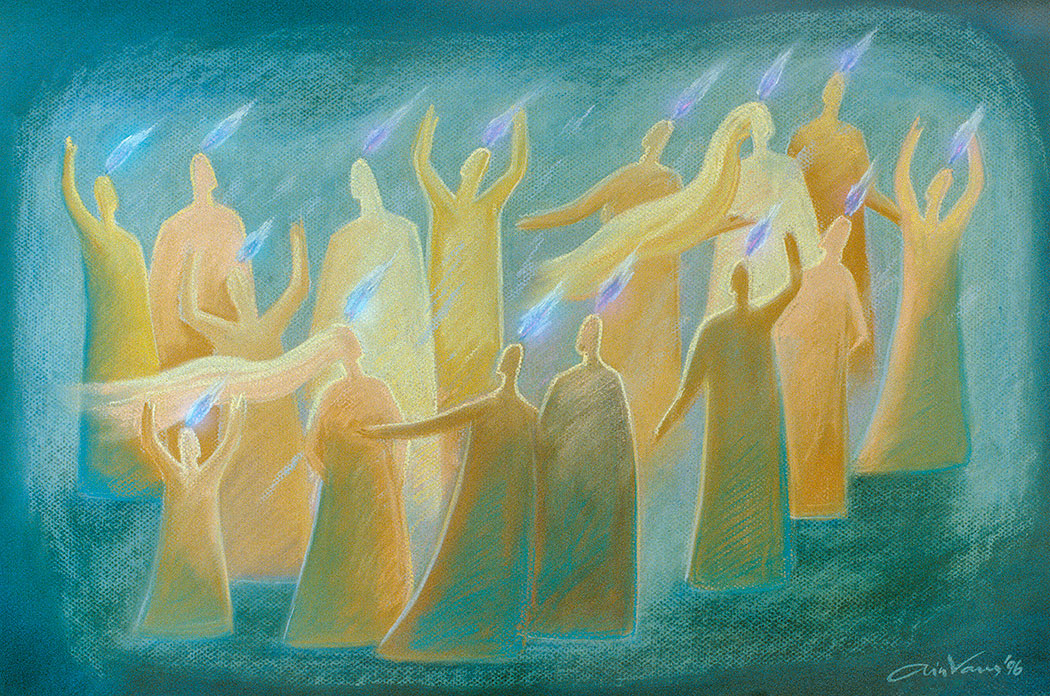
(The day of Pentecost - Ain Vares): We are strengthened because in Jesus, in going to the depths of human despair and alienation, to those places even when we lose ourselves, there is no longer anywhere where God's love is not. Christ's risen life, calls us to new life. In the power of the Spirit, he calls and calls and recalls each of us by name. That Spirit revives us with the breath of love.

This is the promise of abundant life - not just for a few, but for the whole world.  We pray, renew the earth. 

There is a balm in Gilead to make the wounded whole: when we ask not just who has died or who killed them, but what killed them. We hear the protest, seek repentance and hope for a better society. 

When there are disproportionate rates of death in one community - because of age or race - we have to attend to those wounds. And just may be, the spirit will turn them into sites for hope.

There is balm in Gildead to heal the sin-sick soul. 


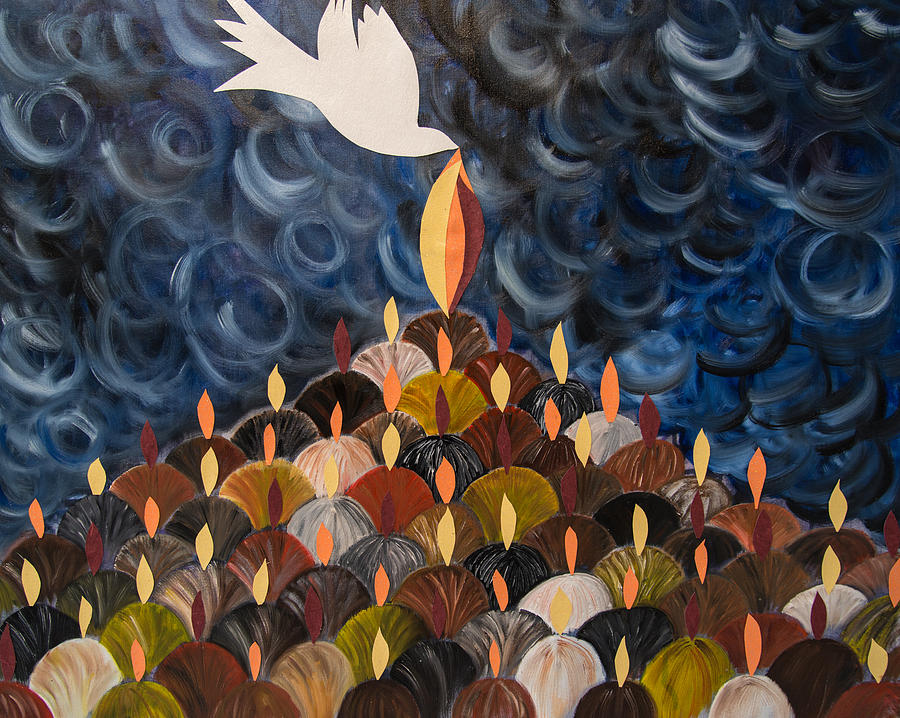
Jana Skarecky): Today we are presented with a vision for how human beings become channels of such love - to be transmitters or translators; to be embodiments of God's story.

In world where we hear the cry, I can’t breathe; Jesus breathes on us, changes us. And we speak. We act.

Like Marilynne Robinson, we’re to notice the stuff going on beneath the surface of life: the joy, guilt, dread and tenderness; and in our lives plot the patterns of forgiveness, the universal healing power of reconciliation and love.

When we feel discouraged, the Spirit revives our souls. We can be balm in Gilead, as the song puts it: 

If you cannot preach like Peter,
If you cannot pray like Paul,
You can tell the love of Jesus,
And say He died for all.

I can’t breath; we can’t breath.
Jesus breathes; we breathe.
Tell this love.

© Julie Gittoes 2020

Saturday, 14 May 2016

Language of the heart

Today it was very good indeed for former Gosden Scholars (lay chaplains) at Selwyn College to be reunited in th leading of worship at Melbourne Cathedral.  


A section of the stunning window in the 'west-end'  of St Paul's Melbourne

Over the last few days it's been a delight to spend time with old friends Andreas and Katherine, and also Gillian our former organ scholar; it's been an equal delight to meet new colleagues/friends and to explore a wonderful city.  Bringing with me greetings from the Cathedral Church of the Holy Spirit in Guildford, it was an honour to preach at the Choral Eucharist at St Paul'sl Cathedral, Melbourne.  The readings were: Acts 2:1-21; Romans 8:14-17; John 14:8-17, 25-7.

As we celebrate this feast of Pentecost, may the Spirit renew our vision, kindle in us the fire of love and bring forth fruit in our lives for the sake of God's Kingdom: in the name of God Father, Son and Holy Spirit. Amen.


What's your story?

That's the question posed by visitors to the State Library this month: already home to millions of stories, treasures and curiosities about the Victoria's history, we're all invited to file our own story to add to their collection. On Instagram, interactive displays or on special catalogue cards there are messages about romance and heartbreak; family and change; hopes and memories; quirky statements
of identity.


What's your story?

Exploring the art, culture and history of new places over the last couple of weeks has been a thought provoking and delightful experience for me.  Spending time with family has been a process of sharing stories about life and work, politics and faith - creating space for connection, laughter, discovery, and banter. It's about identity, yes; but it's also been about purpose. Who are we? What's important to us? What might our legacy be?

Those personal stories don't exist in isolation. They're woven into a complex matrix of narratives; layers and patterns of meaning, waves of disruption. Every gallery, exhibition, museum and garden; every tour, beach and cathedral has an impact. Learning new things and deepening my understanding; being inspired or having my curiosity aroused.

When we encounter something new - or the unexpected other - we adapt and change. Stories get re-written. We ask how well we know ourselves; we change in response to our encounters with others. We confront our prejudices and revise our first impressions. Although its relatively easy for a Brit to fit in here - belonging is intensified when you catch an accent from home.

What's your story?

Family, food, names, dress, daily rituals and, above all, our language roots us. The stuff of our dreams, our emotional reactions, the expression of our senses and the testing of ideas - all of that is so much easier in our mother tongue. When we lose our language, we lose part of our ourselves.

To name that reality heightens the significance of what today's celebration of Pentecost is about.

Today we are caught up in the transmission of a story which is both intensely personal and also cosmic in scope. It's a story which stretches language to the limits of imagination, passion and extravagance: rushing wind, tongues of flame, exuberant speech.

This story reveals the intimacy and power with which God communicates his love for us.

One of the many striking things about this story is that amidst the amazement, bewilderment and sneering, there is a radical home coming. People hear in their native tongue; in the the language of their heart.

This shouldn't surprise us: it is in continuity with the expression of God's love in the diversity of creation; in the commandments to love; in faithful calling and recalling in wilderness, exile and restoration. In the face of our human tendency for our desires to misdirected to things we consume or control, God's love remains faithful. In response to our propensity to exclude and wound - and our experience of being wounded and excluded - God comes to be with us.

This is our story.

John's Gospel began with the declaration that the Word became flesh; the Son who abided with the Father dwelt with us.  His identity was revealed all that he said and did: in words spoken to Nicodemus under the cover of darkness and to a Samaritan woman in the glare of noonday sun; on the boarder zones of blindness and sight; at a wedding feast in Cana and in the home of Mary, Martha and Lazarus. In all this he brought life in all its fullness in the embodied language of touch, taste and gesture.

The language of God's love, forgiveness and mercy, is expressed in Jesus physical death and risen life in the body. In going to the depths of human despair and alienation, to those places even when we lose ourselves, there is no longer anywhere where God's love is not. Christ's risen life, calls us to new life. In the power of the Spirit, he calls and recalls each of us by name.

This is the promise of abundant life - not just for a few, but for the whole world.  In advance of his death and resurrection, Jesus speaks words of farewell to his disciples. His words express enduring presence, not aching absence.

The promised Spirit, the Advocate, continues to guide and inspire us; drawing us more deeply into truth; enabling us to take risks as we improvise on the theme of God's love in all that we do and say. It's a risky  and costly pattern of life: speaking with hope rather than colluding with fear; offering compassion not resentment.

The Spirit speaks of energy and movement; imaginative creativity and prophetic challenge: wind, flame and breath.

The Advocate speaks of peace, comfort and courage; of a presence that guards against loneliness; of the pursuit of wisdom in uncertainty.

Today we celebrate that that is how God communicates with us still: holding, loving, guiding and inspiring with every breath.

This is our story.

The power of God is revealed in the core of our identity; moving close to us in the recognisable, authentic and compelling pattern of a rhythm of speech. We 'hear' that God knows and understands us - every hurt and hope, every joy and regret, every fear and desire.

This is love: restoring, forgiving, compassionate and transformative.

Today we are presented with a vision for how human beings become channels of such love - to be transmitters or translators; to be embodiments of God's story.

Paul reminds us that we are caught up in the process of salvation: some thing decisive has been accomplished in the reconciling love of God in Jesus' death and resurrection; the gift of the Spirit is at work within us, and all creation, as we await the fulfilment of God's Kingdom.

In baptism, we are now adopted children - heirs through grace. Our kinship is manifested in the way in which the Spirit bears fruit in our lives: enabling us to grow in patience and kindness; kindling in us generosity and joy; fostering the capacity to be gentle and forgiving. All these incremental shifts in virtue begin with the cry of prayer - Abba, Father.

That cry of prayer is reassuringly simple and intimate: our Father. It is memorable, profound and transformative: thy kingdom come. It is prayed second by second in 100s of languages;  yet, we are united in one language, that of God's Spirit in our human hearts.

This is our story.

But not ours alone. Assurance of God's love and presence is not a gift to possess; but a gift for the sake of the world. In world of upheaval where men, women and children seek freedom and a better life; when they flee conflict and disaster we have a story which speaks to the human heart. We have a language of kinship that transcends ethnicity and status; we proclaim a Kingdom where all have an honoured place.


This iconic holy place in the heart of a city stands amidst the clamour of sirens, birdsong and trams; it stands at a busy intersection, with commuters, the homeless and fashionistas, the student and the refugee. Here, in this place, your welcome releases gifts in others. Gifts of hospitality and conversation; gifts of advocacy and a concern for justice.

You are a dynamic holy people: you live, worship and work in the heart of this city and beyond. Wherever you are, the Spirit is at work in you: in acts of encouragement and compassion; in your skill and creativity; in your public service and private devotion. In all this, people come to know, explore and respond to the love of God; they worship in the language of their heart; they grow in fellowship, learning a second language.

The Eucharist is our food, our family, our ritual, our language, our identity.

As we touch and taste bread and wine; as we receive God's blessing, may we be renewed as Christ's body. Your story is God's story; God's story is revealed in your lives.

In the power of the Holy Spirit, may we like those Galileans in Acts,  witness to the love of God made manifest in Jesus Christ.

Julie Gittoes © 2016