Showing posts with label resistance. Show all posts

Wednesday, 31 July 2024

Sabbath rest

 2 June 2024 - Trinity 1: Deuteronomy 5:12-15, 2 Corinthians 4:5-12 and Mark 2:23-3:6


Before we set off for church this morning, how many of us checked that our phone was charged? 


We know the anxiety of hitting the red bar, switching to power saving mode; carrying a charger or battery pack ‘just in case’. 


Image Barnes & Nobel website


When it comes to recharging, some of us might be more mindful of the health of our phones than our minds and bodies.  Like our electronic devices, if we’re left on, if we keep going, we gradually run out of strength, energy and capacity.


There’s lots of advice out there for how to recharge: good sleep habits and eating well; taking time for exercise, getting out into the natural world as well as patterns of meditation or prayer.


Recharging feeds into what we need to rest. 


At a fundamental level we need rest and connection: it’s part of the created order. The writer of Deuteronmy reminded God’s people of that - 6 days of labour and 1 of rest, not just for individuals but whole households. Human lives were to echo the divine pattern of creativity.


This commandment, this call to holiness, is in invitation into the rhythm of sabbath: of life lived with God and each other was rooted not only rooted in creation but in the call to freedom from slavery. It expresses liberation from labour not just symbolically but in concrete terms: for immigrants, dependents, employees and creatures


Loving God and neighbour includes a practice or rest - regardless of economic status.It has within it a concern for social justice and the fair treatment of others; remembering and protecting those who’re marginalised, rebalancing social and economic power. 


The scholar Walter Bruggeman calls the sabbath an act of resistance and alternative. 


In the face of the rat race of anxiety and pressures he says  it is resistance because ‘it is a visible insistence that our lives are not defined by the production and consumption of commodity goods’. 


He says that it is an alternative to ‘the demanding, chattering, pervasive presence of advertising’; an alternative to all those things which ‘devour our “rest time”.’


In our Gospel reading, Jesus underscores that sabbath is a principle for just, dignified and humane relationships. It takes us to the heart of God’s will for us - loving God, neighbour and self with all that we are is shaped by the substance of this call to rest. Rest is an expression of being faithful in love. 


Rest is a gift from God; a sign of faithfulness and justice. Within it, there is the freedom not just to recharge from what we refrain from doing, or good habits of sleep and exercise. It also includes those restful goods of rejoicing, being present, hospitality, living lightly - relying on divine grace and delight not human force or coercion. It includes perhaps the gift of compassion as something sacred.


‘The sabbath was made for humankind’, says Jesus, ‘not humankind for the sabbath’.


Like all of us, the Pharisees in today’s gospel have their own values and convictions, preferences and commitments they regard as absolute. Like them, we might find that those things, however well-intentioned - can get in the way of compassion. 


To be human means that sometimes we will set things in stone which block that channel of love. We will sometimes preserve those things which sustain or shape our faith, our habits and preferences, and miss the call to honour what is sacred. That might be the appropriate rest and care for ourselves; it might be the compassionate response to another. 


Perhaps here in Hendon, we are acutely aware of the holy disruption of sabbath: streets quieter, shops closed, cafes falling silent as our Jewish brothers and sisters make space for worship, rest, households and food. 


But what can we relearn from that pattern?


In a world where life runs 24/7, where work is both zero hours and every hour, where what we want is often but a click away; where news, filtered by algorithms, scrolls across our phones, how do we seek what is just? 


When we face the pressure to juggle the demands of work, friends, interests, exams, family, chores can feel overwhelming or paralysing, where are our intentions met by rest and compassion?


When fear fragments and a lack of hope chills our hearts, how do we return to love? To that which is truly sacred and which shapes our lives?


There is something unsettling about the gospel story: as Jesus walks through fields and into the temple and challenges us about what we hold dear - or what we’re too holy, prideful, selfish or judgemental to notice.  


It’s a story about being present and wholeness, about reaching out and the risk of hope. It’s a story which reminds us of the just rhythms of sabbath which will disrupt the relentless expectations - of rest and compassion, of love that notices what is around us.


As Bruggeman explores the traditions of interpreting Sabbath, he says this: it ‘is not simply a pause. It is an occasion for reimagining all social life away from coercion and competition to compassionate solidarity. Such solidarity is imaginable and capable of performance only when the drivenness of acquisitiveness is broken. Sabbath is not simply the pause that refreshes. It is the pause that transforms.’ 


There is something more to sabbath than following a human instruction manual - a physical plugging in waiting for the battery to top up. Rest is necessary for us, allowing exhaustion and grumpiness to be replaced by love; but there’s depth of solidarity too, a reimagining of what relationships and communities might be like as we attend to God and to ourselves and our neighbour.


Our Sunday worship is one such moment of pause: as wanderers through life we come ‘Nearer, my God, to thee, nearer to thee!’ Our anthem speaks of rest and mercy, and walking a path that allows us to rise upwards. God does indeed come near to us - in the words of blessing, in the bread of life and the wine of joy. God comes so near to us here that as Paul puts it we carry in ourselves the body of Jesus - so that his life might be visible in us. 


However afflicted or perplexed, despairing or tired we are, we carry in us light and life and love. We have that treasure in clay jars - because this power comes from God, not us. It’s a power that, as our anthem reminds us, raises us up - may we take that song into our working week and our times of sabbath rest. 


© Julie Gittoes 2024

Sunday, 28 October 2018

Lessons from Catfish Row

On the Feast of St Simon and St Jude, I found myself grappling with Isaiah's challenge to place our trust in God rather than making lies and falsehood our refuge. It seemed so pertinent especially when heard in the context of Jesus' words about the world's hatred.  

But as I was writing this sermon, news of the attack in Pittsburgh unfolded. I am grateful to Paula Gooder who shared words from the Talmud on Twitter. How do we resist the hatred manifest in antisemitism? How to we testify to God's reconciling love in world which seems to intent on deathly falsehoods?  In part, by refusing to be daunted by the world's grief and showing mercy, now.

In that sense, Porgy and Bess might seem like an opening which sounds a lighter note: but this unlikely pairing echo Simon and Jude's commitment to a better world in resistance, kindness and refusing to see the other as a lost cause. There are lessons from Catfish Row.

Preaching today felt like an intense exercise of the poverty of my speaking. 


Summertime, 
And the livin’ is easy

So begins one of the most famous opening songs of any opera or musical: we hear a mother swaying to the bluesy melody.  

So hush little baby
Don’t you cry.

Around her couples sway with each other in sultry dance. It’s hot; it’s airless. The day’s long; the night’s beginning. Dice roll; money’s won and lost; tension rises. This mother keeps on singing; it’s a lullaby of parental protection.

There’s a’nothing can harm you
With your daddy and mammy standing by.

For the residents of Catfish Row such harm comes in several guises. They face the divisions of race and whiteness; livelihoods are threatened by storms; violence, addiction and exploitation are near the surface. 

And yet, on Catfish Row there’s a depth of solidarity and resistance. It’s a community which pulls together; which mourns and laughs together.  It’s a community which calls boldly on the name of Jesus; where cynicism about religion is chastised. 

It’s a world where people rise up singing. 

Then you’ll spread your wings
And you’ll take to the sky.

This lullaby is no whimsical folk song; it’s a call to struggle, liberation and hope. 

This is the world, if you’d not guessed it already, of Porgy and Bess


When Bess’s drunk and aggressive partner abandons her, it’s Porgy the crippled beggar who shows her human kindness. It’s he who protects her and gives her shelter. Together, they find happiness within community. Even when the darkness of Bess’s past haunts their present, Porgy’s love determines not to let her go.

We don’t know the end of the story but Porgy and Bess leaves us with broken silences: there story is an operatic cry for justice. Decades before campaigns such as #MeToo or #BlackLivesMatter, the songs they sing rise up against sexual abuse and racism. Through their eyes we see the ways in which human agency and dignity can be diminished; and we glimpse, albeit fleetingly, the power of love. 

Porgy refuses to write Bess off as a lost cause.

Today we celebrate the witness of a different pairing: Simon and Jude. Though we know little about them, like our operatic duo, they teach us something about both prophetic resistance to oppression and the refusal to see people or situations  as irredeemable.

Something in Jesus’ words and actions resonated with them: the challenge he represented to the powerful, his preferential treatment of those on the margins, his teaching about self-giving love, the way in which his touch brought healing, restored dignity and formed community.


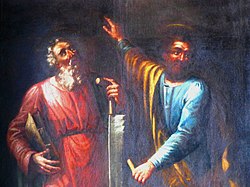
Simon and Jude

Neither Porgy and Bess nor Simon and Jude are under any illusion about the impact of the choices we make on ability to flourish and grow in trust.  

Isaiah makes this contrast in stark terms: when we collude with falsehood and lies, we sign a contract with death. Lies which tell us who to blame, who to mistrust, who is drain on the system; falsehoods about quick wins - staking our futures on the role of the dice.

Isaiah cries out that we are to place our trust in sure foundation; to walk in God’s ways; to chose moment by moment that which makes for peace; to align our wills with justice and compassion. 

A theme picked up by Paul as he writes to the Ephesians. If falsehoods set up a series of divisions and lies generate hostility, God, in Jesus, points us to a different path. He is the cornerstone; the one in whom we trust. In Christ, we move from being strangers and aliens to citizens. 

We literally have a place. 

We have value and dignity as God’s beloved. 

Jesus’ words also remind us of our belonging in God, to each other. To become a disciples and friend and follower of Jesus is to take to heart the call to love one another. And to do that we are called out of the world - the world of falsehood, exploitation and illusions; and yet we are sent into that world, to be a presence of relentless and purposeful love.

The world is loved by God - in all its fragility and beauty. Yet within our world there are places where love is not present; where fragility is exploited and beauty ruined. Our relentless consumption of plastics causes harm within the ecosystem; our enslavement to arms continues to destroy and oppress; our hatreds and fears lead to death. But this is not the end of the story. 

The world is loved by God - in all its fragility and beauty. And the light of the world stepped down into darkness; the word of God spoke truth to power. Jesus gave his life totally in order that through his death we might have the fullness of life.  


Love wins.

Our lives, dedicated to him, are likewise given for truth and justice; to love and cast out fear.  Jesus warn this disciples that the relentless pursuit of love will mean that they too face opposition, misunderstanding and suffering. And yet, the song of that love rises up through us. Even in our smallness and weakness, life breaks in. 

The first disciples, among them Simon and Jude, said “no” to lies, oppression, injustice and abuse; they said “yes” to freedom, truth, compassion and self-giving. 

Jean Vanier, the founder of the L’Arche Community, continues to challenge and inspire us to live together in ways which embody this Christ-like love. It is not easy. 

In what he describes as the martyrdom of daily pinpricks we will sometimes be rejected or misunderstood; regarded as a threat or pushed aside; the hatred of indifference or inconvenience. 

Sometimes those pinpricks arise not from outright hostility but because the Gospel is not understood.  We must continue testify God’s love in our institutions which shape the fabric of our common life - the welfare of the poor, wisdom in education, compassion for the sick, justice for the victim, restoration for the guilty, dignity for the dying.

It would be tempting to risk compromise with a culture that erodes these values or marginalises the weakest. As Vanier says: We are fearful of speaking out about Jesus or about justice and truth. We are afraid to rock the boat. We are frightened of what people might think or do to us if we disturb them or the cultural order. So we water down faith and the gospel message. 

Our witness is not dependent on our own strength but on the gift of the Spirit: our Advocate and guide; the power of God’s love at work in us. Through the Spirit we are to testify to the truth in the name of Jesus. We are to be lights in our world. 

In the face of human prejudices, ambition and loneliness, we are to use the gifts entrusted to us to speak and act for the ultimate values of God’s Kingdom.

As we do so, we are being built on the foundations of Simon, Jude and all the apostles; Christ is our cornerstone, bearing the weight. 

In a world where a gun man attacks members of the Jewish community gathering in the Tree of Life synagogue in Pittsburgh: how does our testimony condemn anti-semitism; how does our witness strive to choose life, to grant others dignity?  

As we are built up as members of God’s household, words from the Talmud, the central text of Rabbinic Judaism:
Do not be daunted by the enormity of the world’s grief.
Do justly, now.
Love mercy, now.
Walk humbly now.
You are not obligated to complete the work, 
but neither are you free to abandon it. 


© Julie Gittoes 2018