Showing posts with label mercy. Show all posts

Saturday, 7 September 2024

A kindness in God's justice

1 September, Trinity 14: Deuteronomy 4:1-2, 6-9, James 1:17-end 

& Mark 7:1-8, 14-15, 21-23


Do you remember any of your school rules?


Reminiscing with my sister, we recalled being allowed to go as far as Wathen’s sweet shop; but also being forbidden from eating in the street. 


We both remembered going to the fair at lunch time - waltzers, dodgems, the mexican hat - cash zipped into blazer pockets alongside pens, making it back just in time for the bell.  Maybe it wasn’t banned, maybe rules were flouted, or maybe it was an accepted tradition: who knows! 


We were definitely banned from ‘spinning out on cups of coffee’ in cafes which always seemed like a curious rule at that time as it didn’t seem a likely teenage temptation let alone habit.


Coffee cups: stock image


Fast Forward 30+ years and that rule has been dropped from the list - replaced by the more ambiguous yet weighty generic of pupils remembering ‘that they are representing the School in public areas’.


That said, working in cafes is now more normative - both socially acceptable on the one hand and an irritation to owners on the other if coffees are ‘spun out’ for hours. 


Rules and traditions are both given by communities and also form them.  Within schools, they’re designed to maintain discipline and provide structure to underpin an environment where learning can happen.  


It’s about more than that: some might be about ideas of etiquette, behaviour or personal development; others about protecting students from harm as part of safeguarding. The values that underpin the wider ethos might be political, social or religious - an overarching vision for human flourishing and fostering the common good. 


Our first reading sets statutes and ordinances within the context of establishing a settled community after a period of nomadic life as God’s people trekked through the wilderness. They were to be a covenant community shaped by obedience to the commandments. 


The ten commandments reflected a series of right relationships: loving God and loving one’s neighbour as oneself. They offered a framework which set boundaries on acceptable behaviour in worship and community.


Adherence to such teachings were to be a sign to others - who might find their way of life attractive, a means of stability and flourishing; a mark of wisdom and discernment.  Their life together was to reflect the nature of God: a Holy One who knows the thoughts of our hearts, beyond our comprehension yet the source of goodness, justice, rest and joy. 


Worship of this God - and the distinctive ways of this people - was to be passed down to future generations. Children would be taught these commandments - inhabiting a culture which set out how to show their love of the Holy One in worship and in their behaviour, honouring their obligations to their neighbour. 


There is wisdom and discernment in this - inviting us to consider our motivations for doing the ‘right thing’. Is it about compliance or how we feel - or pointing to the kind of God we trust in?


Yet overtime, as the community faced new challenges and influences, those commandments prompted further questions. Fresh guidance was needed - clarification, interpretations, case studies. 


All these things were ways of making sure that the holiness of God was honoured; that nothing impure would get in the way. Way of making sure the community was distinct: that food was safe to eat and that relationships were appropriate.


Every community does this. We have our rules which shape our culture and expectations.   Every church has its ‘normal’: but we’re also shaped by beliefs and traditions - about God and how we live together. 


Today Jesus is challenging his hearers to consider what flows from the heart. Do our attempts to live faithfully tempt us to judge others on externals? It’s easy for us to say ‘thank goodness we’re not like the Pharisees’ but we also have an opportunity to understand them - and in turn appreciate how Jesus’ words might challenge us.


The Pharisees took the call to be a holy nation very seriously. As the community settled into ordered patterns of worship, and sought to maintain a distinctive life, we can understand why the ritual of washing hands (done by the priests serving in the temple) might be extended to ordinary meal times as a way of marking it as sacred. 


Those additional traditions of the elders became increasingly important to maintaining their faith and way of life - particularly in exile, when reestablishing community afterwards or under Roman occupation as they then were. 


When they saw Jesus’ sitting lightly to some of those things with his disciples they were moved by fear that  it was a step towards undermining God’s law itself. 


Jesus’ words of reproach in response was perhaps undermining their expertise and seriousness: but rather an invitation to go deeper into. Jesus quotes Isaiah which teases out the distinction between keeping rules externally and neglecting our internal motivations. 


‘This people honour me with their lips, but their hearts are far from me’. 


The external practices designed to demonstrate wisdom and discernment, to point others to God’s holiness and to be a blessing to others had become such a focus, that the life of the human heart had been neglected. 


The focus on the external left some excluded or marginalised - women or foreigners for example. Yet they were those about whom the commandments of God were also concerned. Love of neighbour included the widow, orphan and stranger. 


As people of faith we too want that commitment and trust to be reflected in the concrete realities of our lives. Sometimes we might be tempted to limit the scope of God’s grace - to think that some might be more or less deserving of that grace than others. 


As Faber’s famous hymn puts it, there is ‘a wideness in God’s mercy’ and a ‘kindness in God’s justice which is more than liberty’.  


Faithfulness to God’s ways is about loving God with all that we are - heart, mind, soul and strength - and also loving our neighbour as ourself. Sometimes as Faber continues ‘we make God’s love too narrow / by false limits of our own, / and we magnify its strictness / with a zeal God will not own.’


With the no nonsense pragmatism about the natural processes of digestion, Jesus stresses that nothing from outside of us can defile us. Instead look to our hearts: and the way bitterness or deceit, envy or pride, misdirected desires and selfish intent can take root there. What is in our hearts, can shape our thoughts, attitudes and actions, separating us from God and each other. 


Yet this is also good news: because God knows all the secrets of our hearts. In Jesus love divine is known in human flesh - the one who dares to embrace the outcast, raise up the lowly, restore the sick, challenge the powerful.  His life was given for all. There is welcome and grace, there is ‘mercy with the Saviour, there is healing in his blood’ as the hymn puts it. 


That good news does have a claim on our lives: faithfulness is about attending to our heart and reaching out to others with lives that have been shaped by the radical love of God given for us in Jesus Christ.  The breadth of such love is an invitation to rest on that assurance that ‘our lives would be illumined / by the presence of our Lord’. 


The letter of James leans into the lessons of such a way of faith and faithfulness: he too contrasts the gifts of grace and acts of love which come from God, and the desires that separate us from earth other,  the ways of death rather than life. How can we live as children of God, rather than as those shaped by solely worldly desires?


He talks about the importance of communication - of listening and keeping a cool head; warning against the danger of rising too quickly to anger. Yet at the same time seeking what is justice and good. 


How we communicate impacts on how we are heard; how we listen shapes what we say. Allowing space for curiosity about the other or getting to the root of the concern might open up new ways forward. Though sometimes perhaps we have to take a deep breath, walk away, and allow the temperature to go down; or sometimes the mediation of others.


James also stresses the importance of faithful action - or action informed by our faith. He uses the shorthand ‘law of liberty’ for God’s commandments of love.


These should be things that shape our body language - not glimpsing in the mirror and forgetting what we look like - but practising those gestures of kindness, self-control, compassion, patience, generosity and joy.


For James faith and faithfulness is about caring for each other and those who’re vulnerable or marginalised: remembering that we are not just representing Jesus in the personal and public areas of our life; we are members of Christ's body called, by the power of the Spirit, to be a living sign of God’s ways. Amen.


© Julie Gittoes 2024

Tuesday, 3 December 2019

They will walk behind the ploughshare

A sermon preached on Advent Sunday. Isaiah's words about swords and ploughshares have become iconic. I was stuck by the finale of Les Mis - and by the important work of the Institute for Criminology in Cambridge - in the risk of grace and rehabilitation. The texts were Isaiah 2.1-5; Romans 13.11-end; Matthew 24.36-44

In a few weeks time, a season of waiting will come to an end.

There will be dazzling lights and heartfelt song.

In mid-December, Les Mis reopens at the Sondheim Theatre in the West End.

The tunes: they get us right here.

They tug at us: from 'I dreamed a dream! 'to 'Do you hear the people sing?'


Translating Hugo Victor’s epic novel into musical theatre, draws us into a revolution of the past. 

Through song we are drawn into the struggle of the poor getting older and colder; we grapple with law and grace.

That struggle is framed around how to restore order and harmony: the struggle between the idealist revolutionary uprising and the conservative stability of the state.

Both see political power as  means to accomplish God’s justice and harmony; both seek to violently take charge of the world in order for God’s Kingdom to come.

Les Mis is also shot through with love, grace and mercy.  These things can’t be reduced to politics, law enforcement or economics.

Perhaps it’s the character of Valjean who helps us most vividly navigate a way though the violence of judgement and idealism. It’s through him that the plight of the poor - Les Misérables - becomes personal, rather than abstract.

Valjean’s first experience of grace is when the pries gives back to him the candlesticks he’s stolen. That one act of mercy saves him. The thief is forgiven; he experiences kindness; he sees the world differently. He is restored. 

Valjean’s second experience of grace is when he - now a factory owner and mayor - faces his own complicity with the fate of Fantine: her story is one of exploitation; her song is heartbreakingly and soul-crushingly tragic. 

In his response to Fantine and Cosette, we see Valjean himself become a channel of the grace, mercy and kindness he’d received himself.

In some way, we might see Les Mis as the archetypal Advent musical. For at its heart is the cry for justice; and such a cry is the thread running through this season.

As we light candles week by week, we are laying claim to the hope of our ancestors in the faith; the prophetic cries for peace and; the joy and love of those who point us to a wordless infant who is God with us.

Our Advent cry perhaps echoes the finale of Les Mis:
They will live again in freedom
In the garden of the Lord.
They will walk behind the ploughshare,
They will put away the sword.

The musical puts on the lips of the chorus the cry of the prophet. 

It is a cry that expresses our desire to bring an end to war and injustice; a cry that invites to look at the world around us; to examine our hearts; to name the inconsistencies.

At the very beginning of Isaiah’s witness, this is what he talks about.  He brings into the present this future hope; the ultimate decommissioning of weapons. Swords and spear are put beyond use. The means of mass destruction become the means of food production. 


"Swords into ploughshares..." - Wall at Raoul Wallenberg Place, near the United Nations Headquarters, New York City


The worlds of Valjean and of Isaiah share with us this concern for justice and peace.

Their worlds are marked by criminality and corruption; exploitation and privilege; by judgements and governance that are always imperfect and sometimes unjust.

But these things breed mistrust and fear. Isaiah cries out to a people who’ve drifted away from their first love: who’ve neglected God and God’s ways of mercy and justice. 

Isaiah’s cry calls them back to God and invites them to relearn God’s ways, to walk a different path - placing one step in from of the other. 

This Kingdom is coming, but it is not here yet. We seek it; struggle for it; glimpse it; build it.

And that is why we need to remain alert; so that we can be prepared; and not taken by surprise.

Today we light the first our of our Advent candles: a glimmer of light which reminds us of the hope of the Kingdom where no one is left behind to grow older and colder; where all are made welcome; where human concerns for status, power and wealth melt away before God’s justice.

Jesus’ words in today’s Gospel both alarm us and give us hope.  The task of the disciple is not to predict the ‘end times’. Instead our task is to live by faith - that means refusing to live by fear and embracing life lived in loving obedience to God. Just like Isaiah and Paul, we are in this for the long haul. 

How do we live in these bewildering and uncertain times?

By faithfully embodying the love of God; witnessing, in the power of the Spirit, to that love made manifest in the humility of Jesus. 

But what of Jesus’ words about division, separation and the brutal disruption of daily life?

It’s by use of dramatic and apocalyptic language that Jesus seeks to convert the urgency of the situation and the demands of the challenge he presents to us.  We are called to be ready and prepared; we do not know how much time is left to us here on earth. We are to use the time that we have to an active waiting on God, which makes hope possible. 

All this is summed up in the imperative: keep awake!

We come to Jesus in the hope that he’ll rouse us from sleep: that our hearts might be directed to God in worship; that the Spirit might kindle in our hearts the fire of love; that our wills and desires might be directed to ways of peace.

Perhaps we find in Paul’s letter to the Romans a particularly timely reminder for how to live in the face of upheaval. He asserts that in Christ there has been the ultimate regime change from darkness to light; from night until day. Therefore he urges us to be prepared both inwardly and outwardly. 

If we are alert to the nearness of God, if we live in his light. To live in light means that we lay aside the need to gratify temporal desires; jealously, quarrelling and the revelling are distractions.   

To live in light means being alert to the risks we take for justice and peace in our own generation.  Some of that risk taking for the sake of others was evident on Friday afternoon - as two men used a fire extinguisher and narwhal tusk. 

But it was also evident on Friday afternoon in the work that the Cambridge Institute for Criminology is doing as a force for good in seeking to rehabilitate offenders. Jack Merritt lost his life was part of this project - a 21st century version, perhaps, of Valjean being given the candlesticks as an act of grace and mercy.

Jack's father said: ‘Cambridge has lost a proud son and a champion for underdogs everywhere, but especially those... who ended up in the prison system’. The pursuit of justice and mercy is a matter of the personal as well as the policy.

The Eucharist in which we share, restores our hope in God’s kingdom. We hear of God’s work of creation and redemption; of love which patiently reaches out to us in love. Here we come to the one who is to come; here we lament and repent; here we are forgiven and sent out.

Here receive what we are, and become what we receive: the Body of Christ. And bodies live and move and breath and act in the world.  

We are a body called to both hope and patience - in world which is often devoid of the former and which has no time for the latter. 

And yet, our song is of a hope of restoration, of peace and of justice:
They will live again in freedom
In the garden of the Lord.
They will walk behind the ploughshare,
They will put away the sword.


© Julie Gittoes 2019

Sunday, 28 October 2018

Lessons from Catfish Row

On the Feast of St Simon and St Jude, I found myself grappling with Isaiah's challenge to place our trust in God rather than making lies and falsehood our refuge. It seemed so pertinent especially when heard in the context of Jesus' words about the world's hatred.  

But as I was writing this sermon, news of the attack in Pittsburgh unfolded. I am grateful to Paula Gooder who shared words from the Talmud on Twitter. How do we resist the hatred manifest in antisemitism? How to we testify to God's reconciling love in world which seems to intent on deathly falsehoods?  In part, by refusing to be daunted by the world's grief and showing mercy, now.

In that sense, Porgy and Bess might seem like an opening which sounds a lighter note: but this unlikely pairing echo Simon and Jude's commitment to a better world in resistance, kindness and refusing to see the other as a lost cause. There are lessons from Catfish Row.

Preaching today felt like an intense exercise of the poverty of my speaking. 


Summertime, 
And the livin’ is easy

So begins one of the most famous opening songs of any opera or musical: we hear a mother swaying to the bluesy melody.  

So hush little baby
Don’t you cry.

Around her couples sway with each other in sultry dance. It’s hot; it’s airless. The day’s long; the night’s beginning. Dice roll; money’s won and lost; tension rises. This mother keeps on singing; it’s a lullaby of parental protection.

There’s a’nothing can harm you
With your daddy and mammy standing by.

For the residents of Catfish Row such harm comes in several guises. They face the divisions of race and whiteness; livelihoods are threatened by storms; violence, addiction and exploitation are near the surface. 

And yet, on Catfish Row there’s a depth of solidarity and resistance. It’s a community which pulls together; which mourns and laughs together.  It’s a community which calls boldly on the name of Jesus; where cynicism about religion is chastised. 

It’s a world where people rise up singing. 

Then you’ll spread your wings
And you’ll take to the sky.

This lullaby is no whimsical folk song; it’s a call to struggle, liberation and hope. 

This is the world, if you’d not guessed it already, of Porgy and Bess. 


When Bess’s drunk and aggressive partner abandons her, it’s Porgy the crippled beggar who shows her human kindness. It’s he who protects her and gives her shelter. Together, they find happiness within community. Even when the darkness of Bess’s past haunts their present, Porgy’s love determines not to let her go.

We don’t know the end of the story but Porgy and Bess leaves us with broken silences: there story is an operatic cry for justice. Decades before campaigns such as #MeToo or #BlackLivesMatter, the songs they sing rise up against sexual abuse and racism. Through their eyes we see the ways in which human agency and dignity can be diminished; and we glimpse, albeit fleetingly, the power of love. 

Porgy refuses to write Bess off as a lost cause.

Today we celebrate the witness of a different pairing: Simon and Jude. Though we know little about them, like our operatic duo, they teach us something about both prophetic resistance to oppression and the refusal to see people or situations  as irredeemable.

Something in Jesus’ words and actions resonated with them: the challenge he represented to the powerful, his preferential treatment of those on the margins, his teaching about self-giving love, the way in which his touch brought healing, restored dignity and formed community.


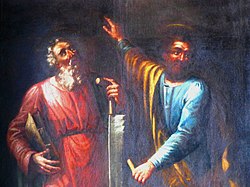
Simon and Jude

Neither Porgy and Bess nor Simon and Jude are under any illusion about the impact of the choices we make on ability to flourish and grow in trust.  

Isaiah makes this contrast in stark terms: when we collude with falsehood and lies, we sign a contract with death. Lies which tell us who to blame, who to mistrust, who is drain on the system; falsehoods about quick wins - staking our futures on the role of the dice.

Isaiah cries out that we are to place our trust in sure foundation; to walk in God’s ways; to chose moment by moment that which makes for peace; to align our wills with justice and compassion. 

A theme picked up by Paul as he writes to the Ephesians. If falsehoods set up a series of divisions and lies generate hostility, God, in Jesus, points us to a different path. He is the cornerstone; the one in whom we trust. In Christ, we move from being strangers and aliens to citizens. 

We literally have a place. 

We have value and dignity as God’s beloved. 

Jesus’ words also remind us of our belonging in God, to each other. To become a disciples and friend and follower of Jesus is to take to heart the call to love one another. And to do that we are called out of the world - the world of falsehood, exploitation and illusions; and yet we are sent into that world, to be a presence of relentless and purposeful love.

The world is loved by God - in all its fragility and beauty. Yet within our world there are places where love is not present; where fragility is exploited and beauty ruined. Our relentless consumption of plastics causes harm within the ecosystem; our enslavement to arms continues to destroy and oppress; our hatreds and fears lead to death. But this is not the end of the story. 

The world is loved by God - in all its fragility and beauty. And the light of the world stepped down into darkness; the word of God spoke truth to power. Jesus gave his life totally in order that through his death we might have the fullness of life.  


Love wins.

Our lives, dedicated to him, are likewise given for truth and justice; to love and cast out fear.  Jesus warn this disciples that the relentless pursuit of love will mean that they too face opposition, misunderstanding and suffering. And yet, the song of that love rises up through us. Even in our smallness and weakness, life breaks in. 

The first disciples, among them Simon and Jude, said “no” to lies, oppression, injustice and abuse; they said “yes” to freedom, truth, compassion and self-giving. 

Jean Vanier, the founder of the L’Arche Community, continues to challenge and inspire us to live together in ways which embody this Christ-like love. It is not easy. 

In what he describes as the martyrdom of daily pinpricks we will sometimes be rejected or misunderstood; regarded as a threat or pushed aside; the hatred of indifference or inconvenience. 

Sometimes those pinpricks arise not from outright hostility but because the Gospel is not understood.  We must continue testify God’s love in our institutions which shape the fabric of our common life - the welfare of the poor, wisdom in education, compassion for the sick, justice for the victim, restoration for the guilty, dignity for the dying.

It would be tempting to risk compromise with a culture that erodes these values or marginalises the weakest. As Vanier says: We are fearful of speaking out about Jesus or about justice and truth. We are afraid to rock the boat. We are frightened of what people might think or do to us if we disturb them or the cultural order. So we water down faith and the gospel message. 

Our witness is not dependent on our own strength but on the gift of the Spirit: our Advocate and guide; the power of God’s love at work in us. Through the Spirit we are to testify to the truth in the name of Jesus. We are to be lights in our world. 

In the face of human prejudices, ambition and loneliness, we are to use the gifts entrusted to us to speak and act for the ultimate values of God’s Kingdom.

As we do so, we are being built on the foundations of Simon, Jude and all the apostles; Christ is our cornerstone, bearing the weight. 

In a world where a gun man attacks members of the Jewish community gathering in the Tree of Life synagogue in Pittsburgh: how does our testimony condemn anti-semitism; how does our witness strive to choose life, to grant others dignity?  

As we are built up as members of God’s household, words from the Talmud, the central text of Rabbinic Judaism:
Do not be daunted by the enormity of the world’s grief.
Do justly, now.
Love mercy, now.
Walk humbly now.
You are not obligated to complete the work, 
but neither are you free to abandon it. 


© Julie Gittoes 2018

Monday, 11 July 2016

Kindness to strangers

The kindness of strangers: Are good Samaritans the exception or norm?

So ran a headline on the BBC news website only 10 days or so ago.  

Uplifting stories of strangers intervening to offer practical help or even to save a life catch our attention. Some of those momentary encounters cost very little. Some might seem undramatic, others heroic; a matter human instinct, just doing my job, or being in the right place at the right time. 


Vincent van Gogh: The Good Samaritan canvas (Kroller-Muller Museum, Otterlo)

In the face of fear, visible intentional support of the other strengthens bonds of community.

The BBC article drew on social psychology to explore what happens when we witness an attack, an emergency or person who's taken ill. Our minds go through rapid, unconscious, calculations in an instant. Is it dangerous? Can I help? Will others step in? What's my responsibility. 'The longer you leave it', says Professor Levine, 'the harder it is to make a decision'. 

We might walk on by.

But if one person acts, others join in. We are most likely to intervene, the article suggests when we 'feel some sort of group kinship with the victim, even something as superficial as wearing the same football shirt'.

 A sense of shared identity; a sort of group kinship.

We are different from one another: what we eat and our accent; the languages we speak and what we wear; our name, our family. What matters, is how we respond to difference. Our identity is shaped in relation to others; we recognise shared concerns or passions, a common humanity.

The imperative to strengthen bonds of recognition across difference is vital to our national life; to take a stand against racism and prejudice; working together because our liberation is bound up with the other. 

We face generational and regional divides; we've been confronted by normative judgements about motherhood and competitive claims about having a stake in our future.  All this is disrupted in today's reading. We are too look beyond difference and see the stranger as an intimate, our own familiar friend.

Perhaps the familiarity of the story makes us complacent; we disconnect it from the challenging questions which surround it. Let's pay attention afresh.

Can we do anything to inherit eternal life? Perhaps it's a trick question; inheritance is itself a gift. We can't do anything to earn it. Yet it is bound up with relationship or kinship; with the nature of love.  In inviting the lawyer to answer on his own terms, we're taken to the heart of the commandments. To love God and neighbour.

How can we love the other as they are unless we're not first filled with the love of God? 

Look around you: loving one another in our difference is a demanding task, even when people are quite like us. It's more than following Jesus as an ethical role model.  The energy and motivation to love deeply, consistently and compassionately flows from the Spirit at work in us.

If Jesus raises the bar on our loving, then the lawyer wants to know the terms and conditions: he wants clarification, who qualifies?

The laws of Leviticus talks of commitments to two kinds of 'neighbour': your own kith and kin, one in your own family line; the stranger, the alien in your midst.   Rather than give such a definition, Jesus tells a story which stretches our imaginations.

We imagine what it is to be attacked, wounded, abandoned, and vulnerable. 
We consider the rules, duties and fears which constrain us.
We contemplate the outsider, despised, who risks everything in compassion for an other.

On seeing a semi-clad, battered and unconscious man, what should the priest do?  There are no ready markers of identity. He goes through the same subconscious calculations as we do: weighing the risks and responsibilities; thinking through consequences. The demands of ritual purity are heavy; he might face punishment.


Ferdinand Hodle:The Good Samaritan (private collection)

The Levite grapples with his own conscience. The one going ahead of him, didn't stop. Does he know better? Would acting undermine or insult the priest? He's a by-stander, a passer by; he keeps going.

The one who is moved with compassion is a stranger. This is the tipping point of Jesus' story.  He acts with hope and care. He responds without judgement; human vulnerability is a sufficient marker of shared identity.

He uses all his resources: oil, wine and cloth to bind up wounds; he takes time and energy; disrupting his journey and using his own transport. He commits his money to care for this unknown yet intimate other.

He risked his life. It was not safe for a Samaritan to seek help. His response extends beyond the act of rescue to an open ended and costly commitment. 

There are no limits.

He binds up and he brings healing balm.  He cleanses and saves. He restores life.

That sounds like a description of the very nature of God.

In the Samaritan, Jesus points us to himself, God with us: the healer who draws all people to himself.

The scholar Kenneth Bailey invites us to see this story afresh through Middle-Eastern eyes, saying: 'in this parable the Samaritan extends a costly demonstration of unexpected love to the wounded man, and in the process Jesus again interprets the life changing power of costly love that would climax at his cross'.

In so doing, he reframes the question for all who walk in his steps: not who is my neighbour, where do I draw the lines in loving; rather to whom to I become a neighbour?

Like the Lawyer, we realise we can't earn eternal life, it is pure gift.  Yet we can become a neighbour; in Christ and the power of the Spirit we can manifest the boundless love of God.

If our lives are woven into God's story, the ethical demands placed on us mean looking beyond language, race, religion, gender, marital or economic status.  

As synod enters into shared conversations about sexuality today, we are acutely aware that as a church we too are learning to respond to the other with compassion; we learn humility in facing those we've wounded, we've stood alongside, we've disagreed with. We pray for them today.

What Jesus' teaches is more than 'kindness to strangers'; he calls us to narrow the gaps that separate others and to attend to a shared identity and group kinship in God.

Bridging that gap is manifested in the church's commitment to education as a means of reducing inequality and fear of the other. But is also manifested in our lives, moment by moment. 

We aren't called to be by-standers but a responsive pilgrim people. Our nation needs channels of mercy not hate. In the train station, supermarket or office, we are called acts of courtesy which bring dignity; in speech and action challenging all that dehumanises.

We are to embody the promises of God: we who take bread and wine, become one in Christ. As his body, we are called to generous self-giving. By the power of his Spirit worship and service are one.

That's Paul's point in his letter to the Colossians:  his letter is full of faith, hope and love; patience and joy; grace and strength. Our fruitfulness is rooted in the truth of the Gospel and unending prayer for each other. Nourished by God's goodness, we can bear the radical claim of love.

© Julie Gittoes 2016

Readings for 10th July 2016, Trinity 7:  Colossians 1:1-14; Luke 10: 25-37 

Kindness to strangers: http://www.bbc.co.uk/news/uk-england-36596511