Sunday, 26 August 2018

As shoes for your feet

A sermon preached at the Cathedral Eucharist 26th on Sunday 26 August 2018 - and the first time since I've been ordained that I've preached on shoes! Members of my various congregations have become particularly observant about my footwear; friends joke about the disproportionate number of shoes I bring to conferences... however, shoes have all sorts of practical and personal connotations about purpose and identity for example. The texts were : Joshua 24:1-2, 14-18; Ephesians 6: 10-20; John 6:56-69

As an aside, tracing the Gittoes family tree back through a plumber and publican, millers, servants and tenant farmers, it is satisfying to know that one ancestor was a "cordwainer".  In seventeenth century Wales, a certain John Gittoes (1643-1688) was plying the same trade as the creator the Saalburg shoe, crafting footwear from leather.

As shoes for your feet, put on whatever will make you ready to proclaim the gospel of peace.

This month, a 2000 year old shoe went on display at the Saalburg in Germany. It had been found in a well - a practical, recognisable and intimate artefact; a point of human connection to those inhabiting the fort between the Roman Empire and Germanic tribes. 
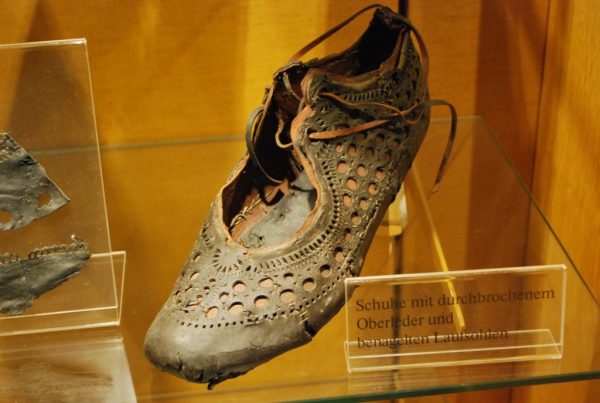


With a hobnailed sole and leather upper, modelled on a military boot, this shoe offers warmth and protection. It also reveals both the craft of the maker and the wealth of the wearer. Holes punched into the soft leather created an intricate design.  This shoe wouldn’t look out of place on today’s high streets; taking retro fashion statements to another level. 

What would the roman shoemaker think of my own collection of footwear: from my faithful DMs, and liturgically coloured heels, to my trainers, converse and floral flats to umpteen pairs of clerical black slip ons, lace-ups, loafers and boots.  


A Canon's shoes!

As shoes for your feet.

When we look at the stories of Joshua, Peter or Paul; the witness of Ruth, Mary or Phoebe, it can feel as if we have big shoes to fill. As we walk in the steps of Jesus, we can sense the weight of responsibility, challenge, expectation and opportunity. 

Stepping into such shoes can feel overwhelming and precarious; but also exciting and rewarding. Eventually, we grow into them - or break them in - knowing we are where we are meant to be; we can be rooted, take risks and flourish.

Without over stretching the analogy it feels immediate and accessible to hear that when Paul talks to the Ephesians about clothing themselves with the armour of God, he also concerned with their feet.  The shoes we are to put on will make us ready to proclaim the gospel of peace. 

Like our physical shoes,  this ‘spiritual footwear’ is practical and intimate, bringing warmth and protection; equipping us for the all-weather terrain of God’s Kingdom.

The steps we take in following Christ are steps towards peace. As Archbishop Justin’s priorities reminds us, this begins with prayer. It continues in the work of reconciliation, transforming conflict in the light of the cross. It involves witnessing in the power of the Spirit to the love of God revealed in Christ.  


Being made ready to proclaim peace demands commitment in the face of struggle. It means choosing life. Today’s readings explore these steps being taken: in gathered community, in communion with Christ, in walking in the world.

In Joshua, steps are taken in gathering together as community and renewing their commitment to serve the Lord.

Joshua was commissioned to lead the nation after Moses’ death. As his life and work draws to an end, he sets before them a choice: between the local gods of their ancestors and the God of the whole universe. 

In the verses omitted today, before he invites them to echo his own declaration, he confesses the story of faith of their community.

He retells God’s call to Abraham; of a promise of blessing which extends to the whole of humanity. He recalls the experience of slavery, the journey through the wilderness towards freedom; he speaks of human bravery in battle and of the nearness of God’s presence in rescuing them.

They are worship and serve the Lord, walk in God’s ways with sincerity and faithfulness. Choose. Life. Today.

His personal commitment is echoed by the voice of the people: ‘we too shall serve the Lord: he is our God’. Today, our footsteps have brought us from our homes to this place, as we too gather to affirm our faith; to recommit ourselves to serve God.


Steps taken

In Jesus’ words, steps are taken in response to an invitation to be in communion; to choose life.

In the beginning, the Word was with God; abiding in the intimacy of perfect communion. That very Word became flesh, entering the complexity human history and taking on the frailty of human a human body.  

That Word came to invite us to abide in him; to lead us to dwell in communion, sharing the very life of God. Jesus dwells with us at wedding feasts and gravesides; he taught on hillsides and sat at table with his friends.  In him, we see love poured out on the cross as God reconciled the world to Godself.

He has broken bread to feed a multitude; he has kindled in them the longing for living bread. The bread from heaven, given by God, is his flesh.  We are hunger for this bread - the presence of God’s love in our hearts.

This invitation to eat and abide demands a decisive response.  Some turn away, refusing the gift and demands of that love. Jesus asks, with openness and vulnerability, ‘Do you also wish to go away’. It is Peter who articulates the hope and courage of this choice. To whom can we go? In Jesus, we chose life; life in all its fullness. 

We hear and respond to that call each time we celebrate the Eucharist together. In broken bread, we are sustained and shaped by Jesus Christ. Our feet are drawn near in faith; our hands reach out to receive; we taste and see how marvellous the Lord is; our hearts are warmed by his love.

And we rise. Our feet walking onwards: clad in leather, heels clicking, laces tied. Our feet walk beyond the threshold of this place into a world. A world where, strengthened by the God’s Spirit, we serve as a pilgrim people; a people called to make peace.


Walking onwards

The Eucharist reveals to us the marks of God’s peaceable Kingdom. And in a messy and complicated world, our lives are to take the shape of the Eucharist as we too are taken, blessed and given for others. 

We are to bring communion to others, in places of beauty and brokenness: as we feed the hungry and struggle for justice; as we take time to be with the lonely and break the bread of hospitality together; as we seek to liberate the oppressed and listen to the anxious; as we share the intimacy and tenderness of care for others; to as we offer the gift of friendship which reveals to others the good news that they are loved by God.

As shoes for your feet, put on whatever will make you ready to proclaim the gospel of peace.

We walk with Jesus today, nourished by his body and empowered by the Spirit; we walk alert to what God is doing in the world; alert to where we need to offer support or challenge. 

Archbishop Justin says: ‘Reconciliation is one of our greatest needs and toughest challenges as human beings. In a world plagued by conflict, division and indifference, the Church has a crucial role to play as a community of reconcilers. Jesus calls every one of us to love God, our neighbours, ourselves and our enemies – a challenging command, with nobody left out.’

As Paul reminds the Ephesians, to do this we need walk in truth and faith, in righteousness and peace. We walk prayerfully, hopefully and courageously; bringing people together - taking small and risky steps of generosity and healing; making cups of tea, creating space to meet or facilitating a difficult meeting. We need to listen carefully and speak wisely; turning suspicion to trust.  We walk the way of reconciliation - transforming strangers into friends, friends into members of God’s household.

Walking this way is difficult: we need ‘spiritual shoes’ for our feet: shoes which are warm, practical and protective; shoes of humility, time and patience.  May we who have gathered to share our faith in God and been nourished in communion with the living bread, be equipped by the Spirit to walk in the world in the ways of peace.


© Julie Gittoes 2018

Tuesday, 21 August 2018

Let freedom ring

This is the text of a sermon preached at Guildford Cathedral at Evensong on 19 August. The texts were Exodus 2:23-3:10 and Hebrews 13:1-15 - both readings speak of the faithfulness of God and the call to liberation. 

Today, the American city of Detroit will be full of song and celebration as people gather to honour the Queen of Soul in her home town. It was here, in the church her father led, that Ree Ree as she was known locally began her singing career and her spiritual life. 
Aretha Franklin Was Already Famous, But Her Hat-Maker Wasn ...

On a crisp, bright day, almost a decade ago, Aretha Franklin stood on the steps of the Capitol. Wrapped in a thick grey coat, paired with a striking hat, her gloved hands held the microphone, and she sang. 

She sang: ‘Let freedom ring’. 

Let it ring, ring ring… let freedom ring.

President Obama closed his eyes; and a vast audience was moved to tears. This was an historic moment but also a prophetic one.  Her voice expressed the hopes and heartbreak of many; it distilled the struggle against segregation and the legacy of slavery.  

Over recent days, tributes have woven together her life story with the impact she had on others. It has been said that she was the voice of America: she toured with Martin Luther King and at his funeral, her rendition of "Precious Lord" gave voice to the bewilderment and resilience of grief. 

Let freedom ring.

Pain and trauma were re-voiced in blues and soul; jazz and gospel expressed out a vision which defied abuse and turned heartbreak into strength.  Hers was the voice which spelt out R-E-S-P-E-C-T, enabling generations to voice their own cry for equality regardless of race or gender.  This voice was gift, crafted by skill and underpinned by character; flawed and flawless, hopeful and human. 

Respect (song) - Wikipedia
In the words of Barak and Michelle Obama’s tribute: Every time she sang, we were all graced with a glimpse of the divine… In her voice, we could feel our history, all of it and in every shade - our power and our pain, our darkness and our light, our quest for redemption and our hard-one respect.

Let it ring… let freedom ring.

This cry is voiced in the scriptures which shaped Aretha’s life and shapes ours. The journey towards freedom is fraught with struggle - with power and pain, the darkness and light. The book of Exodus names the groaning and cries of a people who are enslaved.  The misery and suffering of the Israelites is observed by God; by a God who seeks to deliver them.  

How is that redemption song voiced? How does freedom ring? God works through flawed humanity to restore hope. A flawless glimpse of the divine is made real in human lives. Aretha embodied that in song. Moses embodied it in a call to lead.

The Jewish poet Yakov Azriel retells the family story of Exodus; inviting us to stand with Moses as something mysterious breaks into the mundane; as human curiosity meets divine holiness. He writes:

In the shadow of a burning bush, and in
Its light, we gaze beyond the desert dune.
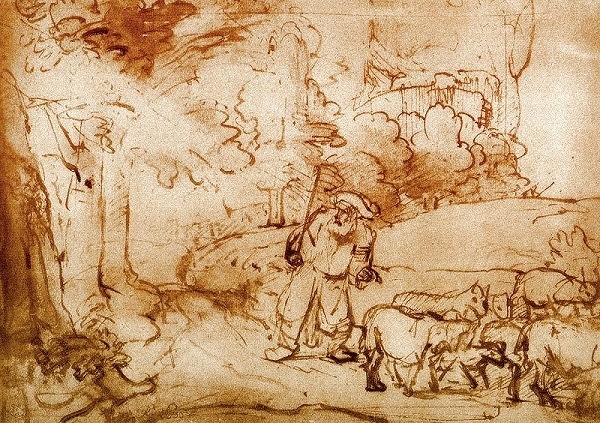
https://bibleartists.files.wordpress.com/2011/01/4-moses-at-the-burning-bush-rembrandt.jpg

Moses' story is as complex as that of the Queen of Soul. A Hebrew by birth, given up for his own safety and raised in Pharaoh's palace; living in privilege yet aware of the injustice of the regime. His intolerance for abuse and exploitation leads to an act of violence. He's a man fearing for his own life yet his own people mistrust him.  The Moses we encounter tonight is a shepherd fugitive.  

Now he looks and turns aside: a bush ablaze yet not consumed. In Azriel’s words:

In the bush's shadow, and its light a thin
Unbroken thread of grace is seen...

There in the burning bush we see a flame of freedom.  God does not coerce Moses; rather he ignites his curiosity.  This isn't a dazzling display of power and glory. In shadow and light of an intriguing phenomenon, there's a thin line of grace which enables Moses to gaze beyond the desert dunes. In the darkness of exile there are glimmers of light and new purpose.

He hears his name.
The soles of his feet touch the heat of holy ground.
He hides his face.
His words: Here I am.
A voice: God’s ‘I am’.

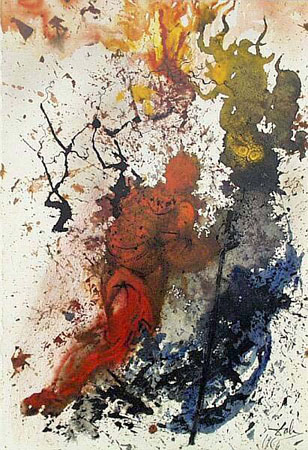
https://bibleartists.files.wordpress.com/2011/01/4-the-burning-bush-dali.jpg


God chooses to act through one who already burns with a passion for justice. Moses will cry out for freedom in the face of systemic oppression.  The voice from this blazing bush is an invitation to us to; a call to courageously enact the possibilities of God’s goodness. This voice is, in the words of one Walter Brueggemann, ‘a flaming warrant for truth to power’. 

Moses goes on to express a number of objections to this challenging call. His reluctance is met by the assurance of support from his brother - and by God’s very self. God’s faithfulness as expressed in ‘I am’; the one who was and is and ever will be.  

God works through our passions and our voices can be threads of grace. Exodus tells one story of slaves and fugitives whose lives are marked by hope and blessing. Yet cry for freedom to ring out has not ceased. 

It’s no less daunting for us than it was for Moses to both stand on holy ground and respond to this call of radical transformation: of relationships, structures, priorities and communities. Our second lesson reminds us that this is about the whole of our life; but it also reminds us that we depend on the love of God.

The writer of Hebrews reminds us of God’s love in words which echo the voice from the flaming bush: Jesus is the same, yesterday, today and for ever. Jesus is ‘I am’, God with us.

For in him, God makes new his covenant and takes notice of human suffering. In Jesus Christ, God’s love reaches out to the vulnerable and marginalised. His teaching challenges the false assurance possessions, status and independence. His love meets us in the depths of despair and humiliation; and heals when we are wounded and fearful.  He bears the agony of the cross and the coldness of the tomb. And freedom rings out in resurrection life.

The writer of Hebrews also reminds us of the very practical demands of letting freedom ring out. Mutual love is revealed in friendship and support; our bodies can communicate tenderness, creativity, compassion and support.  We are to imitate those whose lives have revealed God’s love to us. 


 Angels Unawares | Kimberly Ramey

Hospitality is not confined to those we know - but to those with whom our lives intersect in fleeting ways. Those who are imprisoned or on probation, those who seek refuge or who become invisible in residential care aren’t kept at arms length as ‘other’. They are part of us.  We are to be content with what we have - a prophetic message in a world of zero hour contracts and executive pay increases, where human beings are still enslaved and trafficked.

Collectively and individually, we are to let freedom ring out: confronting the power of inequality, abuse, illness and discrimination. In our lives, that thread of grace, the glimpse of the divine, can run on.  It runs on in what ignites our passion for justice; in what kindles our compassion.  

Each of us can take a lead - in acts of service, influencing others, finding allies in campaigning and seeking the welfare of society; in living out R-E-S-P-E-C-T.

May we walk in the light of Christ, by the power of the Spirit at work in us, revealing something of God's love: Let freedom ring out. 

© Julie Gittoes 2018

 
*This painting created by Kimberley Ramey and the narrative accompanying it speaks movingly and honestly of the challenge of Hebrews and moments of hospitality which can be glimpsed or lost; sharing the image and the link to her work to read more about this.


Sunday, 29 July 2018

Receiving life in our fragile bodies

This is a sermon preached at the Cathedral on Sunday 29 July. The texts were 2 Kings 4:42-44, Ephesians 3:14-21 and John 6:1-21. 

The two things which underpinned it's inspiration: the headlines about stockpiling food; a poem by Malcolm Guite called "Love's Choice". Particularly the line about the lightness of bread 'a wafer-thin sensation'; yet in this sensation we encounter the fullness of Christ. 

I was also struck by a comment made on Twitter by Dr Ayla Lepine about a painting by Eularia Clarke called "The Five Thousand", she described it as 'holiness in the everyday everywhere". 

John's Gospel tells of an episode which is more than simply a miraculous feeding - and we hear it in a context where there is ongoing anxiety about our ability to feed our nation. 


Aunty Credwyn’s afternoon tea is one of the legendary memories of my childhood: the table seemed to heave under the weight of cakes and sandwiches. Plates were emptied and replenished; our eyes boggled at the plenty. 

Elijah’s words could have been her motto: They shall eat and have some left.

If you were to venture Credwyn’s larder, you’d have found an abundance of a different sort: boxes and boxes of washing powder, bags and bags of flour, tins and tins of fruit.

Her capacity for hospitality may well have been shaped by the experience of wartime rationing.

It seems inconceivable that today we read newspaper headlines such as “Hoarding food now seems the only sensible thing to do”.


The Swedish government has issued advice to households on how to cope in situations of ‘major strain’; when services are disrupted by crises from a cyber attack to terrorism. The leaflet suggested stocking up on non-perishables.

Jean Vanier, in his commentary on John’s Gospel, writes: We human beings do not possess life; we receive life in our fragile bodies.

We receive life via a food supply chain reliant on imports and structured on a system of “just in time” deliveries.  All of us depend on physical nourishment; for some that dependence is more precarious than others. 

Social media responded to Dominic Raab’s assurances about ‘adequate food’ with pictures of Spam; but it was the food writer Jack Monroe who pointed out that mass panic and stockpiling hurts those least able to buy: ‘those living hand to mouth, paycheque to paycheque, food bank trip to food bank trip’.

Today’s readings weave together very real physical concerns with deeper questions about the kind of community God calls us to be.  Jesus himself is concerned for life in our fragile bodies:  Where are we to buy bread for these people to eat?

Those of us who’ve enjoyed the excitement of going along to a festival or carnival, might conjure up a vivid image of a crowd caught up in an event. There’s a momentum all of its own; but at some point people get hungry. 

Jesus notices this: those drawn there by the desire to hear his words and to see signs of healing now needed to be fed. He asks out loud, where are we to by bread?

Philip responds by commenting on the impracticality of the question: they can’t afford enough bread. Andrew’s pragmatism is tinged with a realistic sense of scarcity and inadequacy.

Jesus’ response reveals God’s compassion; his actions are directed to our welfare: sit and eat, he says; rest here a while. He gives thanks and distributes food. Nothing is held back; all are satisfied. Nothing is lost; fragments are gathered up. 

As Vanier reminds us, this is not simply a miracle of multiplying food but also of creating and building a caring community where people are concerned for one another. 

This is a foretaste of heaven in ordinary. The twentieth century painter Eularia Clarke captures this brilliantly in her depiction of the feeding of the 5000: bicycles and handbags are set down, fish and chips are spread out; babies rest in their carrycots, children quench their thirst, adults eat without guarding what is theirs; strangers notice the needs of others, perhaps for the first time. 


In Jesus we see the fullness of God with us. A fullness which loves abundantly in order that we may learn how to live like that too. In Paul’s words of prayer to the Ephesians, we are to be filled with the fullness of God - in order that God’s power at work in us may accomplish more than we dare to ask or imagine. 

This is not a vision of competition or rivalry; it’s not life ordered by self-protection or lack. It is an invitation to be liberated from selfishness to become self-giving. Our Gospel reminds us of how costly and challenging it is to live in this way.

The crowds want to claim Jesus as a leader who will satisfy their physical needs for ever; but he wants to lead them into a deeper dependence on God who’ll reshape our attitudes and actions. 

Jesus disappears: he takes his rest and prays. To give out does not mean we must burn out. To be in community with others, we need also to be alone.  To nourish others - emotionally, physically, mentally and intellectually - we need to nourish ourselves. 

This lesson in sustaining life in all its fullness confuses the disciples. Perhaps they had hoped to hold on to the success of this feast; to enjoy the exultation and admiration of the crowd. 

As Jesus goes up the mountain, they walk back down to the lake and wait. They wait until it gets dark. And still he has not returned to them; so they return to Capernum.

Their impatience turns to fear when the storm rises up. Their journey is not merely physical; it is also spiritual. They, like us, long to abide forever on the sun-kissed mountain top where our longings are satisfied; where our fragile bodies are fed; where we know life in its fullness as an equitable harmony, where all is gathered up.

They, like us, return to a world which is fraught with lack, fear and complexity. We face storms which are beyond our control: uncertainty about the future; the fading hopes of our wishful thinking; cycles of anxiety and addiction We do not possess life; we receive it in fragile bodies. Bodies which are dependent on others; bodies which have the capacity to nourish others.

Jesus meets the disciples and us with words of assurance: It is I; do not be afraid. 

Paul prays that the Ephesians, may know this fearless assurance of Christ might dwelling in them. Today’s collect echoes his supplication: ‘open our hearts to the riches of your grace, that we might bring forth the fruit of the Spirit in love and joy and peace’. 

At this cathedral we long to be open hearted - open to God and open to all. To fulfil that hope, in this Eucharist, we bow our knees before our heavenly Father; we are strengthened in our inner being through his Spirit; Christ dwells in our hearts in faith. Our fragile bodies are spiritually fed. As we take fragments of bread, we are being rooted and grounded in love. We receive in what is wafer thin, the fullness of God.

Here in broken bread and poured out wine, we touch and taste and see what is the breadth and length and height and depth of love. Love that surpasses all knowledge. Love that was manifested in compassion as crowds were fed on a hill side. Love that was manifested in peace as disciples clung to their boat.  

This love is cosmic in scope: it creates, redeems and sustains. This love is inexhaustible and yet known in intimate indwelling of us.  We gather to share this meal with the household of God, for the sake of God’s Kingdom. 


Here God’s love chooses to be emptied into us that we might accomplish more than we can imagine. In a world which is struggling with uncertainty about the future; where fragile bodies need to be fed,  let us pray that we may receive and give life, across all generations and forever: in the food we share, the compassion we show, the support we give. 


© Julie Gittoes 2018


Sunday, 24 June 2018

What will this child become?

A sermon preached at the Cathedral Eucharist on the feast of the Birth of John the Baptist. In the light of how we treat children - and the images from the US border and boats crossing the Mediterranean - the question of what this child/these children become is acute. The parallels with reflections on Hamilton in relation to John were thought provoking. The texts were: Isaiah 40:1-11, Galatians 3:23-end and Luke 1:57-66, 80


Hamilton.  Alexander Hamilton.

First US Secretary of the Treasury.
Overlooked as the face on a ten dollar bill.
Brought to life in an exuberant mega-musical.
A score infused with hip-hop, rap, indie-rock and operetta.

Hamilton: praised on this side of the pond for its ‘political passion’ and ‘nimble wit’.
Alexander Hamilton: who lives, who dies, your tells your story?

This is about the independence of a nation: about revolution and government; interpreting the constitution and managing the economy.

It’s about American identity and European destiny; it’s about urban entrepreneurs and agricultural labourers.

It’s about opportunists and visionaries: the people in the room with power and immigrants getting the job done.

It’s about Alexander Hamilton, as the opening song puts it:
How does a bastard, orphan, son of a whore and a Scotsman, 
dropped in the middle of a forgotten spot in the Caribbean by providence, 
impoverished, in squalor grow up to be a hero and a scholar?

It’s about us too - our history, legacy and identity; our cries for comfort, justice and unity.  

For something so historically engaged, Hamilton fizzes with contemporary challenge. 

From this week’s news headlines we are confronted by:  the orphan, the forgotten, the impoverished; the migrant, the president, the constitution; the negotiations behind closed doors, the concerns of business, public services and national debt. 

As we navigate these challenges as people of faith, we unite our cries with the voices of scripture. 

When we’re angry, bewildered and heart-broken, we ask who lives, who dies, who tells God’s story?

One who does just that is John the Baptist.

Today we celebrate his birth: 
How does an only child, son of barren woman and an old man, 
dropped in the middle of a forgotten spot in Israel by providence,
with rejoicing, a sign of mercy grow up to be a prophet in the wilderness?

At the point at which Zechariah and Elizabeth had given up all hope of parenthood, they are promised a son. A son who will bring joy; who will be filled with the power of the Spirit. 


In the words of the angel, this child who will turn our hearts: moving us from disobedience to wisdom, bringing reconciliation to our households.  This child will make us ready, will prepare the way for the Lord.

Whist his father, was literally speechless, this child leapt in the womb as his mother, embraced Mary: the God bearer.

John’s birth is greeted with rejoicing. His name meaning God is gracious expresses something of paternal gratitude. But his name and calling will be challenging too.

What will this child become?
It’s a question which hovers on our lips when we see an infant: godchildren, nieces, grandson; the orphan, the longed for, the impoverished; the child wailing at the American border.  

What a child becomes depends on the stability, nurture and opportunities we provide. We give thanks for them, worry about them and rejoice in them before ultimately letting go of the children in our care. It’s the risk of teaching, parenting or mentoring.

This child, John, grew and became strong. He wasn’t to be the practical consolation in his parents’ old age. John was drawn to the wilderness and there is name and calling become one - declaring God’s name and inviting us to walk in God’s ways. 

Echoing Isaiah, he is a voice crying out in the wilderness. 


He lives, he dies, he tells God’s story.

Words which declare comfort to the afflicted; which speak tenderly of God’s love to the brokenhearted.

Words of comfort when we go astray and face the consequences of our selfishness and disobedience.

Words which remind us that whilst our human life is fragile and limited, God’s love endures forever. 

Words which speak of God’s glory being revealed: the vulnerable lifted up, the mighty brought down, a path made straight for us to walk in through the wilderness.

Elizabeth and Zechariah let John go: freeing him to speak truthfully to those in power; to challenge the complacent; to encourage the visionaries; and to bring compassion to the weak. 

His father’s words of praise - the Benedictus we say or sing at morning prayer - invites us to share in John’s prophetic message.

It’s a message which calls for repentance, an acknowledgement of all that hurts us and breaks our hearts; sins of negligence, weakness and our own deliberate fault.

It’s a message which proclaims forgiveness, the promise of healing, freedom, compassion and peace; being justified by faith.

We too are called to lift up our voices as heralds of this message of good tidings.

Like John, we are to point others to Jesus: declaring, here is your God!

The God who in Christ Jesus, rebukes and forgives, feeds and guides, lives and dies for us; who dies and lives for ever.

This proclamation includes a commitment to fulfil the promise of feeding, gathering, carrying and leading others. 


Feeding, gathering, carrying and leading our children: those who’re anxious about exams or ensnared by debt; those whose relationships falter or who face addiction; those whose ideas challenge and inspire; the revolutionaries and visionaries; those fleeing across the Mediterranean to seek refuge.

What will these children become?

Feeding, gathering, carrying and leading our children: those who slip through the net of social security; those abused within the church; those whose lives are shaped by our immigration control; those who will graduate in this cathedral to be lawyers, politicians, scientists, musicians, financiers and nurses.

What will these children become?

We like them, are called by name; we raise our voices in praise and protest, tenderness and hope; we like them are children. 

By the power of the Spirit, in union with Christ, we are all children of God: There is no longer Jew or Greek, there is no longer slave or free, there is no longer male and female; for all of you are one in Christ Jesus.

We are called by name not simply to tell our story but to take our part in proclaiming God’s story; not to make a name for ourselves, but to speak tenderly to God’s people; our legacy in life and death is to prepare a way for Jesus our Lord; being Spirit led and seeking God’s Kingdom.

Who lives, who dies, who tells your story?

For Hamilton, it was his wife Eliza. She was proud to set up an orphanage - a legacy which showed responsibility for enabling others to take their place in society.  

Who tells God’s story?

We who break bread together are to be heralds of good news - tidings of repentance, forgiveness and peace. In every gesture, every task, every donation, every conversation, every vote, every petition, every act of compassion and every legacy: we live to tell God’s story.


© Julie Gittoes 2018