Showing posts with label suffering. Show all posts

Monday, 24 March 2025

A landowner, a tree and a gardener

 Sunday, 23rd March, Lent 3: Isaiah 55:1-9, 1 Corinthians 10:1-13 and Luke 13:1-9

How do we respond to life’s biggest questions?

In the 1930s, the philosopher Will Durrant wrote to 100s of figures in the arts, politics, sciences and religion challenging them to respond to the fundamental question of how they found meaning, purpose and fulfilment in their own lives.  He published the replies in a book called On the Meaning of Life.

In 2015, James Bailey finds himself sitting alone in a caravan, heartbroken and unemployed, wondering where he’d find happiness and purpose. He stumbles across Durrant’s book of collected letters and decides to repeat the exercise.  

After rejections, responses begin to arrive: one-liners or extended reflections, which gave him inspiration. 

The late Hilary Mantel talked about discovering meaning in the pursuit of it, the spiritual gold of virutes like tenacity, patience and hope.  An environmentalist wrote about preserving the planet we depend on; a holocuast suviver described goodwill and generosity in the face of brutality; a prisoner talked about respecting and appreciating life as a gift.  

Others mentioned friends, being fully present; responding to failure and tragedy. The palliative care consultant Kathryn Manix talks about what matters in the face of death - connection, relationship and love, not weath or success or more stuff. She sees this as the beginning of wisdom, of simplicity, of loving kindness. 

All a work in progress right until our final breath - when we come know the fullness God's loving-mercy, even as we are fully known.

And often the question ‘why’ will remain on our lips, particularly when we want to make sense of the world as it is; especially in the face of personal or collective suffering or loss. 

Jesus is confronted with a version of a ‘why’ question in today’s gospel. Some of the people around him approach to tell him of a violent and traumatic event. We don’t have to imagine very hard - every day, words and images rapidly convey the brutality of leaders slaughtering civilians; of lives lost when buildings collapse. 

There is so much pain in the world, we ask ‘why’ there is pain, cruelty and suffering. Jesus somehow shifts things to ask deep and wise questions; questions that somehow hold open the possibility of meaning and purpose in life. 

Yet our human instinct is sometimes to seek after the proverbial ‘theory of everything’ that makes sense of the senseless; of the bad that happens in a beautiful world. We try to square God’s goodness and power with the reality of suffering. 

Those addressing Jesus are telling him the horrendous news with a rationale already formed in their mind: somehow, they want to suggest that those who have been killed by Herod have done something to deserve it. Jesus undoes their logic. Suffering is not evidence of or punishment for sin. 

Our society has its own inner  logic too: it might be judgements about lifestyle or background; it might be implying that others have it worst; of even that suffering shapes our character. 

All of those ways of thinking about suffering set us apart from those enduring it. We miss our common humanity; the sheer risk and vulnerability of our lives. Jesus in a radical way is challenging the assumptions behind those logics and instead draws us into the reality of an other’s pain. 

He invites us to own the brokenness and hurt of our own lives and to repent. He is inviting us to ask a different question - one which draws us back to God and each other. There’s depth and risk, vulnerability and closeness in turning around. 

In setting aside the ‘why’ Jesus doesn’t offer a strategy or an answer. Instead, he tells a story. A story about a gardener, a landowner and a fig tree. A story full of frustration, perceived waste and lack, but also a story of patience, resources and possibility.  


It’s an odd story - whether or not you know anything about growing fig trees. It doesn’t seem to be a direct answer to the ‘why’ questions about the reality of suffering. It might echo the ideas about finding meaning in life shared with Bailey and Durrent before him in their own perplexity and isolation. 

Are we seeking after the "spiritual gold" of life’s meaning - preserving something for others, fostering goodwill in difficult circumstances or appreciating life as a gift; seeking after connection, relationship and love; finding a simplicity that makes loving kindness possible. All this, even in the face of death,

In the story, the landowner seems to be pretty absent: swooping in to check for fruit but not getting involved; seeing only emptiness and scarcity; offering instructions or making judgments which take no account of potential or patience. Cut it down he says - there’s no life. He quits. He walks away from generosity and preservation, because he sees only failure. He doesn’t reframe it with tenacity and hope. He writes off any potential, meaning or fruitfulness. 

The tree is perhaps stressed by the conditions of soil or weather; under nourished and unable to offer fruit to others. In this seemingly barren state, it needs tender care; to flourish, things need to change. To thrive there needs to be time and attention given to what’s not working well. For us in this Lenten season, there are echoes of that space to look at and amend our lives, to do the heart and soul business we need to do before God. 

The gardener though is intimately and practically involved with this tree. Where others see only uselessness and death, he sees possibility. He is prepared to work hard - labouring with the soil and manure. He puts in the effort even when the odds of a better outcome seem low. Maybe we too can not only hope for change but give our time and effort and love to the cause of possibility - in this crisis, or suffering or in justice. 

The landlord, tree and gardener undo the 'why': they give us more life-giving options and also remind us that we need to be involved. The story doesn’t open up philosophies of living in the face of terrible pain or injustice. Instead, it gives us a spade and manure - weeping with the sorrowful; giving a bit of energy to the future we want to see; nurturing a beautiful thing. Being gardeners who can take on the graft of hopeful, patient tending. 

This is a deeper story that flows from a different set of questions; dispensing with the logic of why allows us to imagine lives lived out of a more meaningful answer. 

Repenting - turning - is an act of mind, heart, will and body.  It signals our need for grace as we seek to do what is right.  As we turn, God is already moving towards us in Jesus to forgive. He bears the weight of the suffering and pain in his body, even death itself. He undoes its power, turning hurt and failure to life and fruitfulness that we might be who we’re called to be. 

Likewise, we too towards our hurt and brokenness Noticing the hurt and going towards it  in the hope that there will be the fruit of new life.  Patiently, the Spirit is doing a new thing with us; nurturing gift and virtue.

There is an echo in Jesus’ story of the promises of Isaiah: reminding us that communion with God will bring a full life, of meaning and purpose. In the passage we heard today, this satisfaction takes physical form - wine, milk, rich food to delight in when we are thirsty, hungry and empty handed. 

Isaiah offers a vision of a restored world which is at odds with those things in our world that do not satisfy our deepest longing: the way conflict and economic systms can drive scarcity and exploitation. His words prompt us to look for a time when our poverty is exchanged for abundance and joy. 

As we are nourished at an earthly table, with bread and wine, we anticipate the promise of that heavenly feast, a peaceable kingdom. We are also invited to witness to such mercy, pardon, life and joy here on earth; to bring comfort to the afflicted and sorrowful in acts of loving kindness. 

This calling to engage with others in love runs through Paul’s letter to the Corinthians. He spends some time retelling the stoires of freedom from salvey and the struggles of the wilderness. In doing so, he offers a teaching exercise. Yes, in Christ, we are drawn into the covenant of God’s love; but we’re human and will face temptations to fulfil our self-ish desires and neglect God’s goodness to us. 

Paul offers a model of radical hospitality as a way of reflecting God’s faithfulness. It does not mean a life free of temptation, struggle or sorrow, but it does give a way thorugh it. A way of love that we see in Jesus. 

On the cross his love overcomes death; and opens up for us new life full of meaning; marked by what is just and merciful. Even in the face of difficulty, we hold each other in this radical love - reflected in patience, compassion, kindness; in simplicity and being fully present in the struggle until a new day dawns. 

© Julie Gittoes 2025

Friday, 9 March 2018

Christa: the cross, shock and dignity

This is the text of a Lent Talk given as part of the "Faith through Art" series at Guildford Cathedral. As a result of tech glitches, we started late and had to rely on a black and white copy of Edwina Sandys' "Christa".  This is the approximate text with some additional images and links including Sandys' own site and reflections on "Christa" thirty-years on can be found in an article in the Huffington Post


Alexandre Getsman and Edwina Sandys in front of CHRISTA
Image and interview from New York Social Diary: 18 November, 2011

On her website, Edwina Sandys describes herself as a  'New Yorker by choice and marriage'.  It is perhaps unsurprising that, given her father Duncan Sandys was a Cabinet Minister and that her grandfather was Winston Churchill, she considered standing for Parliament. 

It's even less surprising then that as an artist, her work is very much inspired by political and social themes - including gender. There's a sense of joy and playfulness in her work - whether we are looking at images of flowers or expressions of female embodiment. And in her wit we find wisdom and challenge. 

She is most well known for Christa a bronze sculpture of a female Christ figure on the cross. First shown in 1975 it was displayed in a range of galleries and churches before being installed at the Cathedral of St John the Divine (New York) in 1984. As the first such representation, the work created considerable furore - the inevitable outrange and voices moved by the emotional power of the work.  

What do we see when we look on this image?

Are we shocked or inspired by the suffering, composure and strength?

The human desire to identify with Christ Jesus in his humanity is an enduring and universal concern.

The human desire to explore what it means for God to be with us in the fullness of our humanity is reflected in a multiplicity of images.

We are provoked to look beyond the pale, male, blond, blue eyed Jesus of some western art, to think about a rich spiritual and religious iconography. Every generation and culture seeking to mark that likeness. 


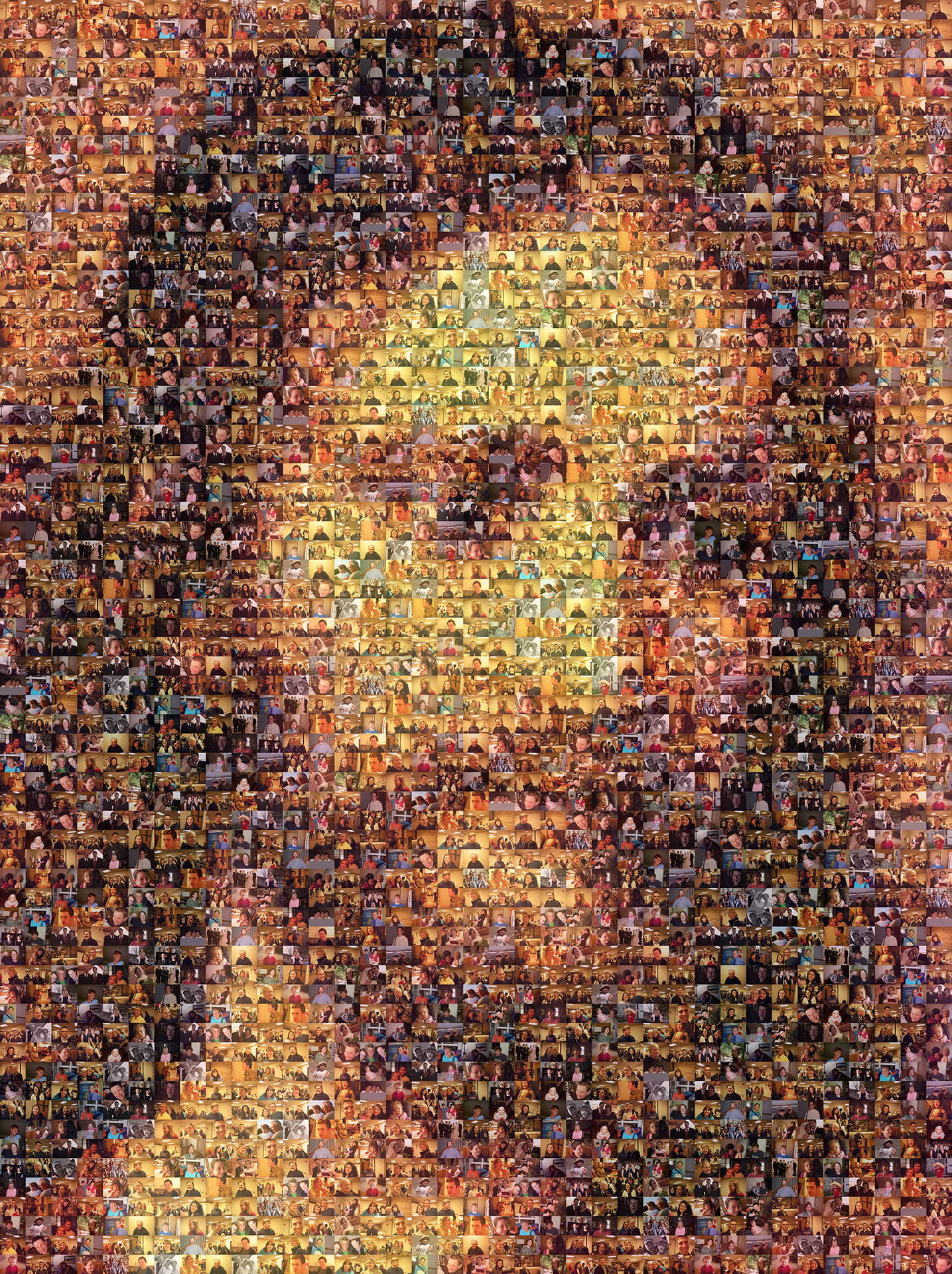
More than that,  as members of Christ’s body, through baptism, we want to make visible our ‘in Christ-ness’ as a community; in all our diversity. Whatever our class, occupation, gender, age, health or ability we seek to find our place within this body - to belong, to be accepted and valued.  Many artists and projects run by St Paul's Cathedral, for example, have created collages or mosaics taking our faces and transforming them - together - into the face of Christ. 


The cross too becomes such a marker of belonging. 

The cross is a ubiquitous symbol. Some make the sign as we proclaim the Gospel or before preaching - reminding us of the love of God before speaking/listening. We mark out or see the sign of the cross as we receive the gift of forgiveness and blessing. It is expression of the embodied reality and cost of God’s love poured out for us in Jesus Christ.

It’s a gesture made by lots of sportsmen and women when they prepare to compete: coming on to the pitch, preparing to leave the blocks, taking a penalty.

It’s an item of jewellery: a sought after fashion accessory; a bold statement of faith in workplace; a cherished birthday gift.

It’s a piece of art: an elaborate design tattooed, perhaps entwined with words of faith or a loved one’s name; or for our Coptic brothers and sisters, received at baptism; an indelible mark of being 'in Christ' as in the image below: Coptic wrist crosses


It’s a near universal symbol of Christianity: it is used in worship – in gesture and image; our churches are identified by it in layout and external signage. We literally follow the cross in our liturgy. We receive the sign of the cross on our foreheads in baptism; an invisible sign of God’s grace, God’s yes to us and of our commitment to live in love.  It has been, and in some places continues to be, a sign that is controversial, a marker of identity or power; of radical challenge or of conformity.  

We follow the cross.

It was not always a marker of Christian faith; rather it was a scandalous sign of brutal and shameful torture. The turning point came at the end of a time of intense persecution in the 4th century. People began to travel to the Holy Land to visit and pray at the places associated with Jesus’ life. Among them was Helena, mother of the Emperor Constantine. She oversaw the excavation of various sites and was said to have uncovered a cross, believed to be the cross of Christ.  

That discovery, and our devotion,  stirs reflection on the breadth and depth of God’s love and forgiveness that we recall in these weeks before Christ’s passion.

Yet sometimes owning a symbol diminishes its power to transform us. A sign of death has become in Christ a sign of love and compassion. Yet we domesticate it; or use it to exclude or marginalize. It is then that we need artists and others to shock us into thinking again about its meaning.

The cross is a scandal.

During her Confessions tour Madonna performed “Live to tell” whilst hanging on a giant mirrored cross wearing a crown of thorns. Unsurprisingly she faced a strong negative reaction from religious groups.  Her performance was described as blasphemous, distasteful and heretical.   

How should we react? Is it offensive or does her performance provoke us to think about how challenging the cross is?  

Madonna’s response to such criticism was to say that her main intention was to highlight the plight of millions of children dying from poverty and hunger in Africa. 

As she performed, the death toll of victims is counted on a screen behind her; the words “in Africa 12 million children are orphaned by AIDS” are projected onto the stage. Images of children fade in and out as she sings.

Perhaps  it is only scandalous nature of the cross that can do justice to the extent of human suffering today; perhaps it is only the cross that can call us back to our humanity made in the image of God; does the cross provoke us to recall the enormity of God’s love and forgiveness of us; challenging us to respond with repentance and compassion.


As “Live to tell” comes to an end, Madonna steps down from the cross.  She kneels, removes the crown of thorns, and bows her head.  

In another ubiquitous sign, she adopts the posture of prayer.  Above her scroll quotations from Matthew 25: And God said…whatever you did for the least of these brethren. 

Whatever you did for the least of these...

How do we respond to the hungry, the naked, the homeless, the excluded, the abused and the marginalized?

God’s love is different: humble, self-giving, generous, challenging and forgiving.  

Howe is such love revealed today. To quote Madonna:

How will they hear
When will they learn
How will they know 

They will hear and learn and know when we ourselves embody the love poured out in self-giving. 

I wonder if in part, Sandys' "Christa" serves a similar function to Madonna's live performance. 

It provokes us to think about the scandal of the cross; to the scandal of human suffering.

It provokes us to think the reality of God with us: the God who humbled himself to take on our humanity, raises up our human nature. 

We are saved - healed, restored, forgiven - through the cross of Christ. The word became flesh: taking on our flesh, male and female.

And perhaps that's the real heresy: denying God's image in us, male and female. 

After much discussion with those Sandys' called the "earthly powers", "Christa" is now displayed at St John the Divine. 


The New York Times

In an interview with Nettie Reynolds in 2015, she said: I didn’t make Christa as a campaign for women’s rights or Women’s Lib as such but I have always believed in equality and I am glad that Christa is just as relevant today as it was in 1975. I didn’t make Christa just for women.  Men also suffer and that is one of the meanings of Jesus on the Cross. In the past there were matriarchs in many societies and religions, and gender was not always a factor. Today women are finding their way to take their place in the Christian church and in society in general. Most women of my generation have been stamped with the idea of Man’s superiority over Woman which is hard to throw off without seeming aggressive.  I hope that Christa continues to reveal the journey of suffering that we all have in common.


    The "Christa" continues to reveal the journey of suffering that we all have in common. Then suffering we share. 

    As we look at Sandys Christa, might we consider the impact of God’s love revealed in Jesus afresh. He is God with us, alongside us. It also says something about our humanity.  

    The pursuit of our desires can have a corrosive effect on others: we hurt them by our selfishness, lack of consideration, impatience, anger and unkind speech.  The prophets were continually reminding the people of Israel to turn things around – to but God’s love first and allow that to shape our relationships.  

    But human pride and self-sufficiency gets in the way; we have a human tendency to mess things up.  Yesterday, we remembered the martyrdom of Perpetua and Felicity and their companions: the account of their death reduces us to tears.

    We hear of their faithfulness and courage; their companionship and dignity. We heard of the  bodies of two young women: naked and exposed; then clothed but mortally wounded. 

    I’d never associated Gerard Manley Hopkins’ poem God’s Grandeur with the crucifixion until I looked at this image.

    He begins: The world is charged with the grandeur of God.
    It will flame out, like shining from shook foil;
    It gathers to a greatness, like the ooze of oil
    Crushed.

    Crushed. 

    Christ is crushed with us; with our humanity, the generations who have, in Hopkins poem Have trod, have trod, have trod

    Yet glory and grandeur is revealed; the world is charged; recharged with life and beauty. 

    And the final stanza: the Holy Ghost over the bent / World broods with warm breast and with ah! bright wings.


    Blog: Christa or Christo, Tomato or Tomawtoe

    God’s response to our human frailty and cruelty is not to condemn the world but to bring healing and reconciling love.  

    That gift is something that we are to receive and also embody.  It subverts and deepens our understanding of reciprocity in love; it extends to us an invitation to life which is eternal.  Jesus life and death are an embodiment of God’s love with us in all the complexity, tension and fearfulness of human life. His risen life demonstrates that our human propensity to mess things up does not have the final word.

    Love wins.

    The "Christa" calls us to think afresh about the vulnerability and power of embrace: her arms outstretched. We are do likewise.

    Reaching out in compassion and speaking out for justice are acts of faithfulness to Jesus. To ignore them and pursue our own ambitions and concerns is the real heresy; denying God’s image in us and in the other. The cross calls us to be with others, not simply doing things for them and returning to our normal lives. It is costly and inspirational. 

    Does this Christa draw us back to the imagery of God mothering us: gathering us like a hen shelters her brood?


    The letter to the Philippians includes one of the earliest creedal statements or hymns to Christ. It reminds us that we are called walk in the steps of the one who did not cling to equality but humbled himself, taking the form of the servant.  It means responding to the one who came into the world not to condemn but to save – to redeem, restore, heal and transform us.

    The cross is a gesture and a piece of body art; it’s a sentimental item of jewellery and pious religious imagery; it is a statement of faith and a neutral sign of artistic beauty.  Ultimately it is a scandal: a stumbling block. 

    Christa reminds us of the scandal of the enfleshed love of God.

    How could it make sense that the God’s Son would be arrested, beaten, condemned and executed as a common criminal? 

    We have been desensitized to the shame and horror of the cross, a brutal instrument of Roman execution.  Instead of seeing the cross as a reminder of God-with-us - amidst the sufferings as well as the joy of the world, we have turned it into a harmless sign; or a symbol of ecclesial piety.

    Often Christians have misguided belief that we “own” it – and try to protect it at all costs. However, our ownership of the symbol can be distorted in judgment and condemnation of others.  Perhaps Madonna provocative performance focuses our attention on some of the very things Christ was most concerned about; even if she does offend our sense of propriety.

    We need to be shocked into being reminded that the cross is a sign of the extent of God’s love for us – giving life for us; that we are to hold on to that as a challenge as we remember all those who suffer and the hurt we cause.  

    On a global scale it shapes our response to injustice, persecution and violence; at a local level it shapes our response to one another - those we mock or judge; those we undermine or envy.  God’s love is different: humble, self-giving, generous, challenging and forgiving.  But, to quote Madonna:

    How will they hear
    When will they learn
    How will they know 

    We like James and John are asked: can you drink the cup I drink or be baptised with the baptism I am baptised with? Do we respond with the reckless abandon of those brothers? With the boldness of Peter? Or faithful grief-stricken waiting of Mary Magdalene?

    How will they hear
    When will they learn
    How will they know

    They will hear and learn and know when we ourselves embody the love poured out in self-giving. What might that look like for you and me as we continue our lenten pilgrimage?

    Let us pray.

    © Julie Gittoes 2018