Showing posts with label Psalms. Show all posts

Saturday, 28 October 2017

A melody of love!

This afternoon Guildford Cathedral hosted the South East Region's Handbell Ringers of Great Britain service In Celebration marking their 50th anniversary. The readings were Psalm 150 and John 2:1-11; and the poem was Melody of Stars by Carol O'Neil.


Living with the Gods has been lauded as among last week’s best radio and rightly so.  Neil MacGregor, the man who chronicles history through objects, is exploring the themes of faith and belief, ritual and ceremony.  It’s compelling, insightful, fascinating and humbling. 

Beginning with a sculpture of  the lion man, MacGregor looks at how different societies have sought to make sense of their place within the cosmos and in community through story and symbol.

The poem we’ve heard today talks about  the way ‘a patch work of twinkling stars / fill the sky’.  Provoking a sense of awe and wonder which is at work within us as we try to connect our place in the world with a sense of the eternal.  MacGregor explores the place of fire and water, light and the seasons; he reflects on life and death, the intimacy and protection of mother and infant; the ways we mark adulthood;  the power of song and the place of prayer. 

There are 30 episodes in this series, and part of me wonders if a bell might be one of the objects used to explore and understand the daily practice of faith.  Bells have long been a call to worship. From the first missionaries to this land who used small handbells to call people to prayer to the complexity and beauty of melodies we celebrate today.   

The ringing of bells draws us into a pattern of praise which has resounded throughout the generations.  Psalm 150 draws heaven and earth together as the sound of praise echoes in earthly sanctuaries and heavenly firmaments; trumpets, lutes, harps; tambourines, stings and pipes. And yes, cymbals too; or perhaps bells! The vibrant sounds of clapper striking metal in a co-ordinated, melodic peal of praise. 


One scholar [Walter Bruggemann] describes this psalm as an ‘extravagant summons to praise, which seeks to mobilise all creation with a spontaneous and unreserved act of adoration, praise, gratitude and awe’.  It speaks of the fulfilment of what it is to be human; it celebrates the purpose and destiny of the whole created order: ‘let everything that has breath, praise the Lord’.


In our acts of praise, we are drawn into harmony with the ‘melody of love’ which is at the heart of God. That love was poured out in abundance in creation - which even now echoes the silent music of God’s praise. That gift of love includes the risk of creaturely freedom - and in our lives that music sometimes becomes the ‘skipped beat’ of an unkept promise or the ‘misplaced note’ of an unkind word. 

But the love of God is not just a ‘perfect harmony’ which fills outer space. It is a love that is made perfect in human weakness; it is love revealed in Jesus Christ, the one who is God with us. It’s a love which ‘vibrates God’s grace’ reaching out to us in sorrow and despair; which brings hope and forgiveness. 

Day by day in churches and cathedrals across our land, it’s a bell ringing out the Angelus which reminds us of the mystery of the incarnation.   The angel of the Lord announced this good news to Mary: she conceived by the Holy Spirit; the Word was made flesh and dwelt among us.  It’s the bell which calls us to pray for God’s grace to be poured into our hearts; that through Christ’s passion and cross, we might be brought to the glory of resurrection.

The story of what flows from that angelic annunciation is retold in the melody of bells and the songs on our lips today.  We lent our voices to Mary’s song of praise - counting unnumbered blessings and longing for justice to be done as the hungry are fed and the humble lifted high.  In singing ‘Come down, O love divine’ our praise becomes a longing for the Holy Spirit to dwell within us, marking our craft and art and lives with ‘holy charity’.

Today our praises draw us more deeply into ‘love divine, all loves excelling’. In Jesus we see love that is compassionate and unbounded. Nothing can separate us from the love of God in Christ Jesus our Lord: it reaches to the very heights of delight and inspiration and to the very depths of grief and bewilderment; it extends into the fragile intimacy of our human relationships and the most mundane aspects of our daily tasks. 

Today we hear in particular of that love made present in the midst of a wedding feast.  In the midst of joy and celebration there’s a creeping sense of anxiety. Unbeknownst to the couple and their guests, Mary and the servants are waiting; they’re concerned lest the wine runs out.  What Jesus does is more than avoiding a moment of acute social embarrassment. 
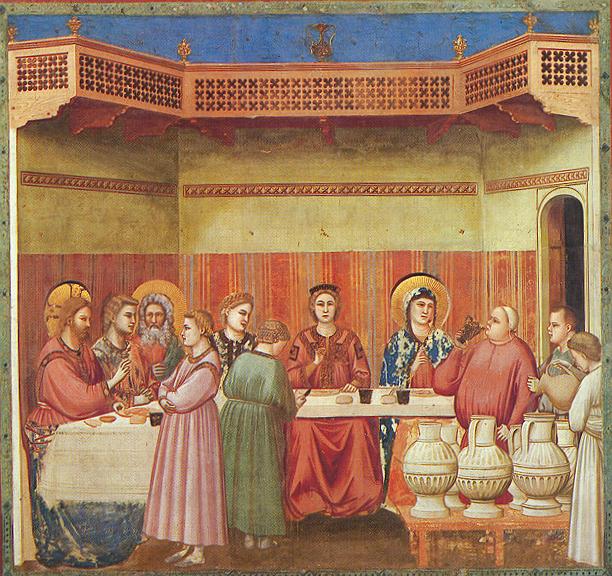

Marriage at Cana by Giotto, 14th century

He is the one who brings plenty when our own resources run out. He gives us hope in our waiting; in the face of lack and limitation, he invites us to abide in God’s love and restores us to fullness of life. When he transforms water into wine, he gives us a new symbol of what love looks like. He takes us from scarcity to abundance. God want to pour our to more and more life, love, joy, companionship. We are to live in that love which makes us more honest, patient, kind, forgiving and hopeful.

The glory that the disciples see in Cana is magnified on the cross, when Jesus’ love brings life out of death. This is salvation: when we are drawn so fully into the melody of God’s love that the whole world is vibrates with grace. We are to pray and praise God without ceasing in gestures of love and in tangible signs of hope.

Living with the Gods will conclude with a contemporary symbol of such love and hope: MacGregor will focus on the Lampedusa cross. It was made in 2013 by an Italian carpenter Fanncisco Tuccio out of pieces from a boat wrecked off the Italian coast.  That boat carried refugees crossing from Libya to Europe, many of whom drowned. When he met a group of Eritrean Christians who’d survived, Tuccio was moved by their story yet felt frustrated at his helplessness. So he made them crosses out of the wreckage.


One such cross is now in the British Museum. It is a sign of salvation and hope for the ship wrecked. It is a sign of the kindness of a small community in the face of the refugee crisis. It is a sign of our capacity to go beyond self-interest and to offer solace. It is a sign of God’s love which moves us from scarcity to abundance, from fear to hope, from death to life.

In the power of the Spirit, may our handbells and our hands express the love of God revealed in Jesus. 

For love in creation, for heaven restored, for grace of salvation, O praise ye the Lord! 


© Julie Gittoes


Thursday, 21 September 2017

Better Together

This is the text of a short reflection given at the Interfaith Panel Discussion convened by Canon Dr Anthony Cane at Chichester Cathedral as part of International Day of Peace. Further details about the event and other panelists can be found on the Cathedral website. The title for the discussion was: How can we live better together, for the well being of all?

W1A is back!

The BBC comedy sails painfully close to the truth of PC or PR-speak corporate culture with all the anxieties about Charter renewal and public service. W1A parodied what we mean by “better” by appointing of Anna Rampton as Director of Better to place betterness development at the core.


Series three goes one step further as Anna introduces the more of less initiative:  as she says, “identifying what we do best and finding more ways of doing less of it better”. 

Putting the words ‘better together’ into Google reveals something of our contemporary longing to live well: it’s associated with our digital lives, increased connectivity and the desire for stable personal relationships; it embraces the tension between increasing GDP  and the concern for sustainable development; it touches on climate change, the environmental and our political aspirations.  There’s talk not only of soft, hard or smooth Brexit; but a better Brexit.


The referendum revealed fault-lines within our society: home owners versus renters; millennials versus pensioners; north versus south; rural versus urban; rich versus poor; graduate versus non-graduate. We can add to this questions of identity - as fluid or sharply defined and inequalities of social and cultural capital, as well as wealth.

In the midst of this, I want to suggest some wisdom from scripture before our conversation:

A line from Psalm 118 [verse 8]: ‘It is better to take refuge in the Lord than to put confidence in mortals’. Psalms draw our entire life under the rule of God - from sorrow and lament to joy and thanksgiving. They represent a struggle for justice and yearning for peace; they express our primary orientation to God. Even in the face of upheaval and distress we are called back to discover a new way of living, rooted in God’s faithful love.

Fixing our attention on God shapes us: our priorities are transformed as we seek to live wisely moment by moment; as God’s ways become our ways. In our relationships and responsibilities we make decisions: to act selfishly or with compassion; to possess and consume or to be content with less. We’re called to seek the welfare of the widow, orphan and stranger.  As Proverbs puts it [16: 8]: Better is a little with righteousness than large income with injustice’.

Attentiveness to God and attentiveness to the needs of others is also at the heart of the Gospel. Luke draws us into the dynamics of two siblings - Mary and Martha - who welcome Jesus into the hospitality of their home. One sister is busily consumed with tasks and a grumpy irritation that she's doing it all; the other sits in rapt attention at the feet of her Lord. 

Into this tension, Jesus speaks with affection [Luke 10:41-2]: ‘Martha, Martha, you are worried and distracted by many things; there is need of only one thing. Mary has chosen the better part…’.  Our ability to attend to the needs of others begins by loving God above all things and extends to loving our neighbour fully, even as ourselves.
It’s this way of being with others, as God was with us in Jesus, that shapes a Christian tradition and challenges selfish ambition. In Philippians this is seen as key to living better together; enabling all to flourish; to seek the good of the communities in which we share; to be concerned for the interests of others. Concentration on the self pushes others to the margins; instead writes Paul [Philippians 2:3]: ‘Do nothing from selfish ambition or conceit, but in humility regard others as better than yourselves.’

How do we live better together, for the well-being of all?

Pay deep attention to God’s loving ways: in prayer, worship and learning. Those habits shape us - so that we might become more who we’re called to be. More loving, generous, compassionate and peaceable; more able to see the other as beloved by God, to seek her well-being. 

Like the Director of Better, we identify what we do best…

…but perhaps we should do more of it - for the sake of all - together.

This is the stuff of God’s Kingdom.

To participate fully in the practices and processes which build community, attending to what God is doing in and through others in the places where we live; strengthening networks of faith and good will. This is a rooted, social and authentic way of building trust and renewing hope; looking beyond self interest to a more sustainable and equitable future.


© Julie Gittoes 2017

Monday, 22 August 2016

Olympians and disciples...


This is the text of a sermon preached at Evensong on Sunday evening - as the Rio 2016 Olympics drew to a close. In part it is a meditation on Psalm119 (or at least the portion set for that day, verses 49-64) in relation to Isaiah 30:8:21 and 2 Corinthians 9. When we think of 'putting in the hours' as disciples, what does that really mean? Perhaps, if it's taking inspiration from athletes, it's about habits of attention to God: in worship, personal prayer, reading the scriptures, fostering relationships... allowing space and time for God's Spirit to be at work in us. It doesn't make us 'busier' but it might equip us to respond to others in obedience to God's commandments of love. Praying the psalms is at the heart of daily prayer - in paying attention to God in them and through them, our lives our shaped with honesty and hope.


O Lord... teach me thy statutes.

As we worship this evening, TeamGB has claimed second place in the final Rio16 medal table.

Some names are well known - Mo Farah, Laura Trott and Bradley Wiggens; others are unfamiliar - including Hollie Webb, Helen Richardson-Walsh and Maddie Hinch in the women's hockey team.

And perhaps, out of the 1000s of people who participate week by week in sporting activities as diverse as archery, badminton and fencing, we wonder what makes an Olympic athlete?

The Director of the Science Gallery at King's,Dr Daniel Glaser, has a succinct answer, based on neuroscience: he says that motivation and innate ability make little difference. 'It's all about the hours your put in.'  Hours and hours of repetitive practice changes brain structure - reflected in the excellence of the 58 year old equestrian Nick Skelton and the 16 year old gymnast Amy Tinkler.

Few of us will dedicate our lives to one such discipline: yet we understand the effort needed to reach a point that a skill looks effortless. In music, languages and sewing, as well as sport, for most of us it's getting to the point where we can enjoy something for fun, make a gift or be understood travelling overseas.

What about our lives of faith: what sort of repetition shapes our lives and deepens our response to God?

Psalm 119 offers wisdom in the form of personal practice. It's made up of 22 eight verse stanzas - bite size pieces which we could read/pray over the course of coming weeks. Psalms form and transform us.

This prayer is addressed to God: it expresses personal faith and encourages others. The psalmist rejoices in God's faithfulness and ponders how we can live more faithfully. We hear of troubles, derision and fear. The quest isn't for the good, lofty or noble ideal in the abstract, but the day by day working out of God's love for us.

Such love is revealed in word, judgments, ordinances, statutes, testimony and commandments.  These are ways of describing God's concern for what is just, peaceable, compassionate and merciful. The faithfulness of God is communicated in such a way that we might be guided; that we might practice ways of kindness; that our dealings with one another might be consistent.

The earth, O Lord, is full of thy mercy. It is full of your steadfast love.

At times of uncertainty and sleeplessness, in weakness and growing older, the young psalmist seeks to learn observe, read, obey, sing about and practice this love. There is joy, delight and freedom. 

Likewise, we are called to put in the hours!  Paradoxically, rather than meaning more human effort, this allows space for God's grace to act on us, in us and through us. We are to practice putting God at the centre; to be mindful of how that love seeps out into the minutia of our life. In acts of tenderness to a child; in courtesy to a colleague; in patience in the face of indignation; in good judgement amidst things which trouble us.

This is the pattern of life Isaiah calls God's people back to: a way which is purposeful and disciplined by the ways of God. Our hope is not in human strength or schemes; our trust is not based on our capacity to manipulate, oppress or deceive others. Instead, we are to return to and rest in God: to abide in his grace, mercy, justice and blessing.

Like the psalmist, Isaiah acknowledges affliction and adversity: but assures us that cries are heard; God's word is spoken. We are to listen and then practice - one step at a time.

This is the way; walk in it.

Both prophet and psalmist weave together thought and action; praise and service.  It is a pattern of live lived under the compulsion of love. God's way of love is made manifest in Jesus Christ; it is costly and generous. It's a love that enables Paul to nudge the Corinthians beyond duty and pride in their giving. It is God's Spirit which awakens in us the capacity to act with such a generous love.

What we hear from Paul is an example of how formation our lives before God opens up transformed lives. It enhances the welfare of others, restores their dignity, enables them to trust others and praise God. It is an act of witness as love divine finds expression in human lives; it's authentic, compelling and live-giving. It glorifies God in expressions of praise, joy and thanksgiving.

Let's weave psalm 119 into our lives: a stanza at a time, perhaps. Let's meditate on God's love; on the commandment to love others. Let's listen, learn, act and sing.

The earth, O Lord, is full of your steadfast love; teach me your statues.  

© Julie Gittoes 2016

Sunday, 27 March 2016

Praise the LORD!


Psalm 117:


Praise the Lord, all you nations!
    Extol him, all you peoples!
For great is his steadfast love towards us,
    and the faithfulness of the Lord endures for ever.
Praise the Lord!