Showing posts with label commandments. Show all posts

Saturday, 7 September 2024

A kindness in God's justice

1 September, Trinity 14: Deuteronomy 4:1-2, 6-9, James 1:17-end 

& Mark 7:1-8, 14-15, 21-23


Do you remember any of your school rules?


Reminiscing with my sister, we recalled being allowed to go as far as Wathen’s sweet shop; but also being forbidden from eating in the street. 


We both remembered going to the fair at lunch time - waltzers, dodgems, the mexican hat - cash zipped into blazer pockets alongside pens, making it back just in time for the bell.  Maybe it wasn’t banned, maybe rules were flouted, or maybe it was an accepted tradition: who knows! 


We were definitely banned from ‘spinning out on cups of coffee’ in cafes which always seemed like a curious rule at that time as it didn’t seem a likely teenage temptation let alone habit.


Coffee cups: stock image


Fast Forward 30+ years and that rule has been dropped from the list - replaced by the more ambiguous yet weighty generic of pupils remembering ‘that they are representing the School in public areas’.


That said, working in cafes is now more normative - both socially acceptable on the one hand and an irritation to owners on the other if coffees are ‘spun out’ for hours. 


Rules and traditions are both given by communities and also form them.  Within schools, they’re designed to maintain discipline and provide structure to underpin an environment where learning can happen.  


It’s about more than that: some might be about ideas of etiquette, behaviour or personal development; others about protecting students from harm as part of safeguarding. The values that underpin the wider ethos might be political, social or religious - an overarching vision for human flourishing and fostering the common good. 


Our first reading sets statutes and ordinances within the context of establishing a settled community after a period of nomadic life as God’s people trekked through the wilderness. They were to be a covenant community shaped by obedience to the commandments. 


The ten commandments reflected a series of right relationships: loving God and loving one’s neighbour as oneself. They offered a framework which set boundaries on acceptable behaviour in worship and community.


Adherence to such teachings were to be a sign to others - who might find their way of life attractive, a means of stability and flourishing; a mark of wisdom and discernment.  Their life together was to reflect the nature of God: a Holy One who knows the thoughts of our hearts, beyond our comprehension yet the source of goodness, justice, rest and joy. 


Worship of this God - and the distinctive ways of this people - was to be passed down to future generations. Children would be taught these commandments - inhabiting a culture which set out how to show their love of the Holy One in worship and in their behaviour, honouring their obligations to their neighbour. 


There is wisdom and discernment in this - inviting us to consider our motivations for doing the ‘right thing’. Is it about compliance or how we feel - or pointing to the kind of God we trust in?


Yet overtime, as the community faced new challenges and influences, those commandments prompted further questions. Fresh guidance was needed - clarification, interpretations, case studies. 


All these things were ways of making sure that the holiness of God was honoured; that nothing impure would get in the way. Way of making sure the community was distinct: that food was safe to eat and that relationships were appropriate.


Every community does this. We have our rules which shape our culture and expectations.   Every church has its ‘normal’: but we’re also shaped by beliefs and traditions - about God and how we live together. 


Today Jesus is challenging his hearers to consider what flows from the heart. Do our attempts to live faithfully tempt us to judge others on externals? It’s easy for us to say ‘thank goodness we’re not like the Pharisees’ but we also have an opportunity to understand them - and in turn appreciate how Jesus’ words might challenge us.


The Pharisees took the call to be a holy nation very seriously. As the community settled into ordered patterns of worship, and sought to maintain a distinctive life, we can understand why the ritual of washing hands (done by the priests serving in the temple) might be extended to ordinary meal times as a way of marking it as sacred. 


Those additional traditions of the elders became increasingly important to maintaining their faith and way of life - particularly in exile, when reestablishing community afterwards or under Roman occupation as they then were. 


When they saw Jesus’ sitting lightly to some of those things with his disciples they were moved by fear that  it was a step towards undermining God’s law itself. 


Jesus’ words of reproach in response was perhaps undermining their expertise and seriousness: but rather an invitation to go deeper into. Jesus quotes Isaiah which teases out the distinction between keeping rules externally and neglecting our internal motivations. 


‘This people honour me with their lips, but their hearts are far from me’. 


The external practices designed to demonstrate wisdom and discernment, to point others to God’s holiness and to be a blessing to others had become such a focus, that the life of the human heart had been neglected. 


The focus on the external left some excluded or marginalised - women or foreigners for example. Yet they were those about whom the commandments of God were also concerned. Love of neighbour included the widow, orphan and stranger. 


As people of faith we too want that commitment and trust to be reflected in the concrete realities of our lives. Sometimes we might be tempted to limit the scope of God’s grace - to think that some might be more or less deserving of that grace than others. 


As Faber’s famous hymn puts it, there is ‘a wideness in God’s mercy’ and a ‘kindness in God’s justice which is more than liberty’.  


Faithfulness to God’s ways is about loving God with all that we are - heart, mind, soul and strength - and also loving our neighbour as ourself. Sometimes as Faber continues ‘we make God’s love too narrow / by false limits of our own, / and we magnify its strictness / with a zeal God will not own.’


With the no nonsense pragmatism about the natural processes of digestion, Jesus stresses that nothing from outside of us can defile us. Instead look to our hearts: and the way bitterness or deceit, envy or pride, misdirected desires and selfish intent can take root there. What is in our hearts, can shape our thoughts, attitudes and actions, separating us from God and each other. 


Yet this is also good news: because God knows all the secrets of our hearts. In Jesus love divine is known in human flesh - the one who dares to embrace the outcast, raise up the lowly, restore the sick, challenge the powerful.  His life was given for all. There is welcome and grace, there is ‘mercy with the Saviour, there is healing in his blood’ as the hymn puts it. 


That good news does have a claim on our lives: faithfulness is about attending to our heart and reaching out to others with lives that have been shaped by the radical love of God given for us in Jesus Christ.  The breadth of such love is an invitation to rest on that assurance that ‘our lives would be illumined / by the presence of our Lord’. 


The letter of James leans into the lessons of such a way of faith and faithfulness: he too contrasts the gifts of grace and acts of love which come from God, and the desires that separate us from earth other,  the ways of death rather than life. How can we live as children of God, rather than as those shaped by solely worldly desires?


He talks about the importance of communication - of listening and keeping a cool head; warning against the danger of rising too quickly to anger. Yet at the same time seeking what is justice and good. 


How we communicate impacts on how we are heard; how we listen shapes what we say. Allowing space for curiosity about the other or getting to the root of the concern might open up new ways forward. Though sometimes perhaps we have to take a deep breath, walk away, and allow the temperature to go down; or sometimes the mediation of others.


James also stresses the importance of faithful action - or action informed by our faith. He uses the shorthand ‘law of liberty’ for God’s commandments of love.


These should be things that shape our body language - not glimpsing in the mirror and forgetting what we look like - but practising those gestures of kindness, self-control, compassion, patience, generosity and joy.


For James faith and faithfulness is about caring for each other and those who’re vulnerable or marginalised: remembering that we are not just representing Jesus in the personal and public areas of our life; we are members of Christ's body called, by the power of the Spirit, to be a living sign of God’s ways. Amen.


© Julie Gittoes 2024

Monday, 30 October 2023

You shall love

Sunday 29th October - last Sunday after Trinity: Leviticus 19:1-2, 15-18, 1 Thessalonians 2:1-8 and Matthew 22:34-end


+You shall love the Lord your God with all your heart and with all your soul and with all your mind. This is the greatest and first commandment. And a second is like it, you shall love your neighbour as yourself. 


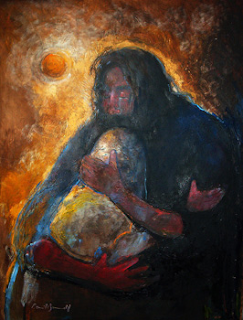
Image credit: Daniel Bonnell - Jesus Wept


How do we love in a time of fear? How, when two peoples, as one writer puts it, ‘with deep wounds, howling with grief, are fated to share the same small piece of land?’ [Freedland here]


Pain is both particular and vast for Israelis and Palestinians, the pain of Holocaust and Nakba and the cycles of trauma and fear of annihilation. The anxiety and grief that exists within communities in Barnet too, and a longing for safety and empathy. A pain so relentless and unquantifiable it breaks our hearts.  


Yet we must find a way of loving because the world is both too dangerous and too beautiful, too broken and too holy, too unjust and too full of possibility for anything else. 


The alternative is unending loss; the horror of conflict limits the range of our human sympathy or solidarity we can end up in a dark place; a place where more hatred is birthed; further harm conceived.


Our readings today invite us into that hard way of loving that allows for humanity and hope, empathy and justice, those things which make progress towards peace. Even when, especially when, our prayers are cries for resolution, pleas for freedom. 


You shall love. 


Leviticus reminds us that this is a command that flows from the very nature of God.


You shall be holy for I the Lord your God are holy. 


Holiness revealed in human lives looks like just judgement - without partiality or deference or slander; without vengeance, grudges or hatred; without profiting from the life of a neighbour by their blood. 


I am the Lord. I am the Lord.


You shall love.


Such love is a matter of effort and practice rather than a feeling or preference. It is a commandment. A matter of obedience. 


It means vulnerability and trust; it means crossing boundaries.


It seems beyond our human capacity. And it is. Yet we find hope. 


Jesus himself says you shall love, not as a social nicety but in the context of having silenced critics, amazed others and being tested by some. Betrayal, arrest, denial, condemnation and death are but days away for him.


There can be no more demanding context within which to say to friend, enemy, follower or critic: you shall love.


The love of which he speaks demands our all: heart, soul and mind. A whole-person attention God’s inexhaustible self. God’s love makes our love possible.


It means an acceptance that we are loved in order that we can love neighbour. That first step perhaps the hardest needing constant renewal in order to overflow to others. 


In Jesus, the fullness of God’s love has flesh and bones, blood and breath.  Love going to the cross and grave and depths of hell; love rising again to reach beyond locked doors and warm fearful hearts. 


To walk that way of love is to weep and laugh, touch and feed; to welcome, set free and forgive; to comfort, confront and guide; to listen, to wait and speak. 


Rabbi Jonathan Wittenberg, reflecting on solidarity in a time of fear writes on being kind or loving, from the Hebrew ‘Chesed’. [Rabbi Wittenberg's blog is here]


Such 'enduring kindness’ he says ‘sounds weak in response to terror. It’s not, it’s a way of life… it requires constancy, generosity, forbearance and the courage to stay present amidst pain. It demands our time, commitment and heart.’


You shall love. 


It is our way of life too. Life shaped by our prayer- by placing infinite love at the centre of our hearts. Life shaped by our community - by gathering around our Lord’s table. 


It is a life that requires much of us: our time, our commitment, our hearts. 


Writing to the Thessalonians, Paul spoke of the courage to walk this way of love and to share it with others, despite his own suffering and maltreatment.  He shared good news of God’s love  without flattery or greed, deceit or trickery but with gentleness. 


His words and actions drew on a reservoir of divine love: loving God whole-heartedly, and being loved absolutely, had shaped and tested his human heart - so that he could express a deep care for for the other, to those he did not know.


Rachel Goldberg, the American-Israeli mother of one of those taken hostage, addressed the United Nations yesterday: she spoke of pain and hope and the courage to resist hatred; to not let it erode our humanity [the link is here]. 


She also speaks of the Bedouin Muslim who stood in front of the shelter where her son and others hid. He tried to negotiate with the militants to

save them, telling them his family were in their and not to search it. He was brutally beaten by Hamas.  


The Muslim broadcaster Remona Aly spoke on Radio 2 about life and love which bring hope out of despair, like suns rising after darkness. She sees ‘suns rising’ she said ‘within people who bravely, vulnerably reach out to share each other’s pain.’ [Here is the link to Remona Aly's pause for thought]


We don’t not find ourselves outside Israeli shelters or Palestinian hospitals; nor are we negotiators or aid workers, but we are neighbours. And our neighbours need us to have forbearance and courage, generosity and constancy. To be there to listen. To not other them.  


Love is not weak but it is strengthened in prayer: turning to a loving God that our hearts might have the capacity to be alongside our neighbours. It begins with our silence, our cries. Let us pray, in words shared by Archbishop Justin:


God of compassion and justice,  we cry out to you for all who suffer in the Holy Land today. For your precious children, Israelis and Palestinians, traumatised and in fear for their lives. Lord, have mercy.


For the families of the bereaved, for those who have seen images they will never forget, for those anxiously waiting for news, despairing with each passing day. Lord, have mercy.


For young men and women heading into combat, bearing the burden of what others have done and what they will be asked to do. Lord, have mercy.


For civilians in Israel, Gaza and the West Bank, that they would be protected, and that every life would count,  and be cherished and remembered. Lord, have mercy.


For the wounded, and those facing a lifetime of scars, for those desperately seeking medical treatment where there is none. Lord, have mercy.


For medical and emergency personnel, risking their own lives to save those of others. Lord, have mercy.


For those who cannot see anything but rage and violence, that you would surprise them with mercy, and turn their hearts towards kindness for their fellow human beings. Lord, have mercy.


For people of peace, whose imagination is large enough to conceive of a different way, that they may speak, and act, and be heard. Lord, have mercy.


Mighty and caring God, you promised that one day, swords will be beaten into ploughshares, meet us in our distress, and bring peace upon this troubled land. Amen.


© Julie Gittoes 2023 (the concluding prayer, Archbishop of Canterbury)

Tuesday, 16 May 2023

Ring out, wild bells

 14 May, 6th of Easter: Acts 17:22-31, 1 Peter 3:13-end and John 14:15-21


Tennyson wrote his epic poem In Memoriam following the sudden death of his friend Henry Hallam. The section called “Ring out, wild bells” captures the intensity of his feelings of loss Ring out the grief that saps the mind; but also the hope that the turning of the year and its seasons would mark a fresh start Ring out the old, ring in the new, Ring happy bells, across the snow. 


“Bell Sunday” is a new initiative - offering us an opportunity to give thanks for the contributions of bells and bell ringers in the life of the Church.  Long after St Dunstan, their patron saint, began experimenting with forging bells in the 900s, they have rung out to offer praise and call people to worship; marking moments of personal and national significance at times of sorrow and great gladness. 


Here in Hendon, one of our bells carries the inscription:  Gloria in excelsis Deo - glory to God in the highest. As the psalmist puts it, bells join with harps and voices to sing out a glorious noise to the Lord.


Tennyson goes further, suggesting that the ringing out of wild bells echos the call to proclaim the good news of Jesus - the call to repentance, the commandment to love and the nearness of God’s kingdom.


Ring out, wild bells… ring out the false, ring in the true…

Ring out the feud of rich and poor, ring in redress to all mankind.


Wild bells are to ring out strife, want, care and sin; the faithless coldness of the times.

They ring in a nobler mode of life, sweeter manners, purer laws.


Ring out false pride in place and blood,

The civic slader and the spite;

Ring in the love of truth and right,

Ring in the common love of good.


Our wild bells ringing in the love and obedience of which Jesus speaks: If you love me, he says, keep my commandments


It is such a simple and memorable command; yet how often we struggle to embrace it fully. To love makes us vulnerable and invites us to trust. That’s hard when we’d prefer to sit with our own preferences or suspicions. It's hard when the world seems to be bent towards slander and spite, rather than common love of good.


Love flows over the margins and blurs the edges when we’d sometimes prefer neat boundaries of the ability to control what happens; love remoulds us and brings change, when we’d rather not deal with the disruption or effort.


Jesus invites us to love one another as he has loved us: with honest engagement, with a depth of compassion, with a generous invitation and patient, persistent challenge. Even when we see ourselves as most unlovely or unworthy, Jesus rings in love of truth and right.


And don’t we at some level yearn for this - for the common love of good which rings out strife, want, care and sin?


At some level, we yearn for a love that gives to food banks and shares cake with those who are alone; a love that draws people together in their diversity and stops to ask if someone is ok.


Jesus’ words form us into a community centred on God’s all-inclusive commandment to love: to love beyond our preferences and friendships; to love beyond what feels manageable. His call to love is to be pulled towards a fierce hunger for the other, for justice, for compassion. To love until our heart breaks.


For love to become part of the muscle memory of our hearts and minds, we need to practise love as diligently as ringers learn to handle a rope and learn a method.  


Ringers begin with one stroke at a time; getting the measure of the weight and movement; they ring in rounds, sensing when to pull off and when to hold back. They embody technique and get to know rope and bell. 


In the same way we learn to love: practising charity as our heart changes, expands; until we love friends, companions and then the stranger or those we disagree with. 


Ringers model for us how to move into new patterns and changes; they remind us that we don’t do all the work of learning and loving by ourselves. That would be too much to carry. Whereas they practise and trust, learn and build their memory, with dedication and discipline, so do we. Together.


We do so not only in the company of a human band of ringers, but with one who is our advocate, helper, comforter and encourager: the Spirit who lives in and moves through us. The Spirit is a gift from the heart of God to abide with us. 


Such a Spirit is inexhaustible - taking root in our hearts and helping us to be more fully who we are. The Spirit abides in our hearts and minds - allowing the possibility of love in each thought, breath and gesture. 


The Spirit rings in truth in us, rings in remembrance of love and calls us to abide and rest. Peals of bells are all our attention because they spring forth after times not only of practice but of rest. Here we abide: around one table, one food - for the sake of one world.


Our lives, like the wild bells ringing out, have times of movement and rhythm, rest and stillness.  Perhaps we can listen to them and be reminded of God - the one, as Paul quoted another poet, in whom we live and move and have our being. 


What we see in Paul is someone caught up in the Spirit. When he encounters those outside his own frame of reference and experience, his speech, as Jennings puts it  meets divine desire. Then the Holy Spirit will tell you [him, us] what to say in order to create the new in and through your [our, his] words. That new is a relationship aimed at a marvellous joining.


Paul sees the idols as signs of distorted hope - made by human beings and reflecting human longings. However, he does not condemn but rather finds a point of connection which speaks of God’s love for them.  He finds a way of bending them towards what they do not know to be enfolded by God - showing them that they are loved and wanted. 


It is why, as with the wild bells, the call of love rings out sin, selfishness and separation; and rings in truth, love and peace. The ringing out of wild bells expresses something of God’s love and the claim that love makes on us - a claim that changes us. Which is why, to quote Jennings again, God demands of all people the turning-toward that is repentance. A habit for individual, churches and communites.


The love of God in Christ stands between life and death. In baptism, as Peter reminds us, we die in the flesh but are made alive in the Spirit.  Here we find gift and grace; here our hearts are set on fire with justice. This is the hope of love that we are to be willing to give an account of: the call to repentance and the gift of new life, for the sake of the world.


Ring in… the larger heart, the kinder hand;

Ring out the darkness of the land,

Ring in the Christ that is to be.


© Julie Gittoes 2023