Showing posts with label temple. Show all posts

Sunday, 7 March 2021

Holy disruption

 Third of Lent: Exodus 20:1-17 and John 2:13-22
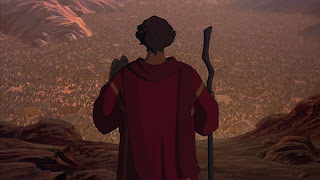


Image: YouTube still


The Prince of Egypt is a beautiful animation of an ancient story. 


A story of the struggle for freedom in the face of power and oppression.


It’s an epic narrative which blends the emotional intensity of human relationships with the presence of God. There is awe and mystery and intimacy. A God speaking in fire and cloud and in a still small voice.


The film ends with the moment that God speaks in today’s reading from Exodus.


It  ends with the giving of the Ten Commandments.


What makes for a cinematic finale is actually the beginning of a new phase of understanding God’s character and relationship with humanity, with us.


Here is a God who is loving and merciful. A God whose words demand a degree of courage and humility. 


For God speaks words which redirect our hearts towards love; words which name the damage done when our hearts are ruled by selfish desires.


Moses Delivering His Ten Commandments by David Courlander. 


The words that God speaks reminds the people of their story. 


The Lord God brought them out of slavey and into freedom. 


This God is the great I am: who was and is and is to come. There is no other. 


The words that God speaks forms a people with identity and belonging and purpose.


The Lord God has given them a way to live. To turn away from that - to give other gods, idols, desires and prizes central place - would have repercussions on future generations.


To remain faithful to God’s ways would be a blessing of love to not just the third or forth generation, but the thousandth. 


The Greyhound might be one of the few, if not the only, pub in north London with the ten commandments on the walls. 


And yet perhaps those words which God spoke ought to be just at home  convivial meeting place as in a place of worship.


These words: 


Honouring God’s name and embracing the command to rest. The holiness of God blessing and setting aside and hallowing the rhythms of time.


Honouring one another: in family relationships, in preserving life and in faithfulness.


Honouring community: not stealing, speaking falsely or coveting that which belongs to another.


All these words, held within a covenant of love.


A covenant of love, which as it was lived out and interpreted, included provision for widow and orphan; which released those in debt; which acknowledged that the earth was the Lord’s. 


Before the presence of God, and in the company of one another, God’s people are called to live in faithfulness to the commandments.


Jesus Cleanses The Temple by Jhoti Sati


What then are we to make of today’s episode from John’s Gospel? So soon after turning water into wine at the wedding feast, Jesus is overturning tables in the temple.


If God’s response to our failures to love it to keep on loving, perhaps we need to be alert to that fact that that’s not always comfortable; for the Lord comes to the Temple as a refiner’s fire.


Is this perhaps a form of holy disruption? 


Does it reveal something new? Does this action draw us more deeply into the mystery of God’s ways of loving?


This story feels familiar to us - the other Gospels place the episode in the final week of Jesus’ life; but John sets it at the beginning.


Here, Jesus doesn’t talk about the Temple as a den of robbers; nor does he remind his hearers that it should be house of prayer for all nations.


Whilst not naming exploitation or exclusion, Jesus seems to be saying something about himself, as well as the Temple.


Amidst the noise and hubbub and habits of trade, the Temple’s purpose, as a place of intimate and awesome encounter with God, has been obscured.
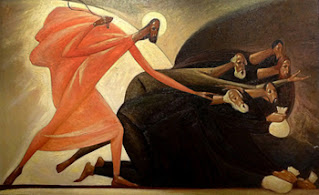


Alexander Smirnov - The Cleansing of the Temple


In the midst of this whirlwind of disruption, the bystanders ask for a sign to explain this action; they want to debate it.


Jesus doesn’t given them a ‘sign’ or miracle; instead he gives them something more like a riddle.


“Destroy this temple”, he says,  “and in three days I will raise it up.”


To take this literally sounds preposterous or outlandish.


The people don’t understand. John breaks the narrative wall to turn his gaze on us; to say to us, that Jesus is talking about his own body.


Here, at the beginning of his ministry, Jesus is making a bold statement about where God’s presence dwells.


Here, in flesh and blood, God is with us. 


But what Jesus reveals about himself - and the natures of God is the depth of loving.


Stations of the Cross - Alice Sielle


He points us to this arrest, death and resurrection.


In this holy disruption in a holy place, Jesus overturns what we thought we could say about God’s presence with us.


The God who’d led a people from slavery to freedom is leading us from death to life. 


The God whose commandments call us to faithfulness, rest, honour and obedience doesn’t stop loving when we make mistakes.


Instead, this God remains steadfast; dwells with us in Jesus; and through him loves and heals and forgives. 


This God puts out all our misdeeds; and makes us a clean heart.


In Jesus, we are not cast away from God’d presence; in him the covenant of love is extended.


This God calls us back from sin, selfishness, misdirected desire: and says:

If ye love me - keep my commandments. This God promises to renew us with his Spirit.


© Julie Gittoes 2021


Monday, 4 February 2019

When Christmas meets Easter...

It was a delight to celebrate Candlemas with the people of St John's West Byfleet - especially as the opening hymn was one of my favourites (Of the Father's love begotten). Candlemas is my favourite festival - because of its honesty about the challenges and sorrows of life but also because of its assertion that the light will continue to shine in the darkness.  The readings for Evensong were: Haggai 2:1-9 and John 2:18-22

Last night, my colleague turned a simple birthday cake into a dramatic extravaganza by adding an indoor fire work to the candles: on such occasions the association of food and celebration is self-evident.

Yet, our culture seems increasingly drawn into a commercially driven disconnect between festive food and seasonal specificity: Santa themed chocolate in August, mince pies in October and hot cross buns in December. 

But there is one item in particular which leads to shocked headlines:


Shoppers take to Twitter to express their disbelief alongside pictures of the offending eggs.

In the aisles of Aldi and Waitrose, shoppers complain; whilst store managers speak of storage space, sales figures and consumer choice. 

Yet today, we celebrate festival where Christmas meets Easter.

At Candlemas, we turn from Christ’s nativity to Christ’s passion; we move from cradle to cross.

Candlemas, or the feast of the presentation of Christ in the Temple, is my favourite festival because it straddles the seasons. It weaves together the themes of amazement and sorrow; joy and grief. It confronts the reality of death and the promise of new life.

Luke’s account of the presentation, blends together the hopes of infancy, the expectations of parenthood and the wisdom of old age. 

And at its heart is a dazzling brightness. 

Light shines in the darkness.

Darkness does not overcome it.

The light of the world comes into the Temple, in substance of our flesh.

Every time we gather for Evensong, we are drawn into this moment as we share in singing Simeon’s song: the Nunc Dimittis.

Simeon held the Christ child in his arms and he beheld his salvation.

He knew that this gift of hope was not his alone. 

He looks into the eyes of this infant and beheld God with us: the light to lighten the Gentiles; the glory of the people of Israel.

Or, in the words of a Candlemas hymn, he recognised that: A glory dawns in every dark place,  /the light of Christ, the fullness of grace.


Icon of the Presentation of Christ in the Temple

This evening, our readings don’t tell us about Simeon’s blessing and counsel; or the things that Mary ponders in her heart. We don’t hear of Anna’s exuberant proclamation of good news. 

Instead we are drawn into the fulfilment of Simeon’s words: this child will face opposition; this child will reveal the inner most thoughts of our hearts; this child will challenge authority and raise up the weak.

Our second reading, parachutes us into the middle of something; like tuning into The Archers or Casualty half way through an episode. 

Jesus is asked ‘What sign can you show us for doing this?’ But it’s not clear what ‘this’ is.

As an adult, Jesus returned to the Temple several times. On this occasion, he has been horrified that his Father’s house is a place of commerce. Commission got in the way worship; impoverishment got in the way of justice; exchange got in the way of gift.

The prophet Haggai had spoken of the ruins of the Temple compared to its former glory. It’s restoration was to enable God’s people to abide in that holy place - to listen to God; to be faithful to the covenant of love; to seek justice and mercy.

Perhaps Jesus recalled Haggai’s words as a rebuke in the midst of exploitation: How does it look to you now? Is it not in your sight as nothing? 

We can imagine the scene - the clamour of money changers; the noise of the sheep and the doves. Jesus is consumed by zeal. Tables are overturned, coins scattered, people and animals driven out.


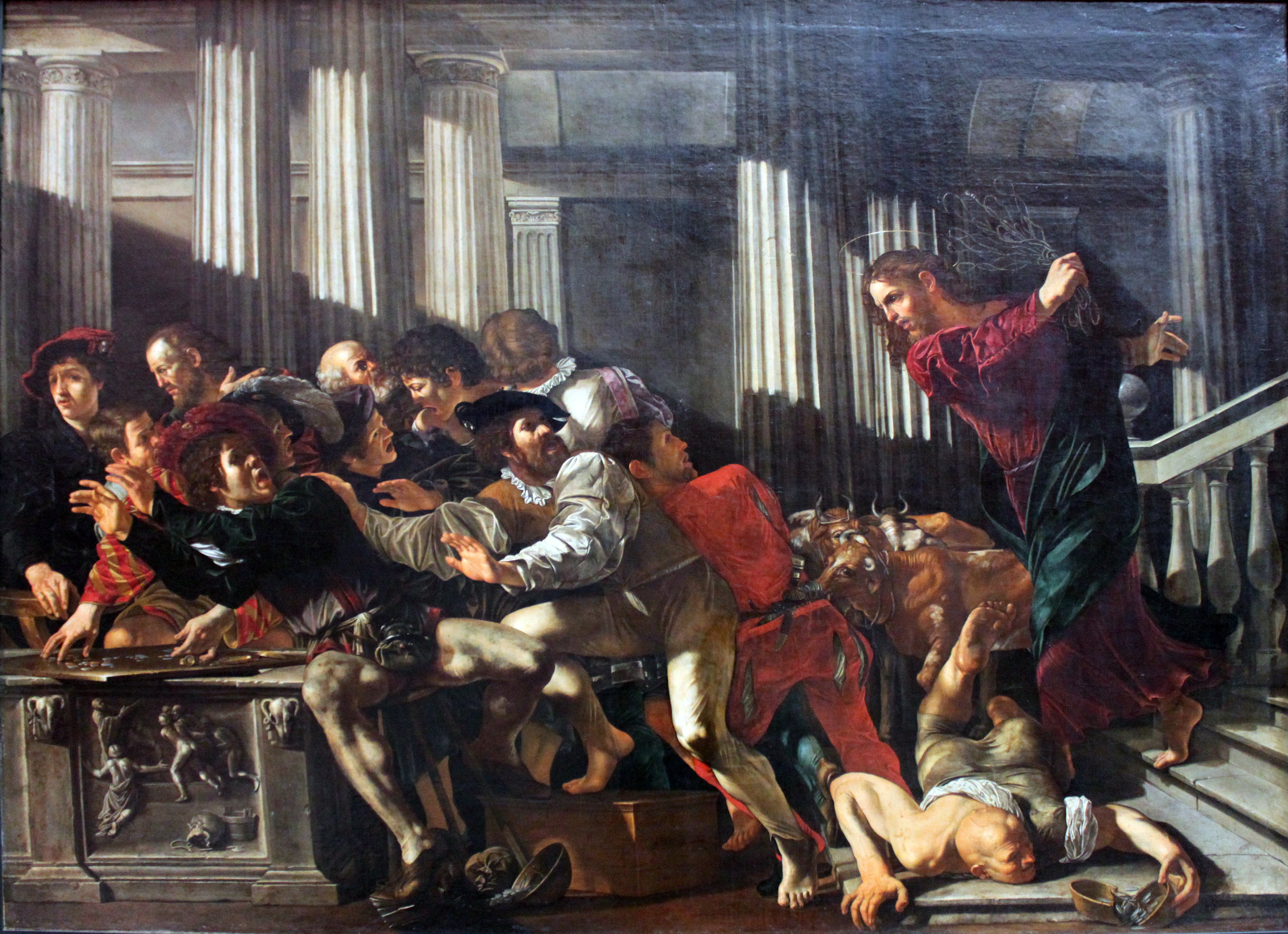
Christ driving the money-changers from the temple - Caravaggio 

What sign can you show us, say those in authority, for doing this? Why have you caused such chaos and commotion?

Jesus’ response claiming to rebuild the Temple in three days sound either ridiculous or arrogant, dismissive or some kind of riddle. 

Taking in a literal sense, his words are misunderstood. 

Jesus’ words aren’t fully understood until his death and resurrection. He is speaking of the temple of his body: of its sacredness.  

Three times, Haggai exhorts the remnant of God’s people to be courageous in seeking to rebuild the architectural splendour of the Temple. The God known in such beauty and majesty is now made known in the fragility and vulnerability of human flesh. 

Jesus body is the dwelling place of God; a new Temple. This body is the site of life and love; of mercy and justice. He is the Word made flesh.  A body which will reach out to bring a hope and a healing touch; a body which will be broken to bring wholeness to others; a risen body bringing abundant life.

In Christ, we are invited see our bodies as sacred too. If we live in love, we abide in God and God abides in us. By the power of the Spirit, the words of Haggai are fulfilled. The Spirit does indeed abide in us; we need have no fear. 

To appreciate the sacredness of our bodies to speak of personhood made whole. We are called to treat ourselves and others as holy. The human body isn’t a commodity or object; we aren’t a set of issues to be solved. We are in a profound sense the home of God; God’s Temple; the place where love dwells.

Jean Vanier writes movingly about the sacred space of our human flesh saying: This place, which is the deepest in us all, is the place of our very personhood, the place of inner peace where God dwells and where we receive the light of life and the murmurings of the Spirit of God. It is the place in which we make life choices and from which flows our love for others.

The implications of this vision runs deep. In the words of your vision, it means being committed to seek prayerfully to know and do God’s will. To be God’s holy people in this community is to go deep into the love of God through that rhythm of prayer and worship. 

To go deep means that the worshipping community is reshaped; becoming more open and caring; being a place where bonds of trust grow; where patient love and forgiveness create a safe place; a place where we can question and wonder; where we can see in the other the image of God. 

To go deep means that we are challenged and equipped to engage loving with the wider community of which you are part. That includes being zealous for justice; being committed to the demands of peace; but also seeking to live in a way which respects the integrity of creation, knowing our dependence on the honey bee demands a sacrifice of sustainability. 


The Presentation - Chris Gollon

Today, the light and glory of God fills the Temple in substance of our flesh.

Today, the power of the Spirit, the fullness of Christ dwells in us as we abide in God’s love. 

This Candlemas, as Christmas meets Easter, let us make Jean Vanier’s words our prayer: 
Church is the place where, 
in the midst of the demands of our daily live, 
we can come together with others, as a community of believers, 
to a place of silence, our inner sanctuary, 
to listen to the word of God, to hear the murmurings of the Spirt 
and to welcome into our being the presence of 
the Word-made-flesh, Jesus. 
As we welcome Jesus and become one with him, 
we seek to welcome each other 
and together to go forth 
to welcome others, 
revealing to them the compassion and forgiveness of God.


©  Julie Gittoes 2019


Sunday, 30 December 2018

Day by day like us he grew

A sermon preached at Guildford Cathedral on 30th December 2018.  Writing in The Guardian a couple of weeks ago, Emma Brockes reflected on the experience of sifting through boxes in her parents’ home and finding what she calls ‘the detritus of girlhood’.  Perhaps we still have similar boxes of seemingly banal objects - and certainly exchanges on Twitter indicated that I wasn't alone in keeping the seemingly banal, worthless or useless.. As Brockes writes, ‘there is often an inverse relationship between the trivial nature of a keepsake and the wonder it evokes simply through having survived’.   

That article and the conversation was in my mind as I prepared to preach today - preaching on a glimpse into Jesus' childhood. Having just returned from a flying visit to my childhood home, I was conscious that setting foot in my bedroom is like a microcosm of  the National Museum of Childhood. Their collection of games, clothes, mechanical toys and dolls includes each generation’s “must have” (not things which ended up in our stockings!).  In holding in trust our nation’s collection, their curators are also engaging us in the wider culture and experience of childhood - and it also made me ponder how those things enable us to enter an adult world. 

Having heard sermons which sit lightly to the infant Jesus - rushing to focus on his adulthood teaching us how to be human - I began to wonder even more about the significance of Jesus growing up and what that might mean for us and for our salvation. And if childhood matters, then how do we enable others to grow up well. I had in mind another exchange about labels and ways in which we pigeonhole others within our congregation. However, as I've preached elsewhere, the responsibility goes much much wider and deeper in relation those who are robed of childhood through.  The texts were: 1 Samuel 2:18-20, Colossians 3:12-17 and Luke 2:41-52


48 hours in my family home reconnects me to the mysterious and intimate detritus of my childhood:  A-level notes; a Charles and Di thimble; a walkman; a Barbie doll; felt tip pens; tickets galore; letters from friends; commemorative coins; games, puzzles and banal keepsakes; books read and then re-read with my sister. Shared toys may have acquired a disputed status, but the Meccano my sister resurrected last week is definitely hers!


My sister's Meccano boat under construction (her photo credit too!)


These things not only preserve an experience of childhood. They also reveal the ways in which children are prepared for the adult world through imaginative play and construction toys, through storytelling and creativity.  

There is one carol which speaks of  ‘child’ ‘childhood’ and ‘children’ more than any other.  It is of course Cecil Frances Alexander’s ‘Once in Royal David’s city’. It was first published in her ‘Hymnbook for Little Children’ in 1848; but last week, as in so many cathedrals and churches, our carol service began with a treble voice breaking the silence of anticipation.

The familiar words may have a sentimental glow; but they continue to remind us of the truth that the little child in Mary’s arms is our God and Lord of all. 

Our God came to share in our humanity: sharing in our infancy, childhood and adolescence. 


The ordinariness of that matters. It is wondrous: Jesus shared in the life of an earthly home in Nazareth; day by day like us he grew.

At the heart of our faith is the truth that God, in whom we place our trust, lived among us; occupying particular time and space. That means sharing in our weakness, obedience and curiosity; in tears, laughter and love.  

Luke’s Gospel gives us a glimpse into that reality - not by preserving the detritus of Jesus’ boyhood, but by engaging us with who he is. Luke offers a snapshot of Jesus' cultural experience of growing up and discovering who he is.

Like other Jewish parents, Mary and Joseph took Jesus with them to Jerusalem to celebrate the Passover as soon as he was old enough.  They raised the child entrusted to them within a wider community of faith. At home in Nazareth, on the road to Jerusalem and in the midst of crowds celebrating across the city, he would have mixed freely with his extended family and friends. 

To be 12 years old comes with a whole set of preoccupations and anxieties: the things we want to explore or understand; the people we want to spend time with; the absorption in a moment.  It can be exciting, frustrating and not without worry as any child setting off for secondary school knows all too well.

The adolescent testing of boundaries and growing independence is in part a gift of enabling a child to grow up. Mary and Joseph are not immune from that risk or worry.  They make assumptions about who Jesus is with; his absence goes on noticed for a day.  Gradually the reality dawns that he’s not amongst the extended network of family and friends; they have to retrace their steps. 

Luke matter of factly states that they searched for three days: a search which may well have been restless, impatient and sleepless.  The expression of anxiety only breaks in when Jesus is found. 

He is found not acting as a precocious teenager teaching his elders. Rather he is sitting amongst them. Jesus is listening and asking questions. He forms his own responses - giving answers which demonstrate a depth of understanding.  The amazement of the crowds and the astonishment of his parents give way to a perfectly normal exchange.

Luke captures Mary’s relief and frustration, her anxiety and rebuke: child, why have you treated us like this? 


Luke also perfectly captures a typically nonchalant and frustrating teenage reply: why were you searching for me? Wasn’t it obvious? I must be in my Father’s house!

To grow up is about discovering who we are; where our passions and aptitudes lie; taking responsibility for ourselves, growing in maturity. 

For Jesus, he was growing in ever deepening awareness of who he was: God’s Son, with a longing to be in his Father’s house and to be amongst his people; knowing a complete union with his heavenly Father and a complete identification with our humanity. 

For now, that also meant living with his parents; continuing to grow up in obedience to their authority. 

For now, Mary and Joseph nurture him and come to know the cost of parenthood.  Like Hannah and Elkanah before them, their will watch their son grow up not only in service of God, but as the one who is God’s Son; the suffering servant.

No doubt every stitch that Hannah made in the robes she prepared for Samuel expressed love and prayer. Perhaps Mary too sewed garments for Jesus as she pondered all that she had seen; all that she did not yet understand; all that she hoped for and feared. 

The child at her breast became the child abiding in his Father’s house; the one who listened became the one who taught with authority.  

He was the glory of the people of Israel and a light for all nations; and yet a sword would pierce her soul too.  The one who was missing for three days would die and on the third day rise again. 

The adolescent engaging with teachers in the Temple grew in wisdom. His wisdom is not an abstract divine knowing; it is an enfleshed knowledge. 

The one who is our childhood’s pattern, thought and learned like us. He got older. He grew in understanding who is was: the Word made flesh, God’s beloved Son.

The Word was speechless in infancy and eloquent in humanity: God’s love sharing fully in our humanity so that we might share the life of his divinity. 

Our prayer today is that as members of the Church, we might live as one family united in love and obedience.  This is the prayer of Paul to the Colossians too. He adopts a language so familiar to our childhood. Just as we played at dressing up - taking on roles and identities of adulthood - so Paul invites us to dress in the new life that is in Christ. 

We are to cloth ourselves in the virtues of God’s kingdom: to be compassionate as we put our feelings of empathy into action; to be kind in our treatment of others; to be humble in our service as we allow others to flourish; to be patient in recognising that building up a community in love takes time as well as sustained effort.

To bear with others is to recognise that within a diverse community, sharing in one faith, there will be irritations and disagreements. What matters is how we resolve them.  Perhaps that means listening carefully to others; or enabling others to grow up, embracing their gifts. It means cherishing what each has to offer and avoiding labelling others in a way which belittles them. 


We are all called to belong: and each Eucharist marks the character of that belonging. We are people who are forgiven and called to forgive others; moving from hurt and sorrow to healing and hope, seeking peace.  We are to listen and to teach; to sing joyfully and express our gratitude. Our family likeness is to be the breadth and depth of love we receive and share. 

Such redeeming love is revealed in the one who shared our life from childhood to final breath; he is the one who leads his children on, growing into one body in him.  

As we break bread together,  may God’s Spirit be at work in us; leading us onwards to reflect the character of God’s love revealed in Jesus Christ.

Amen.


© Julie Gittoes 2018