Showing posts with label angels. Show all posts

Sunday, 29 September 2019

Touched by an Angel

A sermon for Michaelmas preached at Evensong - a poetic beginning and ending. The texts were: Daniel 10:4-21 and Revelation 5


Some words by the eighth-century Northumbrian scholar Alcuin: Sequence for St Michael

Hear us, Michael, 
Greatest angel, 
Come down a little 
From thy high seat, 
To bring us the strength of God, 
And the lightening of His mercy. 

And do thou, Gabriel, 
Lay low our foes, 
And thou, Raphael, 
Heal our sick, 
Purge our disease, ease thou our pain, 
And give us to share 
In the joys of the blessed. 

Underlying the psychedelic imagery and dazzling weirdness of today’s lessons, there are threads of these poetic medieval themes: strength and mercy; light and healing; blessing and joys.

These are themes of consolation.

We long for such consolation, especially as seasons turn with darkening nights and shorter days; especially with the prospect of literal and metaphorical storms.

Angels are associated with the presence of God. In the books of  Daniel and Revelation, angels appear as mysterious spiritual beings who dwell in the realms of light. 

They remind us that we live in eternal day. Though Christ, darkness has been banished. In his death, death dies.

Our old foe no longer has the final word: laid low by light and love and life divine. 

The angels in this evening’s readings, share in the beauty and holiness of unceasing praise in heaven. They dwell in the nearer presence of God. Yet they also go forth from the holiness on high as messengers. They speak words of protection and peace. 

Angels appear in scripture at times when human beings wrestle with their memories, hopes and fears as Jacob did. They bring heaven to bear on earth and help us lay hold on life that is life.

At others times there is obedience and joy as when Mary embraced her call to be the God bearer; and when Joseph took on the role of guardian and protector of wife and child. 

They bring courage and strength in the fulfilment of our calling; and whilst we sometimes struggle with the message or find ourselves rendered speechless; we are also blessed by entertaining them unawares in moments of kindness and hospitality. 

Part of the consolation of this evening’s readings it the glimpse they give of the imagined unimaginable of heavenly worship.

Revelation speaks of a new song and of myriads and thousands singing with full voice.

The voice of many angels sings one song: giving glory the the Lamb of God, the risen and ascended Lord. The one who is power and wisdom and glory and blessing. 

This worship is so all encompassing that the praises of heaven draw all creatures of heaven and earth into one. 
God is worshipped, given honour and worth; and in our songs earth and heaven meet. 

The worship of heaven is like never stop. It is continually echos the pulse of God’s love for the world. We tune into it when we lift our voices and open our hearts. 

As we live and breath in this awesome place, we are swept up in the beauty of holiness; the eternal hymn of praise. 

Praise which gives glory to God; but which also raises us up. 

Angels teach us that worship is a way of being; an encounter with God changing us from glory to glory.

They remind us of the consolation to be found in tuning into this rhyme and rhythm of love.

Love that speaks of strength and mercy when we are our hearts are turned in on ourselves. 

Love that brings to light our hopes and woes and tenderly heals the loneliness within.

Love emboldens and sets free bringing blessing and joy to those who cross our path.

We are changed by love divine. Angels remind us that love we cannot contain or confine.

That love stretches from the medieval scholar to recent poet.


We, unaccustomed to courage
exiles from delight
live coiled in shells of loneliness
until love leaves its high holy temple
and comes into our sight
to liberate us into life.

Love arrives
and in its train come ecstasies
old memories of pleasure
ancient histories of pain.
Yet if we are bold,
love strikes away the chains of fear
from our souls.

We are weaned from our timidity
In the flush of love’s light
we dare be brave
And suddenly we see
that love costs all we are
and will ever be.
Yet it is only love
which sets us free.

© Julie Gittoes 2019


Angelic embrace

A sermon preached on the Feast of St Michael and All Angels (Eucharist). I can't believe that the Angel of the North has turned 21. I still remember the first glimpse of the sculpture; and look out for it every time I travel north. How might this iconic angel shape our understanding of the place of angels - and indeed enable us to extend an embrace. The texts were: Genesis 28:10-7, Revelation 12:7-12; John 1:47-51


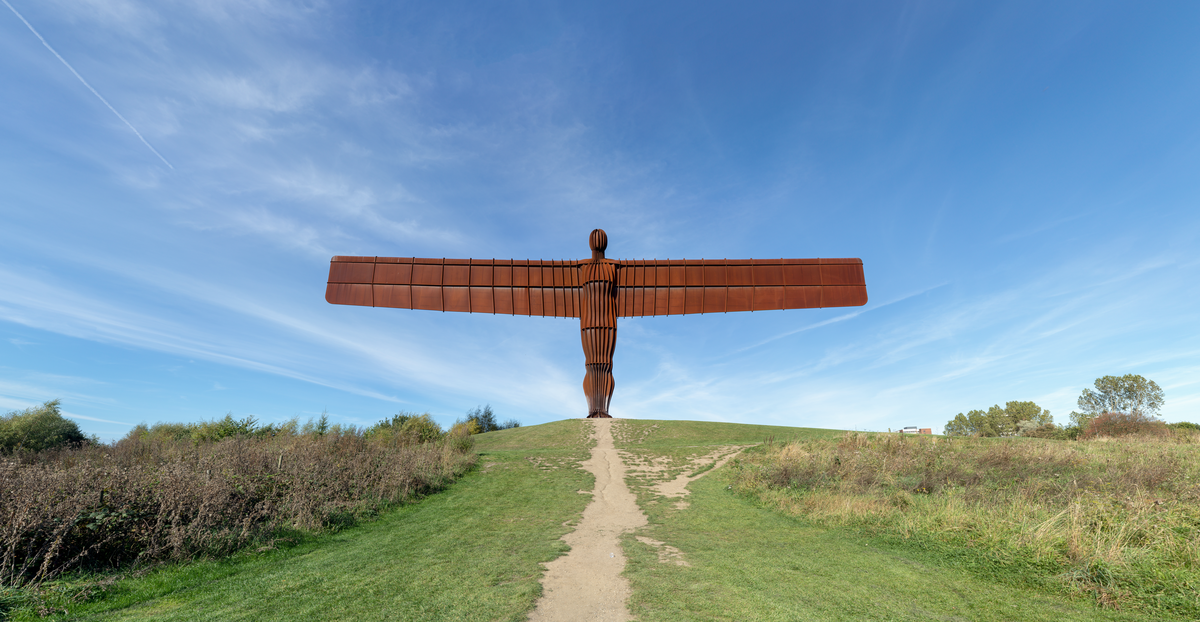
The Angel of the North is iconic.

With its 54 metre wing span creating a sense of embrace, this 20 metre steel sculpture greets travellers to and from the north east.

When Antony Gormley was invited to submit his ideas to Gateshead Council, he famously said that he didn’t do “motorway art”. 

What changed his mind was the context: an image of a remote mound next to the A1 which covered 300 years of mine-workings.

‘Is it possible’, writes Gormley, ‘to make a work with purpose in a time that demands doubt?’

His answer was to make an object which would (in his words) be a 'focus of hope at a time of painful transition for the people of the North East, abandoned in the gap between the industrial and the information ages’.

It recognises the sacrifice of generations of miners who’d worked the pits; it marks the end of an era and refuses to lets us forget.

The angel’s form modelled on the torso of the artist himself; its 200 tonne body is ten times life-size. 

This angel has come of age, having stood for 21 years: withstanding winds and rain; shrouded in snow and bathed in sunlight.

Rarely does this angel stand alone; nor does this icon slip from view. 

An angelic way-marker and gateway; rooted in earth and raising our eyes heavenward.

In uncertainty, transition and abandonment this northern angel remains a focus of hope and belonging.

In her beautifully illustrated book on angels, Jane Williams ponders her own underlying questions about what these figures. What do they tell us, she asks ‘about our own longings and what messages they might bring us about our place in the world, our connections with each other and our relationship with God - if we really listened to them.’

The Angel of the North speaks powerfully of hope, place and connection - emerging of a sense of abandonment.


This feast of St Michael and All Angels extends to us an invitation to us to listen carefully to our world and our longings; to notice and bridge the gaps.

The ordering of angels speaks of God’s holiness and greatness; but they also speak of the distress of separation and division between us, earth and heaven, humanity and God. 

They stand as way-markers, ladders, gateways, reminding us that even at points of isolation God still reaches out; God still reaches out with a fierce, tender and radiant love.
The language our Eucharistic Prayer speaks of how angels reveal God’s wise purpose for the salvation or healing of the human race.

The ministry of angels speak of steadfast love and protection. Whilst they behold the one equal light of God’s glory, beyond dazzling and darkness, they also keep faithful vigil for us. They guard us in the way that leads to life; they guide us to God’s kingdom of light. 

As Jane Williams writes: ‘The angels are part of the struggle to define what kind of a universe this is to be be.’ 


The help to enlarge our vision of the world. Reminding us that in the struggles against fear, oppression and suffering, the strength of God’s goodness is the ultimate reality. 

It may not always feel that way - our God doesn’t coerce humanity to make the good, wise and just choice. The struggles and tensions are real; and yet, as in the stories we hear today, we are to be alert to messengers of assurance and encouragement, who help us to glimpse traces of grace.

In our Gospel reading, Jesus greets Nathaniel as someone he already knows - even though they’d never met. 

Jesus looks on him and sees someone who is honest; a child of God without deceit. Nathaniel takes Jesus’ literal answer as a sign that he must be the Messiah, God’s chosen and anointed one.

Jesus has something deeper in mind. He is more than what they think that title means. John tells of the call of Andrew, Simon, Philip and now Nathaniel. They are all invited to come and see; to open their eyes to something that is ‘more than’. 

They are to name their heart’s desire; the thing they seek. They are invited to stay. To be with the one who was with the the Father. To abide with the one who stoops down to earth to raise earth to heaven.

Jesus enables them to go deeper when he talks of angels ascending and descending on the Son of Man. He’s reminding them of a story of their ancestor Jacob; the story which we have heard this morning.

At this point in Genesis, Jacob is a fugitive. Having tricked his elder twin brother Esau out of his birthright, he had fled. In that time of being separated from his own kin, he earns a living using his skill in rearing animals; he settles in marriage. And yet, here he is sleeping out in the open with a rock for a pillow.

He is utterly alone. He is in-between places and in-between people. He’s caught between the consequences of his act of deception and self-will; and the purposes God has in store for him.

The vision he receives is one of hope.


God is saying, I have not abandoned you; I know you and I am bound to you. 

Despite his physical isolation, he is reminded of his human ancestry and of God’s faithfulness. This land is gift; his people will be a blessing; blessing the earth.

Heaven and earth were not separated. There was an unseen ladder - upon which angels ascend and descend, ministering to the world. 

Through a flawed human being a promise is renewed: blessing is extended.

Today we hear Jesus reminding the honest Nathaniel of the story of crafty Jacob; but he goes a step further in telling him that he is that ladder. 

He is the visible means of joining earth and heaven.

Come and see, says Jesus; open your hearts and minds to see more.

Jesus is still inviting people into a journey of faith and transformation; Jesus is attracting us to abide with him and walk with.

We live in a world where many still cry out to God; willing God to tear open the heavens and come down. 

We live in a world where many echo Gormley’s question: asking, is it possible to create and work and live with purpose in time of doubt?

We live in a world where many still long to open their hearts and minds to a new vision; to follow a more authentic way of life and love; to begin, however falteringly, a journey of faith.

In Jesus, the heavens are opened. 

The Word becomes flesh: walking with us in human weakness to lead us into a new vision.

The longings of Jacob and Nathaniel have been fulfilled and God’s promises continue to be renewed here among us.

For, how awesome is this place!

The altar around which we gather is where we are no longer alone; here we unite our praise with angels.

The bread which we take, is Word made flesh stooping down to be with us.

The world in which we tread, is raised up to heaven; the ultimate hope and reality is revealed.

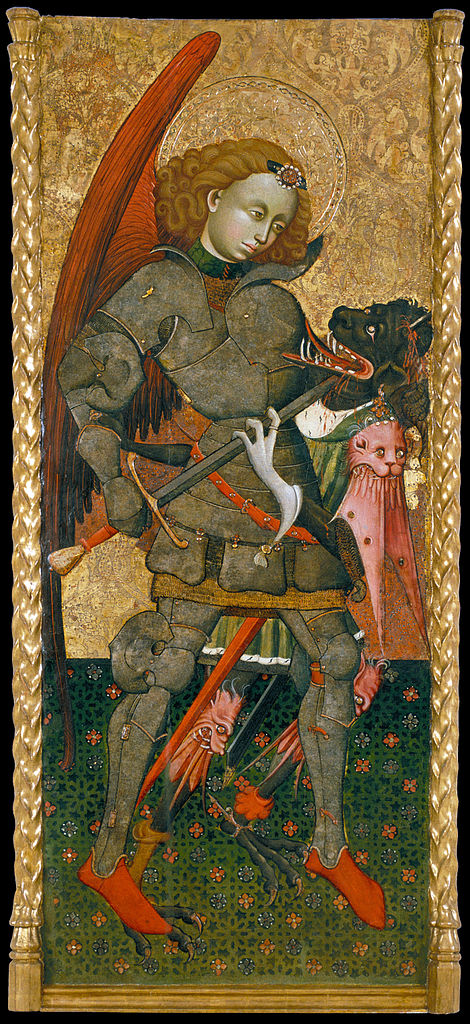
And yet, the image of St Michael reminds us of the ongoing  struggle. He is more than an angel; he is a warrior. He reminds us with utter seriousness of the fight for all that is good and just and holy.


May we be messengers of love’s fierce radiance; discerning traces of grace.

May we pierce the darkness of our world with words and actions of hope; and, like that northern angel, offer a tender embrace of belonging.


© Julie Gittoes 2019