Showing posts with label John. Show all posts

Wednesday, 4 August 2021

Hungering for bread

 1st August: Exodus 16:2-4, 9-15 and John 6:24-35
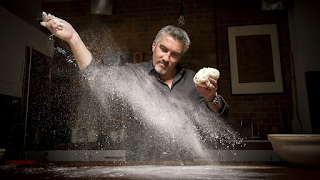

Paul Hollywood image BBC


Paul Hollywood has become known at the ‘King of Bread’ by fans of the Great British Bake Off. It takes a lot to impress him in terms of taste and technical skill - and the coveted Hollywood handshake is a rarity in bread week. 


For all the exotic flavour combinations on show, Paul himself talks about the simplicity and nostalgia of baking: the taste and smell evokes memories of childhood, community and comforts. Civilisation, he says elsewhere, is ‘built around wheat, around people’s settling down and not being nomadic.’


No wonder then that the Israelites long for Egypt: for the time when they were able to eat their fill of bread. It seemed to them that forced labour was compensated for by the sensory delights of bodies and food. 


They’d have been content to die there. Now, in the wilderness, they were unsettled and hungry; hungry and vulnerable. 


In the wilderness, in their vulnerability they see only the prospect of death: they complain and cling to nostalgia of the old ways. Perhaps we recognise that longing. 


They hunger for life, for comfort, for bread; but life was nomadic, relentless, unpredictable. The congregation complained. 


The Lord hears this complaint.

The Lord speaks to Moses.

Moses speaks to Aaron.

Aaron speaks to the congregation of the Israelites.


In their hunger and vulnerability, the Lord does a new thing.

That new things is a gift of bread from heaven.
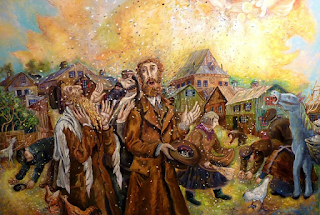


Manna from Heaven - Original by Alexander Kanchik


What is it? They ask. It is the bread that the Lord gives.


This bread rains down from heaven and settled on the wilderness as the dew lifted. Fine. Flaky. Fragile.


And in those gathered fragments hunger is satisfied; it is a practical gift of physical food.


More than that: in these fine, flaky, fragile fragments, the faithful God calls a people back to faithfulness.


In this substance they find sustenance: but it is just enough.


No selfish storing up; no greedy gathering of too much; no excessive consumption.


It is enough for hunger to be satisfied; for complaining to turn to gratitude; for vulnerability to become community.


There is grace. It is enough.  Day by day.


Loaves and Fishes - John August Swanson original


Jesus too had looked upon a crowd with rumbling stomachs and grumbling words: in compassion he responded to that hunger and vulnerability and took what was offered - blessed it and broke it. 


He gave it to them, and they ate their fill; they had enough.


Fragments are collected up and baskets are filled. 


But they wanted more: they look for him.


When they find him, he points them beyond the meeting their physical needs to a deeper longing.


He points them beyond the food that perishes, to the food that fills our stomachs and leaves us wanting more.


He points them to the food that endures for everlasting, abundant and eternal life.


He points to himself: the one who is God’s eternal word; the one who is flesh of our flesh. 


Believe in me, he says; believe in the one sent to you because of God’s love for this world.


They know the story. 


They jump in with their own telling of the story of fine, flaky and fragile bread.
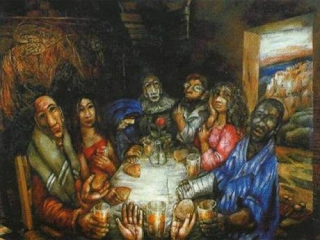


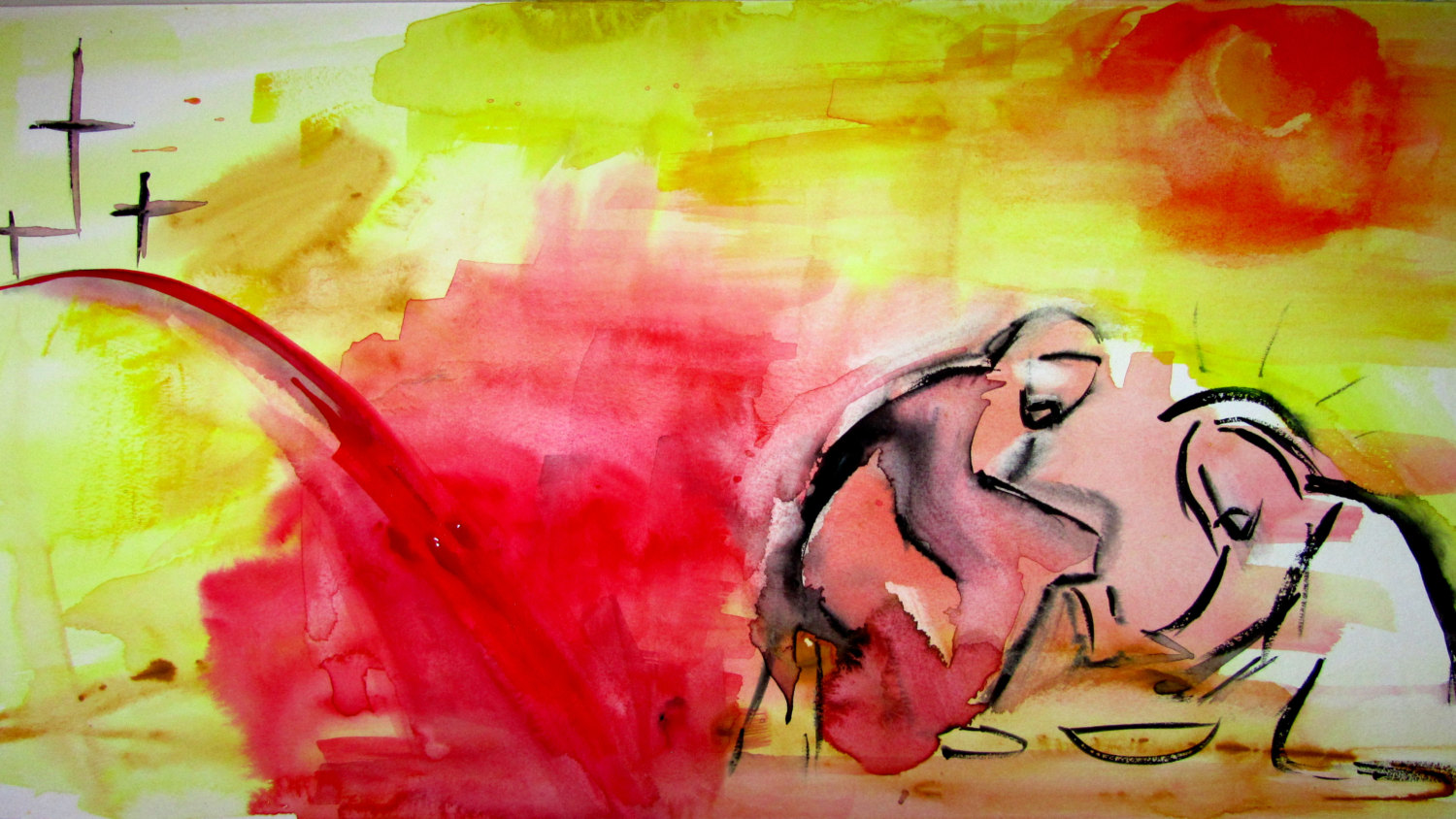
Sieger Köder 


Jesus listens. Yes, he says, you’re right about Moses. You’re right about the way a faithful God calls people back to faithfulness with these gathered fragments.


But he says, there is more: there is more than eating your fill; there’s  more than nostalgia for the old ways.


There is more than the bread shared that day: which smelt so fresh and filled their stomachs; but which will go stale and mouldy. 


This more than is the true bread from heaven: God’s own son.

This more than is the living bread: giving life to the world.


This bread is known to us in the fine, flaky, fragile fragment which we break and snap, bless and share at every communion.


For there, in that place, we receive a fragment of Christ’s body to be united as Christ’s body.


The body that was bruised and bled; died and rose to new and eternal life. In communion we are draw near to this gracious and fragile life. 


In that place, the fragments of our lives, our stories, our hungers and our vulnerabilities are gathered up; they become more than the sum of their parts.


There is communion in this. As the bodies within one body we are fed; where we learn to hunger for God; where we learn to love each other as God loves us.


Our faithful God calls us into faithful communion in this way: through the giving of himself in fragility that our fragments might be made one.


So we pray that our bodies may be revived; that the body of Christ might be revived. That we might be strengthened in the Spirit; that we might hunger for God’s ways; that we might meet others in their vulnerability. 


With open hearts might we touch and taste and see how gracious our Lord is. For what is fragile and fragmented is the stuff that makes for communion. Amen.


© Julie Gittoes 2021

Sunday, 10 May 2020

Hearts: troubled and embraced

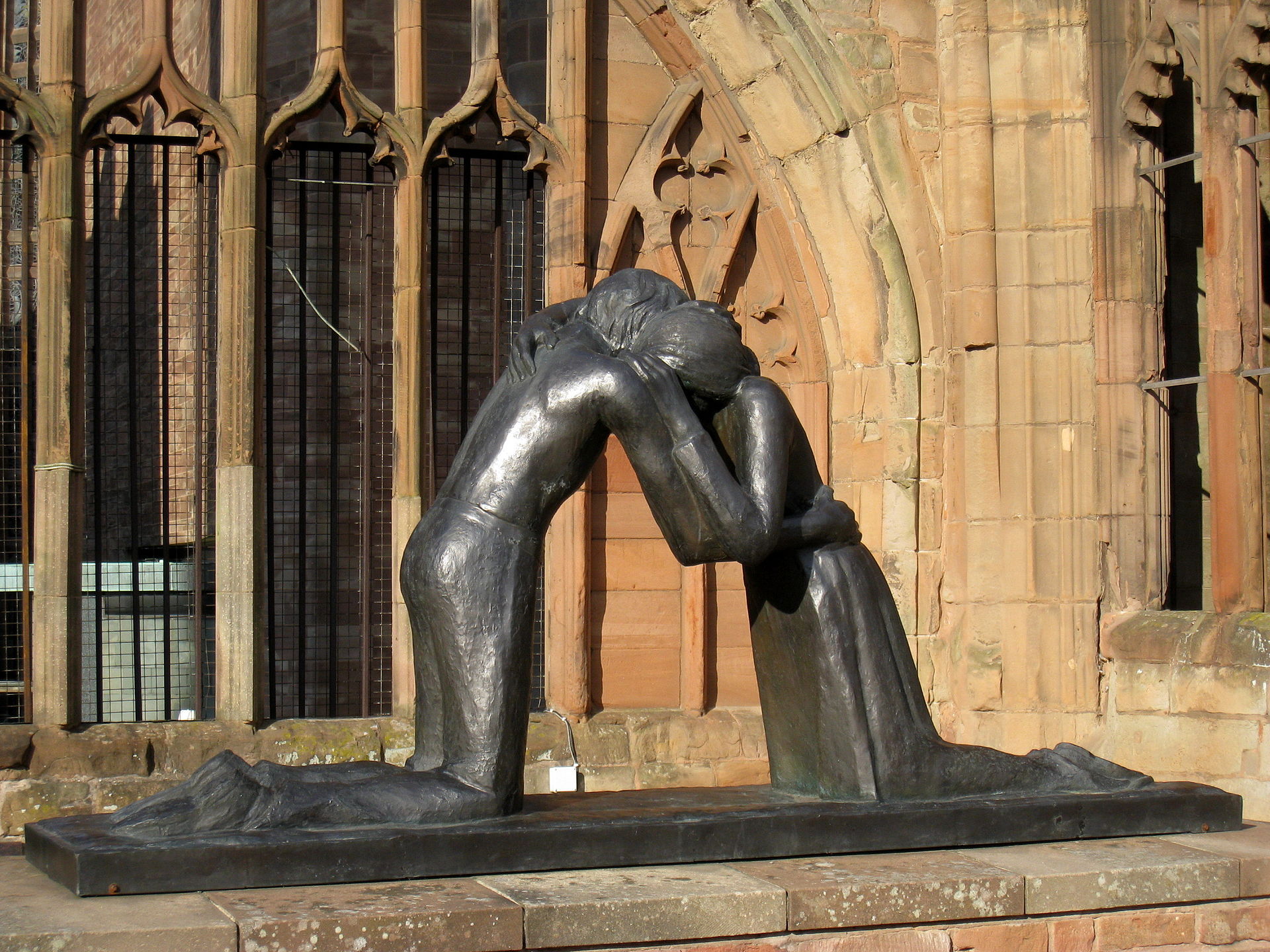
The texts of two reflections shared on during our zoom worship this morning. Thinking about parting conversations, being enfolded by, and letting go in, love and the ways in which our lives are drawn into God's story.  The thing about an embrace is that it is risky - we have to wait with outstretched arms for the other to respond; but for an embrace to be an embrace, we have to let go as we open our arms again. May we enfold and bless in our communities. The texts were Acts 7:55-end and John 14:1-14.

Reflection One

Like many folk, I’ve found the BBC’s adaption of Sally Rooney’s bestselling novel Normal People to be utterly compelling. 

The ending however, is about a letting go. 
A parting conversation. 
Looking back on misunderstandings, triumphs, disappointments, failures in communication. 
These have been troubled hearts. 


A still from the BBC's adaption of 'Normal People'

And Connell says:  I wouldn’t even be here if it wasn’t for you. And Marianne contemplates this new life that’s been made possible.  

They emerge from the shadows of loneliness; hearts troubled by being unloveable beat with purpose. One person has shaped another; the other has marked them with love. 

They’ve had a place in each others lives and hearts; they still do. They’ve grappled with questions of truth, trying to find their own way and are embarking on a new phase of life.

I wonder if the disciples, as we encounter them today, feel a bit like that too. Partly despondent and uncertain. In the midst of this parting conversation, do their minds drift back to that moment of calling? The time when the stepped out of boats and looked to a broader horizon?


Fishers of Men - Michael Dudash

 Did they perhaps recall other meals? The familiarity of the home of Mary, Martha and Lazarus; the seats amongst the religious leaders; the intense debate and the way Jesus would turn an observation into a new parable, a story to re-tell. How many of our deepest relationships and most memorable moments have been over a meal?


Jesus walking with his disciples - unknown

And there would have been conversations along the way. The one to one discussions; the opportunity to ask Jesus something away from the crowd; the moments of rebuke when they’d started to disagree.  We will have our own recollections of those we love and those who’ve had an impact on us:  genuine love and kindness; the colleague who inspired us; the person who held us close when we cried. 

Yet now, all those things are cast in a different light; conversations now are under a shadow. This is a farewell conversation. He’s talked of love. Again and again he says this commandment is made new. Love. But it isn’t cheap. 

Jesus washes his disciples feet - unknown

Some parting words we anticipate and script: the leaving do or the exit interview. Others we sit lightly too, aware that it might be the end: graduation days, the house moves, the lengthening gaps of time between calls. Yet every day holds that possibility of last words: things we can’t say; don’t say; the things we dismiss, cling to or only really hear long after the last breath. 

This conversation is one which shaped lives and imaginations; which has been dwelt on and lived with. A parting conversation which says: love allows you to do great things.

Now what does he say, the one who’d asked them what they were looking for and invited them to see? He says don’t let you hearts be troubled. He says trust me. Believe in God. He says there’s a place for you; and I’ll come to you. He says, after feet are washed and before bread is dipped, he says you already know all this.


The Lord's Last Supper - Okaybabs Studio

But the questions around this table are real and intense: we don’t know, how can we? Show us the Father, then it’ll be fine. The hearts of these disciples are troubled, perhaps our are too. And yet even in this movement Jesus stretches their imaginations. Their belief, their hope, their trust is not just in him as an end in itself; it’s not a personal possession. It is a more radical gift. Something greater will emerge as these troubled hearts embrace new life.

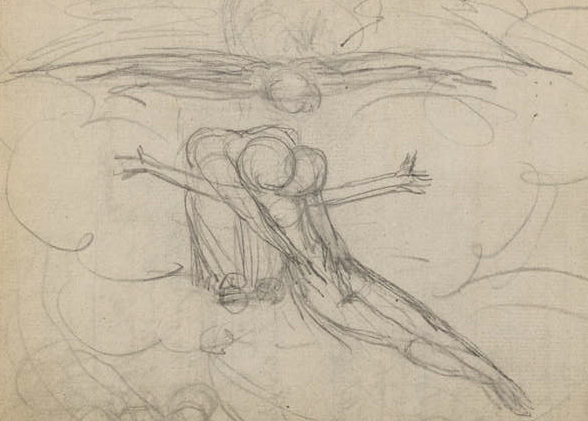
In Jesus, God chooses to dwell with us; to have a place with us. In the midst of grief, uncertainty and all that troubles our hearts, Jesus invites us to place our trust in God; to abide, with him, near the heart of the Father. We are held in this eternal embrace. 


William Blake

Yes, we trust that when earthly life is over, we will have a place at home with God, in whose image we are made. But here and now, in troubless days; in days of possibility, we have a place too. A place amidst homes and colleagues; churches and communities.

A place where new life is made possible, even when - especially when - there is sickness, disruption and death; even when we have let go of all that is familiar. In this letting go, we are embraced by a love that opens our hearts; by a love that gives us a share in God’s story. 

We will explore that in a moment through Stephen’s story woven into God’s story.

Let not your hearts be troubled. 

Reflection Two

We know that in our human experience, moments of letting go can be hard and messy. As adults, we experience the nervousness and courage of a toddlers first steps: when we say yes to a job; when we say I do to a loved one; when children move out; or when we empty a parental home. And there will be many more ‘letting gos’: moment by moment, when we resist the urge to cling on tightly to what we know in order to do a new thing.
Banksy

Our reading from Acts tells us of Stephen: of his letting go of life in order to gain life. He is enfolded in love. Earlier in Acts, we hear how he is one of those who is committed to care for some of the most vulnerable.  He is one of those deacons, filled with the Spirit, who with wisdom and compassion to a great work.  They take on the great work of enabling many bodies to become one body. Hope and struggle are bound together as resurrection life, life in abundance, breaks into the ordinary and intimate, the domestic and the public. 

Stephen reminds us that we live in what Willie Jennings calls ‘the tight space between faith and fear’. Wherever we are placed - at home or at work, in our daily activity and times of isolation, it is the nearness of the Spirit that prevents faith being overcome by fear. The Spirit that Jesus promises in his parting words enables us to imagine the embrace of Jesus;  and embrace that enfolds our deepest longings and enables us to embrace a new way of life. 

The Questions: We will have our own questions; uncertainty about finding the way; needing others to point us in the right direction; allowing us to trust the compass point, the GPS of God’s love.  We are enfolded love so that our lives are unfolded in love. Rachel invited us to sit with one particular question last week: where do we find abundant life, even in lockdown.

The Way: It’s a journey. Yes, Jesus is our way; he walks with us; guiding us behind and before. It takes time; and the process of placing one foot in front of the other changes us. In the 2010 film, The Way, Martin Sheen’s character experiences this change on the way to Santiago in Spain. A pilgrimage route walked by thousands, each one carrying hopes, griefs, expectations; yet the personal, as the film reveals, cannot be contained. On this way, the lives and loves of others change us.

The Truth: Jesus promises to be our guide; to be with us on path to the place he is going - through life and death to life eternal.  Jesus reveals the truth of God’s love: in all its depth and breadth. Jesus reveals the truth of our human condition - in all its contradictions and confusion, its potential and beauty. Light shines in the darkness - attracting us back to the truth of love.


The Baptism of Christ with Dove - Daniel Bonnell

The Life:  The way, truth and life of Jesus is to reconcile all things in love. That is our ultimate reality.  In laying down his life for us, Jesus goes to the depths of the grave and reveals the power of the resurrection. It is perhaps this image of baptism that speaks also of the power of this new life.

We see in Stephen the embrace of this new life.  Like him, may our hearts be set on the world to come; like him, may we sow seeds of new life on earth. Stephen has become a story teller: it’s a story with Jesus at its centre; a story of God, the great I AM, in the midst of all things - past, present and future. In the moment we heard today, Stephen is able to witness to the way, the truth and the life; he is enfolded by the Spirit. As he speaks the Spirit speaks; he point us to the love of God revealed in Jesus. 

Let not your hearts be troubled; I have prepared a place for you; I am the way, the truth and the life. Those things are about love: consoling, reimagining, embracing, convicting, cherishing. 

Stephen has found his way to the truth of this love; and through his life, so will Saul. That figure, lurking in the shadows of hatred will become that great witness, Paul.

Our human bodies reflect something of this way of life. Jesus taught his disciples to love. God’s Spirit is at work in us - when we show compassion and kindness, when we show hospitality and friendship. We are to walk this way; embrace this truth; discover this new life. We are called - like Stephen and Saul, Thomas and Philip.

For a long time, Christian Aid has adopted the slogan: we believe in life before death.  Like Stephen may we perform with grace and power the story of  Jesus.  This Christian Aid week may our gestures reveal the divine life made flesh. 


Heart of God - Gary Rowell


©  Julie Gittoes 2020


Sunday, 26 August 2018

As shoes for your feet

A sermon preached at the Cathedral Eucharist 26th on Sunday 26 August 2018 - and the first time since I've been ordained that I've preached on shoes! Members of my various congregations have become particularly observant about my footwear; friends joke about the disproportionate number of shoes I bring to conferences... however, shoes have all sorts of practical and personal connotations about purpose and identity for example. The texts were : Joshua 24:1-2, 14-18; Ephesians 6: 10-20; John 6:56-69

As an aside, tracing the Gittoes family tree back through a plumber and publican, millers, servants and tenant farmers, it is satisfying to know that one ancestor was a "cordwainer".  In seventeenth century Wales, a certain John Gittoes (1643-1688) was plying the same trade as the creator the Saalburg shoe, crafting footwear from leather.

As shoes for your feet, put on whatever will make you ready to proclaim the gospel of peace.

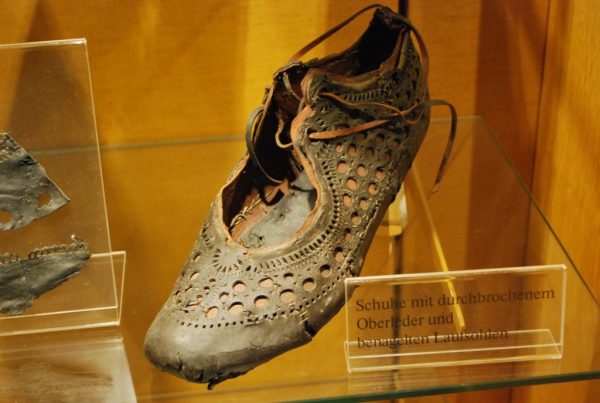
This month, a 2000 year old shoe went on display at the Saalburg in Germany. It had been found in a well - a practical, recognisable and intimate artefact; a point of human connection to those inhabiting the fort between the Roman Empire and Germanic tribes. 


With a hobnailed sole and leather upper, modelled on a military boot, this shoe offers warmth and protection. It also reveals both the craft of the maker and the wealth of the wearer. Holes punched into the soft leather created an intricate design.  This shoe wouldn’t look out of place on today’s high streets; taking retro fashion statements to another level. 

What would the roman shoemaker think of my own collection of footwear: from my faithful DMs, and liturgically coloured heels, to my trainers, converse and floral flats to umpteen pairs of clerical black slip ons, lace-ups, loafers and boots.  


A Canon's shoes!

As shoes for your feet.

When we look at the stories of Joshua, Peter or Paul; the witness of Ruth, Mary or Phoebe, it can feel as if we have big shoes to fill. As we walk in the steps of Jesus, we can sense the weight of responsibility, challenge, expectation and opportunity. 

Stepping into such shoes can feel overwhelming and precarious; but also exciting and rewarding. Eventually, we grow into them - or break them in - knowing we are where we are meant to be; we can be rooted, take risks and flourish.

Without over stretching the analogy it feels immediate and accessible to hear that when Paul talks to the Ephesians about clothing themselves with the armour of God, he also concerned with their feet.  The shoes we are to put on will make us ready to proclaim the gospel of peace. 

Like our physical shoes,  this ‘spiritual footwear’ is practical and intimate, bringing warmth and protection; equipping us for the all-weather terrain of God’s Kingdom.

The steps we take in following Christ are steps towards peace. As Archbishop Justin’s priorities reminds us, this begins with prayer. It continues in the work of reconciliation, transforming conflict in the light of the cross. It involves witnessing in the power of the Spirit to the love of God revealed in Christ.  


Being made ready to proclaim peace demands commitment in the face of struggle. It means choosing life. Today’s readings explore these steps being taken: in gathered community, in communion with Christ, in walking in the world.

In Joshua, steps are taken in gathering together as community and renewing their commitment to serve the Lord.

Joshua was commissioned to lead the nation after Moses’ death. As his life and work draws to an end, he sets before them a choice: between the local gods of their ancestors and the God of the whole universe. 

In the verses omitted today, before he invites them to echo his own declaration, he confesses the story of faith of their community.

He retells God’s call to Abraham; of a promise of blessing which extends to the whole of humanity. He recalls the experience of slavery, the journey through the wilderness towards freedom; he speaks of human bravery in battle and of the nearness of God’s presence in rescuing them.

They are worship and serve the Lord, walk in God’s ways with sincerity and faithfulness. Choose. Life. Today.

His personal commitment is echoed by the voice of the people: ‘we too shall serve the Lord: he is our God’. Today, our footsteps have brought us from our homes to this place, as we too gather to affirm our faith; to recommit ourselves to serve God.


Steps taken

In Jesus’ words, steps are taken in response to an invitation to be in communion; to choose life.

In the beginning, the Word was with God; abiding in the intimacy of perfect communion. That very Word became flesh, entering the complexity human history and taking on the frailty of human a human body.  

That Word came to invite us to abide in him; to lead us to dwell in communion, sharing the very life of God. Jesus dwells with us at wedding feasts and gravesides; he taught on hillsides and sat at table with his friends.  In him, we see love poured out on the cross as God reconciled the world to Godself.

He has broken bread to feed a multitude; he has kindled in them the longing for living bread. The bread from heaven, given by God, is his flesh.  We are hunger for this bread - the presence of God’s love in our hearts.

This invitation to eat and abide demands a decisive response.  Some turn away, refusing the gift and demands of that love. Jesus asks, with openness and vulnerability, ‘Do you also wish to go away’. It is Peter who articulates the hope and courage of this choice. To whom can we go? In Jesus, we chose life; life in all its fullness. 

We hear and respond to that call each time we celebrate the Eucharist together. In broken bread, we are sustained and shaped by Jesus Christ. Our feet are drawn near in faith; our hands reach out to receive; we taste and see how marvellous the Lord is; our hearts are warmed by his love.

And we rise. Our feet walking onwards: clad in leather, heels clicking, laces tied. Our feet walk beyond the threshold of this place into a world. A world where, strengthened by the God’s Spirit, we serve as a pilgrim people; a people called to make peace.


Walking onwards

The Eucharist reveals to us the marks of God’s peaceable Kingdom. And in a messy and complicated world, our lives are to take the shape of the Eucharist as we too are taken, blessed and given for others. 

We are to bring communion to others, in places of beauty and brokenness: as we feed the hungry and struggle for justice; as we take time to be with the lonely and break the bread of hospitality together; as we seek to liberate the oppressed and listen to the anxious; as we share the intimacy and tenderness of care for others; to as we offer the gift of friendship which reveals to others the good news that they are loved by God.

As shoes for your feet, put on whatever will make you ready to proclaim the gospel of peace.

We walk with Jesus today, nourished by his body and empowered by the Spirit; we walk alert to what God is doing in the world; alert to where we need to offer support or challenge. 

Archbishop Justin says: ‘Reconciliation is one of our greatest needs and toughest challenges as human beings. In a world plagued by conflict, division and indifference, the Church has a crucial role to play as a community of reconcilers. Jesus calls every one of us to love God, our neighbours, ourselves and our enemies – a challenging command, with nobody left out.’

As Paul reminds the Ephesians, to do this we need walk in truth and faith, in righteousness and peace. We walk prayerfully, hopefully and courageously; bringing people together - taking small and risky steps of generosity and healing; making cups of tea, creating space to meet or facilitating a difficult meeting. We need to listen carefully and speak wisely; turning suspicion to trust.  We walk the way of reconciliation - transforming strangers into friends, friends into members of God’s household.

Walking this way is difficult: we need ‘spiritual shoes’ for our feet: shoes which are warm, practical and protective; shoes of humility, time and patience.  May we who have gathered to share our faith in God and been nourished in communion with the living bread, be equipped by the Spirit to walk in the world in the ways of peace.


© Julie Gittoes 2018