Showing posts with label transforming church. Show all posts

Monday, 11 February 2019

Here we are: send us!

The text of a sermon preached at the Cathedral Eucharist on 10 February. I was struck by the way in which Jesus seeks Peter's help; by the experienced fisherman seeing empty nets bursting full in inauspicious circumstances; by the glimpse of holiness in boat. Kenneth Bailey's work on seeking Jesus through middle eastern eyes is so evocative but the text also opened up a response to more contemporary concern for evangelism and what it means for us to tell the story of God's transforming love. The texts Isaiah 6:1-8; I Corinthians 15:1-11; Luke 5:1-11


Do you remember J. R. Hartley?

He is a fictional character, an elderly gentleman. It’s over 30 years since he captured our cultural imagination in an iconic advert for Yellow Pages.



We encountered him looking for a copy Fly Fishing by J. R. Hartley.  He goes into one second-hand bookshop after another, asking the same question and receiving the same answer. It’s no where to be found.

He gets home. His daughter hands him the Yellow Pages. From the comfort of his arm chair, he continues his search by ringing around. Eventually he finds a shop which has a copy. The last words we hear are some of the most famous in advertising history: 
‘My name? Oh, yes, it’s J.R.Hartley.’

Fly Fishing still features in the top ten ads of all time alongside John Lewis, Levis and Coca Cola. A new generation of marketing experts and advertising creatives, are trying to reinvent or update the impact of the ad using the digital tools at their disposal.


For although Mr Hartley comes from a different age, that basic premise of searching for something remains the same. Instead of flicking through a hard copy of Yellow Pages, we rely on apps, search engines and social networks to track down a particular book, to find a gift or to replace a treasured item.

What are you looking for today?

What is it that we seek?

Some of what we search out reflects basic human need for stability: a living-wage, satisfying work, a regular pension, a place to call home, food and warmth. But our material needs are woven together with our quest for relationship and meaningful intimacy; for emotional support, for people to care about us; for meaning, value, dignity and purpose.

What are you looking for today?

It’s quite possible that we don’t quite know what it is that we seek; and sometimes we don’t realise what it is until we discover it in the unexpected. 

Peter’s experience as recounted by Luke is a bit like that: it brings to the surface all sorts of practical needs and reveals a deeper purpose.

Luke sets the scene: it isn’t the patience and tranquility of a riverbank, which might be at the heart of Fly Fishing. Rather we are drawn to a busy and crowded lakeside. There’s a sense of expectation - people want to listen to Jesus, to hear the word of God. But there’s also a sense of tiredness and frustration - Peter and his colleagues are exhausted after a fruitless night’s work and they want to get on with cleaning and mending nets. 

Jesus looks to Peter for help. He needs his boat to use as a makeshift platform from which to teach; but he also needs his particular skill as an oarsman to manoeuvre the boat and prevent it from drifting too far from shore. 

It’s from this place of confidence within his own world of work that Peter was able to listen to Jesus; in the familiarity and intimacy of his own boat he is caught up in a life-transforming encounter. 

Having taught the crowds, Jesus doesn’t ask Peter to row the boat back to the shore. Instead he tells him to go into the deep water and let down the nets. Given that fish hide rather than feed during the day, this sounded preposterous.  It’s quite possible that, having worked all night, Peter had a few choice words to say about that request. 

Kenneth Bailey, a scholar who invites us to see the Gospels through middle-eastern eyes puts it like this: ‘The very idea that a landlubber from the highlands of Nazareth, who has never wet a line should presume to tell a seasoned fishing captain what to do is preposterous… the order to launch into the deeps in broad daylight is ridiculous!’
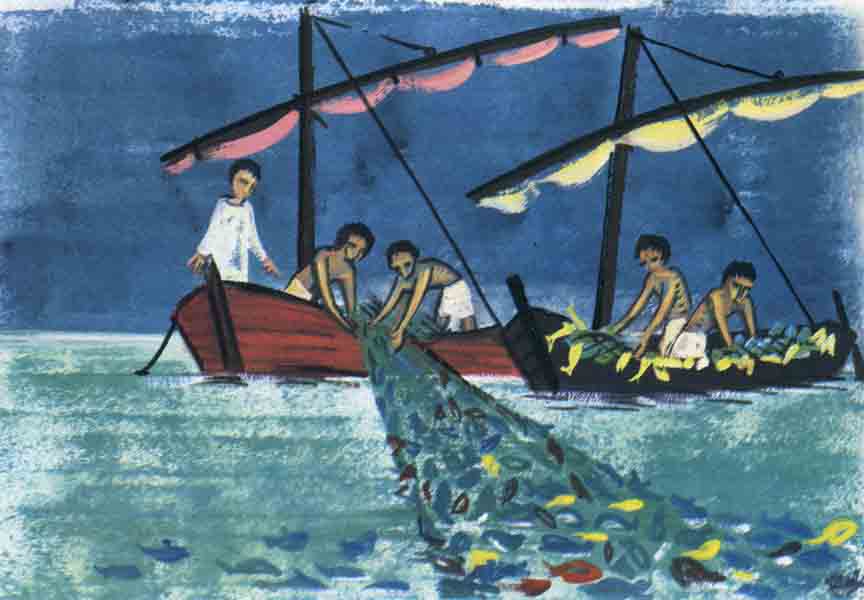


Peter's Catch of Fish - Eric de Saussure

Yet, even in his grumpy exhaustion, Peter sets aside his professional opinion and obeys. The result is astonishing. The scale of the catch is indeed miraculous. It is economically lucrative too. All that Peter looks for as a fisherman is fulfilled. As Bailey puts it: ‘This net-tearing, boat-swamping catch can greatly enrich him and his team. At last he has hit the jackpot!’.

Yet, Peter doesn’t look at Jesus as a potential business partner: he responds at a deeper level. There is something here of more value than material gain, commercial success and profit margins.

Peter falls to his knees.

Having addressed his teacher with bravado, he now addresses his Lord with humility.

In the confined space of the boat, with the nets and fish, with the familiar noise and smells, Peter senses that he is in the presence of holiness. 

It is a far cry from the splendour and majesty of the Temple. The whole earth is indeed full of God’s glory; glory revealed in Jesus Christ. 


Peter’s works echo those of Isaiah as he acknowledges his unworthiness. He is not only seeing Jesus as who he really is, but he is also being seen. As Jeffrey John puts it: ‘Peter’s words… are the authentic response of someone feeling himself, unbearably, exposed to the glare of this vast, unconditional love. He can’t bear it, he wants to run and hid; yet having known it, he could never let it go. He will give up everything to follow it’.

Jesus reaches out to Peter and to James and John too.  Amazement and fear become the place of invitation into a new partnership; his skills are to be deployed in a new venture.  Jesus takes them from the material world of catching fish to the world of catching people; of drawing them to the new and abundant life found in Jesus.

This is the heart of the good news proclaimed to us and received by us: that in his death and resurrection, Jesus Christ defeats the power sin and death and sets us free to be more fully who we are. 

As Paul reminds us, we come to know this good news because someone passed it on to us: by telling us the story or caring for us; by listening to our fears and hopes; by the way they embodied the attractiveness of God’s love in their own lives; by the way they sought forgiveness and justice, compassion and healing.

This is the very heart of evangelism: to know and show and tell of God’s love. This happens in the middle of our lives - in the places which are as familiar to us as Peter’s boat was to him; in lecture halls and offices, in hospital waiting rooms and our own homes.

Here in broken bread and outpoured wine, the good news of God’s transforming love is retold. In the power of the Spirit we are sent out to tell others of what we’ve known and to see lives transformed.

To be a witness is to understand what others are looking for - hope, comfort or challenge; support, dignity or freedom. It is to respond to that search with a love that turns empty nets into abundant life.

To be an evangelist is tell of what we have experience of God’s love; and each of us is sent in the power of the Spirit to live lives and speak words which tell of that goodness. 

Whom shall I send?

Here we are; send us.

Let us pray: Lord Jesus Christ, you stretched out your arms of love on the hard wood of the cross, that all might come within reach of your saving embrace. So clothe us in your spirit, that we reach gin forth our hands in love, may bring those who do not know you to the knowledge and love of you, for your own love and mercy’s sake. Amen. 


© Julie Gittoes 2019

Monday, 14 November 2016

In turbulent times

This is a sermon preached at Evensong on Remembrance Sunday: the texts were Daniel 6 and Matthew 13:1-9, 18-23.  As I thought about Daniel's faithfulness in prayer, I also called to mind words by Leonard Cohen: 'prayer is translation. A man translates himself into a child asking for all there is in a language he has barely mastered'.  So much of that language we share with Daniel and with our Lord Jesus Christ in the words of the psalms. That thought resonated during Evensong, if if I didn't preach on it!  And, as Cohen so famously sang, 'And even though it all went wrong, I'll stand before the lord of song with nothing on my tongue but hallelujah.'  


With a budget of £100 million, it's hardly surprising that the adjective 'lavish' is by almost every reviewer to describe The Crown: the New York Times describes the ten part series as 'an orgy of sumptuous scenes and rich performances'.

And yet, there's a fragility, edginess and humanity in every scene. Queen Mary bluntly tells her granddaughter: while you mourn your father, you must also mourn someone else. Elizabeth Mountbatten. For she has now been replaced by another person. Elizabeth Regina. The two Elizabeths will frequently be in conflict with one another. The fact is, the Crown must win. Must always win'.

There are conflicts between instinct and impartiality; marriage vows and coronation oaths; promises made to a sister and commitment to the church; the business of government and ensuring good governance. It's a world where too much character, personality and knowledge are seen as dangerous.

An ordinary, modest young woman is anointed queen and is adorned as a goddess; or in the bitter words on the lips of the Duke of Windsor: 'we are half-people. Ripped from the pages of some bizarre mythology, the two sides within us, human and crown engaged in a fearful civil war, which never ends. And which blights our every human transaction as brother, husband, sister, wife, mother'.


As the director Stephen Daldry says: 'it's not just the story of a family, it's the story of post-War Britain'. The glamour and possibility of this new Elizabethan age is fraught with catastrophe. Hospitals are at breaking point as a result of the smog; rationing is ongoing; the impact of the abdication looms large; post-War becomes Cold War; the Suez Canal brings crisis and controversy; both Churchill and Eden face loss of power and loss of heath.

Untimely elevation to high office vies with thwarted personal ambition; devotion to public service tests other human loves and loyalties.  What we thought were stable political realities jolt and shift like tectonic plates. We talk of metropolitan elites and those left behind; of experts and popular opinion; the will of the people and parliamentary representation.

This isn't just the stuff of The Crown - in reality or in lavish drama. It's the world as we know and experience it, locally, nationally and internationally.

This isn't just the stuff of Brexit and President-elect Trump. It permeates the life of the church as we grapple with authority, influence and faith in the public square.

This isn't just the stuff of 1918, 1947 and 2016.  It's also the stuff of the Book of Daniel.

The story of the lions' den is more than a dramatic imaginative tale; it takes to the heart of the questions of our time. Questions for church, state and for each on of us as disciples of Christ.

How do we seek stability and God's peaceable kingdom in the mess and compromise of life?

How, in the responsibilities entrusted to us, do we live with integrity and faithfulness as people called by God?

Daniel's working within a system designed to ensure stability - and the security of the king. His service is distinguished by his excellent spirit. His brilliance was a threat to others; his promotion aroused suspicion of corruption. He led a life which was consistent and centred on God; that very steadfastness becomes a means to ensnare him.

An irrevocable ordinance signed by the king would not disrupt his pattern of prayer. When human authority was elevated to serve as an idol, he prayed. Regularly, openly and faithfully. In the mess of life, that is where we find mercy.

In the face of uncertainty, our laments, petitions, and hopes are uttered on our knees; they rise like incense to our heavenly Father. As Daniel found, praying is the most risky thing we can do.  It changes us as we discern God's will and purpose for us; it changes the world as we, in Christ, commit ourselves afresh to love and service.

We hear of Daniel's fate through the words of a narrator attuned to the reaction of King Darius: he faces the implications of human attempts to manipulate and flatter.  Vanity turns to distress. As the ink dries on the page, his own signature leads to condemnation rather than rescue.  And yet, in fasting and sleeplessness he speaks of human faithfulness to God and of God's ability to deliver.  Against all the odds, the blameless is unharmed; the accusers are overpowered.


In turbulent times, we justice, peace and stability can seem like a mirage.
It is then that we need to be both steadfast and prophetic in making it real.

In turbulent times, prayer is the anchor of hope.
It is then, we need that anchor more than ever.

In turbulent times, we pray without ceasing.
It is then that our Remembrance is held in God .

President Obama has frequently quoted Martin Luther King's remark that 'the arc of the moral universe is long, but it bends towards justice'. We speak of the arc of God's kingdom. A kingdom of justice and equity which we only glimpse in our fragile earthly polity.  In Jesus, that kingdom has come near; in his life, death and resurrection, he reveals the end of the story - that love wins. In his own teaching, he uses parables to explain how we are to live in the light of that truth.

So in Matthew's Gospel, Jesus isn't offering advice about how to sow seed effectively. Instead it is explained as a description of the impact of the proclamation of God's kingdom. We are good soil - we are in Christ. And yet, we too are subject to the cares of the world; the lure of prosperity chokes us; the cost of love disillusions us; the fear of lost status hardens authority.


Sower: Vincent van Gogh

In the face of those pressures, the Gospel is more than a story to give our lives meaning; it is to illumine our imaginations with new possibilities. In joy, sorrow or temptation, we are to seek God's mercy in prayer. Only then perhaps, we will act in the world as we should: for we cannot act on behalf of the marginalised if we ourselves are possessed by possessions; we cannot challenge the powerful if we ourselves are enslaved by a desire for power; we cannot serve the vulnerable if we ourselves mask of our own weakness.

For we are called to walk as disciples of Christ, the one in whom love divine  was made perfect in human weakness.

In a turbulent world we are to articulate a vision of God's loving mercy as we exercise the responsibilities entrusted to us. We do that, because in Jesus we see and hear God's 'yes' to us and all creation. May the Spirit strengthen us as we embody with integrity a narrative of fruitful, fearless and forgiving love. May God's radiance bright illumine our us and our world; may those bright beams refracted in us bring hope and joy; transforming church and transforming lives.

 © Julie  Gittoes 2016

Monday, 26 September 2016

Transforming Church, Transforming Lives


The text of a sermon preached on Sunday 25th September; the texts were 1 Timothy 6:19 and Luke 16:19-3. The Diocese of Guildford has launched its mission and vision strategy - Transforming Church, Transforming Lives - which includes twelve transformation goals. For more information, follow this link:http://www.cofeguildford.org.uk/about/transforming-church-transforming-lives

At the Cathedral, we are praying for parishes, schools and chaplaincies; and discerning the part we play in being a resource for that work. We pray in order to resource ourselves to play our part in the building up of God's Kingdom.  As Bishop Andrew says: 'God - Father, Son and Holy Spirit - is in the business of transforming individuals and communities, as we have the joyful privilege of joining in.'


The name Alan Scrase probably won't mean much to you.

Alan is a banknote collector; so the newly issued polymer notes were of particular interest to him. On his second visit to the bank, he was excited to discover that three of his new five pound notes had the sought after AA01 serial numbers. On the internet auction site, Ebay, they fetched £460!

What would you do - or have you done - with your first plastic fiver? The aptly named Johnny Five - a fundraising consultant - announced on Twitter that he'd given his to charity. The hashtag #firstfiver led to an impromptu social media campaign; as others joined in naming the charities which would benefit in tangible ways from an intentional act of kindness.

Some have likened the new note to Monopoly money. Perhaps that's not a bad way to begin to critique the illusion of wealth addressed in today's readings. Indeed, at last week's interfaith peace gathering in Assisi, Archbishop Justin said this: 'our money and wealth is like the toy money in a children's game: it may buy goods in our human economies that seem so powerful, but in the economy of God it is worthless'.

How we use our money matters inasmuch as it reveals our character and can express values of God's kingdom; but it is the mercy of God which quenches our thirst and satisfies our desires.  As Pope Francis commented: 'We are to drink daily of that mercy in order to overcome our sin and anger, and to bear mercy to others.'

This resonates with the story Jesus told about Lazarus and the rich man.  One longed for his hunger to be satisfied; the other longed for his tongue to be cooled. At a first reading or hearing, it makes us uneasy because it seems to suggest a simple reversal of roles. Life was unfair to Lazarus when compared to the luxury of the rich man; but God will balance things out in the next life.

It's more challenging; more transformative than that.

Jesus' "pearly gates" tale is intriguing: it's a useful scenario in making judgements about public life and personal lifestyle Contemporary humour does the same - you know the kind jokes involving a conversation with St Peter and a politician, pastor, atheist or accountant.

Today's parable is a vivid picture of our world; where the inequality between rich and poor reflects a fundamental injustice. Developing the x, y and z of a comprehensive economic policy which achieves sustainability and equity is huge task; and yet, the church is called to have a vision of how we hold together a commitment to justice with income generation - at a micro and macro level.

Transformation is possible. Archbishop Justin's challenge to Wonga and exorbitant pay day loan rates is an example of institutional shifts within and beyond church. Canon Andrew explored with us last Sunday how we might engage at a personal level (his sermon can be read here :http://canonandrewb.blogspot.co.uk/?spref=tw Here at the Eucharist we move from worshipping and serving mammon to take our place within a sacramental economy: an economy of grace and transformation, which enables us to be bearers of mercy.

In recognising that all we have is God's, we're already caught up in the process of transformation. Our faithfulness to God means using all that's entrusted to us with love.  We cannot, like the rich man, ignore the demands of mercy and generosity. The rich man's indifference, self-indulgence and arrogance is dehumanising; yet it's Lazarus who's named and remembered as one whose human dignity calls forth compassion.

This pearly gates story expands our imaginations by presenting a stark challenge to us: but what does that look like for us?  In his letter to Timothy, Paul sets out memorable 'soundbites' which we can take to heart and reflect on. It alerts us to or dependence on God's generous love; which in turn enables us to be generous.

We brought nothing into this world, we can take nothing out. Rather than getting caught up in the pursuit of transient riches and the desires of this world, we find contentment by placing our attention on God. Such contentment goes hand in hand with the pursuit of what is good, right and just; our lives begin to radiate patience, love, gentleness and endurance. We are draw on God's mercy; transforming our hearts that we might be merciful.

This is life that really that really is life.
This is the transformative dynamic of God's economy.

Such transformation is at the heart of our diocesan vision: we are all called in our own contexts and places of work, to respond to the world of God's Spirit so that we might be channels of God's love - gradually transforming the world around us. We will be aware that we face challenging times in our nation and across the world.  As a pilgrim people we share in God's transforming work. It's not just how we use our first fiver, but how in the power of the Spirit, we reveal the transforming love of God made manifest in Jesus Christ? What does that look like decision by decision, breath by breath?


Churches across our diocese will be launching our vision and transformation goals this morning: making disciples, improving buildings, sharing expertise, encouraging generosity and nurturing education.

As the body of Christ in this place we share in that vision: we are facing a period of disruption because we are restoring our building and making it accessible; we nurturing education with a new programme for schools, families and adult learning; our public lectures reach out to those of faith and goodwill seeking the Spirit's gift of wisdom.

How might a vision of transforming church and transforming lives shape our priorities, our worship, our budget, our learning together and our common life?

Feed your reflections into conversations with Chapter and talk about it over coffee. But for us to be a resource to others, we need to resource ourselves: As the body of Christ in this place, our first calling is to pray in the power of the Spirit:

Almighty God, you sustain us with your life

and transform creation with your love.

May we always rest in you,

that the world might know your healing power,

through Jesus Christ our Lord. Amen.


Julie Gittoes 2016  ©