Showing posts with label Church. Show all posts

Monday, 4 February 2019

When Christmas meets Easter...

It was a delight to celebrate Candlemas with the people of St John's West Byfleet - especially as the opening hymn was one of my favourites (Of the Father's love begotten). Candlemas is my favourite festival - because of its honesty about the challenges and sorrows of life but also because of its assertion that the light will continue to shine in the darkness.  The readings for Evensong were: Haggai 2:1-9 and John 2:18-22

Last night, my colleague turned a simple birthday cake into a dramatic extravaganza by adding an indoor fire work to the candles: on such occasions the association of food and celebration is self-evident.

Yet, our culture seems increasingly drawn into a commercially driven disconnect between festive food and seasonal specificity: Santa themed chocolate in August, mince pies in October and hot cross buns in December. 

But there is one item in particular which leads to shocked headlines:


Shoppers take to Twitter to express their disbelief alongside pictures of the offending eggs.

In the aisles of Aldi and Waitrose, shoppers complain; whilst store managers speak of storage space, sales figures and consumer choice. 

Yet today, we celebrate festival where Christmas meets Easter.

At Candlemas, we turn from Christ’s nativity to Christ’s passion; we move from cradle to cross.

Candlemas, or the feast of the presentation of Christ in the Temple, is my favourite festival because it straddles the seasons. It weaves together the themes of amazement and sorrow; joy and grief. It confronts the reality of death and the promise of new life.

Luke’s account of the presentation, blends together the hopes of infancy, the expectations of parenthood and the wisdom of old age. 

And at its heart is a dazzling brightness. 

Light shines in the darkness.

Darkness does not overcome it.

The light of the world comes into the Temple, in substance of our flesh.

Every time we gather for Evensong, we are drawn into this moment as we share in singing Simeon’s song: the Nunc Dimittis.

Simeon held the Christ child in his arms and he beheld his salvation.

He knew that this gift of hope was not his alone. 

He looks into the eyes of this infant and beheld God with us: the light to lighten the Gentiles; the glory of the people of Israel.

Or, in the words of a Candlemas hymn, he recognised that: A glory dawns in every dark place,  /the light of Christ, the fullness of grace.


Icon of the Presentation of Christ in the Temple

This evening, our readings don’t tell us about Simeon’s blessing and counsel; or the things that Mary ponders in her heart. We don’t hear of Anna’s exuberant proclamation of good news. 

Instead we are drawn into the fulfilment of Simeon’s words: this child will face opposition; this child will reveal the inner most thoughts of our hearts; this child will challenge authority and raise up the weak.

Our second reading, parachutes us into the middle of something; like tuning into The Archers or Casualty half way through an episode. 

Jesus is asked ‘What sign can you show us for doing this?’ But it’s not clear what ‘this’ is.

As an adult, Jesus returned to the Temple several times. On this occasion, he has been horrified that his Father’s house is a place of commerce. Commission got in the way worship; impoverishment got in the way of justice; exchange got in the way of gift.

The prophet Haggai had spoken of the ruins of the Temple compared to its former glory. It’s restoration was to enable God’s people to abide in that holy place - to listen to God; to be faithful to the covenant of love; to seek justice and mercy.

Perhaps Jesus recalled Haggai’s words as a rebuke in the midst of exploitation: How does it look to you now? Is it not in your sight as nothing? 

We can imagine the scene - the clamour of money changers; the noise of the sheep and the doves. Jesus is consumed by zeal. Tables are overturned, coins scattered, people and animals driven out.
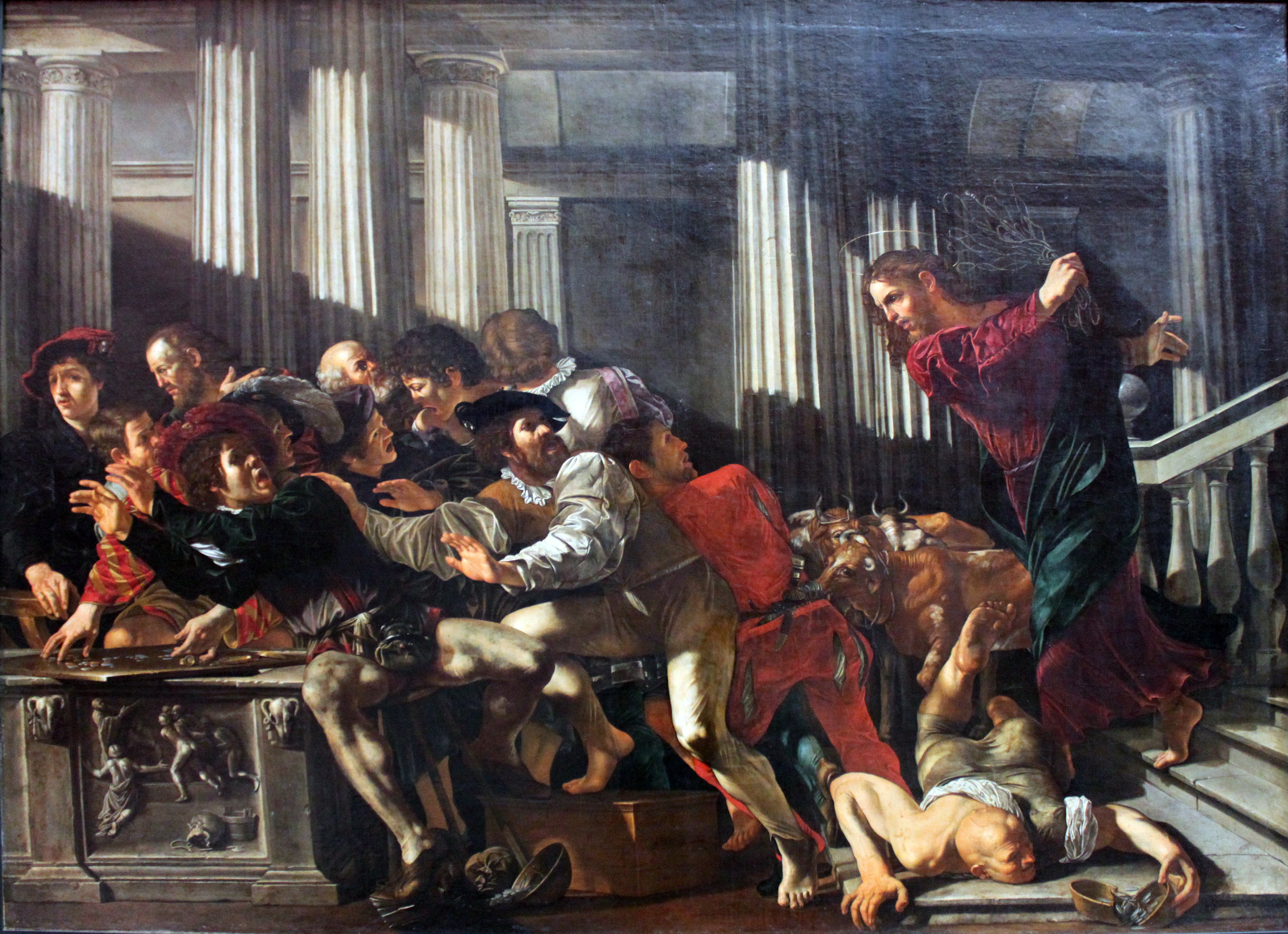

Christ driving the money-changers from the temple - Caravaggio 

What sign can you show us, say those in authority, for doing this? Why have you caused such chaos and commotion?

Jesus’ response claiming to rebuild the Temple in three days sound either ridiculous or arrogant, dismissive or some kind of riddle. 

Taking in a literal sense, his words are misunderstood. 

Jesus’ words aren’t fully understood until his death and resurrection. He is speaking of the temple of his body: of its sacredness.  

Three times, Haggai exhorts the remnant of God’s people to be courageous in seeking to rebuild the architectural splendour of the Temple. The God known in such beauty and majesty is now made known in the fragility and vulnerability of human flesh. 

Jesus body is the dwelling place of God; a new Temple. This body is the site of life and love; of mercy and justice. He is the Word made flesh.  A body which will reach out to bring a hope and a healing touch; a body which will be broken to bring wholeness to others; a risen body bringing abundant life.

In Christ, we are invited see our bodies as sacred too. If we live in love, we abide in God and God abides in us. By the power of the Spirit, the words of Haggai are fulfilled. The Spirit does indeed abide in us; we need have no fear. 

To appreciate the sacredness of our bodies to speak of personhood made whole. We are called to treat ourselves and others as holy. The human body isn’t a commodity or object; we aren’t a set of issues to be solved. We are in a profound sense the home of God; God’s Temple; the place where love dwells.

Jean Vanier writes movingly about the sacred space of our human flesh saying: This place, which is the deepest in us all, is the place of our very personhood, the place of inner peace where God dwells and where we receive the light of life and the murmurings of the Spirit of God. It is the place in which we make life choices and from which flows our love for others.

The implications of this vision runs deep. In the words of your vision, it means being committed to seek prayerfully to know and do God’s will. To be God’s holy people in this community is to go deep into the love of God through that rhythm of prayer and worship. 

To go deep means that the worshipping community is reshaped; becoming more open and caring; being a place where bonds of trust grow; where patient love and forgiveness create a safe place; a place where we can question and wonder; where we can see in the other the image of God. 

To go deep means that we are challenged and equipped to engage loving with the wider community of which you are part. That includes being zealous for justice; being committed to the demands of peace; but also seeking to live in a way which respects the integrity of creation, knowing our dependence on the honey bee demands a sacrifice of sustainability. 


The Presentation - Chris Gollon

Today, the light and glory of God fills the Temple in substance of our flesh.

Today, the power of the Spirit, the fullness of Christ dwells in us as we abide in God’s love. 

This Candlemas, as Christmas meets Easter, let us make Jean Vanier’s words our prayer: 
Church is the place where, 
in the midst of the demands of our daily live, 
we can come together with others, as a community of believers, 
to a place of silence, our inner sanctuary, 
to listen to the word of God, to hear the murmurings of the Spirt 
and to welcome into our being the presence of 
the Word-made-flesh, Jesus. 
As we welcome Jesus and become one with him, 
we seek to welcome each other 
and together to go forth 
to welcome others, 
revealing to them the compassion and forgiveness of God.


©  Julie Gittoes 2019


Tuesday, 5 July 2016

Here because we're here


On Friday, I was struck by the Tweets posted by Cambridge University Library: they were snippets from Siegfried Sassoon's diary:
The sun flashes on bayonets + tiny figures advance steadily + disappear.
Clouds of drifting smoke - brown, blue, pinkish + gray: shrapnel bursting.
Just eaten my last orange. I am looking at a sunlit picture of hell.
The intimacy of the handwriting; the ink making visible the tiniest fragments of story. Such glimpses make us stop of life in the face of death was both compelling and disruptive. In something so fragile yet tangible, we glimpse something of our humanity. The ordinary in the face of horror.  We imagine the truth of that and piece it together. Jeremy Deller's project and the #Wereherebecause  We pay attention to the story; to the gaps.  In silence, art, words and song. All that was on my mind as I preached on Sunday for the feast of Thomas the Apostle.

Matins 3rd July 2016: St Thomas the Apostle - II Samuel 15:17-21; John 11:1-16

O Saviour of the world, who by thy Cross and precious Blood hast redeemed us, 
Save us, save us and help us, we humbly beseech thee, O Lord.
Strengthen ye the weak hands - William Henry Harris.

On Friday, more than a thousand volunteer actors loitered in military uniform in stations and mingled with commuters in public squares. If spoken to, they remained silent; offering instead a card bearing the name, date of birth and rank of a man killed on the first day of the Somme. Periodically they broke into a song sang in the Trenches: we're here because we're here because we're here because we're here....


Wearehere-WW1soldiers2


A tribute to the fallen. 
A piece of performance art. 
A making present of the past. 
A reminder that death impinges on life.

Archbishop Justin described WWI as a 'catastrophic political failure' and cited 'complacency about peace' as the biggest disaster we could have.  We face a turbulent time in our national life. When regions, families and generations are divided, it seems as if we are strangers to one another; yet in the condemnation of racism, we declare we are one flesh; we called to demonstrate love which casts out fear and reflects God's faithfulness.

Amidst disruption, we remember the ApostleThomas: pigeonholed as 'doubting' yet the one who made the bold declaration of faith, 'my Lord and my God'. This morning, we are plunged into two stories  which seem utterly unrelated to each other, disconnected to the Thomas we think we know, and apparently incomplete in themselves; we're left with cliff hanger moments.

Neither episode has an auspicious beginning:

David leaves Jerusalem.

Lazarus is gravely ill.

The first reading hints at some sort of political upheaval; it raises questions of belonging and loyalty. John meanwhile draws us into a moment of family crisis; Jesus words arouse our curiosity about love and death. In the midst of memories and experiences of uncertainty, perhaps these texts open up the possibility of self-examination and renewed hope.

The previous chapters of 2 Samuel have recounted political intrigue beyond anything we're likely to read about in the Sunday papers: betrayal, rape, division, violence, exile and espionage.  David's is usurped by his own son, Absalom, who successfully wins the hearts of the people with promises of justice.

In the face of such rebellion, King David pauses mid-flight and watches his officials and others pass by. It's a poignant moment:  looking back at Jerusalem, the seat of his power; looking towards the wilderness, an uncertain future. 

In the face of his son's disloyalty, who can he trust? Has he lost divine favour, will those marching past remain with him?

David encounters Ittai: a professional Philistine soldier, known to him. Perhaps this foreigner is more loyal than his own kin.  He addresses him saying, why are you here? Go back, a foreigner has no obligation to be with us; Go back, take your family, rest in the city; why wander about with a fleeing King?

Ittai offers unwavering loyalty. It is the outsider who sets aside self-interest; he exemplifies faithfulness and truth; he becomes a sign of assurance and comfort to a grieving king. He commits to being David's servant; dwelling with him, journeying alongside him; remaining steadfast in life and death. The stranger embodies a blessing of love and faithfulness.

Perhaps at this moment of loss and disruption, betrayal and dispossession, one act of human trust invites David to remember that God is with him.  It changes the way we hear those words: we're here because we're here...

In life and death, there's a glimpse of faithfulness.

In John's Gospel, we hear for the first time of Jesus' love for a particular person: Lazarus his friend; the one who is beloved. We hear of this love in the face of crisis: he's sick, his strength is fading. Yet Jesus speaks without alarm - this illness won't lead to death. He loves Lazarus, yet remains with the disciples. He speaks with assurance that the one who sleeps will awake.

What sort of love is this? 

The euphemism of sleep gives way to the unequivocal reality of death: it is love in the face of death; love that brings glory; which sheds light in darkness.

Now Jesus speaks of going to be with Lazarus - in death. Yet to go to him now is to risk losing his own life. In going to Judea, Jesus will weep at Lazarus' grave; he will be moved by the heartrending pain of grief that we know too well. He will also demonstrate his power over death in this particular act of love; and in so doing face his own death. The scandalous power of his love, revealed on the cross, reconciles the whole world to God.

In loving, Jesus embraces death.
This love is vulnerable in its solidarity.
Love that is with us: love that summons us to stand alongside others in their sorrow and fear.
In the words of the psalmist: Love that careth for the stranger.
We're here because we're here because we're here...

And Thomas says: let us go, that we may die with him.

St Thomas the Apostle


St Thomas the Apostle (2006, private collection, Australia)


Thomas is fearless; he's without doubt. Thomas speaks boldly not knowing the cost, but following light and love. Thomas stakes a claim to loyalty; he takes the first step towards the cross.

We too are called to walk in that way: we are called to solidarity with the other; called to life in the face of death.  

Faithfulness to God demands love in the face of transience and turbulence. The way of the cross is an alternative to fearful isolation or intolerant nationalism. Echoing the example of Elie Wiesel, we can't remain silent. He said 'we must always take sides'; we must do this 'whenever and wherever human beings endure suffering and humiliation'.

Thomas made a decision and so must we. His confession of Christ as Lord is ours too. 

We are called to love not indifference; to remain faithful in despair; to hold on to life in the face of death. Even in darkness, light shines.  By the power of the Spirit, may confess the scandalous and vulnerable love of Christ; as God's pilgrim people, amongst commuters and in public spaces, we're here because we're here because... we embody that reconciling love, living with the other. 


© Julie Gittoes 2016

Friday, 8 April 2016

Alone Together

This is the text of a short paper entitled Alone Together: Towards a Theology of Singleness which I presented at the Society for the Study of Theology Conference in Durham this week. The Conference theme was  Redeeming Human Nature. This work is the beginning of a longer project on the theme 'Alone Together' - and giving this paper at the start of a period of Extended Ministerial Development Leave was extremely helpful in terms of framing the question and exploring other strands of research for this topic. In thinking about an image to use as I transferred this paper to my blog, I wanted to avoid stereotypes of solitude or 'togetherness'. So in the end, I've used one of Chris Gollon's works which hangs in my hall way at home. She's called 'Crock of Gold' - but I think she expresses something of our human capacity to radiate the light and glory of God - alone, together.

Single is...

'"Single" is, ironically, a complex word' says  Jana Marguerite Bennet in her book Water Is Thicker Than Blood (p.84). It is frequently used to describe various states of not being married, perpetuating the idea that singleness is a lack of something.  Questions about marital status seem so black and white. Yet the word 'single' masks the complexity of how we form households and the diverse network of people with whom we share our lives.

In this paper, I will make some observations about why 'singleness' might be a focus for our theological anthropology - including social context and pressures with the church. Although those factors demand our attention when it comes to mission and pastoral care, my primary concern is how we underpin that with a theological understanding of humanity. The question of how we live well - alone together - takes into account our need for companionship, intimacy and solitude in the face of mortality. This questioning is rooted in God's creative and redemptive movement towards the world. To think about being alone together is not yet another set of binaries; but perhaps generous spacious way of thinking which God, in Christ at the centre; but which also opens up a way of relating well in the world, in the power of the Spirit.

Crock of Gold  - Chris Gollon (2013)

Alone Together
 
The phrase, or more precisely those two words, 'alone together' have stayed with me since hearing my colleague Mark Oakley describe the truths he discovered after surgery; the truths about masks we wear to fit in. And when the medics have left him he addressed God saying, 'ahh alone together at last'. God and creation; God with us; you and me; in relation to others. Together. Alone. To think this way takes us into the abundance of Genesis 2 and the stillness of Mark 1; it takes us into the ecclesial vision of life together shaped by Bonhoeffer and Hardy.

Children, widowers, divorcees and the never married are all 'single'. We will all be 'single' for some or all of our lives. Patterns of work and serious illness might mean that spouses spend time having to live in a way that is 'single minded' if you like, in terms of ordering practical aspects of their lives, emotional resilience and relational intimacy.

That we find 'single' problematic is not just matter of definition. There are a number of social and ecclesial pressures which demand a more adequate theological response. There's both a nervousness about sex and what it means to be married but open to relationship; plus a tendency to equate intimacy with sexual encounters, rather than cultivating and cherishing bonds of friendship, intellectual curiosity, support and appreciation.

Perhaps too there's added pressure around our language of discipleship and particularly leadership - typified in the presumptive 'your spouse will...'. In many contexts, we've grown to accustomed to certain ecclesial role models (as evidenced by the comments about the marital status of women who've become bishops).

Households and friendship

Our scriptures are quite subversive on that - offering a rich diversity of 'households' within the church, including Lydia a (presumably) financially independent business woman. We may also be aware of the emotional pressure at work - to fulfil the ideals of an implicit hierarchy of discipleship by dating with a view to marrying.  It does indeed tap into deep human longings - the plot of London Spy turns on Danny recollecting a conversation with Alex about being 'the one'. A contemporary twist, perhaps, on 'Reader, I married him'.

There have been some wise and resourceful responses from Kate Wharton on navigating such pressures (Single-Minded: being single whole and living life to the full, published 2013); but it still leaves open some of the deeper questions which demand engaging with and changing societal and ecclesial culture.   There are over 26 million single person households in the UK and in the 2011 census, the percentage of those who are married dipped below 50% for the first time.

Added to this, the statistics on loneliness in the UK have been given human context by the BBC documentary The Age of Loneliness. It was narrated by those who were in a more nuanced sense single: students, widowers and new mums; the unemployed, divorcees and those will fulfilling careers. It is an inter-generational issue not related to marital status. If that is our social context - the world in which we witness - it is salutary to remember that those who attend church report higher instances of loneliness than the national average. Cultivating a vision of living well alone, together becomes even more of an imperative.

In Being Single, Philip Wilson reveals the isolation experienced by single church goers and (in his words), their 'over use' (Wilson, DLT, 2005).  He writes of the potential and challenge for the church, including the place of friendship. Friendship has become a significant category and indeed practice for thinking about ecclesiology (see comment below). Indeed, it is the category that John Pritchard draws on in Living Faithfully. He describes the church as a network of friends called to 're-vision the church as the place where Jesus is at the centre, living in his friends and empowering them to live his abundant life of each other and the community around. Then anything is possible' (Pritchard, 2013, p. 120).

Think single?

It is then that he issues the imperative to 'think single' - offering activities 'to reflect this diverse make-up' of the widows, students or unsupported by a partner for whatever reason (Pritchard, 2013, p.120).  If 'single' is a complex word; than activities is perhaps too simple a response. Singleness with the body of Christ demands of us a sustained engagement with being an embodied human being.

In the marriage liturgy, the couple say 'all that I am I give to you'. How we foster a sense of 'all-ness' which is good for personal and corporate flourishing, which doesn't collude with fierce autonomy; nor that we are incomplete apart from others; but which recognises that our identity in Christ is more important that our legal status is the question at the heart of a project exploring the notion of what it is to be alone together.

Turning to Genesis 2 we are confronted with the reality of being alone: As we contemplate creation - the glorious and tumultuous diversity of it - we respond with our whole being. We are in a profound way 'together' - we are part of the goodness of that create order; yet in the face of delight and responsibility, we catch a glimpse of the reality of being alone.

it is not right... to be alone

It is is not right or good for the man to be alone. He - you and I - need helpmates. We need companionship. Not God nor creation alone:  the well-being of the one, as Brueggemann puts it, 'requires a fresh creative act of God' (Brueggemann, Genesis 1982, p. 47). There is something good in being together. We share in work and creativity; we learn compassion and empathy. In the first instance, this is not about hierarchy, complementarity or marriage. Rather it seems to be an opening up of what it is to be human - in relation to other people.

As we shall see, that is also fragile and complex. But for now it is worth exploring further the language of sameness and different; the covenantal nature of being alone together. Again, quoting Brueggemann: 'the place of the garden is for this covenanted human community of solidarity, trust and well being. They are one!' (Brueggemann, Genesis 1982, p. 47).

This is a dynamic and generous 'one'. Genesis speaks of being bone of my bones; flesh of my flesh. Is there a transformative movement here beyond 'our flesh and blood' and ties of biological kinship and commitment. For we also use such language to speak of our belonging together as the body of Christ. We we are called by name in him; shaped together by word and sacrament; improvising together in the power of the Spirit.

The vision of Genesis of human companionship and shared endeavour turns to fragmentation. Life and knowledge are within our grasp: freedom, trust and calling in love are exchanged for autonomy, oppression and hierarchical ways of organising life (Brueggemann, Genesis 1982, p. 53).

Dan Hardy's language of extensity and intensity expresses the hope and reality, the dynamism of divine and human interaction. God creates in generosity and freedom. Intensity is that movement of love pouring forth in diversity and abundance; our response to that freedom means that that energy is spread outwards into the world. Extensity is the consequence of such spread-out-ness; we get distracted by our own desires and find ourselves caught up in complex social and economic systems, which draw us further away from one another and from God.

Part of that is that our identity is reduced to just one aspect of who we are: we are defined by race, gender, age and marital status. The fullness of who we are is impaired. If Genesis 1 reminds us of our primary desire or orientation as being made in the image of God; Genesis 2 reminds us of the glorious relational and material aspect of that.  But divine intensity continues - in redemption; in the formation of the human person; in Christ; in the Spirit.

A lonely place

In the midst of this, God reaches out to us. Mark's gospel begins with a direct assertion that this is good news precisely because Jesus is God with us in the midst of hurt and loss, delight and commitment. We are called to live with difference - whatever our marital status, gender or class - we are all gathered up together. We are a body, together; attentive to God in worship and to God's ways in the world. We are together with God and an innumerable company of pilgrims, yet also alone.

Mark recounts that Jesus goes to a deserted place, early in the morning, to pray. He had gathered around him a group of disciples who had responded to his call; he had begun to proclaim that the Kingdom of God had come near; he was reaching out to those in need bringing grace and healing. He had spent time in the intimacy of Peter's household. He was with us; together with others. And he went to be alone.

Prayer in this lonely place becomes a place of power, direction, strength and cost. We are called to lay ourselves open to the intensity of God's refining light that we might be strengthened and sustained in our discipleship. Our life together is rooted not just in corporate worship but also in our capacity to be alone. Bonhoeffer warns us that many people 'seek fellowship because they are afraid to be alone'; but he says let whoever 'cannot be alone beware of community' (Bonhoeffer, Life Together pp. 76-8). Silence and stillness before God shapes our day, being alone in meditation, prayer and intercession.

One Body & the Spirit's work

This time is not, says Bonhoeffer,  an 'abyss of loneliness' but time alone with the Word (Bonhoeffer, Life Together p. 88). The value of solitude is to be deeply away that we are loved; it is rooting all else in God's desire for us. It resources all of us for those times 'alone' in the world, in the dispersed life of the church: political imagination? We cannot risk  being alone, unless we are in community: bearing with one another, carrying griefs and burdens; rejoicing in gifts and joys.

Perhaps 'singleness' becomes less about self-sufficiency, but somehow a sign of freedom in Christ; which paradoxically points to our primary social reality. As John Bradbury puts it in 'Called to Become: 'the individual is the locus of the work of the Spirit of God: a human person can be led into a new social reality that fundamentally changes who they are' (Bradbury and Cornwall, Thinking Again about Marriage, SCM 2016, p. 144 ). This transformation of our personhood is what Hardy describes as abduction; as all that we are is drawn to God.

Within the body of Christ, we are still living in between times: we await the fulfilment of God's Kingdom, knowing that something decisive has happened in Christ. Something is deeply personal in effect, but also cosmic in scope. We hear the cries and groans and longings of the whole creation; and utter the assurance that nothing can separate us from the love of God in Christ Jesus. We live in the midst of Romans 8.

Genesis speaks of one flesh; Paul writes of being many but one body. That entails a fruitfulness of relationship that transcends procreation; which recognises mutual care and affection; where the powerful do not overlook the weak.   Such language describes a whole personal relationship of love. The fruitfulness of Genesis is echoed in the spiritual fruit - becoming a little more patient and hospitable; joyful or self-controlled. It's a way of holiness. Alone together.

Letting go...

In this Easter season, we are acutely that of life coming though death. Of both Jesus profound expression of being alone together on the cross and in the grave. Of the way in which resurrection disrupts and deepens out being alone together; we could talk about Mary Magdalene's calling by name, her desire to cling on; her letting go and her commissioning. Alone she witnesses to those gathered together. In reflecting on how, we come to life in death; that letting go might actually mean deepening our love and care.

If Bennett laments that little has been written of the moral life of the single person: perhaps a Spirit let ecclesiology shaped by Dan Hardy is a good place to start or, in terms of this paper, to end.

He writes that: ‘understood in their fullest sense, both Church and mission are the social means of incorporating all the dimensions of human life in the world in their comprehensive fulfilment by God’ (Hardy, Finding the Church, p. 25).  I could say more about flourishing expressed as sociopoiesis, as good news for all humanity and the whole creation.  Or I could end with a comment on facing death; perhaps more attention should be paid to how all our 'letting gos' become signs of attraction to God and other.  It's less about one's marital status;  all our relationships are provisional, yet rooted in our ultimate hope of redemption. It's about our vocation in Christ to witness to the light, love, grace and beauty of Christ. Alone. Together.


Julie Gittoes   © 2016

Work on friendship:

Steve Summers, Friendship: Exploring its Implications for the Church in Postmodernity (T&T Clark, 2011); Guido De Graff, Politics in Friendship: A Theological Account (T&T Clark, 2006); John B Thomson, Sharing Friendship: Exploring Anglican Character, Vocation and Mission (Farnham: Ashgate, 2015); Samuel Kimbriel, Friendship as Sacred Knowing: Overcoming Isolation (Oxford: OUP, 2014).