Showing posts with label doubt. Show all posts

Saturday, 29 April 2023

Doubt as productive

16 April 2023 (Easter 2): Acts 2:14, 22-32, 1 Peter 1:3-9 and John 20:19-end


As human beings, we often seek certainty but also find ourselves living with doubts. 


There may be times in our lives when guidance and direction are important; or there might be moments when we need space to weigh the questions, trust our instincts. 


Some of us might be predisposed to ways of thinking and acting rooted in confidence and clarity; others of us may experience decision-paralysis or imposter-syndrome, being all too familiar with doubt.  


Perhaps we say to ourselves ‘I’m not sure’ or ‘I don’t know’ - on the threshold of changes in work or relationships, circumstances. It is rare to hear such phrases in public though.


Someone seeking to change that is Nicola Reindorp, the CEO of Crisis Action. In reflecting on the impact of her own doubtfulness on her career, she decided to explore it in conversation with neuroscientists, counsellors, economists and leaders. 


In doing so, she writes [here] that she ‘discovered another side to doubt that is productive and powerful, not the destructive doubt of paralysis and pain, but a productive form of questioning and discovery.’


In a way, her “rebranding” of doubt makes sense: she puts it at the heart of self-awareness and humility, seeing it as a prompt for curiosity and learning. Doubts enable us to interrogate our own biases driving not only innovation but also inclusion and diversity. 


Does it help us understand Thomas better? He was someone who elsewhere in John’s gospel speaks openly and directly about his thoughts. Questions don’t seem to phase him. So perhaps it shouldn’t surprise us that his faith and belief was also mediated openly, directly and indeed relationally. 
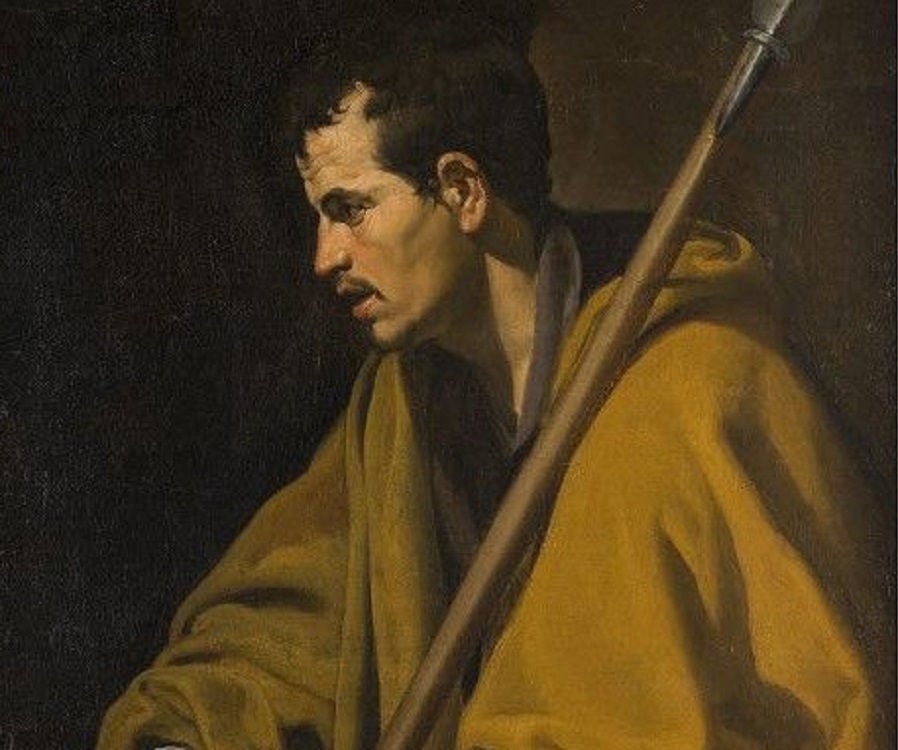


St Thomas - Diego Velázquez

As Rowan Williams puts it: ‘doubting Thomas is often thought of as demanding hard evidence - unless I touch the wounds - and yet it was his encounter with the person of Christ that sparked faith.’


Thomas's doubt leads to a desire for touch; but what he sees inspires his belief, his trust. His testimony opens up space for others to find new purpose, new life. 


A better nickname might be ‘inspiring Thomas’ after all!


Does such a rebranding sit alongside what we hear in our text?


The tomb was empty. The doors were locked. 


Rumours of resurrection were circulating as fears were pressing in.


Into that place of grief-stricken hearts and troubled minds the risen Lord breathes peace.


To the exhausted, troubled and anxious: peace.

To the fearful, questioning and grieving: peace.

To the curious, hopeful and courageous: peace.


The marks of the nails and the pierced  side are visible: the continuity of scars witnessing to the continued presence of the self-giving love of God. 


The one breathing peace was of the Father’s love begotten; breathing peace having been betrayed, denied and beaten.  


Those wounded hands took the sting out of death and now reach out to places of mistrust, pain, disappointment and guilt.


Those wounded hands also reach out with the balm of love to forgive and heal rather than condemn.


But Thomas was not there. 


His doubtfulness means the confidence or charism of the words of others was not enough. He needed to see, to touch, to feel the breath of peace.


Those are productive signs of questioning and discovery rather than a painful paralysis. 


He had to take that doubtfulness into the week of waiting, of talking, eating, praying. 


Did their joy give space for his questions? Did his curiosity deepen their joy? Did their peace soothe his hurt? Did his interrogation prompt deeper fellowship?


The tomb was empty. The doors were locked. 


Stories of resurrection filled the room, fears being dispelled.


Into that place of hearts warmed by conversation, fellowship and prayer another word of peace is spoken. 


There is no rebuke or condemnation - simply an invitation for Thomas to reach out, to touch, to see, to trust.


Doubt becomes worship: my Lord and my God!


Evidence and observation becomes unconditional acceptance.


That is not the end of the matter: all this is for our sake - the words, the stories, the testimony, the breath of peace.


All this is written to assure us that we are healed by the same words; that we might put our trust in the promise of renewed life; that we might know ourselves to be loved, forgiven, restored, made whole and blessed. 


More than that, in the power of the Spirit, the risen Jesus sends us to transmit that love and forgiveness. 


In problem broken bread and outpoured wine, our fragile and fallible bodies are nourished as we are called from penitence to restoration; as we allow love to seep into those locked places of fear. 


This new life is a gift but also a process. The Spirit is at work in us - confronting us those things we hide from and cultivating in us new hope and dignity.


This process is held within our community - the accountability we have to one another before God.  If doubts are about curiosity, self-awareness and humility - if it prompts our learning and the safe space to interrogate our own biases, questions and weakness - then they have their place. 


Together, faith and doubt can be productive: bearing those first fruits of healing, generosity, conviction; rejoicing with those who rejoice, weeping with those who weep.


Hand in hand it staves off those things that paralyse us or hidden growth and change; finding a deeper stability and ways forward that do not coerce, demand or control. 


This kind of questioning and discovery drives the processes of forgiveness: being honest with ourselves and knowing what sets others free; the changes that bring hope and liberation; letting go of habits which cause harm.


For the one who breathed peace was the one who endured the worst of humanity - shame, failure, selfishness and betrayal - and burnt it away in the refining fire of a crucible of love.


Perhaps Thomas and Peter strengthened each other in their faith and witness through the way they tested, challenged and encouraged one another. Certainly Peter’s words - in Acts and in his letter - speak of a liberating hope and new life, which is full of gladness, mercy and love. 


It is a message, as Willie Jennings puts it, that is ‘far more powerful than its messengers’; it is a remarkable message which draws our life from fear to peace. 


Faith and doubt, peace and forgiveness: worked out in prayer, fellowship and breaking of bread for the sake of the world.


As Rowan says: ‘Faith is not just ideas in your head, faith is not just feelings in your heart - faith is the whole of a new life, making a difference to your lives, to your neighbours, to your community, by the grace and the Spirit of God.’


© Julie Gittoes 2023

Sunday, 8 April 2018

Love's risen body

The text of a sermon preached at the Cathedral Eucharist on the Second Sunday of Easter.  As i was preparing to preach, I came across a news story on the BBC website entitled Can you be spiritual if you don't believe in God?  More than half of the British population identify as having no religion. The sociologist Linda Woodhead describes them ‘nones’ - rejecting the categories of secular or religious, but still affirming a spiritual side to life. In this context, the BBC asks people to explain what spirituality means to them. 

In the article above, Barbara describes her spiritual life as enabling her to move away from hatred towards compassion, forgiveness and love.  Ziad names the pressure of individualism and self-indulgence; seeing in all religions expressions of the one truth, the divine spark in us. Hugh talks about being an orphan from infancy and discovering that he had a Father who was God.  Reverend Bonnie talks about the way in which doubt and questions have shaped her personal development. She says ‘certainty closes doors. Doubt deepens faith’. 

It's the final comment which feels pertinent when preaching about Thomas' response to being absent when the disciples encounter their risen Lord behind closed doors. It's become a truism to say that faith and doubt aren't opposites; questioning and conviction often go hand in hand. What we see in Thomas a deep desire to be assured of the extent of transformation brought about by resurrection - it is the wounded Jesus who is risen, defeating death. 

I begin with another Thomas: R. S. Thomas whose own ministry grapples with the nature of presence and absence, and persistence in the way of faith.


Alleluia: Christ is risen!
He is risen indeed: alleluia!

Lines from the welsh priest-poet R. S. Thomas [The Answer]:

There have been times
when, after long on my knees
in a cold chancel, a stone has rolled
from my mind, and I have looked
in and seen the old questions lie
folded and in a place
by themselves, like the piled
graveclothes of love’s risen body.

Like the Thomas of today’s Gospel, his witness to ‘love’s risen body’ flows from the intersection between certainty and doubt, sight and insight. 

They walk with us - these faithful Thomases - as old questions resolve in faith: in silence and waiting, in seeking and hoping, in absence and presence, and in kneeling to pray, 

Belief flows from the defeat of death itself. 


In the days following the resurrection event, Jesus’ disciples have been grappling with the reality of an empty tomb and rumours of encounter with the one who was their lord, teacher and friend.

As they gathered behind closed doors, did the beloved disciple share the experience of sudden realisation as he saw grave clothes piled up in a tomb? Did he describe the way in which that absence awakened in him an ever present love?

Did Mary Magdalene take the risk of seeking them out, her heart pounding as she hammered at a locked door? As the bolt slides back, she rushes in; her breathless declaration ‘I have seen the Lord’ flowing from a faith which lets go and embraces new life.

They talked about these things: these moments of recognition and these transformed lives. Their old questions shifted to make space for new ways of thinking, giving way to new life.  

A stone rolled back; piled grave clothes; love’s risen body.

The very person who was crucified is risen.

They see his wounded side.

And Jesus speaks words of peace.

They see the marks of death.

Their fear is turned to joy.

And Jesus repeats the promise, the gift, the truth, the hope: Peace be with you.

This moment of encounter is an awakening of a new community: a community which is breathed into existence. 

Those who are gathered together in a room are sent into the world. 

Jesus’ death and resurrection have changed the world: this is the ultimate reality of the power of God’s love to create, heal, forgive and bless. 

But the world is changed through them, through their witness; it is changed through us, through our witness that love wins.

In an act of recreation, love’s wounded and risen body gives to them the gift of the Spirit: a gift which continues to seek reconciliation; a gift which bequeaths mercy and justice; a gift which pursues forgiveness; a gift which dares to hope. 

The church is a wounded body; a body which dares to speak of love’s risen power.  Walking in the step of Jesus demands humility and courage; compassion and patience.  Small acts which resist the toxicity of hatred; repeated gestures which build peace; dogged perseverance that things can change.

In the complexity of our lives and the uncertainty of our world, that can sound naively optimistic, but there are glimpses of realistic hope.

Watching the BBC’s My Dad, the Peace Deal and Me last week offers one such glimpse (quotations from the Irish Times).  It’s a searching and disarming documentary by comedian Patrick Kielty: his father was killed in the troubles; his family resisted revenge. Twenty years after after the Good Friday Agreement, he continues to search out fresh perspectives on the way forward - remanning equally open minded when interviewing the DUP’s Arlene Foster of Sinn Féin’s Emma Rogan.  


Today Stormont is deserted and Brexit presents new obstacles. The experience of violence and mistrust are grievances which way heavily. And yet. And yet transformation is possible. The peace campaigner blinded by a British soldier’s bullet speaks of the way forgiveness brings freedom; it ‘allows us [you] to let go’. Those Kielty meets in schools and comedy clubs, on the Belfast streets and in his home town hold onto the hope expressed my Mo Mowlam: ‘it may take a wee while but we’re going to make it’.

We’re going to make it. God’s Kingdom will come near in small steps amounting to unimaginable change.

Reconciliation takes time.  It is a glimpse of love’s risen body transforming wounds. As Kielty puts it: ‘where there’s peace, there’ll always be a wee bit of hope’.

This is the hope of forgiveness that love’s risen, still wounded body, breathes into us: forgiveness is a process; there is no coercion; each of us can chose moment by moment to accept that gift and be embraced by it; to refuse it or withhold it.

Thomas stands with us - like us - in that place of hesitation.  He has heard his friends talk about the peace of love’s risen body.

Rather than seeing him as the doubter or the skeptic, the pragmatist who wants to see for himself; perhaps he is just like every other disciple, then and now, grappling with loss and the most profound grief.

He hesitates with his tears and questioning; he’s seen some run away from the cross and others waiting at the tomb.


He, like us, waits for the old questions to answered; for fears to be rolled back like the stone. He needs to know that the horror and scandal of death - of the death of his Lord - to be overcome.

As the poet and writer John Gardener puts it:  ‘For [Thomas] to believe, death itself - and those specific wounds - would need to be overcome. It would have to be transformed, all of it… Thomas would have to see the very thing that had crippled him and broken his spirit undone’ [John in the Company of Poets]. 

Jesus speaks peace to his anxious heart.

Jesus tells him: what you most fear has been turned into life.

Death has been overcome by love’s risen body.

And Thomas declares the truth of his heart; the reality of his experience; the meaning of the Gospel.

My Lord and my God!

My Lord and my God!

Thomas rejoices that in Jesus God is with us. His death restores life to our frail, wounded, suffering and mortal bodies.

Jesus is God himself, in the fullness of our humanity, overcoming the enemy of death. He is love’s risen body.

Here at this Eucharist, our fears are dispelled by the peace we share; in broken bread and wine outpoured, we rejoice at transformed wounds and restored life.

We are called by name as witnesses to a new reality: like Thomas, belief is rooted in recognising this new life in love’s risen body.  


Such life is not an abstract ideal or unobtainable ideal. It is found in a person.  Because Jesus lives and overcame death, we too live.

We are united with as members of his body: love’s risen body.

We are to communicate that love in our body language:

Dare we have the confidence of Moses: encouraging others to stand firm, to not be afraid, to trust that God will guide us?

Dare we have the boldness of Thomas: naming our hurts, declaring our faith and having the courage to place our trust in the risen Lord?

Dare we follow the example of the early church: witnessing to our faith with grace and passion and striving to deepen our fellowship with each other?

To be members of love’s risen body is to be willing to put all that we have - and all that we are - at the disposal of God, in the service of others - in words of peace and in generosity, in acts of trust and in a movement towards forgiveness.

Alleluia: Christ is risen!
He is risen indeed: alleluia!


© Julie Gittoes 2018