Sunday, 28 August 2022

More than "table manners" - honour and dignity


August 28, 2022: Proverbs 25:6–7, Hebrews 13:1–8, 15–16 and  Luke 14:1, 7–14


Image: Louis Kahan - Jesus at the Wedding in Cana


People watching is a fascinating pastime: waiting in a queue, sitting on a park bench, taking the tube or anywhere you find yourself noticing the world passing by. 


We take in elements of their identity, their appearance and style; maybe wondering what their life story is or what’s running through their mind; are preoccupied with their phone or immersed in a book.


We catch something of their body language and their mood; do they seem content or anxious. We take in their interactions with others - friendly, dismissive, courteous, oblivious.


Likewise, perhaps others are watching us. 


There are times perhaps when we’ve felt uncomfortable, unwelcome or a bit awkward.


In today’s Gospel, Luke tells us that Jesus is both being watched closely; but also the one who is watching, observing, noticing what’s going on around him. 


He is people watching in a situation that highly recognisable to us: at social functions, school canteens, work lunches, leaving do-s, family parties, perhaps also our own dinning rooms. 


There are signifiers of social status or importance; indicators of belonging and popularity. Those who are gathering their posse; those sitting on their own. Perhaps we do have scanned the room for a friendly faced; looked at a seating plan with dread; or been asked to move or told, no we’ve no space for you.


Jesus observes those who’re watching him; and decodes what is going on in that room; he notices what underlies the table manners.


The historian Ingrid Rowland wrote a book called The Lost Art of Eating in which she notes that food is about identity, community, social status and conscience, as well as nutrition and appetite.  Who we eat with and how much, when and where are all markers of those things. She says that food is ‘the all sufficient metaphor for power’. 


Perhaps that is what Jesus notices too: the desire for social capital mapping onto the desire for wealth.


In his ministry, he feeds thousands when a small offering of bread and fish are given away; he prepared grilled fish for disciples after a night’s fishing. He talks about feasting and fasting; he eats with friends, disciples and those he meets on the way;  he sits at table with outsiders on the fringe and leaders at the centre. As guest or host, he notices when food builds community or undermines it. 


As he observes the social drama around him, he poses a challenge.


Drawing on the wisdom of Proverbs, he speaks of honour and humility. 


It could be heard as a way of gaming the social system: assume the worst place at the table to get invited to a better one. 


Instead of a new social strategy, he is pointing to the reversal of God’s ways with the world. We often use the word ‘kingdom’ to describe what that looks like - the world as the sphere of God’s influence or aligned to God commands. 


Jesus’ way of  people watching invites us to pay attention to what is going on around us - to give them our full attention rather than thinking only of our interests or place.  


There is both generosity and humility which stretches our imaginations. Once we can imagine the world differently, we might be able to live differently. 


If the metric social honour and disgrace risks self-seeking and shame,  is there a kinder and more generous way?


If we think less about ourselves, might we be more aware of others - their needs, worries, gifts?


If we sit lightly to the company we keep - and where we are at the table - might we make more space for others?


Allowing for a social life of gift - rather than reciprocity - allows all of us to flourish and be treated with dignity.


This is the place where our imaginations are shaped and where habits are formed; the Eucharist is where culture shifts away from self to other. 


In the calendar of saints, today we remember St Augustine: amongst his most famous and memorable sayings relates to the Eucharist: ‘you hear the words, “The body of Christ” and you reply “Amen”. Be then a member of Christ’s body, so that your “Amen” may accord with the truth’. Or receive what you are; become - in the power of the Spirit - what you receive.


Here we share in the life of Christ - letting go of our desire for status. Christ, the host, invites us to sit and eat; we know ourselves as beloved - as does the person extending their hands before us or kneeling after us.


God comes near to us in this gift of broken bread and out poured wine; in the proximity of blessing. The norms of social status laid aside; our dignity is affirmed. We are children of God - fed in this place that our imaginations, hearts and actions might be enlarged: with compassion and generosity, kindness and service.


As members of one body, we receive the gift of community; what ever our differences and gifts, our quirks and vulnerabilities, there is no place for humiliation or exclusion. Here, we pray that we may imagine a different world - where all are regarded with honour - and we dare to take that vision into our lives and work places. 


Here as we gather at one table, we are held in equal honour and dignity: it’s a form of social capital which can help to shape and heal the world. We’re invited into a widening circle of blessing which reflects God’s preferential treatment to the stranger, widow, orphan and poor; embracing the lonely and overlooked as well as the influential and well connected. 


This is the blessing mutual love about which the writer of Hebrews speaks.


Extending care and love to others, whatever their circumstances, is to entertain angels unawares.


Given the pressures and fears about the cost of living and fuel bills - the need for food, warmth and company - we are exploring how we use this space to extend hospitality. 


We’re considering how we can deepen relationships within community in the face of isolation and fear; using the resources we have together to enable relationships and build social capital. 


We are reminded today that even under pressure, we are not to neglect to do good and share what we have: 


At at time when many are fearful and lonely; when our hospitality and are creative industries are under pressure once more; when political leaders debate investment in housing, education, health and social care; when schools and care homes are concerned about budgets; and in many sectors workers are considering strike action it -  can feel overwhelming. 


As people are faith we are somehow to hold fast to the dream of our prophets and poets as we reflected last week; to commit to raising others us; and to extend the welcome we receive at this table to others. 


We all have a part to play at home, at work and in our churches: all of which make up the life of our community. Every seat we off is the one of honour; every conversation can be a sign of hope; every action an opportunity for loving kindness. In the power of the Spirit, we share the love of God revealed in Jesus, who is our guest and host.


For as Rowan puts it in the poem “Rublev” as we bake bread ‘we shall sit and speak around /one table, share one food, one earth’.


© Julie Gittoes 2022


Saturday, 27 August 2022

Hold fast to dreams - raise one another up

 Sunday 21 August: Isaiah 58: 9b-14, Hebrews 12: 18-29 and Luke 13: 10:17

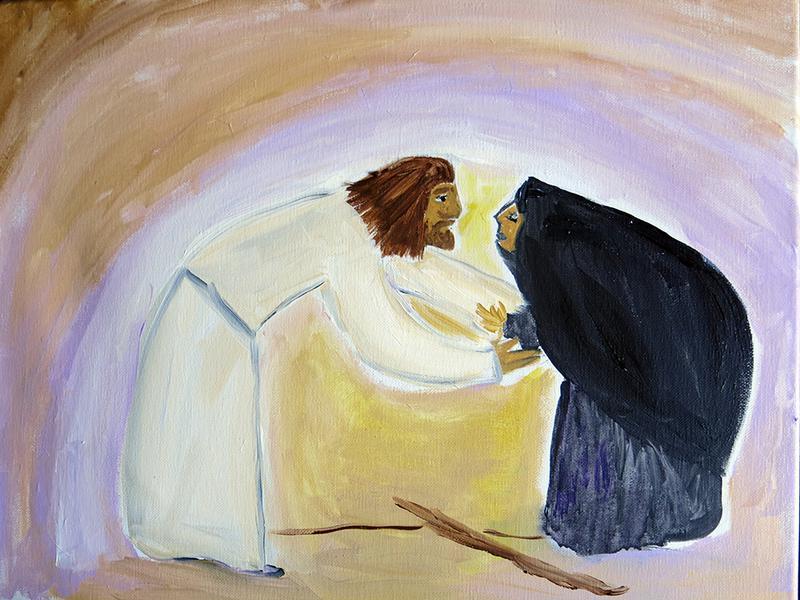
Jesus and the Bent Over Woman
by Barbara Schwarz OP. 2014


Hold fast to dreams

For if dreams die

Life is a broken-winged bird

That cannot fly.


Hold fast to dreams

For when dreams go

Life is a barren field

Frozen with snow.


Words from the poet Langston Hughes:


Perhaps it’s something that poets and prophets have in common: they hold fast to dreams. Perhaps, that’s even more important when the land around us is parched, when sewage gushes into seas and humanity is thirsty. 


They hold fast when we want to see longings of our hearts quenched; they dream when we want to see neighbours unburdened, relationships repaired and our city built up. 


Now we need the poets and prophets; to hold the dreams and not let them die or go. 


We need to learn from them in our dreaming: straining against broken wings and barren fields and frozen hearts so that life, like a bird might fly.


Hold fast to dreams.


Hughes was twentieth-century black American poet who was described has having an ‘anonymous unity with his people’. Avoiding both sentimentality and stereotypes he attends to stories of joy and hardship, money and relationships, work and seeking work.


He wanted to hold fast to a dream: that humanity in all its diversity longed for security. The violation of those things offended his conviction that humanity is possessed of the divinity of God. Yet he hoped - he held fast to a dream - that the world and her people could understand each other. 


Isaiah too is holding fast to a dream. It’s a dream of the establishment of peace and security; of social life flourishing across generations. This is God’s dream.


There’s a poetic rhythm to our translation of the Hebrew: rebuild, raise up and repair. 


Holding fast to a dream speaks to places, people and responsibility: rebuilding the places where people live; raising people up and providing a foundation across generations; repairing the breach, those things which have come under strain, through the work of reconciliation. 


Hold fast to this dream is rooted in the sabbath principal: a revolutionary habit of work balanced by rest and liberation. Isaiah words demand that we refrain from self-interest.


Instead, delight is to be found in removing burdens from others: the yokes that are carried are removed by the provision of food and the satisfying of needs.


We might paraphrase Isaiah as a dream of freedom from all that diminishes human life and access to those things which allow everyone to flourish. 


This is God’s dream for human beings - relationships of support not exploitation; it’s God’s dream for the world - waters refreshing the parched places. 


Then there will be light in darkness.


The Word of God is that light - a light that stoops down into darkness in Jesus.


In the exchange we hear in today’s Gospel, dreams are held fast and made real.


Hold fast to dreams

For if dreams die

Life is a broken-winged bird

That cannot fly.


We know very little about the woman who comes to the synagogue: but imagine for a moment walking in her steps.


Bent over and moving forward, yet seeing only a very little way ahead. 


A world of feet moving around her but without eye contact.


Feeling the heat of the day and cool of the night but not seeing the sun set or moon rise.  The mental and physical labour of each moment; and the isolation of not being seen; of going unnoticed. 


Yet she goes to synagogue; and today a teacher notices her. Jesus breaks off his words and sees her, addresses her; and sets her free. 


His touch relieves the yoke; her body moves in a new way; her perspective shifts; her lips sing God’s praise.


She stood up straight: released from her burdens.


The light breaks in at that moment. The crushed spirit, the hurting body, the lonely soul are met with compassion and restored to community.  The dream of God’s Kingdom breaks in; life is no longer a broken winged bird that cannot fly.


There will be times in our lives when we feel that the yoke of our circumstances weigh us down: financial pressures, grief, loss of agency, illness or injury, isolation.  


May this worshipping community to be palace where we are noticed, beloved, invited, set free.


All of us will know or encounter those who are exhausted, weighed down, marginalised: because of age or ethnicity or sexuality or gender; because of fears about the cost of living, finding a job, passing exams or mental health. 


May this place - and our way of relating day by day - give encouragement, release and dignity. 


God we hold fast to dreams. To God’s dream - a dream that goes beyond a collection of self-interests to the flourishing as humanity as one community, one family. God won’t accomplish it without us; we can’t accomplish it by ourselves. With God we can - and each of us, individually and together, have a part to play in the healing of the world; of setting others free.


That means living some space for God to surprise us. Luke tells us that the leader of the synagogue protested because Jesus stopped teaching, noticed the woman and acted with compassion; he rightly wanted to honour the sabbath, holding the commandments of faith and love. But perhaps like him, we sometimes hold on to what we know and do, that we miss the moment dream becomes reality.


Hold fast to dreams

For when dreams go

Life is a barren field

Frozen with snow.


In Hebrews we’re invited to hold those two things together: our worship and God’s kingdom. In doing so, we honour the hope of sabbath rest and freedom. 


The writer of Hebrews sets out the destination: an unshakeable kingdom. They also plot the the journey thought images that offer security of people and place: a holy mountain, a vibrant city, a diverse gathering and assembling before God. 


Like the woman, we are children of a compassionate God. To be human is to be worthy of love and dignity. 


As we receive the gift and nourishment of the sacrament; as we are touched by words of forgiveness and blessing, may we find ourselves standing upright, set free to praise God. 


As we worship in reverence and awe, may we hold fast to the dream expressed by prophets and poets; the dream of restoration that Jesus brings. May the Spirit move us, equip us, inspire us to restore others to community; to notice those who’re weighed down to respond with compassion. 


In a fearful world, a world where many are denied dignity: hold fast to dreams, heal broken wings, quench parched fields, raise one another up.  Amen.


© Julie Gittoes 2022

Saturday, 19 February 2022

The human heart: blessings and woes

A sermon preached on 13th February 2022, 3rd before Lent; Jeremiah 17:5-10, 1 Corinthians 15:12-20 and Luke 6:17-26


Ahead of Valentine’s Day, Good Housekeeping published 72 supposedly “swoon-worthy love quotes”; “the perfect message for your Valentine”. Inspiration is taken from Barak Obama and Leo Tolstoy, Maya Angelou and Jane Austen, from Shakespeare, Madonna, the Song of Songs, and Mother Theresa.


Who knows if the compiler of these “swoon-worthy” quotes, printed against red-bubble-hearts, would have given thought to the religious hinterland to some of those lines. 


But we know, love can bring blessing and woe: yes, love is full of hope and bravery; tenderness and consolation; but, its risky and a life-long labour; there are too many broken hearts in the world, as Jason Donovan sang in 1980-something.


No complier of valentine’s day quotes would turn to Jeremiah, though perhaps his words about the human heart are recognisable too.


First, who can even begin to understand the human heart?


Second, we know the ways our hearts can turn away from loving - loving God, self and neighbour.


Finally, we trust that hearts can be turned outwards in love - that God will search us out, know us and see the fruit of all our doings.


When Jesus came to stand with the crowd on the ‘level place’, he opens up our hearts by speaking a litany of blessings and woes: they’re not words of advice per se; they’re not offering judgement even; but they do weigh our hearts by exploring the truth of how life works. 


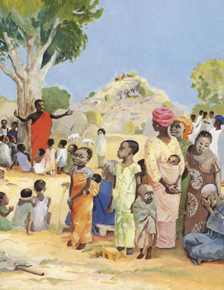
Jesus Mafa Project


It’s easy to slip into guilt or romanticism about these words; but I wonder if we can step into this radical topsy-turvy kingdom today.  Unlike Matthew, Luke doesn’t soften these sayings by saying hunger for righteousness, rather than hunger;  or poor in spirit, rather than poor.  


He’s amplifying where God’s heart is in places of need  or sorrow, and saying something about the transience of our wealth and privilege. He reminds us that our common human dignity reaches across comfort and discomfort; it doesn’t sanitise hunger and poverty, for moments before this passage Jesus is revealing the abundance of God’s care in healing and compassion.


As we hear them sayings of blessing and woe, as we learn them, say them or enact them, we might have our hearts searched, turned or changed too.


The American monk, Brendan Freeman, says this: “[The Beatitudes] draw our hearts out of themselves into a new way of understanding our lives…they are deliberately incomplete.  They await the inclusion of our lives.  Each person fills in the blank spaces with the details of his or her own life situation.”


Blessings and woes are part of the fabric of human life: it is where we all live - in our homes, work places, schools and communities.  The line between empty and full, tears and laughter is a thin one; we cross it because of one crisis or one act of kindness. 


As Jack Monroe has highlighted in her work on food poverty: we all notice the increase in the cost of living but it effects those on low incomes most. When we invest in early interventions and support for children and families, they are more likely flourish at school and attain their potential.


Blessings and woes are woven into the life of the church. We are all members of Christ’s body - when one mourns, our hearts ache; when on is rejoicing we share in the overflow of their gladness. 


When one member is wounded, we bleed too. As Lord Boateng reminded the Church of England’s General Synod that racial justice is all about Jesus. He said ‘love is not as soft as sentiment but as strong as strategy, we will wash your feet but sometimes we will hold your feet to the fire’.


If blessing and woe can happen to us all - and if we, as a Body, are hurt by the wounds of another member - perhaps Jesus’ words are not heard as condemnation but as invitation: an invitation to open our hearts in love. 


Our calling is perhaps to acknowledge the tensions and to listen carefully to the other; to let go of our own self-sufficiency, and receive the gift of another. As the writer and preacher Barbara Brown Taylor puts it: ‘Much of the power of the Beatitudes depends on where you are sitting when you hear them.  They sound different from on top than they do underneath.’


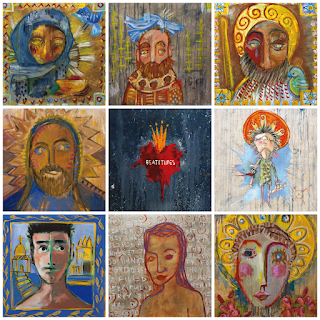
Beatitudes: S. Garrard


At different points in life, we might hear the challenge; at other points here the hope. The words are the same; they sound different.


Hearing these familiar words in The Message translation highlights that:

You’re blessed when you’ve lost it all.

God’s kingdom is there for the finding.

You’re blessed when you’re ravenously hungry.

Then you’re ready for the Messianic meal.

You’re blessed when the tears flow freely.

Joy comes with the morning.

But it’s trouble ahead if you think you have it made.

What you have is all you’ll ever get.

And it’s trouble ahead if you’re satisfied with yourself.

Your self will not satisfy you for long.

And it’s trouble ahead if you think life’s all fun and games.

There’s suffering to be met, and you’re going to meet it.


Is it comfortable to hear the woes, not at all: it reminds us that all that we have is temporary, fragile. Is it easy to hear the blessings, not always: yet they reminds us of the hope of consolation and the possibility of change.  


Are the beatitudes comfortable, no: but the do help us understand the human heart. Is this teaching costly, yes it is: but it is a way of turning our hearts to wards God, ourselves and our neighbour in love. Is there a risk of domesticating these words - always: and yet, as we take them to heart, God is with us searching us out and seeing the first fruits of all our doings.


Cutting across the woes and blessings is a word about the treatment of God’s prophets. Blessed when challenging those in power; in trouble when they flattered them. Blessed when speaking uncomfortable truths; in trouble when courting popular opinion. 


Jesus walked that way himself: it cost him his life and breath and yet, death was not the final word. As Paul reminds us, our hope is in our risen Lord. He is the first fruit of God’s kingdom breaking in - in our blessings and woes, in comfort and in grief. 


May we walk this way in love: our hearts open.


In the words of John O’Donohue:

May we live this day

Compassionate of heart,

Clear in word,

Gracious in awareness,

Courageous in thought,

Generous in love.


© Julie Gittoes 2022


Hope is everything

 Epiphany 3: Nehemiah 8, 1 Corinthians 12 and Luke 4


In many ways After Life, the Netflix series scripted and staring Ricky Gervais, is not for the fainthearted: it explores the nature of love, grief, depression, addiction, friendship and community; it goes to places which are bleak and raw; the humour is by turns dark, blue and even tender. 


Threaded through it all, is the message that we’re here for others, not just ourselves.  


Image


Gervais is an atheist.  Tony, the character he plays, shares that world view. He makes statements about what he knows rationally, as fact. At the same time, he recognises the things we cannot account for; the emotions, loves and connections that lie beyond what we can prove or explain. 


In the world of After Life, faith and belief aren’t ridiculed but hover at the margins. Love and goodness aren’t abstract. They’re things located within our capability to make someone else’s life a bit easier. Acts of kindness, offering help, listening and giving others a chance to contribute.


Perhaps the core conviction of the series is that hope is everything. Tony hopes that he’ll get his life back on track as he lives through the chaos and darkness of grief. That he’ll be able to laugh and find happiness again. 


In fact, most of the ‘action’ takes place when people sit together; when they pay attention to another’s story: on a bench, in a care home, at an office desk, in a cafe, on a sofa - his or someone else’s.


As we sit here, together, on chairs or pews, we too are invited to pay attention. To attend to God’s story - a story that holds us from first to final breath, with all the loves and griefs in between. To we hear two stories of worship - worship in the context of political and social challenges - and a letter on the cusp of perhaps one of the most famous hymns to love. 


First: at a gathering in a public square, the book of the law of Moses is fetched.


The people are told that this day is holy.


Even as they face the challenge of rebuilding their lives after exile, the people are told that they will find strength and joy beyond the pain of grief.


Second: in a synagogue, the scroll of the prophet Isaiah is unrolled.


Familiar words are heard: that is the year of the Lord’s favour.


Even as they live under the an occupying power, they are told that these words aren’t consigned to a familiar memory or a distant dream. The are fulfilled. Now. Today.


Today, as we gather and God’s word is shared: dare we believe that this day is holy?


Within our congregations and wider community, there will be feelings of loss and dislocation and anxiety as we rebuild routines, businesses and relationships.


Like the people listening to Ezra read, we are invited to persist in our ‘rebuilding’ and to dare to hope as we grieve. Like them, we are to embrace the time that we have left to us here on earth to encourage hospitality - to share the resources we have with those who have nothing. The life we have is to be holy - precious, marked by kindness and loving kindness. 


As words of promise are reaffirmed, dare we expect this to be a year of blessing?


Within our congregations and wider community, there will be feelings of uncertainty and fear about the future: about the costs of living, youth violence and mental health.


And perhaps, like the people listening to Jesus read, the words of Scripture are comforting; but when we’ve heard them hundreds of times do they lose their power? 


What Jesus does is not only read them, but embody them; he makes them his own and breathes new life, possibility and hope into them.  Now. Even in this year. God will work through the time we have - even if we don’t have all the answers - so that even this year might be one of hope.


Like those who have heard words and unfolded texts before us, we are invited to be attentive. 


We are be attentive to the present moment - to recognise that it is precious, sacred, even holy. 


As we pay attention to the words we listen to each other as a community of God’s beloved: many, yet one; diverse, each member indispensable. 


Wherever we sit - on pews or bar stools, at desks or on park benches, on sofas in cafes, staff rooms, care homes or living rooms - we are to pay attention to each other’s story through the lens of God’s story. A story that offers us the good news of a new beginning, a love that has the last word, a freedom that dares to see a hope-filled future amidst the rebuilding and the struggles. 


To embrace the holiness and potential of today is to lean into God’s love with our sorrows and our longing. 


To embrace the year of the Lord’s favour is to trust that God’s love embraces all of our human experience in the joys and feasting and the anger and doubt. 


We don’t say yes and amen to this love on our own. We do so together. 


We are not here just for ourselves. In Christ we are made one  - each of us has a place and a purpose; each one of us is needed. 


However complicated our circumstances - however much we fear change or worry that we don’t have the resources or the answers - we are to say yes to the one who helps us sit together. 


Paul’s words again are so familiar, perhaps today we can let them sink in: if one of us suffers, we suffer together; if one of us is honoured and shown kindness, we all rejoice. We are to exchange dissension for care for each other. 


This is the stuff that sets us free. 


Paul speaks about the diversity of gifts - of teachers and leaders, those who bring healing and those who carry the prophetic call to justice and mercy. We can add our own - what each of you do, and are and hope for. Yet above all that we are to strive for a greater gift - the gift of love about which Paul writes in the next chapter. 


For now, dare we be here for others  not ourselves? Can we be present, now, to each other and our community? With our brothers and sisters in other Christian traditions and alongside others of faith and goodwill, can let’s listen; let’s notice God light and love breaking and inviting us to rebuild.Together, let’s find ways of making life a little bit easier - for our hope is everything. 


May the Spirit anoint us with loving kindness, with fierce determination, with the gifts we don’t know we need, with the ability to be present when we feel helpless, with the patience to listen and with the generosity to bring a shred of joy where there is none.


Today is holy. Today hope and love is, can be, will be fulfilled.


© Julie Gittoes 2022