Saturday, 23 December 2023

Buried love?

Sunday, 19 November 2023:  Zephaniah 1:7, 12–18, 1 Thessalonians 5:1–11 & Matthew 25:14–30


Image of parable of the talents found here

When he was Archbishop, Rowan Williams spent a day at Canary Wharf meeting with CEOs in the midst of the financial crisis of 2008. In that context he observed that there had been a preoccupation with maximising profit without building trust or relationships and without taking time, as he put it, ‘for enterprises to come to fruition’.

He observed that:  ‘that double problem; lack of relationship and the telescoping of the time taken had produced the unreal, destructive world of speculation which has so wrecked the lives of so many, including many of the most needy and vulnerable in our society and across the world.’

His observations lead us into thinking about the parable that Jesus tells to some of his closest disciples as recounted by Matthew.  But perhaps, as the scholar Amy Jill Levine suggests, we might consider what parables do rather than what they mean. 

Jesus tells us stories which stretch our imaginations and invite us think more deeply about God’s ways with the world and our place in it. 

On the one hand, it might be possible to hear this parable as a comment on good and bad economics. Two servants trade with what they’ve been given - accepting the trust placed in them to build relationships and to take risks over time. 

The other servant buries what he’s been given - he’s fearful rather than trusting; he conserves what he has, but in isolation and secrecy.  Part of his response is driven by how he imagines his master - he alone describes him as harsh rather than generous.

There are limits with an economic line of imagining in this parable: the risk of seeking God working through those with money, assets, abilities, strengths; those who can take the risk of a gamble, who can count the cost of loss, who have the security to dare experimentation and growth.

A talent wasn’t cash used day by day, but more akin to gold bullion: wealth and security which amounted to 20 year’s of a labourer’s wage. Twenty times the London Living Wage would be over half a million.

But what is the master really giving his servants? Running through the gospels is the promise that God gives us something more precious than a lottery win - that is love. This is a love which creates, restores and sustains us. Such love is an invitation to relationship; a love that casts our fear; that creates trust. It changes us and our life. If we let it.

And perhaps that is the crux of the matter: if we’ve been given this extraordinary gift what happens if we bury it? 

Imagine that physical act of taking what is most precious and digging deep into the earth, placing it there; then spadeful by spadeful shovelling the soil over it until it disappears from sight. And then walking away. Leaving it hidden in an unknown and unmarked place. No one else knows about it.

Buried.

Love.

But strangely that is what happens to God’s love poured out in Jesus. 

The love flowing from God’s very self choosing to dwell with us, risking everything for us.

At this point in Matthew’s Gospel, Jesus has taught about the kingdom of God - through the lens of the beatitudes, attitudes of blessing in the pursuit of peace and mercy. He has brought healing and wholeness to young and old, influential and marginalised. 

He has told his disciples that he must suffer and die; and has sent them out in pairs to share the good news of repentance and forgiveness. He crosses thresholds and breaks boundaries. He has fed multitudes on the hillside, debated with those in authority, cast traders out of the temple and told stories. 

Stories about the nature of God’s grace and mercy; stories about a kingdom which is begins like the smallest of seeds growing into a tree offering sanctuary for birds; stories which stretch imaginations and reveal new ways of being. 

And now, as the plot against him thickens, and fear and betrayal fill the air, he tells another story about the risk and cost and abundance of this love.

For in his body this gift of Godself will be lowered from the cross to the grave; entombed in the earth, and hidden. 

And some will think that that is the end. But like the buried grain, a green blade rises and life is seen again. 

We are entrusted with this gift of life and love - so that it can multiply in relationship, with trust and generosity and sacrifice and forgiveness. 

This is the seed of a new and transformed humanity: yes, it can also feel like hard work; but the alternative is worse, we risk losing everything. 

As Jesus says elsewhere, if you hang on to life, you will lose it; if you let go of it, you gain everything. 

To give love away overtime and in relationships might be a struggle we’d prefer to avoid or bury; but to invest in it is to share in the Spirit led work of humanising the world around us. 

Challenging those who limit dignity and blessing,  or who dismiss falling through the net of our fragile social fabric as a "life-style choice”. Strengthening households, friendships and families; playing our part in changing systems; offering what we have to bring glimmers of comfort, inspiration, purpose; taking time for our enterprises in justice and kindness to come to fruition.

To build relationships where conflict can be transformed, joys are shared, burdens are carried, hope is renewed. 

To love as God has loved us: faithfully, even in small things. 

That means being alert, keeping awake as Paul reminds the Thessalonians: because we, like them, never know when the day of the Lord will come with dazzling brightness.

In this waiting, we don’t fearfully bury the gift given to us. Instead we are to go about our lives expecting to see Jesus in the familiar and in the unexpected places. 

In this waiting, we are to keep alert: responding the cries and the longings, the suffering and the stuff that brings joy.

We are called to this even more so when the world is in distress: the words of Zephaniah paint a picture of anguish, ruin, devastation, gloom and anger; of places laid waste, generations lost, homes abandoned and material resources plundered.

This is the outer darkness of mistrust, fear and love buried so deep tears no no end. 

Yet, somehow we are to encourage one another. When all seems lost, we are to build each other up; to keep the rumour, the possibility, the hope of a new humanity alive. 

To refuse to bury love with fear. To do the handwork of giving life and love away instead. No wonder Paul resorts to the language of breastplate and helmet for a spiritual struggle played out in acts of kindness, solidarity, advocacy and service.

Live in faith, hope and love, he says: trusting that salvation will be revealed, that time when God will be all in all, all our hungers met, brokenness forgiven, creation restored; trusting that in that moment of judgment we’ll be surprised by those who’ve been Christ for us; those in whom Christ as been revealed to us; and those who’ve served Christ with us.

In worrying less about what today’s parable means, we can trust that it does something in us: reminding us that as we give away in love, fear subsides; that in going to the margins, salvation breaks in.

Our trust in the one who lives, dies and lives again is renewed as we share in blessing and bread. Gathering around our Lord’s table, we say everyone has a place here, even when we disagree; but as Bishop Sarah reminded Synod last week, to gather around this table also takes us to the edge; we continue to invite others to eat with us. She said: 'if that means that I need to sit outside with the powerless, the marginalised, the lost, then that is where I will sit and I am certain that I will encounter Christ there.'


© Julie Gittoes 2023

Saturday, 18 November 2023

In these living years

Sunday, 1st October, Trinity 17: Ezekiel 18:1-4, 25-end, Philippians 2:1-3 & 

Matthew 21:23-32


Generational stereotypes abound in memes and advertising, sketches and articles:

Boomers: well-off

Gen X: cynical 

Millennials: entitled

Gen Zs: civic-minded


But, as one headline puts it: ‘Boomers to the left of you; Gen Z to the right. Are we really so bafflingly different?’


At one level, the answer is “no”: we’re human with the same fears, affections, hopes, biases and limitations. Our experience might mean that we find solidarity or difference across generations because of our personality, interests, politics and community.


Yet at another level, the answer is “yes” because as individuals we do exist within cohorts or time frames; the impact of global events or national policy impact us differently.


Some of it is about cultural norms and reference points; or having analogue childhoods versus being digital natives; some of it is about wealth, taxes and the cost of living; coming of age in the era of student grants or student loans.


In a way, bridging the generation gap has always been with us.  It’s 30 or more years since Mike and the Mechanics debuted their rock ballad “The Living Years”. It’s a track which names the way ‘every generation blames the one before/all of their frustrations come beating on your door.’ We come hostage to hopes or imprisoned by fears. 


We can go back even further - 1000s of years rather than a few decades - and find those frustrations exposed by Ezekiel: in repeating the proverb about parents eating sour grapes and children’s teeth been set on edge, he is naming the inter-generational blame game.


Or, to return to the ballad, ‘we open up a quarrel between the present and the past/ we only sacrifice the future it’s the bitterness that lasts.’


Ezekiel speaks into this conundrum by reminding his hearers that each life belongs to the Lord - of parent and child alike - and together they share responsibility for the present and the future.  He asks what leads to life - and explores the impact of moments of change.


He names the pivot moment: when we walk away from what is righteous and pursue what is harmful, we bound to the fortunes and fate of death; when we walk away from what is wicked and pursue the law of love, we open up a new perspective that leads to life. 


The lyrics of “the living years” are personal and particular - a son regretting all the things he’d not told his father before he passed away, and yet hearing his echo in a baby’s new born tears. 


As the refrain puts it: ‘I just wish I could have told him in the living years.’


Ezekiel is concerned about these living years and breaking cycles of blame. 


We are judged not on the basis of being a boomer or millennial, Gen X or Gen Z - it’s true, we might not always see eye to eye - but on the basis of living in God’s ways. Repentance of hurt or harm opens up space for transformation. 


Bitter quarrels between present and past sacrifices the future; but Ezekiel promises God’s people life  based on a new heart and a renewed spirit. 


Turn and live, says the prophet.


Don’t miss the living years, says the ballad. 


We’re drawn into the substance of this life through the lens of a story Jesus tells when his authority is questioned - and in the words of  hymn which predates Mike and the Mechanics by almost 2000 years.  


Together they invite us into a way of life and faith which is fully integrated - it’s not about the ability to "talk the talk” of Christianity but allowing words and actions to stretch, enrich, sustain and deepen each other. 


Jesus’ story about the two sons highlights the gap between talk and action, intent and deed: one makes a promise but does not fulfil it; the other shrugs off the request, but goes on to do the work anyway.


It’s a very human dynamic. 


We, like the the first son, are capable of both promising things and putting them off, deciding against it, getting caught up in other stuff or simply forgetting.  


However we can also be like the second son - in our hearts being reluctant to do something but in the end being moved to step into the gap, spontaneously moved to act, responding to the need. 


Jesus tells this story in the context of questions about his authority - having arrived in Jerusalem a few days earlier riding on a donkey, to hosannas of hope and adulation; having within the  previous 24 hours cast traders out of the temple, challenging the things that got in the way of it being a house of prayer for all nations. 


We can imagine the outcry - who did he think he was? Responses to him vary across generations perhaps but also across social standing or position. Those without influence or control embraced him; those with power and status didn’t.  How much or how little hope or agency effected their capacity to accept the promise of good news.


This good news is about what leads to life - and demands a moment of change.  It’s not just about the promises we make and fail to keep - it’s about acknowledging mistakes knowing that we can turn and choose life. 


When we name our need and vulnerability, when we let go of self-reliance and selfishness, when we acknowledge the injustices or unfairness we see there is a choice: to blame others or to accept the invitation to shared responsibility - across the generations - and see where God is opening up new possibilities, where change might be possible and where hope might begin.


In the water of baptism, we are brought to new birth - cleansed, renewed, enlivened. There our thirst is quenched - promises are made, we turn to God and choose life. 


However many years ago that moment was for us, we know that we need to be sustained in our journey of faith: not only in prayer, learning and fellowship but by this hour on a Sunday when we are invited to turn and choose life - again and again. Here promises are renewed and forgiveness is received. 


Here we receive the gift of bread and wine which is life itself: receiving what we become and becoming what we received, that is the body of Christ. And we draw near not just with reverence but with an awareness of our need and a deep longing to be fed. Here we rejoice in the hope of an intergenerational community - of hope and life.


But we don’t stop there: this is just a gathered interval in our scattered lives - for we are bodies within the body of Christ moving into the world. We go out equipped to do what we say - acting with love and mercy, seeking equality and justice, embodying compassion and resisting blame. 


Perhaps we can offer a counter narrative to Mike and the Mechanics by healing the quarrels between the present and the past; refusing to sacrifice the future with bitterness. We are drawn into these living years by an early Christian hymn. 


Paul introduces it sayings: if there is any encouragement in Christ, any consolation from love, any sharing in the Spirit, any compassion and sympathy, make my joy complete: be of the same mind, having the same love, being of full accord and of one mind.


It doesn’t matter if we’re boomers or millennials, Gen Xs or Gen Zs - or even the Gen Alpha amongst us: none of us are to act with self ambition or conceit - but instead to look with humility to the needs and interests of others.


That radical intergenerational vision is rooted in the love of God revealed in Jesus - who emptied and humbled himself, becoming obedient to death on the cross. In turning to him we find life. In his name, we find our unity. 


In the power of the spirit we live our lives working out what this salvation - this hope of healing, forgiveness and life means. For God is at work in us in every breath or step we take - in our words, actions, choices, tasks. In these living years may we choose the life that truly is life. 


© Julie Gittoes 2023

Monday, 30 October 2023

You shall love

Sunday 29th October - last Sunday after Trinity: Leviticus 19:1-2, 15-18, 1 Thessalonians 2:1-8 and Matthew 22:34-end


+You shall love the Lord your God with all your heart and with all your soul and with all your mind. This is the greatest and first commandment. And a second is like it, you shall love your neighbour as yourself. 


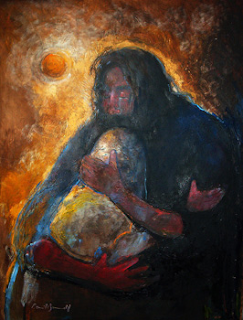
Image credit: Daniel Bonnell - Jesus Wept


How do we love in a time of fear? How, when two peoples, as one writer puts it, ‘with deep wounds, howling with grief, are fated to share the same small piece of land?’ [Freedland here]


Pain is both particular and vast for Israelis and Palestinians, the pain of Holocaust and Nakba and the cycles of trauma and fear of annihilation. The anxiety and grief that exists within communities in Barnet too, and a longing for safety and empathy. A pain so relentless and unquantifiable it breaks our hearts.  


Yet we must find a way of loving because the world is both too dangerous and too beautiful, too broken and too holy, too unjust and too full of possibility for anything else. 


The alternative is unending loss; the horror of conflict limits the range of our human sympathy or solidarity we can end up in a dark place; a place where more hatred is birthed; further harm conceived.


Our readings today invite us into that hard way of loving that allows for humanity and hope, empathy and justice, those things which make progress towards peace. Even when, especially when, our prayers are cries for resolution, pleas for freedom. 


You shall love. 


Leviticus reminds us that this is a command that flows from the very nature of God.


You shall be holy for I the Lord your God are holy. 


Holiness revealed in human lives looks like just judgement - without partiality or deference or slander; without vengeance, grudges or hatred; without profiting from the life of a neighbour by their blood. 


I am the Lord. I am the Lord.


You shall love.


Such love is a matter of effort and practice rather than a feeling or preference. It is a commandment. A matter of obedience. 


It means vulnerability and trust; it means crossing boundaries.


It seems beyond our human capacity. And it is. Yet we find hope. 


Jesus himself says you shall love, not as a social nicety but in the context of having silenced critics, amazed others and being tested by some. Betrayal, arrest, denial, condemnation and death are but days away for him.


There can be no more demanding context within which to say to friend, enemy, follower or critic: you shall love.


The love of which he speaks demands our all: heart, soul and mind. A whole-person attention God’s inexhaustible self. God’s love makes our love possible.


It means an acceptance that we are loved in order that we can love neighbour. That first step perhaps the hardest needing constant renewal in order to overflow to others. 


In Jesus, the fullness of God’s love has flesh and bones, blood and breath.  Love going to the cross and grave and depths of hell; love rising again to reach beyond locked doors and warm fearful hearts. 


To walk that way of love is to weep and laugh, touch and feed; to welcome, set free and forgive; to comfort, confront and guide; to listen, to wait and speak. 


Rabbi Jonathan Wittenberg, reflecting on solidarity in a time of fear writes on being kind or loving, from the Hebrew ‘Chesed’. [Rabbi Wittenberg's blog is here]


Such 'enduring kindness’ he says ‘sounds weak in response to terror. It’s not, it’s a way of life… it requires constancy, generosity, forbearance and the courage to stay present amidst pain. It demands our time, commitment and heart.’


You shall love. 


It is our way of life too. Life shaped by our prayer- by placing infinite love at the centre of our hearts. Life shaped by our community - by gathering around our Lord’s table. 


It is a life that requires much of us: our time, our commitment, our hearts. 


Writing to the Thessalonians, Paul spoke of the courage to walk this way of love and to share it with others, despite his own suffering and maltreatment.  He shared good news of God’s love  without flattery or greed, deceit or trickery but with gentleness. 


His words and actions drew on a reservoir of divine love: loving God whole-heartedly, and being loved absolutely, had shaped and tested his human heart - so that he could express a deep care for for the other, to those he did not know.


Rachel Goldberg, the American-Israeli mother of one of those taken hostage, addressed the United Nations yesterday: she spoke of pain and hope and the courage to resist hatred; to not let it erode our humanity [the link is here]. 


She also speaks of the Bedouin Muslim who stood in front of the shelter where her son and others hid. He tried to negotiate with the militants to

save them, telling them his family were in their and not to search it. He was brutally beaten by Hamas.  


The Muslim broadcaster Remona Aly spoke on Radio 2 about life and love which bring hope out of despair, like suns rising after darkness. She sees ‘suns rising’ she said ‘within people who bravely, vulnerably reach out to share each other’s pain.’ [Here is the link to Remona Aly's pause for thought]


We don’t not find ourselves outside Israeli shelters or Palestinian hospitals; nor are we negotiators or aid workers, but we are neighbours. And our neighbours need us to have forbearance and courage, generosity and constancy. To be there to listen. To not other them.  


Love is not weak but it is strengthened in prayer: turning to a loving God that our hearts might have the capacity to be alongside our neighbours. It begins with our silence, our cries. Let us pray, in words shared by Archbishop Justin:


God of compassion and justice,  we cry out to you for all who suffer in the Holy Land today. For your precious children, Israelis and Palestinians, traumatised and in fear for their lives. Lord, have mercy.


For the families of the bereaved, for those who have seen images they will never forget, for those anxiously waiting for news, despairing with each passing day. Lord, have mercy.


For young men and women heading into combat, bearing the burden of what others have done and what they will be asked to do. Lord, have mercy.


For civilians in Israel, Gaza and the West Bank, that they would be protected, and that every life would count,  and be cherished and remembered. Lord, have mercy.


For the wounded, and those facing a lifetime of scars, for those desperately seeking medical treatment where there is none. Lord, have mercy.


For medical and emergency personnel, risking their own lives to save those of others. Lord, have mercy.


For those who cannot see anything but rage and violence, that you would surprise them with mercy, and turn their hearts towards kindness for their fellow human beings. Lord, have mercy.


For people of peace, whose imagination is large enough to conceive of a different way, that they may speak, and act, and be heard. Lord, have mercy.


Mighty and caring God, you promised that one day, swords will be beaten into ploughshares, meet us in our distress, and bring peace upon this troubled land. Amen.


© Julie Gittoes 2023 (the concluding prayer, Archbishop of Canterbury)