Saturday, 6 March 2021

Where can we find light?

 Sunday, 14 February: 2 Kings 2:1-12 and Mark 9:2-9


When day comes, we ask ourselves,

where can we find light in this 

never-ending shade?


It was a little over a month ago that the poet Amanda Gorman spoke at the inauguration of the 46th President of the United States. 


Her poem was entitled “The Hill We Climb”. 


Her words embraced themes which resonate beyond the steps of the Capital. She allowed space for grief and growth, hurt and hope; purpose and promise; truth and trust. She picture of what stands before us rather than between us; acknowledged that norms and notions of what is ‘just’ isn’t always justice


Her words were infused with passion and joy; woven together with the vision of our Scriptures - that everyone shall sit under their own vine - their own fig tree - and be unafraid. 
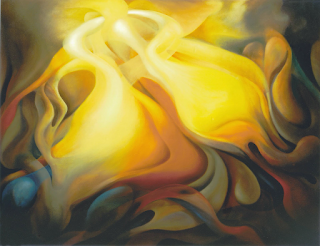


Armando Alemdar Ara - The Transfiguration of Jesus 


The hill we are invited to climb today is one of transfiguration; of transformation; of unsettling, overwhelming and dazzling radiance.


A hill where perhaps we can say with Gorman:


For there is always light, 

If only we’re brave enough to see it.

If only we’re brave enough to be it. 


We come to this light: sharing with the disciples in this private moment. 


A moment of bewilderment and glory.

A moment Peter at least wants to hold on to.


Yet as they rise up from their fear, perhaps they ask what kind of love is this?


What kind of love?


Charles Pabst - the luminous mysteries


This is love incarnate - God’s beloved Son. 


This love is the fountain of mercy and justice.


This radiant moment connects us to promises and renews our purpose. 


Here we too are refashioned. 


At the feet of Moses who led a people to freedom, alerting them to the presence of God in cloud and fire; who called out the dangers of false idols and golden calfs; whose face glowed with God’s glory; who brought the commandments down from mountain top to the valley.


At the feet of Elijah who defended the worship of the Lord God; who called out the evil deeds of rulers and brought hope to the fearful; whose words of prophecy called people back to mercy and justice; who departed in glory, leaving Elisha a double portion of his spirit.


At the feet of Jesus we see the fulfilment of the law and the prophets; who came from glory as love incarnate; who stood alongside fragile and fractured humanity on muddy river banks; whose presence brought God’s Kingdom near in words, whispers, sighs and signs of compassion, welcome, healing, challenge and hope.


Now he sets his face towards Jerusalem: walking a path of suffering, rejection and death.


No wonder Peter wants to hold on to this sacred and wondrous moment; to hold onto this vision of glory.


A cloud overshadows them. 


A voice speaks.


This is my Son, the beloved.


Listen to him.


Found of mercy and justice.


And now, only Jesus. 


What kind of love. 


A love that raises the disciples up from a place of fear.


A love that takes them back to the valley.


A love that gives them a glimpse of glory; a glimpse of risen life. 


A light in shade: if we’re brave enough to see; brave enough to be.
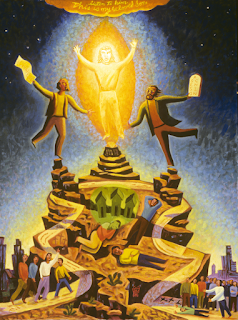


Transfiguration - James B. Janknegt, USA


To rest in the Lord is to commit our way to him, and to trust him. 


To abide in radiance calls forth a response. 


And in commitment and trust, Jesus points the disciples - and each of us - back to this messy world. 


A world where the fault lines of social and economic circumstances collide with the stories we tell of past and present and future; where structures and legacies can be deployed to bind or to set free. 


A world where there are tensions, inequalities and injustices; where polarisation and privilege threaten to disfigure or diminish the dignity we have as human beings. 


Jesus takes us from radiance and reality. 


He brings us back to those who need us: the sick and sorrowful, the restless and vulnerable. 


This is the kind of love we see incarnate with us and acting for us. 

Love that liberates and brings life.


Dare we pray for a portion of God’s Spirit?

Truth to guide us and love to free us. 


Dare we become the light we seek?

With compassion, courage and resolve to see dignity restored. 


When it comes to racial justice, this is not a zero sum game - where someone else’s gain is our loss. We are invited out of apathy into equality. We are invited to a kind of love that reflects God’s glory as we honour one another.


In the words of my dear friend Anderson Jeremiah - a member of the Archbishop’s Antiracism Taskforce: the ‘way of the cross cannot be privatised as an individual spiritual journey. The cross becomes a dynamic public pursuit of fraternity, liberty and justice rooted in love. The cross and subsequent resurrection has overcome the world’s power game of domination, exploitation, greed and deception.’


Will we rise from fear - being the light we see and the love we receive?


Today we are gifted a glorious vision - in a world such as this.


Love incarnate: fount of mercy and justice 


In a world of inequity and pain, may our actions be our prayer. 

May we seek to honour one another and rise from fear. 

May we labour unto to the the glory of this kind of love.


© Julie Gittoes 2021

Wednesday, 10 February 2021

God is with us, come to save, alleluia!

 Candlemas 2021: Malachi 3:1-5 and Luke 2:22-40


In his novel, The Midnight Library Matt Haig explores the question ‘what is the best way to live?’ Through the lens of Nora, who finds herself at a point of utter despair, he asks ‘would you have done anything different, if you had the chance to undo your regrets?’


Our lives are made up of so many choices - opportunities and relationships we say yes to; hard decisions and unmet expectations; imagined futures and the gift of each day. 


Nora had struggled to accept her life as it was, but reaches the point when she can see that ‘same messy life as full of hope. Potential… will my life be miraculously free from pain, despair, grief, heartbreak, hardship, loneliness, depression? No. But do I want to live. Yes. Yes’.


Sometimes it’s easier to mourn the lives we’re not living. Perhaps that feels very real for us at the moment after 10 months of lockdown and restrictions.  It’s been hard and disruptive; and we’ve adapted to different patterns of life.


We notice what we miss; and yet the universal emotions from love and laughter to fear and sorrow are with us in every road we travel.


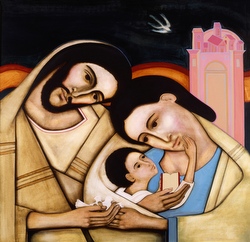
The Presentation in the Temple - M. D. O'Brien

 (CNS photo / courtesy of Michael D. O'Brien)


Today we’re drawn into a familiar family scene; a scene that reminds us perhaps of some of the things we miss. Today, Mary and Joseph bring their son to the temple for what the Government’s Covid-guidance calls ‘a life-cycle event’.


It is a rite of initiation. It is a family affair.


With thanksgiving for safe delivery, new parents bring their first born into community.


They fulfil what was expected under the law; they come, trusting in the covenant promises made through Abraham and Sarah. 


This is a private moment in a public space.


This is a communal event in a holy place.


Trusting and responding and acting as their ancestors had done.


Trusting the promise of blessing; hoping for descendants as numerous as the stars. Believing that a light would dawn, drawing all nations into ways of love.


The Presentation of Christ - James B. Janknegt


In this moment, the hopes of infancy, the expectations of parenthood and the traditions of a community of faith are expressed.


Yet in this gathering there is also a moment of encounter and recognition.


The hopes and expectations of Mary and Joseph are met with the hopes and expectations of Simeon and Anna.


Their lives had been shaped by patterns of faithful prayer and worship; they had paid attention to God with all their being, and now they see.


A dazzling brightness.


Uncreated light shines through infant eyes


The light of the world comes into the Temple, in substance of our flesh


Light shines in the darkness.


Darkness does not overcome it.


The smallness of this flame is the spark of hope that Simeon and Anna have longed for.


In the face of this child they see the face of God.


The one they had sought and had waited for had come into the temple.


As Simeon cradles the child in his arms, he encounters the one who is God with us, come to save us.


As she steps into this space, Anna praises God. And she speaks.


Perhaps she takes up those powerful images of Malachi: images of heat and intensity, refining and purifying.


For this light changes us; burns away regrets and fears; brings hope in the mess. 

In the words of a Candlemas hymn: glory dawns in every dark place, the light of Christ, the fullness of grace.


We’re invited into this light to say yes to life. This light is to shine in our lives.


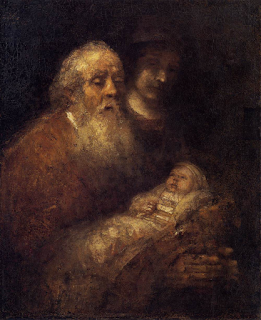
Rembrandt van Rijn (Dutch, 1606–1669), Simeon in the Temple, 1669. 

Oil on canvas, 98.5 × 79.5 cm. Nationalmuseum, Stockholm, Sweden.


Over the years spent in the temple, Simeon and Anna paid deep attention to the presence of God in their prayers; their hopes were shaped by scripture.


They were faithful to the law which shaped the expectations; their hearts were open to the Spirit of God and recognised the consolation they sought when it came.


They sought the consolation of an end to death, poverty, disease and despair.


In this child what they see and embrace and speak of is personal and poignant; consoling and challenging. 


For Simeon, this moment of fulfilled desire and longing meant that he could face his own mortality in peace. 


Yet he knew that this gift of hope was not his alone.


He looks into the eyes of this infant and beheld God with us: the light to lighten the Gentiles; the glory of the people of Israel.


He sees salvation.


He is able to depart in peace, trusting in that uncreated light.


Yet he knows the cost of the light shining in the infant eyes of the one who brings healing to people and nations.


This is the point where Christmas meets Easter.


Golden Cross and Candle


At Candlemas, we turn from Christ’s nativity to Christ’s passion; we move from cradle to cross.


Here the reality of death is named and new life is promised.


Here there is amazement and joy and fulfilment.


For the light and love of Christ will be welcomed by many: those seeking justice and liberation; those seeking to live with love; those embracing the risk, the creativity, the hope of God’s kingdom.


Here fulfilment comes by way of sorrow and pain and grief.


For the light and love of Christ will be opposed by some: those clinging to power and position; those seeking to live by exploiting others; those rejecting the risk, the creativity, the hope of God’s Kingdom. 


Today, we light candles at the end of the service, not the beginning. We do so because as this season of Christmas and Epiphany comes to an end, we are invited not only to dwell in the light of Christ, but to move into the world with that light shining in our hearts. 


As our opening hymn put it, make us your own, your holy people, light fo the world to see.  We aren’t to be bound by regrets; but embrace life. We aren’t immune from sorrow or loneliness, but we can give and receive kindness and joy. 


We pray that we might shelter others; that we might be servants to one another, making your kingdom come. 


May we who’ve seen uncreated light in infant eyes, sing with Simeon and Anna, Mary and Joseph: God is with us, come to save us: alleluia!


© Julie Gittoes 2021

Sunday, 3 January 2021

Look up at the stars!

A sermon for Epiphany 2021 (feast transferred): Isaiah 60:1-6 and Matthew 2:1-12


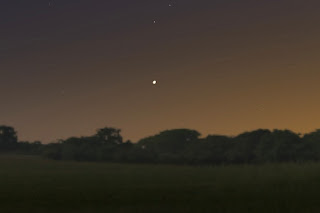
Jupiter and Saturn


The late Professor Stephen Hawkins once said:  “Remember to look up at the stars and not down at your feet. Try to make sense of what you see and wonder about what makes the universe exist.”


Look up at the stars: perhaps we miss that in north London; perhaps we only remember when we’re away from the functional glare of street lights. 


Maybe we peered at the night sky hoping to see the rare conjunction between Saturn and Jupiter; an unusual light, shining a little brighter.


Perhaps it's an innate human instinct to look up: and the longer we stare the more we see and the smaller we feel; with awe and expectation we try to make sense of the cosmos. 


In the beginning, the Spirit moved over a formless void; and lights were set in the dome of the heavens; the sun and moon and stars.


“Be curious” said Hawkins. In the midst of trying to make sense, he continued “however difficult life may seem, there is always something you can do and succeed at… It matters that you don't just give up.”


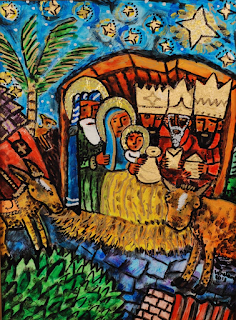
Image unknown


The magi in today’s Gospel were experts in heavenly realms; they were certainly curious. 


As astronomers, they were disciplined in the science of mapping the stars and planets; alert to different constellations; noticing changes in alignment; asking the kind of questions Professor Hawkins did.


Perhaps, like us, they looked upon a similar conjunction to the one seen last month. 


And as they looked, they saw not personal fate; but a sign of cosmic hope. 


Jupiter and Saturn blazing bright; a light had come causing them to arise.

A sign of royalty: the glory of the Lord rising upon them.


Years before, Abraham had been promised that his descendants would be more numerous than the stars; Isaiah foretold that nations would be drawn to this light; kings, to this bright, new dawn.


A still from T. S. Eliot reading Journey of the Magi


And the journey begins: in words from a sermon by Lancelot Andrews, taken up by T. S. Eliot, we’re drawn into their steps [text of The Journey of the Magi here]:


‘A cold coming we had of it,

Just the worst time of the year

For a journey, and such a long journey:

The ways deep and the weather sharp,

The very dead of winter.


There are camels too: not the multitude of which Isaiah spoke, but perhaps sore-footed; with camel men cursing and grumbling as the poem goes.


And did these star-gazers, at times, regret their journey, as Eliot supposes? Longing perhaps for the precision of their science over against the seeming folly of this journey?


Did they miss the the summer places as night-fires went out? Did they avoid those cities hostile and the towns unfriendly and instead travel all night, sleeping in snatches?


Herod and the Magi


This star of wonder had made them curious; they’d wondered about the universe; they could not give up.


These nameless pilgrims seek a royal birth; they go to a palace to pay homage. 


They find a named king seeking to cling to power; his palace a place of fear, deceit and brooding violence.


Amidst the pieces of silver and empty wine skins, Eliot simply says: 

But there was no information, and so we continued.


They continued to a smaller town; a more marginal place; a town that was satisfactory


Brian Whelan: 


Their curiosity and expertise, their determination and endurance had led them this far.


Their arrival looks back to Abraham and Isaiah - to promise and prophecy. All nations shall come to the light - God’s blessing of Israel becomes hope of healing for the nations. 


The bring gold and frankincense, yes; gifts marking this child our as a king; as the Lord worthy of worship. 


Yet they also offered at his feet the gift of myrrh; foreshadowing burial.


This is unexpected. As Eliot’s magi puts it: were we led all that way for

Birth or Death?


There was evidence of birth, for sure; and yet the poetic star-gazer continues: I had seen birth and death,

But had thought they were different; this Birth was

Hard and bitter agony for us, like Death, our death.


This birth is hard for Jesus will face opposition; a sword will pierce his mother’s heart.


This child who is Emmanuel - God with us - will not cultivate fear and deceit. Instead he is with us where the pain and grief is. 


This birth prefigures his life: in fulfilment of the law and prophets; in love that heals and sets free; that binds up broken-hearts and breaks down divisions.


Here is the King of the Jew; the hope of the nations. 


Not a king who rules through fear, oppression and violence; but the Lord who brings reconciliation through justice and compassion.


He dies with us; and we die with him.

He lives; that we might live.


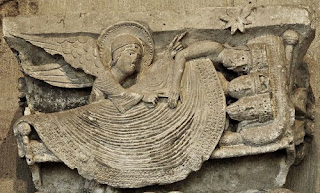
Gislebertus: The Dream of the Magi, Autun Cathedral


The magi sleep and dream.


They are warned about Herod’s intentions.


They return, but not to him; they return home by another road.


They returned to their palaces and kingdoms, their maps of the cosmos.

Yet, as Eliot puts it, they were: no longer at ease here, in the old dispensation.


They no longer clutched their gods.


For they had worshipped the beauty of holiness.

They had knelt and adored.

They’d set down burdens and sorrows alongside their costly treasures.


There they’d found comfort and prayerfulness.

Truth took on this strange beauty of birth and death.

Love enfleshed in tenderness. 


And now: curiosity had been met with joy.

Their ease unsettled in the face of this glory.

The old dispensation giving way to a new world.

A world where we too are called to carve out space that is less polarised.


We are to look up at the stars and to look into the face of Christ.


We are to dream: to dream that we will find another road where a commitment to being with and living for overcomes the fearful ‘I’. 


A world that may be more compassionate and just.


© Julie Gittoes 2021