Sunday, 14 June 2020

Holy Tears

The texts of reflections from this morning's worship in Hendon. Sadly, the church wifi went down towards the end of this part of the service. 


Sinai: from creative commons

They journeyed. They entered the wilderness. There they camped. 

A place of escape; but not the destination. Open space; open skies.  Guided by cloud in the heat of the day; by fire in the cool of the night. 

And did the remember what God had promised Abraham? That they’d be blessed; that they’d be numerous than the stars; more numerous than the sand. Blessed to be a blessing. 


Sinai: wikipedia

They journeyed. They camped.  Freedom was uncomfortable in this strange land. They longed for the tastes of Egypt; of garlic and melons, fish and cucumbers. And yet, in this strange landscape, their needs were met with manna and quail. Freedom meant having enough.   

As they camped there before the mountain, did they know that that covenant would be renewed? 
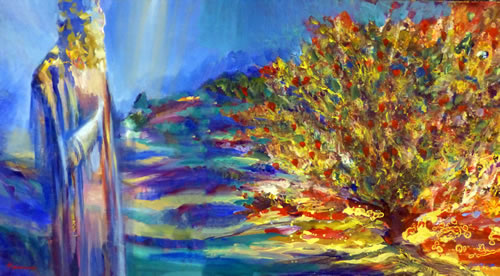

Image: Yoram Raanan

Moses was one who led them: he’d demanded their freedom; he'd heard their grumbles; and still he spoke for them. He knew the wilderness. He’d learnt to turn aside once before.

In a wilderness like this, he’d dared to look; he’d stood on holy ground. Where the presence of love burned in the world and did not consume it. There in flame I AM spoke. The one who was, and is and is to come. 


Image: Rae Chichilnitsky

And I AM will touch his heart again; I AM will give voice to commandments and renew this covenant.  Obey and keep says the voice of I AM; guide these people through the wilderness that they may know a way of promise and peace.  

And will they honour the name of I AM; will they honour each other? For way back when, when Abram said ‘yes’ and Sarah laughed, a promise was made.  A people  grew like sand and stars; brothers dreamed and brothers parted; plenty turned to slavery; and yet God said, there is way of love.


Image: Richard McBee

Moses went up the mountain. The Lord called to him. I AM speaks and Moses listens. This is neither a burning bush nor an overshadowing cloud. It is just him. On this mountain. In this wilderness. Waiting. Breathing. Listening. But he must also speak.


Image: Lisa Fahey

He must speak of I AM who carried this people on eagles’ wings. I AM is like this majestic bird; carrying them from a place of bondage; preventing them from falling; drawing them home to Godself.

But fledglings must learn to fly. Before wings grow strong, the mother eagle swoops down and carries them up. Higher, this time. Until they grow accustomed to the air currents; and the beating of their own wings.  


Image: Ercole de' Roberti

The same is true for God’s people. We must listen to the voice of love, and obey it; we must adjust to the breath of love, and take flight on it this vortex of air. Keep it, this way of promise and peace.


Image: Nasa

For God loves the whole world.  This orb of life. Fragile. Diverse. Full of beauty and creativity, gifted freedom; yet consumed with the desire to acquire and control. I AM says they whole world is mine. Yet, with you I make a covenant out of all peoples; blessed to be a blessing; a light to lighten the nations. 


More treasured than keepsakes, mementos and souvenirs; even more precious than the heirloom, or gift or childhood toy. This is how God looks on his chosen people; precious and beloved. Called to obey God’s voice and keep the covenant in order to draw others back to Godself.



This is a holy nation: drawing near to the refining fire of God’s love; this is a kingdom of priests mediating something of God’s justice. And yes, the people embrace this call; and yet we know that for centuries the prophets continued to challenge and recall them to God’s ways of mercy and compassion.

Yet here in the wilderness there is a willingness to trust and obey; a willingness to listen and act; to receive a promise in order to bring hope; to embrace a covenant in order to bring light in darkness; to receive a blessing in order to bless.

The grace of this convent - this way of promise and peace - is a sign to the world of God’s love of humanity. 

We are heirs in faith; heirs of the promise of this kingdom. In Jesus, this promise and peace is extended to all.  So their answer is on our lips: everything that the Lord has spoken we will do. 

Will we seek after the lost sheep; will we go into the harvest?

Be bold and be brave in the way of promise and peace; bringing good news and raising others up.


Stock image

Jesus left the wilderness and came to his own. He walked amongst them. He went about in their towns and cities; we walked the land, step by step. 

He taught in synagogues: opening the scroll, declaring liberation for all held captive. He proclaimed good news: in him the kingdom of heaven drew near, touching earth and transforming lives. 


Image: unknown

There was something attractive and compelling about these words.  In Jesus the holy one, the great I AM had come near. He came alongside us in our suffering and sorrows; he came to the places of loneliness and despair and was in solidarity with us. 

Jesus loved. In him the heart of God spoke. In him, the love spoke and acted, living out the answer to our deepest longings. In him, this way of promise and peace is extended to all; we walk as members of Christ’s body, we are Spirit-led in making this love visible in the world. 
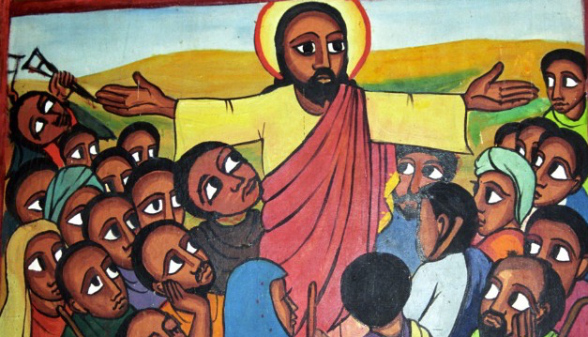
And crowds were curious. They were drawn to the life and love they saw in Jesus. They were attracted to this good news of freedom and hope, of peace and healing. And yet, they were vulnerable.  They were harassed and helpless.


Icon found here

And Jesus looked on them - and we see in him emotional at the very dept of his being; a physical sensation that leads him to act. We are to look on the world as Jesus looked on the crowd: to be moved with gut-wrenching, heart-stopping, all-consuming love. We are to be jolted out of complacency or disconnection - and to see them with love.

These sheep - God’s flock - were harassed and helpless; scattered, stressed, vulnerable; crying out with hurt and longing.  In need of compassion and hope. We are to see each other differently, with the eyes of Christ; to respond differently with the love of Christ. 

There is longing and the season is ripe. Jesus responds to the crowd at the level of authentic human response; he will pour out love for them and us, going to the very depths of suffering and death to bring new life. 

Jesus sees their need and also calls others to pay attention. To see what is happening - and to listen to human cries and to obey God’s call. 


Image found here

And they followed him; and he called them.  And as we hear their names, we know that they like us are not perfect. There is humility in this list - we know some of the details of their lives: they were stubborn and argumentative; they were ambitious and misunderstood; they denied and betrayed. 

Yet these flawed human beings, like us, are capable of extending great love in our gestures - small, persistent and effective. And yet, they too are sent: they are sent to share the same space as Jesus. They too are to walk the land; they share is vulnerability and poverty; they share the journey and the resting places. They will face opposition and will raise others up.


They go and they make known a kingdom. Not only do they speak words of love and kindle hopes for justice; they bring the kingdom near. 

There are tangible signs of release as people are restored to dignity; as of healing breaks in. There are tangible signs of promise, as mercy is extended to those who have suffered; signs of hope as penitence is met with forgiveness. 

What will it take for the kingdom to come near today?
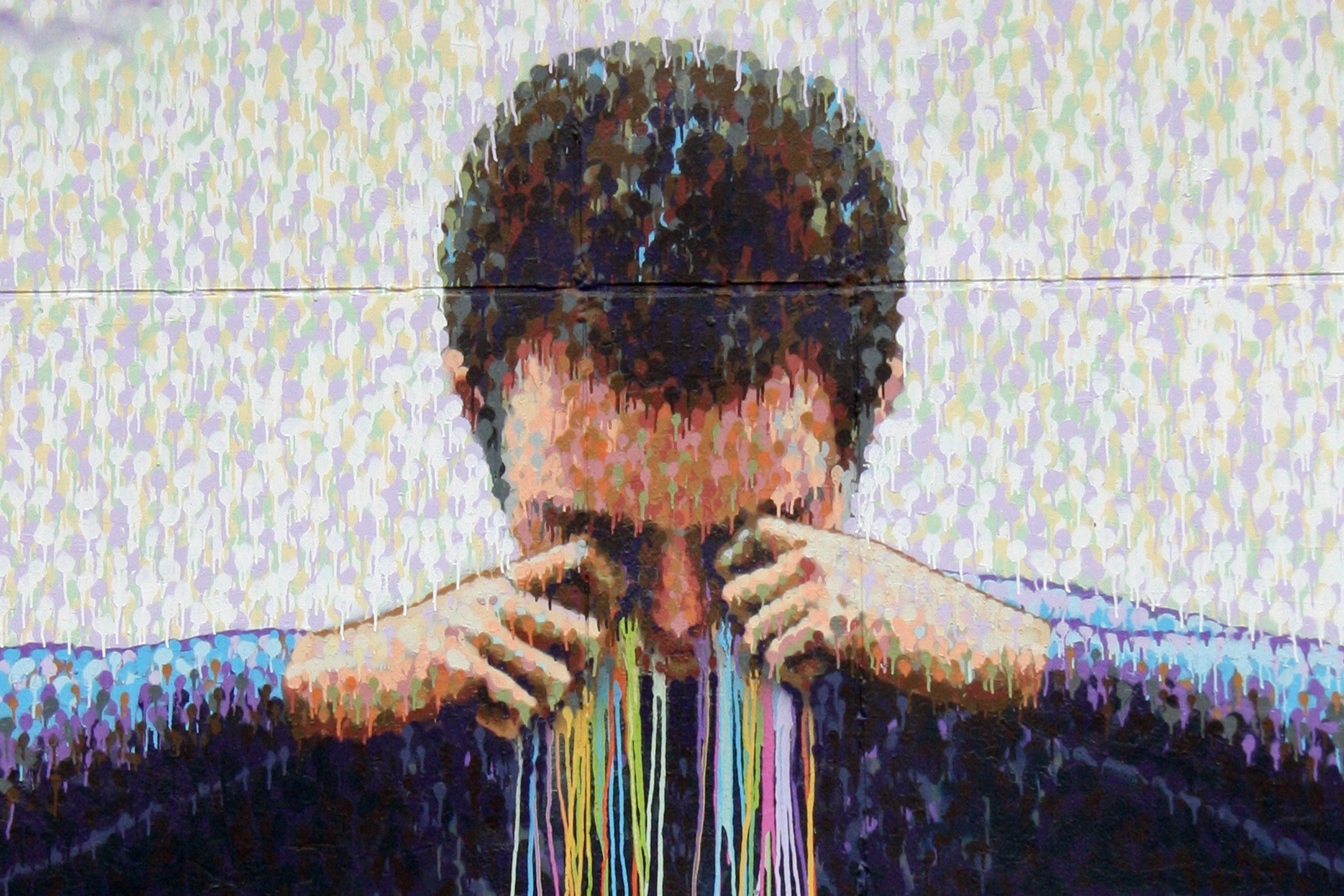


Image: The Artist's Tears - Jimmy C (James Cochran)

Do we see those holy tears? 

Tears of how racism has impacted on the identity of individuals; or how as whole we are less than we might be because of the exclusion of some. Tears of social and economic inequality - which means some bear the disproportionate impact of lockdown; which means as a society we suffer. 

Tears of repentance as we seek to learn, to listen to understand and to be better stewards of this kingdom. A kingdom which speaks, in the empty, desolate and vulnerable places of promise; a kingdom which speaks in the corridors of power and the places of plenty, of justice and peace. 


Image found here

But we have this treasure in clay jars: the frailty of our human nature demands a constant recalling to the claims of the gospel for creation; for the raising up of others to new life; and a gentleness in understanding ourselves and others. We have a gospel to proclaim; a way to walk in; a kingdom that is near to us. 

Miriam Therese Winter:

Be bold in the claiming of the gospel for the whole creation. 
Be brave in the lifting up of the life of God in every place.
Be firm in carrying the holy name of Jesus Christ into the place of worldly power.
Be gentle in the understanding of ourselves and one another. 
And may songs of the Creator sound with love in all the earth,
the tenderness of Christ Jesus cover the wounds of the people
and the truth of the Holy Spirit rise free in every age. Amen. 


© Julie Gittoes 2020

Sunday, 31 May 2020

Singing the Lord's Song

Earlier in May, I was asked to speak to the clergy in Two Cities about worship in the 'exile of lockdown' with a line from Psalm 137 as the title. I spoke in three parts - with some space for reflection in between. Psalm 137 has a powerful cultural hold on our imaginations; but it's a complex and challenging text. What song might we be called to sing? What are the cries we hear in the world that we are to respond to?

“How can we sing the Lord’s song in a strange land?”
Worship in the exile of lockdown.

PART I


Before I begin,  thank you for inviting me to be with you. Like each of you, I’m still trying to navigate our pattern of worship.  In the immediate crisis demanded responses that stabilised our communities; we’re moving to a longer term pattern of sustain our worshipping life, alone and together.

Edging onto our horizon are the post-lockdown questions. It’s going to look different for each of us. Where I, where we, ended up is shaped by our congregations and households, by the tech and resources available. But what we do, is part of and in support of the whole.

Today isn’t about dichotomies of domestic or public; in a strange land, we might be surprised by the sacred moments. However we worship - word or sacrament or both - forms us as the body of Christ; a body that is whole, because of its many parts - worshipping across the blurred boundaries of being gathered and scattered. That body exists in and with and for our world - and it has a sings a song of lament, praise and generosity; of protest, goodness and passion. Song is expressed in our body language. 

What did we start that was crisis specific - or what do we see has promise for the future? What did we stop doing and will now let go of; perhaps it’s clear that there are  things that we need to pick up again?

The title of this talk is a line from Psalm 137  and over the next hour we’re going to use that as the hook to think about worship in the exile of lockdown. Alongside listening to scripture with the ear of our hearts, there’ll be space to be attentive to the cries of our world.   This double attentiveness is at the heart of worship: attending to God and to our world: we do it in our liturgies all the time.

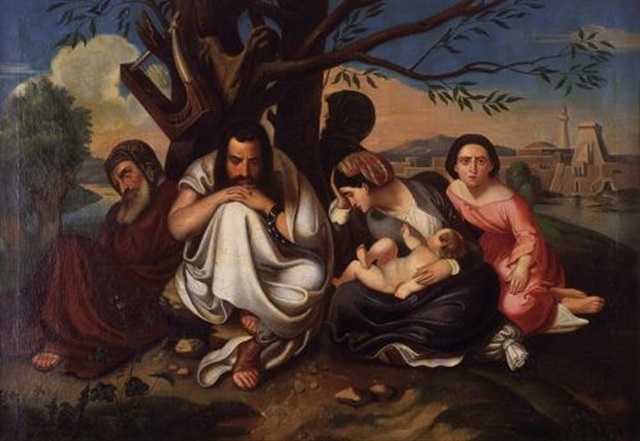
This double attentiveness might give us a fresh perspective on how we manage expectations - for some may not be returning to church, but will be worshipping at home; some will struggle to contemplate worship without singing; all of us will bring the marks of this rupture - longings, anxieties, traumas and hopes. Perhaps, like this painting, hope is cradled in the tiniest body; while we shift between watchfulness or tiredness. 

Each section will begin with song: reminding us of the cultural hold that Psalm 137 has on us; then there’ll be images/reflections and chance to talk. We’ll end with a blessing, which might be the most powerful song we’re called to sing in this strange land. First, I want to share this song:


That might be a surprising place to start in this first section thinking about scripture.  One writer has called this psalm ‘poetic catnip for composures’. We could have opened with Bach or Dvorak or Verdi. But it does express something of the psalmist’s passion and hope. It deals with music - there’s a pathos and passion, and a desire for change.


What is this land - how do we map its strangeness through the lens of this psalm?

It’s a psalm that deals with what to remember; what to forgive; how to seek justice. 

It’s a psalm which is situated in a very particular experience of exile: captives mourn for Jerusalem and captors mock them in asking for a song. 

Here exile is experienced as catastrophe; not just the sort where the people’s relationship with God is rethought; but one where fantasies of vengeance are expressed. 

We can’t leap to thinking about worship in exile without appreciating that it is an uncomfortable and painful crucible. Exile might highlight the preoccupations with our ecclesial inner life; it reframes questions of access - physical and digital; it exposes fault lines diversity and equality across age and wealth, race and health; it forces us to re-learn our body language of care as we minister to those needing food and in the absence of touch.


God’s people continued to sing their sacred songs in exile. We too have found many ways of worshipping is this strange land. Sacred songs are sung - individual voices woven together in multi-tracks; lips moving, mics on mute, as hymns are sung alone yet with others.

The strange has become familiar: confidence is renewed as we adapt, hope of renewal breaks in as we see the ‘likes’ drift across the screen.

But it has also forced all sorts of separations between people; between people and places where stones are made holy: that can be painful and alienating, especially as we notice the absent and disconnected ones.


The streets of this  diverse, unequal, vibrant and ancient city have emptied; but nursing continues; shelves are staked; refuse collected; and many more will be returning to work.

At its best, worship in exile might increase engagement with those who’re curious and deepen the faith of those who’re praying at home; but however much might new and exciting, let’s not forget we are still haunted by the shadows of sickness and death. 

Who’s cries are we hearing in this city - as beloved to us as Jerusalem; and in places perhaps just as sacred?  

Who are we uniting our cries with in our worship - those struggling to home school and those for whom home isn’t safe? 

And how do we take them up in worship?


PART II


Collection of images from The Handbook: Chasing rainbows

Rainbows adorn windows and pavements. As London stands together, we offer gratitude and appreciation; we name front line staff and those they care for; we consider how we keep others safe. Yet for us, rainbows also signal a covenant; a promise. It’s a hope that is renewed in our worship; out lives are a living out of that hope - for the sake of our world as we seek God’s Kingdom.

My late supervisor Dad Hardy wrote of the way the light of God was refracted in the world in a band of colour. Part of our calling it to attend to the radiance of that light in worship; but also to attend to its refraction; to the rainbows straddling our city: where are do we see glimpses of grace in kindness to strangers; where are we alongside those for whom this exile heightens anxiety?

Reading Scripture’s in the power of the Spirit - including psalms like 137 which gives voice to being silenced and vividly expresses anger - we rediscover who we are called to be.  It is a psalm of maturity as all that troubles us is handed over to God in hope. We learn afresh something of God’s ways with the world - as our hearts turn towards forgiveness and we become agents of justice. 

Next clip is from Mad Men. Rachel has just told Don to look up the meaning of utopia. It isn’t the idyll he imagines, as king of his own kingdom. It’s a non-place. And we hear a familiar song - across the montage of a familiar landscape. 


What are the cries of heartbreak and isolation we hear? Those who’re feeling trapped or whose world has suddenly shrunk; those who realise they cling onto the kingdoms they’ve built?

In this strange land those cries mingle with our worship: lost income and domestic violence; distanced funerals with unexpressed grief; or teenagers missing markers of exams and proms. 

This exile is experienced in different ways: a loss of place and of people. There is a sense of exile from churches; and a longing to return to them. But our exile is also a scattered one - our gathered community is dispersed with phone calls and zoom mitigating that sense of loss. In this exile others are also wanting to hear the songs that we sing - not as mocking captors but as those looking for a glimpse of hope or belonging.  


And as doors begin to re-open, this particular exile to a strange land doesn’t suddenly end. There will be some re-building or reshaping;  what we continue and what we let go of will be demanding. And not all will be able to return. 

In exile the psalmist knew that there was grief; a sense of being helplessness and bereft. That will be true for our churches - our holy people and our sacred places. But the exile in across our city also brings fear of abandonment or a loss of dignity - as people live in isolation or worry about work.

In exile, there is also a new resolve. Memories and hopes aren’t taken away in this displacement; God’s promises remain a source of hope and truth. Our worship becomes not only the still point of our our lives, but an act of defiance: there is still a deeper meaning and purpose in what it is to be human for God is with us. Nothing can separate us from the love of God - even sickness, disruption, exhaustion and fear. As Paul says, God is for us in this too. 

One of the markers of this changed season for many people is a new appreciation of the dawn chorus; and of birdsong throughout the day. Our worship also calls forth a faithful tenacity: to endure; remembering who we’re called to be; and continuing to turn outwards towards others in loving service.


Enduring this exile challenges us to embrace our calling - our identity - as the body of Christ in new ways. Even if we return to our buildings, we are still in a strange land. This extended period of having to be imaginative in our worship - finding ways to draw people into praise and lament, glory and hope whilst acknowledging separations -  is demanding.

But even in this strange land, we the scattered church is formed and nourished in order that we can continue to live and serve, breath by breath over this extended and difficult interval.  The gifts and skills we have are consecrated, blessed, set apart for the sake of others. 

For Mad Men’s Don Draper, some thing had to change in the levels of disconnection and misdirected desires. If our worship is about reconnection and directing our desires to their right ends, then that song is both distinctive and compelling.  Our song - our lives - might become as noticeable as that dawn chorus. 

One of the gifts of this exile is that for all of us, our homes have become more keenly places of prayer and worship. If habits developed cultivated over 6 to 8 weeks are likely to endure, then what a gift as we continue to worship in this strange land.


One of our teachers in this might be the scholar, spiritual director and mystic, Evelyn Underhill. Over her lifetime, she was able to bring the riches of ancient texts to a wide audience. She did so over a time of upheaval - during and between two world wars. Her focus is immensely practical; her desire was to communicate in plan and untechnical language how we might participate in and experience the reality of God’s love. 

In a short book, simply entitled Abba, she explores the nature of the incarnation is explored with reference to seven clauses of the Lord’s Prayer. Perhaps you’ve encouraged people to say it as they wash their hands, as a prayerful pause or spiritual song,  rather than singing happy birthday! Underhill awakens in us an awareness of its beauty. 

It’s a beauty born of searing honest. It’s honest about our human situation - our dependence yes, but also what she calls the ‘twisted, thwarted and embittered nature’, the state of sin [p. 9]. But it is also honest about the nature of God - who rescues and supports us ‘coming to our help right down in the jungle of life’ [p. 9] as the Infinite stoops down to the finite.

Her exploration our physical and spiritual hungers and the symbolism of food leads us to the Eucharist as ‘the crest of a great wave; a total sacramental disclosure of the dealings of the Transcendent God with men’ [p. 59].  It is the crest of a wave, for Jesus’ ministry is vividly marked by moments of feeding - from the first temptation to the practical compassion of the feeding of thousands; in midst of the hospitality of homes, Jesus is there are guest and host; and at Emmaus the Holy One is known in the breaking of bread. 

Might it also be the crest of the wave for us in our worship - whatever form our spiritual communion takes. For our worship remains disrupted, offering and taking, blessing and breaking; Christ’s body is given for us; across time and space, Christ is with us as those who have and who will touch and taste the graciousness of God.

For Underhill, one response to Christ’s sacrifice was intercessory prayer: standing before the love of God with the needs and cries of the world on your heart. Perhaps this is part of the song of our worship that we are to sing out. 

For our prayers also orientate us to the future; of a world transformed. For Underhill, the kingdom for which we pray is announced by Christ ‘by the quiet action of a flawless love giving back to our lost tormented planet its place in the orchestra of heaven’ [p. 37].

That is an extraordinary and powerful vision: it’s the prayer of the rainbows we see. A expression of hope in worship as we cross onto God’s side; dedicating ourselves to God’s purpose. 

May our song, in this strange land, be one, in Underhill’s words of ‘love transfiguring the whole texture of life’ that includes our status and position; a very different - perhaps also a more humble church - at the heart of God’s kingdom. 

What is the chorus the world hears?


PART III

The musical Godspell is structured around Jesus parables; and in clip we’ve just seen, Jesus breaks the bread and shares the wine, telling his followers that they will dine together in the Kingdom of Heaven. 


We’re drawn back to Psalm 137. This time it is tinged with farewell and sacrifice as Jesus asks his companions to watch and wait and pray. 

He asks that they wait for him as he goes into the Garden of Gethsemane to pray.   
The ending has been criticised for the lack or ambiguity around the resurrection; and yet, it is full of love and faith. 

How might our worship in the midst of this crisis bring hope of healing?

The Eucharist draws us into a moment of betrayal in the light of resurrection; we sit and eat knowing as penitents who are restored. In this scattered interval - of multiple exiles in a strange land - we are being invited to live this gift of life more fully.  This Eastertide, for some of us, it might feel as if we are still walking the road to Emmaus. 

What if, singing a song in this strange land, actually means stretching our social imaginations too?

It’s a time when we are being confronted by limitations and trauma; our bodies, united in Christ’s body, remain susceptible to suffering and need to be cared for as well as caring for others.  It takes us back to another song. The Magnificat. 


It is a song which bursts forth on the lips of Mary as she is greeted by Elizabeth  the world around us in this city is also changing: disease isn’t the great leveller. It demands of us a new a new song; and a new world.  

Mary and Elizabeth share a moment of intimacy. It’s a moment which reflects the hopes and promises of all the ages. It’s a moment of greeting and blessing, of recognition and joy. It’s the physical proximity we crave; yet it echoes in our virtual conversations by phone, or zoom or letter. 

There is awe and wonder, joy and dignity. The name of their Lord is on Mary’s lips; promises of God are being fulfilled.  Words of praise and gratitude overflow into a song of hope and radical change.  This is worship.

We make her declaration our own song:


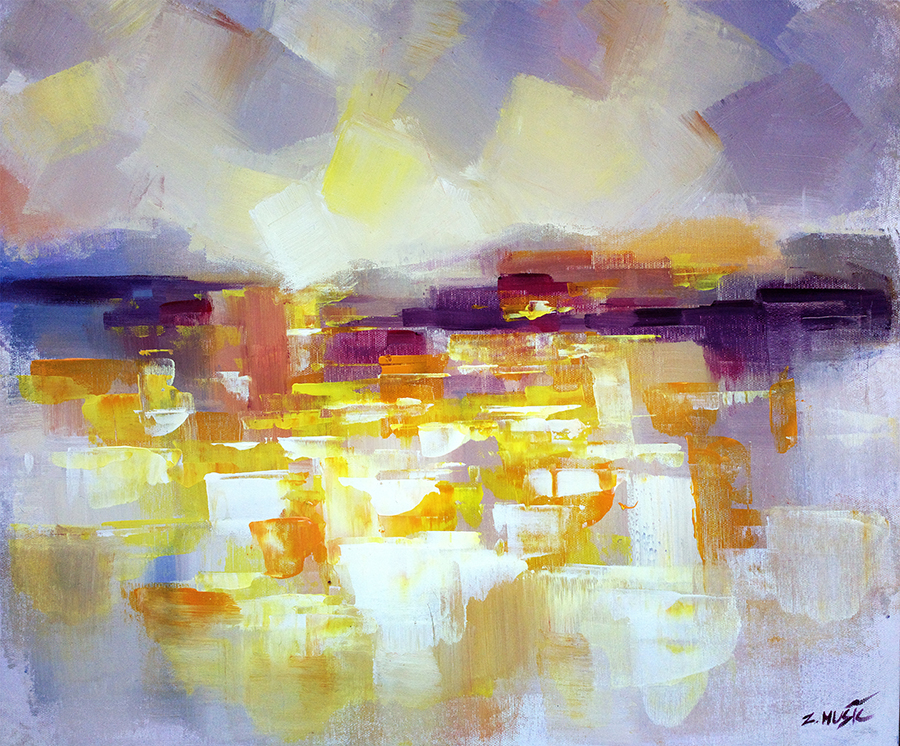
Image: Zlatko Music 


We make it our own because like Mary, we when we draw out the consequences for the world. The one whose name is holy will make known mercy from one generation to another. And mercy is revealed in deliverance from poverty, exploitation and domination. 

Mary - this determined, trusting, courageous and joyful woman - makes the voice of the prophets her own. 

Her song is a powerful declaration of what salvation looks like: relationships are transformed, imaginations are renewed and resources are redeployed.  This song calls us to embody the compassion and justice of God; the flourishing of the whole of creation is a promised fulfilled in the pursuit of equity.

We are to make Mary’s song our own - committing ourselves to feed the world and banish fear; embracing the lonely, vulnerable and fearful; challenging those gifted with economic and social capital. 


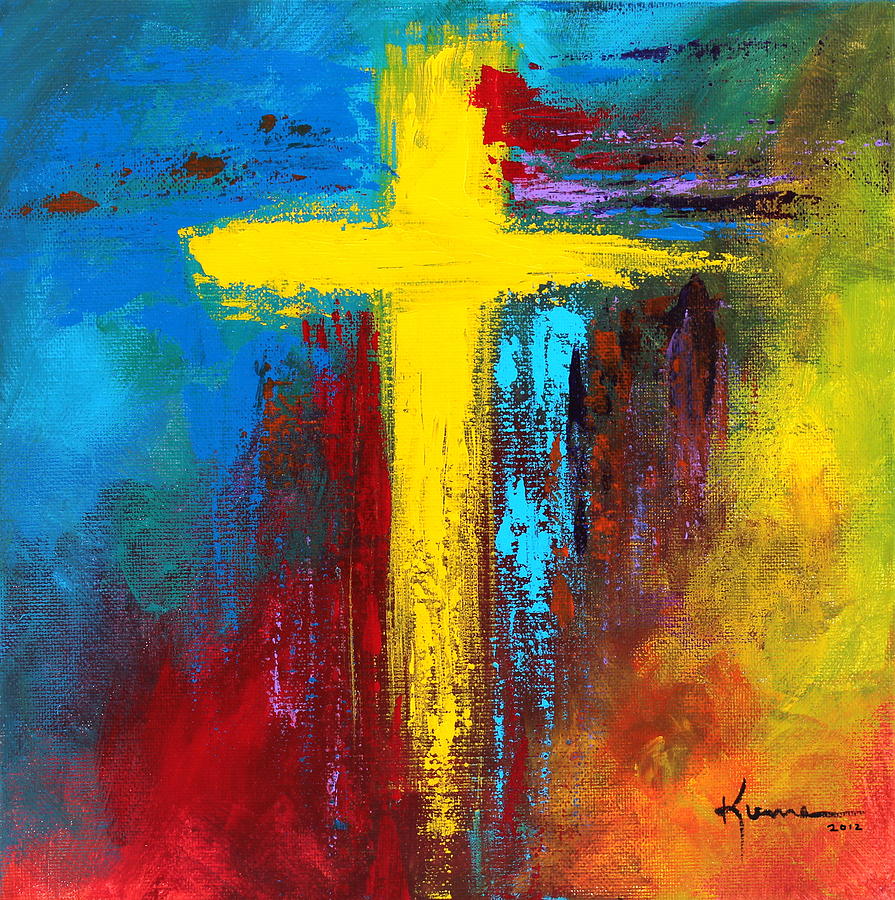
Image: Kume Bryant 

It’s a song sung in the light of the cross. 

As the world cries out and as cries are heard.

The body Mary carries in her body is God with us. That body will teach and heal, console and provoke. That body will be beaten, mocked and lifted up on a cross. That dying body destroys death and brings new life. In broken bread, we are fed, restored and strengthened by his body; we become his body, receiving dignity and purpose. 

We too, as a body, walk this way; we improvise on the themes of our worship as walk In Crosslight Now. That phrase is taken from the title of a poem by Micheal O'Siadhail - it speaks of intensity of friendship and finitude; it speaks of gratitude and care, of gestures and utterances. The small and things we hoard of love: A radiance / I've wanted to word but can't. He speaks to of the fractured voices of humanity. These things make up world's cry; and our song.


Image: Angelica Sotirious

We sing out in places of vulnerability and fear; we stand in solidarity with suffering and anxious. As his body we cry out for those seeking healing and hope; we act of those seeking justice and peace. May our lives be blessings of love.

Some truths aren’t self-evident; some we only learn in a strange land; some we only learn in the crucible of worship. They are written with the Spirit of the Living God; written on human hearts formed within Christ’s body.

Can we word the radiance of our worship on this road?

Can we hear the fractured voices of humanity - and speak a word, an utterance, a gesture of love?


© Julie Gittoes 2020