Tuesday, 25 December 2018

Crying out in song

The text of a sermon preached at the Cathedral Eucharist on Advent 4 - reflecting on the ubiquity of Christmas songs and the way that music can hook us back into childhood memories or cultivate a sense of community. It's Mary's song which takes centre stage. It's family words challenge us to think about the cries of our world and our part in singing God's song of justice. The readings were Micah 5:2-5a, Hebrews 10:5-10, Luke 1:39-45 [46-55 sang by the choir]

December is the season, more than any other month of the year, when our lives accompanied by a communal soundtrack. The Christmas classic is as ubiquitous as tinsel, mince pies and festive jumpers.



Supermarkets set the ‘Christmas vibe’ as play the sentimental schmalz of Bing Crosby’s ‘White Christmas’, and the harmless cheese of Chris Rea ‘Driving Home for Christmas’; the Jackson 5 accompanies the last minute trolly dash with the up beat ‘Santa Claus is coming to town'; we leave to the bell-chimes of Wizzard's ‘I wish it could be Christmas every day’.

On an overcrowded, late running last train, there’s a spontaneous sing-a-long of Mariah Carey’s ‘All I want for Christmas is you’, enthusiasm turning to awkwardness when no one knows all the words; church choirs and music groups gather in their local pub for beer and carols, weaving Slade’s ‘Merry Christmas’ alongside ‘O come all ye faithful’. 

Perhaps we lift the needle to play the old vinyl of Elvis’ ‘Blue Christmas’; or, like me, find ourselves catapulted back to our childhood as Bonny M sing ‘Mary’s boy child’. 


Why do these songs get under our skin? Setting aside our inner music critic, they tap into our memories and emotions. When it’s cold outside, Christmas songs remind us of home; of warmth of friendship and community.  

But there’s complexity too. The songs which put a smile on our face are also the ones which express our loneliness and or the personal heartbreak of  Wham’s ‘Last Christmas’.  Others convey and urgency of protest; weaving together hope for change and calls for action. 

The Band Aid single ‘Do they know it’s Christmas time?’ remains as challenging as it was in 1984. Simon LeBon sings  ‘But when you're having fun / There’s a world /outside your window /And it's a world of dread and fear’. Can we feed the world?

Music is fundamental to celebration but what we sing shapes our hearts and minds. Our scriptures are full of songs of praise and gratitude, lament and protest; justice and hope; they express our human responses and invoke the promises of God’s Kingdom.

Today we are drawn into the intimacy of a precious moment between two women; a moment which has been taken up in our own songs and praise. The angel greeted Mary as full of grace; Ave Maria, gracia plena. Now Elizabeth calls forth blessing; Benedicta tu. Blessed are you; blessed is the child you carry.


Mary journeyed from Nazareth to the remote hill country to give and receive kindness and affection. These woman in their first and second trimesters, share the same hopes and anxieties; the same physical changes and sensations of pregnancy. And in the midst of the expected gift of life, there is immense delight, excitement and energy. 

Elizabeth and her unborn son are responding not only to the presence of a beloved younger woman. The Spirit is moving in the face of human recognition to prompt them to rejoice in presence of God. John leaps in utero at the nearness of Jesus in Mary’s womb. There is awe and wonder, joy and dignity. The name of their Lord is on their lips; promises of God are being fulfilled. 


But words of blessing and trust, fulfilment and joy are not the end point. For on Mary’s lips, words of praise and gratitude overflow into a song of hope and radical change. 

We make her declaring our own as we sing or say the Magnificat every day at Evensong: Mary gives thanks for what God has done for her and she expresses God’s generosity towards her. But she goes on to draw out the consequences for the world. The one whose name is holy will make known mercy from one generation to another. And mercy is revealed in deliverance from poverty, exploitation and domination. 

Mary - this determined, trusting, courageous and joyful woman - makes her own the voice of the prophets. The poor are lifted up and the rich sent away empty; the hungry are filled with good things and the powerful are brought down.  

Her song is a powerful declaration of what salvation looks like: relationships are transformed, imaginations are renewed and resources are redeployed.  This song calls us to embody the compassion and justice of God; the flourishing of the whole of creation is a promised fulfilled in the pursuit of equity.

We are to make Mary’s song our own - committing ourselves to feed the world and banish fear; embracing the lonely, vulnerable and fearful; challenging those gifted with economic and social capital. 

The prophet Micah denounced dishonesty in business and superficial religion; he challenged the abuse of power and the exploitation of the poor.  He looked forward to a time of peace - when we could set aside our reliance on military might and the false gods of wealth.

And foretold that this work of redemption would begin in a small place; in a city which was home to a small clan. In Bethlehem, this marginal place, blessed Mary will go into labour. In this city her firstborn child - God’s own beloved Son - is born. 

Peace breaks in in the cries of an infant; in a babe at his mother’s breast.

Blessing is found in the fruit of Mary’s womb.

We are blessed by God’s love dwelling with us in flesh of our flesh. 

We bless as we become receptive to that gift, and channel that love.

Our world cries out for that gift of peace and love: a world of universal credit and food banks; a world of environmental degradation and refugee crises; a world of homelessness and zero hours contracts.

Our world cries out:
His name was Gyula Remes: aged 43, a Hungarian national working as a chef’s assistant; there was no space for him in a hostel. He died at Westminster Tube Station. 

Cries are heard:
The baby has no name yet, rescued at two days old from a boat carrying 311 migrants off Malta. The mother is only 23; fleeing in hope of a better future; trusting in the immediacy of medical assistance. 

We cry too:
Like Mary, we sing songs of praise and protest, hope and vision. We make her joyful song about God’s with boldness and tenacity.

We respond to cries: singing increases our capacity to act; the Spirit strengthens us to seek justice, compassion and peace. We commit to Mary’s manifesto of struggle and change with hope and courage. 

The body Mary carries in her body is God with us. That body will teach and heal, console and provoke. That body will be beaten, mocked and lifted up on a cross. That dying body destroys death and brings new life. In broken bread, we are fed, restored and strengthened by his body; we become his body, receiving dignity and purpose.

We sing out in places of vulnerability and fear; we stand in solidarity with suffering and anxious. As his body we cry out for those seeking healing and hope; we act of those seeking justice and peace. May our lives be blessings of love.


© Julie Gittoes 2018

Sunday, 16 December 2018

Not a Crazy Cat Lady

Last week, I was preaching at Choral Evensong for Advent 2. The story of Zechariah and Elizabeth drew my attention to what it is to be childless - through choice or circumstance. As Carole Cadwalladr reflected on the comments made about her being a mad cat woman, I reflected on how such judgemental stereotyping continues to silence or belittle women. It's not something I've named in the pulpit quite so explicitly as on this occasion, but it felt timely and pertinent. The texts were Isaiah 40:1-11 and Luke 1:1-25


Carole Cadwalladr (pictured left from The Guardian website) is an accomplished British investigative journalist and features writer. Earlier this year, she won the Orwell Prize for her reporting of the impact of ‘big data’ on the EU Referendum and the US Presidential Election.

She’s a woman who knows the power of words to communicate and challenge; to question and persuade.

She’s a woman who found herself on the receiving end of words which wound and damage. In the early hours of a November morning, Andrew Neil used a few key strokes to type out and send a Tweet calling her a ‘mad cat woman’.


It’s a familiar stereotype: the more mature women, living alone, who has a cat or cats. As Carole puts it ‘it isn’t a harmless animal lover with freethinking views; it’s a woman who’s outside acceptable society. Who doesn’t conform to conventional norms’. 

In the twenty-first century, is being a middle-aged woman, without children, to occupy of the last bastions of seemingly acceptable prejudice?  

Is the ‘crazy-cat lady’ an example of using stereotypes to cast judgement or shame women into silence? As a society, do we still see woman who’re childless through circumstance as to be pitied for avoided; do we see those childfree by choice as somehow ‘unnatural’ intimidating or too fiercely independent?


Or is there a sense that such women hold up a mirror to our own fears; fears which lurk around the edges of consciousness: fears about ageing or being lonely; fears about being isolated, with no one to care; the fear of being forgotten and the fear of death itself. 

Beyond, the stereotype of the crazy cat lady is the reality that one in five women in the UK has turned forty-five without having had children. These women - and men too - find themselves living the life unexpected; moving beyond disappointment and grief to find meaning, purpose and fulfilment. 

Our scriptures are echo with the cries of those who long for a child of their own. And in this season of Advent, it is in the lives of the childless that God chooses to witness to promise and calling beyond the scope of biological kinship.

We hear of the faith of Abraham and the laughter of Sarah; the wordless prayers of Hannah and the confusion of Mary. Today we hear of the Zechariah and Elizabeth who are both getting on in years.  

Luke sets out an orderly account of the events which have been handed on to him - by eyewitnesses and following his own investigations. He does not spare us the tragedy of this human situation.

He presents us with a couple who were devoted to each other; and also devoted to God. They had lived out the commandments in faithful love and dedicated service. But they had no children. 


‘Sons are a heritage of the Lord', writes the psalmist, and ‘the fruit of the womb a reward’. But for Zechariah there was no son to join him in the priestly oder of Abijah, no hope in his old age; for Elizabeth, there had been no children to teach, no grandchildren to take by the hand. 

Despite this apparent lack of blessing, there is no hint of bitterness in Luke’s account of their character. This couple might be aged and barren but their lives were not unfruitful. For we find them at the heart of the Temple - the place where God’s people gathered to draw near to the holiness of the divine presence. We find them living out the promise of the law with gratitude, service and love. 

In this place, the horizon of life is extended beyond old age to the breaking in of a new age. 

In this seemingly barren place, there is a depth of attentive and faith waiting which speaks of new hope.

In this place of patient prayer, God is present, preparing hearts to receive afresh promise and blessing.

God chose Elizabeth and Zechariah to nurse and nurture John. He was not a child to bring comfort in the old age; but a child who would speak words of comfort to an entire nation. 

His parents will know joy and gladness because John will speak powerful words which will bring healing. Human hearts will opened; relationships will be restored. 

Just as Elizabeth and Zechariah walked in the ways of righteousness, their son will invite others to place their trust in God; recalling them to those paths of wisdom and obedience. 

Luke’s orderly account reminds us that in the most ordinary of circumstances, God addresses us by name and invites us to live the life unexpected. 

Perhaps we feel as unlikely candidates as Elizabeth and Zechariah; we still trust in God but we’re uncertain as to what the next season of our life will bring.  

Perhaps we feel as if we are exhausted, stigmatised or in some way ‘past it’; perhaps we’re feeling overwhelmed or fearful.

Or may be the fact that we’ve already endured much is opening up in greater capacity for resilience and altruism. There is nothing to lose - because in small gestures of care, in smiling at the stranger, or an act of kindness, joy and blessing are multiplied. 

In the midst of all this, God releases us from the stereotypes of the judgements of others.

We won’t be seen as crazy cat ladies or ruthless careerists; grumpy old men or broken hearted widows; as snowflake millennials or middle-class consumers.

We are released from such stereotypes when come before the loving mercy of God - who knows our heart-breaks and our dreams; our potential and our fragility.

John stands in a long line of prophets who seek to bring comfort to God’s people by restoring of vision of what is possible; by challenging us to walk in ways of justice and mercy; by opening our hearts to reconciling love.


Zechariah was rendered speechless by the fulfilment of God’s promise; his son cried out with a loud voice pointing us to the one who is God with us. 

The record of John is to prepare the way for our Lord Jesus: he is our God drawing near to bring us hope and healing; we are gathered together as members of his body. In him we are loved; we are freed from stereotypes and invited into new life.

However impatient our waiting and however patient our prayers, may we know the promise of his Holy Spirit leading us onwards from fear to hope; from despair to new life. The Spirit’s breathes words which silence voices of inadequacy; and quells our fears.

Prayer written by Alison Webster, as part of the Oxford Diocesan health, wellbeing and social care group.
God of compassion, 
you meant us to be both fragile and ordinary,
Silence the voices that say we are not good enough; 
haven’t achieved enough;
haven’t enough to show for our lives; 
that we are not enough.
Help us to know that we are treasure, we are prized,
We are cherished, 
We are loved. 
Infinitely. 
By you.
So be with us in our corrugations of feeling:
When our hearts are in downward freewill, be with us.
When our minds race with anxiety, be with us.
When our throats close in fear, be with us.
When sleep will not come, be with us.
When walking hurts, be with us.
In the name of Jesus,
Who knew trauma, abuse, despair and abandonment
And has nothing but love for us.

Amen.


© Julie Gittoes 2018

Tuesday, 20 November 2018

One Day

One Day

Today, members of the University of Surrey gathered around the statue of Alan Turing for a Vigil on Trans Day of Remembrance.   TDoR has been observed on 20th November since it was founded by transgender activists Gwendolyn Ann Smith in repose to the murder of Rita Hestler, a transgender woman whose case has not been solved. This day has evolved in to remembrance events across the world - which honour those people who've died as a result of transphoboic violence. Members of the Chaplaincy Team were invited to speak. This is my text - and I am deeply indebted to the poetry of Rachel Mann with which I ended my meditation. 


One day.  One day, there will be no names on the annual list.

This day,  we stand in solidarity with those those harmed by heteronormative and patriarchal prejudice. We come together to honour those we’ve lost; those who’ve died by suicide or the violence of others because of their gender identity.

One day, there will be a better and more enlightened world for us all.

Today we remember the cost of the struggle.   Although our society has grown in understanding and acceptance of trans people, headlines, columns and trans-negative language reveals we’ve got a long way to go.

One day, everyone will be free to be themselves: loved and to love as they are. 

This day, we acknowledge the harm caused by prejudice and ignorance; the trauma caused when negative messages are internalised. We renew our commitment to listening, learning and understanding what it means to be transgender.

One day, trans bodies will not be erased or controlled; their dignity, creativity, beauty, ordinariness, vulnerability and strength will be upheld.

Today, we seek to be a visible network of support and friendship; to be hopeful companions on journeys towards self-acceptance; to be advocates for people with dreams and purpose, conviction.

One day, we will sing songs of joy which celebrate the richness and diversity of human experience. 

This day, for the love of God, let trans people flourish. We seek forgiveness for past failures of individually, institutionally and relationally.  As people of faith, belief and good will we can change the world; discovering it to be more full of light and love than we thought.

One day, the body of Jesus Christ was cradled in the his mother’s arms; one day that body embraced the marginalised and rejected; one day that body was anointed with oil, and washed the feet of others; one day that body was betrayed, rejected, humiliated, bruised, beaten and buried. 

Today, in my remembrance, I recall that that body given in death is also a hopeful body; a body of new life and light. That body reminds me that we are loved, in our tender and fragile bodies. 

One day we will sing a glorious song of love. I end with a poem by Rachel Mann whose Twitter biog reads “Priest, Canon, Dr, Trans, Journo, Broadcaster and Author”:

Body of Christ

Find me when the journey ends and sun
bleeds into night; and I shall conjure spelt's
wild thunder, make bread crack and roar,
tear stories with my hands, let grain shatter and fall.

And we shall eat in the dark, mute in wonder,
understanding or not; will walk softly in fields
as if we still breathed, as if we knew company
of the dead, our dreams tremble in the dawn.

And we shall speak as if our mouths
are no longer our own; I going on ahead,
if that is what you need, learning secret tongues,
searching melodies and chords for glorious song.

These words are reproduced from Rachel's blog and formed part of a series of Good Friday addresses delivered in Derby Cathedral entitled: The Precarious Body on the Cross of Love. The full series can be found here .

© Julie Gittoes 2018

Sunday, 28 October 2018

Lessons from Catfish Row

On the Feast of St Simon and St Jude, I found myself grappling with Isaiah's challenge to place our trust in God rather than making lies and falsehood our refuge. It seemed so pertinent especially when heard in the context of Jesus' words about the world's hatred.  

But as I was writing this sermon, news of the attack in Pittsburgh unfolded. I am grateful to Paula Gooder who shared words from the Talmud on Twitter. How do we resist the hatred manifest in antisemitism? How to we testify to God's reconciling love in world which seems to intent on deathly falsehoods?  In part, by refusing to be daunted by the world's grief and showing mercy, now.

In that sense, Porgy and Bess might seem like an opening which sounds a lighter note: but this unlikely pairing echo Simon and Jude's commitment to a better world in resistance, kindness and refusing to see the other as a lost cause. There are lessons from Catfish Row.

Preaching today felt like an intense exercise of the poverty of my speaking. 


Summertime, 
And the livin’ is easy

So begins one of the most famous opening songs of any opera or musical: we hear a mother swaying to the bluesy melody.  

So hush little baby
Don’t you cry.

Around her couples sway with each other in sultry dance. It’s hot; it’s airless. The day’s long; the night’s beginning. Dice roll; money’s won and lost; tension rises. This mother keeps on singing; it’s a lullaby of parental protection.

There’s a’nothing can harm you
With your daddy and mammy standing by.

For the residents of Catfish Row such harm comes in several guises. They face the divisions of race and whiteness; livelihoods are threatened by storms; violence, addiction and exploitation are near the surface. 

And yet, on Catfish Row there’s a depth of solidarity and resistance. It’s a community which pulls together; which mourns and laughs together.  It’s a community which calls boldly on the name of Jesus; where cynicism about religion is chastised. 

It’s a world where people rise up singing. 

Then you’ll spread your wings
And you’ll take to the sky.

This lullaby is no whimsical folk song; it’s a call to struggle, liberation and hope. 

This is the world, if you’d not guessed it already, of Porgy and Bess. 


When Bess’s drunk and aggressive partner abandons her, it’s Porgy the crippled beggar who shows her human kindness. It’s he who protects her and gives her shelter. Together, they find happiness within community. Even when the darkness of Bess’s past haunts their present, Porgy’s love determines not to let her go.

We don’t know the end of the story but Porgy and Bess leaves us with broken silences: there story is an operatic cry for justice. Decades before campaigns such as #MeToo or #BlackLivesMatter, the songs they sing rise up against sexual abuse and racism. Through their eyes we see the ways in which human agency and dignity can be diminished; and we glimpse, albeit fleetingly, the power of love. 

Porgy refuses to write Bess off as a lost cause.

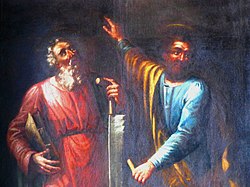
Today we celebrate the witness of a different pairing: Simon and Jude. Though we know little about them, like our operatic duo, they teach us something about both prophetic resistance to oppression and the refusal to see people or situations  as irredeemable.

Something in Jesus’ words and actions resonated with them: the challenge he represented to the powerful, his preferential treatment of those on the margins, his teaching about self-giving love, the way in which his touch brought healing, restored dignity and formed community.


Simon and Jude

Neither Porgy and Bess nor Simon and Jude are under any illusion about the impact of the choices we make on ability to flourish and grow in trust.  

Isaiah makes this contrast in stark terms: when we collude with falsehood and lies, we sign a contract with death. Lies which tell us who to blame, who to mistrust, who is drain on the system; falsehoods about quick wins - staking our futures on the role of the dice.

Isaiah cries out that we are to place our trust in sure foundation; to walk in God’s ways; to chose moment by moment that which makes for peace; to align our wills with justice and compassion. 

A theme picked up by Paul as he writes to the Ephesians. If falsehoods set up a series of divisions and lies generate hostility, God, in Jesus, points us to a different path. He is the cornerstone; the one in whom we trust. In Christ, we move from being strangers and aliens to citizens. 

We literally have a place. 

We have value and dignity as God’s beloved. 

Jesus’ words also remind us of our belonging in God, to each other. To become a disciples and friend and follower of Jesus is to take to heart the call to love one another. And to do that we are called out of the world - the world of falsehood, exploitation and illusions; and yet we are sent into that world, to be a presence of relentless and purposeful love.

The world is loved by God - in all its fragility and beauty. Yet within our world there are places where love is not present; where fragility is exploited and beauty ruined. Our relentless consumption of plastics causes harm within the ecosystem; our enslavement to arms continues to destroy and oppress; our hatreds and fears lead to death. But this is not the end of the story. 

The world is loved by God - in all its fragility and beauty. And the light of the world stepped down into darkness; the word of God spoke truth to power. Jesus gave his life totally in order that through his death we might have the fullness of life.  


Love wins.

Our lives, dedicated to him, are likewise given for truth and justice; to love and cast out fear.  Jesus warn this disciples that the relentless pursuit of love will mean that they too face opposition, misunderstanding and suffering. And yet, the song of that love rises up through us. Even in our smallness and weakness, life breaks in. 

The first disciples, among them Simon and Jude, said “no” to lies, oppression, injustice and abuse; they said “yes” to freedom, truth, compassion and self-giving. 

Jean Vanier, the founder of the L’Arche Community, continues to challenge and inspire us to live together in ways which embody this Christ-like love. It is not easy. 

In what he describes as the martyrdom of daily pinpricks we will sometimes be rejected or misunderstood; regarded as a threat or pushed aside; the hatred of indifference or inconvenience. 

Sometimes those pinpricks arise not from outright hostility but because the Gospel is not understood.  We must continue testify God’s love in our institutions which shape the fabric of our common life - the welfare of the poor, wisdom in education, compassion for the sick, justice for the victim, restoration for the guilty, dignity for the dying.

It would be tempting to risk compromise with a culture that erodes these values or marginalises the weakest. As Vanier says: We are fearful of speaking out about Jesus or about justice and truth. We are afraid to rock the boat. We are frightened of what people might think or do to us if we disturb them or the cultural order. So we water down faith and the gospel message. 

Our witness is not dependent on our own strength but on the gift of the Spirit: our Advocate and guide; the power of God’s love at work in us. Through the Spirit we are to testify to the truth in the name of Jesus. We are to be lights in our world. 

In the face of human prejudices, ambition and loneliness, we are to use the gifts entrusted to us to speak and act for the ultimate values of God’s Kingdom.

As we do so, we are being built on the foundations of Simon, Jude and all the apostles; Christ is our cornerstone, bearing the weight. 

In a world where a gun man attacks members of the Jewish community gathering in the Tree of Life synagogue in Pittsburgh: how does our testimony condemn anti-semitism; how does our witness strive to choose life, to grant others dignity?  

As we are built up as members of God’s household, words from the Talmud, the central text of Rabbinic Judaism:
Do not be daunted by the enormity of the world’s grief.
Do justly, now.
Love mercy, now.
Walk humbly now.
You are not obligated to complete the work, 
but neither are you free to abandon it. 


© Julie Gittoes 2018