Saturday, 15 April 2017

A crown of thorns

The second and third reflections from the Good Friday service: what do we see before our eyes as we look on power and customs, on the robe and the crown?


Power and Customs
[John 18:28-40]


Salvation to all that will is nigh,
That All, which always is All everywhere,
Which cannot sin, and yet all sins must bear,
Which cannot die, yet cannot choose but die,
Loe, faithful Virgin, yields himself to lie
In prison, in thy womb; and though he there
Can take no sin, nor thou give, yet he'will wear
Taken from thence, flesh, which death's force may try.
Ere by the spheres time was created, thou
Wast in his mind, who is thy Son, and Brother,
Whom thou conceiv'st, conceiv'd; yea thou art now
Thy maker's maker, and thy Father's mother,
Thou hast light in dark; and shutst in little room,
Immensity cloistered in thy dear womb.


1.

They took him: Those who held power and religious authority.

They took him: To one who held power of a conquered people.

Accusations have been made; he is treated as a criminal.

What’s the law, the custom, the penalty?
Who has the power over life and death?

2.

We see unfolding a clash of world views: it begins with a question ‘what accusation do you bring against this man?’

But the fingers aren’t just pointing at Jesus - but at the expectations of custom and the exercise of power.

We see the power of the occupier with the superior force of military might and a system of taxation and exploitation; a system which engendered fear, but which has it’s own fragility. 

We see the customs of the occupied with their religious practice and rituals, their beliefs and laws; with the challenge of resentment or collision and the desire for liberation. 

Is there a weakness to this power - born of rigidity?
How does it relate to the apparent stability of customs - and fear or confusion?
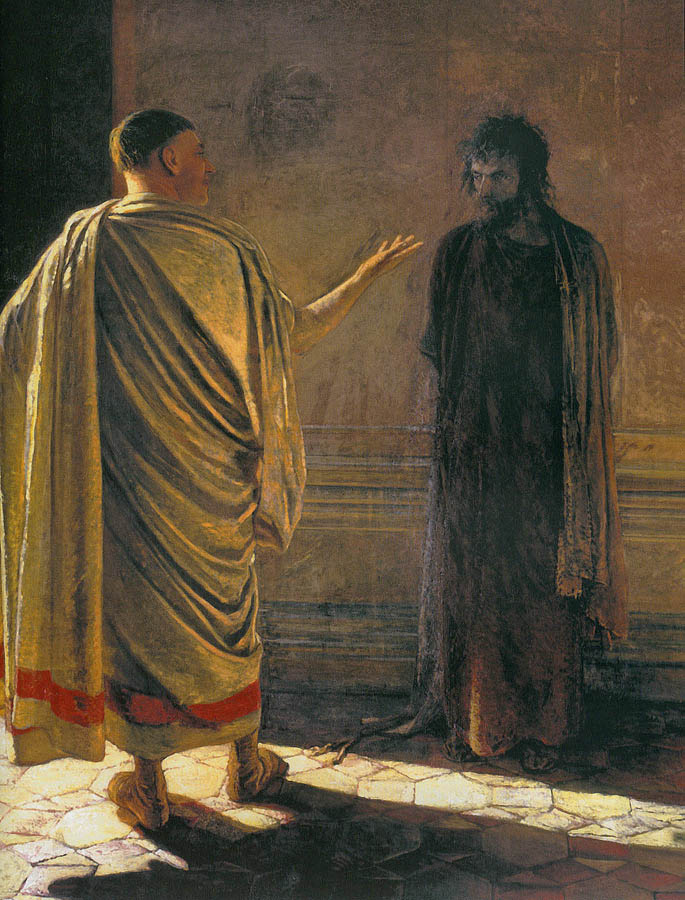

Nikolai Ge - Christ and Pilate (what is truth?), 1980.

3.

They’ve brought Jesus here because his presence is seen as a threat.

He’s the spark which might light the tinder box. The possibility of triggering a revolt would threaten the stability of custom.

What do we see before our eyes? 

Jesus’ presence unsettles their spiritual power and the social order. Not only does he raise up the poor and the broken, the curious and marginalised, but he is the Word made flesh. 

But the accusations and charges aren’t made explicit: there are assumptions about how much power understands about custom; appeals are made to power to implement custom.

4. 

The questioning becomes more intimate, more direct. Earthy power summons Jesus; they face each other

Pilate asks. Jesus replies. They speak of kingdoms and kingship.

Perhaps Pilate is trying to understand: he knows he is reliant on what others say, what he has seen of religion and custom in the place he’s been sent by those who have power over him.  Before him stands a King:

King of the Jews?
Do you ask on your own?
What have you done?
Kingdom not of this world?
So you are a king?

5.

A king who is bound, imprisoned and vulnerable.
A king of love.

A servant king who, in washing feet made  new the commandment to love.
A king who touched our wounded pride, reached beyond our defences and brought healing.

A king whose weakness communicates love made perfect.
A king of glory.


6.

The one who understands temporal and social power is confronted by one who reveals the truth. The truth of God’s love.

That question hangs in the air.

Truth.

What is truth?

7.

Truth. What is it?

The truth he speaks - the truth he embodies - is the power of love.

That heals and brings new life; which brings freedom. That message is declared by one who is held captive.

He was born for this truth: that in the face of our human propensity to sin we see God’s propensity to reach to the very depths and bring forgiveness and transformation. 

Jesus has created space for power to be challenged; for custom to be examined. 

Is it an invitation, statement or challenge: belonging to the truth means listening to his voice.

What is truth?

Pilate’s own question hanging in the air - unanswered.

We might speculate: does he want to go deeper or his he wearied by competing claims?

Does he live in a post-truth age? Where expediency and winning the argument, holding a fragile truce become more important?


When the voices of power next confront each other, we enter the realm of compromise.
Pilate finds no case against Jesus; but he hands the power of life and death over to custom. 
Who will be released:  Barabbas or King of the Jews?
What do we see before our eyes?

We face annunciation. Salvation is nigh.

The crowd yells: this all, this one who is God with us yields not to a womb but to a prison.
The one who is immensity in Mary’s womb - and she her Maker’s maker - is refused release.

This all - the alpha and omega - God with us:
Which cannot sin, and yet all sins must bear,

Which cannot die, yet cannon choose but die.


Robe and Crown
[John 19:1-15]


Immensity cloistered in thy dear womb,
Now leaves his welbelov'd imprisonment,
There he hath made himself to his intent
Weak enough, now into our world to come;
But Oh, for thee, for him, hath th'Inne no roome?
Yet lay him in this stall, and from the Orient,
Stars, and wisemen will travel to prevent
Th'effect of Herod's jealous general doom;
Seest thou, my Soul, with thy faith's eyes, how he
Which fills all place, yet none holds him, doth lie?
Was not his pity towards thee wondrous high,
That would have need to be pitied by thee?
Kiss him, and with him into Egypt goe,


With his kind mother, who partakes thy woe.


1.

Despite his conviction that there was no case to enter, afraid of the crowds power, gave into their custom.

Pilate wants to let him go: Jesus poses no threat. Perhaps he thinks he’s delusional or an idealist; a good teacher perhaps who’s getting under the skin of the religious authorities. 

And now we see the soldiers weave a crown of thorns.


2.

Perhaps Pilate had hoped to placate the crowd by having Jesus flogged.

They inflict physical harm and humiliation.

The soldiers get carried away with their mockery.  Perhaps the’ve heard the cries of the crowd and look on at Jesus and see no threat to their strength and brutal might.  

It horrifies us: this routine violence.  

Jesus stands alone. Yet he also stands with.

With those who today face degrading physical abuse: today we open our papers and see the violence perpetrated against the gay community in Chechnya; at the start of this Holy Week we heard news of violence against our Coptic brothers and sisters.

Hidden behind closed doors human beings face torture, death and domestic abuse.

The one who is God with us stands alongside them. He has spoken up for them; we too are called speak out against abuse.  Who are we called to stand by?

3.

The soldiers see his physical weakness, exhaustion and vulnerability.

Do they think him a lunatic: they take Pilate’s questioning about kingship and kingdoms and twist it.

They mock him in a purple robe; they mock him in a crown of piercing thorns; they mock him in voices of spiteful adulation.  

Hail!
Hail, King of the Jews!

They strike him again.

In this way they mock and despise him and those whom he’d come to save: the Samaritan woman, the man born blind, the Greeks at the festival, Lazarus who’d been restored to life. 

Pilate takes him and brings him out to the crowd again. 

4.

He repeats his decision: I find no case against him.

Does he say it with more or less conviction now? Does he say it with more or less fear of the crowds?

Pilate hopes, perhaps, that this is enough. That this will bring an end to a trial which he does not understand.

Here is the man! he says.

A man. Enough now, surely.

But the chief priests and police alike still cry out ‘crucify’!

Pilate had no case against him. He wants to let him go. To let him go into the hands of those calling for his death.

The final charge is Jesus’ claim to be the Son of God.

This claim made in contempt and fear and derision takes us to the truth of who Jesus is.
It’s a truth that makes Pilate more afraid than ever. 

5.


Mockery, escalating tension and provocation leads to fear and compromise. Yet Pilate doesn’t stop asking: does the word ‘truth’ still linger in the space between them?

He asks: ‘where are you from?’

Jesus remains silent.

Silence.

Pilate is caught between the logic of custom and the limits of his power: he stands face to one who is poised yet in chains; the silent Word.


What power does this silent king hold.

Pilate takes this as refusal. As a threat to power.

He knows his own power: the power to release or crucify. 

How can he understand this divine rule? A refusal to speak which becomes words of heavenly authority; words which set earthly power in an altogether different light.

Having between these two men is the weight of power: of silence and purpose; of crown of thorns and imperial might; of heaven and earth; life and death; fear and freedom.

6.

Pilate tries to release him.

He hears again the cries.

So many what ifs break in: what if he loses control… what if the crowd overwhelms him… what if he’s removed from a position of power at the edge of a fragile empire?  

Religious authority grasps the fragility of his power: his friendship to the Emperor is being tested. Yet what if he acts against justice and his own conscience; where does this lead? 

Does it lead to open conflict? Can he suppress outright threat?

Here is your  king, he says: your king; he distances himself.

Does he, like Peter, lose his identity? Is this condemnation a denial of sorts?

7.

Truth and love: an eloquent silence.

Pushed to the margins by the clamour of the crowd.

When does fear darken our world leading us to abandon what is just and true?

Like Pilate (and like the crowd) we can become ensnared by our own fears and judgments?

There is no easy forgiveness or cheap grace.

Yet the one who is in chained came as a light to shine in the darkness.

What do we see before our eyes?

Still he proclaims the truth that God is love.

Many fear him, misunderstand him, reject him, condemn him: not wanting to be changed by this love.

Unpredictable earthly power cannot silence the life and hope he brings.
His wounds bring love to our broken hearts; to our fractured world.


8.

The one who was cloister’d in Mary’s womb came into our world in weakness. 

The inn had not room; yet the wise travelled to honour him.

The jealous general doom of Herod is magnified by those in power: in palaces and crowds.

His mother kissed him then and fled to Egypt. We with her share a different woe.


© Julie Gittoes 2017

Fire and Cock-crow

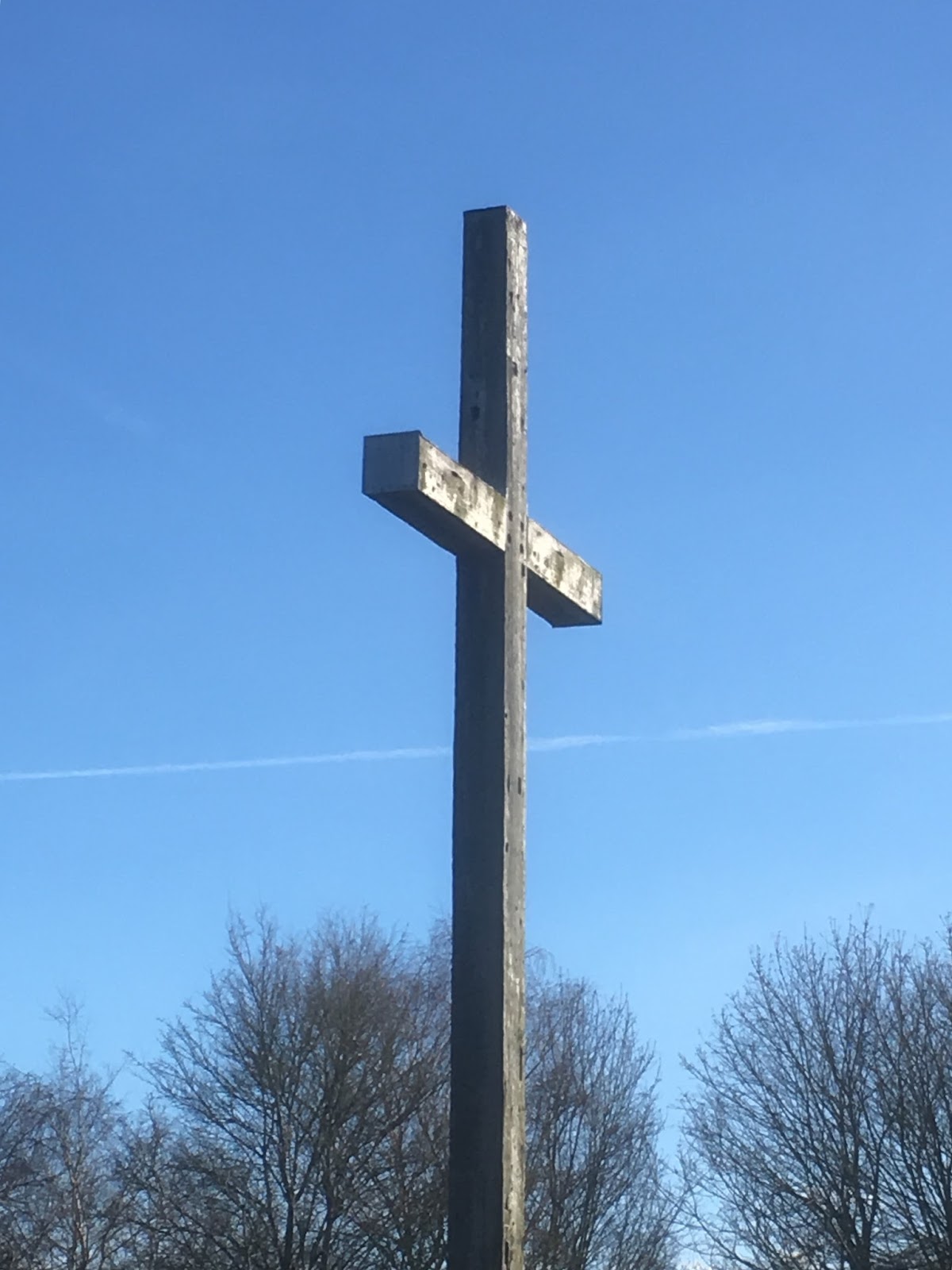
During a service of readings, reflections and prayer at the foot of the cross at St Andrew's Cobham, we focused around some of the images and themes in John’s Passion Narrative. The text of John Donne’s sonnet series La Corona were  woven into our mediation, rooting the recollection of crucifixion in the mystery of incarnation.

We moved from fire and cock-crow to power and customs; from robe and crown to wood and words; from hyssop and spear to the linen and spices. The section numbers refer to images used during the mediation which are not all re-produced below.


Graham Sutherland - The Deposition
Methodist Modern Art Collection 
https://www.methodist.org.uk/our-faith/reflecting-on-faith/the-methodist-modern-art-collection/index-of-works/the-deposition-graham-sutherland/


At the end of the three hours we left in silence; entering into this time of watching and waiting at the tomb; returning to our own homes. Graham Sutherland’s painting The Deposition reflects the reality of death; of being entombed. 

To quote John Donne's 'Resurrection' in La Corona:
Flesh in that long sleep is not putrified,
But made that there, of which, and for which it was;
Nor can by other means be glorified.

Even those who had cared for Jesus’ body after he’d drawn his last breath, are beginning to slip out of view. And yet, for all the starkness and finality, there is in Sutherland’s work, an almost light. It is neither darkness nor dazzling; a setting sun perhaps; a looking towards the break of day. The body is lifeless, lifelike and life giving. 


Fire and Cock-Crow
[John 18:12-27]


Deign at my hands this crown of prayer and praise,
Weav'd in my low devout melancholy,
Thou which of good, hast, yea art treasury,
All changing unchanged Ancient of days,
But do not, with a vile crown of frail bays, 
Reward my muse's white sincerity,
But what thy thorny crown gained, that give me,
A crown of Glory, which doth flower always;
The ends crown our works, but thou crown'st our ends,
For at our end begins our endlesse rest,
The first last end, now zealously possest,
With a strong sober thirst, my soul attends.
'Tis time that heart and voice be lifted high,
Salvation to all that will is nigh.


1.

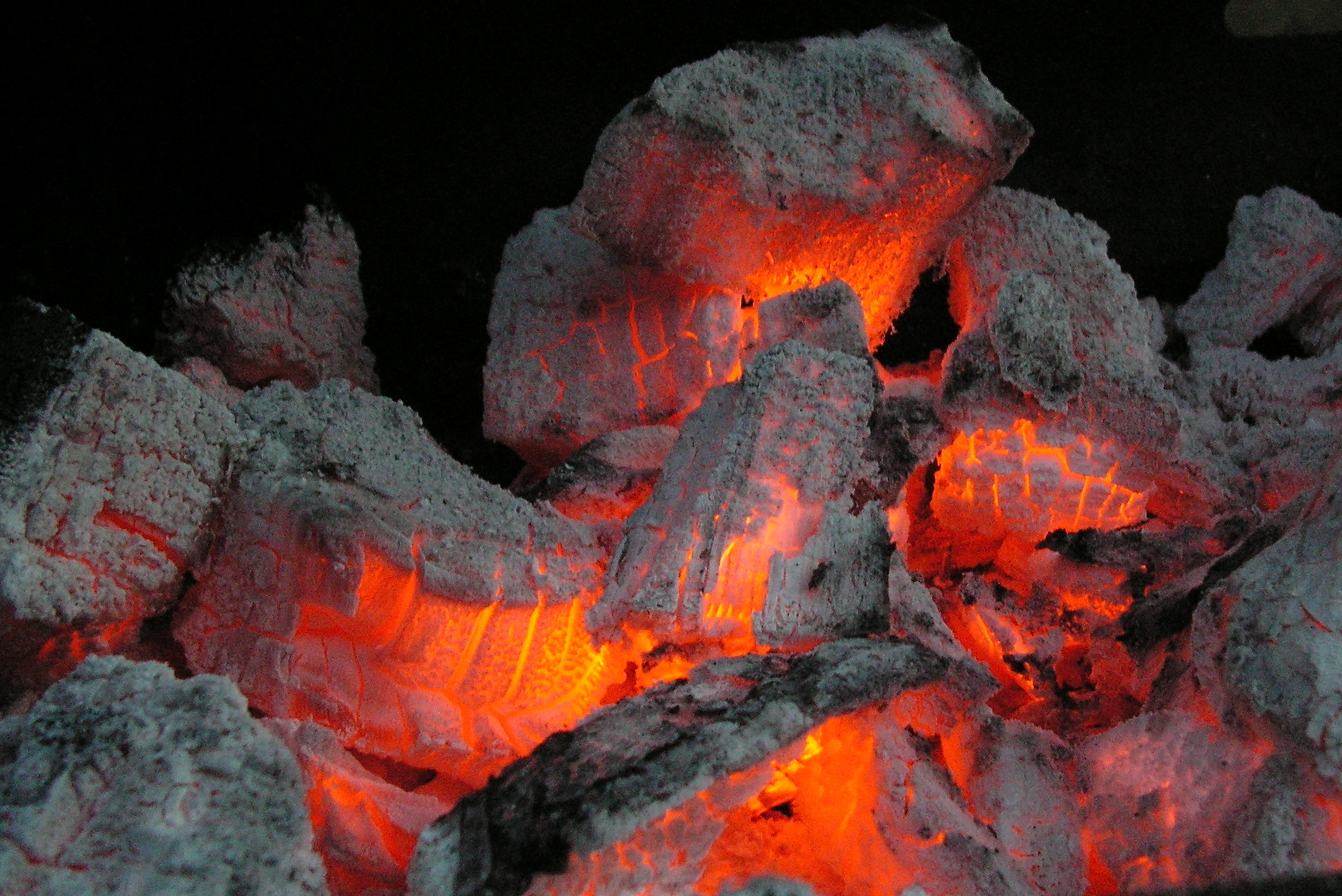
Fires conjure up an atmosphere of ‘togetherness’. Whether it’s making toast on the dying embers of an open fire, the noise and roar of bonfire night or the easy companionable conversations around a camp fire. 

The warmth is literal and relational. 

But there are times when sparks do fly: when we see things only in part against shadows and flickering flames; when the conversation gets heated, more volatile. It might be on a picket line or at a guarded gate that difference, suspicion, protest and disagreement converge. 


2.

Peter is caught up in such a scene of tension: of questioning both inside and outside the gate. 

It was cold. 

The slaves and police, both the men and the women, were warming themselves. 

The desire for warmth draws him out of the shadows; draws him into this unpredictable intimacy by the fire.

A woman catches his eye: are you one of this man’s disciples? Are you not?

I am not.

It’s cold. The question isn’t followed up. They’re too intent on keeping warm. Perhaps wondering what is being said in the court yard; waiting to hear a more intriguing line of questioning.

There in the cold - as they warm themselves - Peter stands together with them. He stands apart from his Lord and teacher. 

I am not.

3.

We cut away from the fire. 

Here Jesus faces  a different line of questioning: about his disciples, about his teaching.

Is it possible that Jesus has caught his eye; is Peter looking across the courtyard?

The one who said “I am”: I am the bread of life, the light of the world and the true vine has spoken openly.

The one who is the way, the truth and the life has said nothing in secret.  All his teaching is a matter of public record.

Ask them, says Jesus. Ask those who heard me.  Accusers and disciples are breathing the same air, sharing the same space.

There, standing in the courtyard, warming himself by the fire, is one who had followed. Peter had seen miracles performed; he’d heard the challenge and hope of the teaching; he’d witnessed the power of love to heal.

A split second after Jesus had spoken, one of the police struck him.
What flashed through Peter’s heart and mind?

Did he have a moment to take in what had happened? Did he gasp or look away?

Jesus mean while calls his accusers out on the injustice they perpetrate: they neither acknowledge what is right nor give evidence for what is wrong.

Accusers and disciple are silent. He’s led away. Bound.

4. 

And Peter stays at the fire, warming himself.

This time, it’s not one voice that asks; not just one finger pointing or one elbow nudging in curiosity.

Now they asked him. Are you not also one of his disciples? Are you? Are you? Are you not also?

I am not, he said. He denied it again.

His words eat away at relationship; they eat away at his identity. 

Something deep inside of him is burnt away. This is no longer a comfortable warmth, protecting against the cold.

As he warms himself, Peter confronts a painful and bitter truth.

Does the fire kindle disappointment or anger, despair or regret?

The questioning doesn’t stop: did I not see you? In the garden? With him?

Again Peter denies it. 

Having denied all that he had scene and heard, he now denies something of his own existence. I wasn’t there. I wasn’t seen at that scene. 

5.

And at that moment, the cock crowed.

He had been there. He denied it. And now he is seen again.

Is this fear?

He’d swung from bold declarations of allegiance to denial - furtive at first; but repeated, sucked into a narrative beyond him and within him.


6. 

And as the cock crowed, he finds that all he’s committed to has crumbled around him.

Peter confronts his own brokenness. 

He had been seen in the garden and now sees himself not just in the dying embers of a charcoal fire, but in the breaking dawn.

It is a day that breaks on so many levels.  It reveals the brokenness of those who brutalise and condemn the one who’d restored Lazarus to life; it reveals the brokenness of Peter’s ideals and assertions.

7.

Peter is outside of what we might call his ‘echo chamber’: imprisoned by his own self-image, false idols and certainties.

This more than fear; more like a breakdown.

Yet even at this moment of self-condemnation, Jesus is walking alongside him.

He leads us beyond our false idols and certainties; he meets us in our times of denial and paralysing fear and disintegration. 

His love is utterly self-giving to the point of weakness and vulnerability: it reaches out to us in our hypocrisy and failure. In the midst of our desire for self-preservation, our resistance to change, our need to manage our image… the one who wears a crown of prayer and praise bears those things too.

8.

The one who is ‘all changing unchanging Ancient of days’ takes upon himself a crown not of our prayer and praise, but the crown of thorns.

The one who is God with us, takes on our loneliness and melancholy. 
This is no victor’s crown of leave which fade.
This crown of thorns is a crown of glory.

Our hands and our works are redeemed in him.

Can Peter’s heart and voice be lifted high? Can ours?

In the face of fire and cock-crow salvation is nigh.


© Julie Gittoes 2017

Thursday, 13 April 2017

Washing feet is hard

This evening I was preaching and presiding at the Maundy Thursday service at the Cathedral: commemorating the Last Supper, washing feet and the Watch. It is always profoundly moving - the gathering and remembering; the water, bread and wine; the stripping of altars; music and silence; watching and waiting.  


Washing your feet is hard. 

It’s hard when you’ve put on a few pounds, broken a bone or strained your back; we wheeze and strain.

It’s hard as a fidgety toddler; it’s awkward on a beach or in a communal changing room.

It’s hard as we get older; becoming by degrees a little less mobile, a little more dependent on others.

It wasn’t always like this: how we take for granted the freedom of movement and flexibility; agility and balance; the sheer everyday mundane act of washing our feet. 

As the poet John Ciardi puts it: In lither times the act was unstrained and pleasurable. 

Washing feet is harder than it was.

We wonder at an infant’s tiny toes; we paint nails with varnish or protect them with steep capped boots.  We flex them on a sandy beach, wince at our bunions and admire a dancer’s grace and poise on point.

But for someone else to wash our feet?
For us to wash the feet of another?

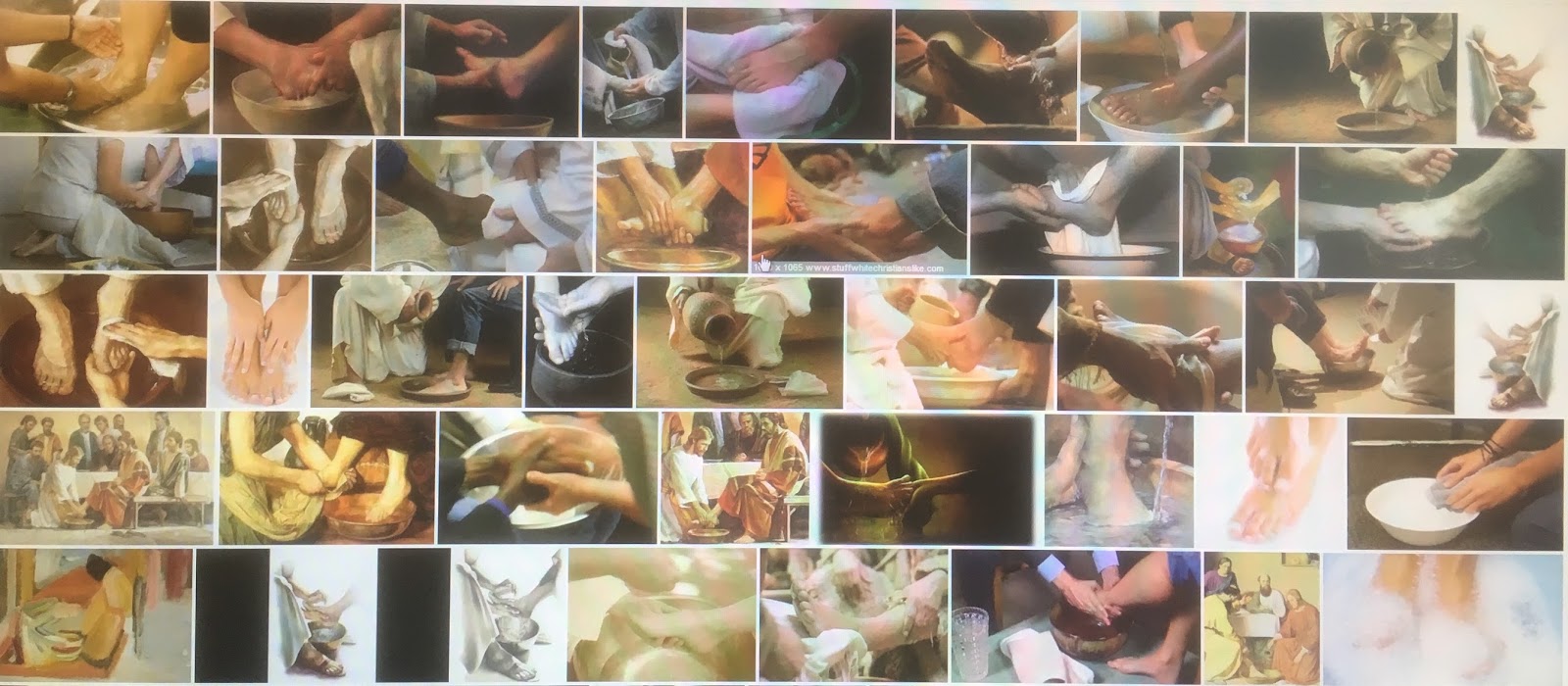
The etiquette of washing of feet isn’t limited to dusty streets and hot climates; it isn’t a relic of middle eastern custom. In the practical tenderness of caring and the pragmatic dignity of nursing it remains part of our social tapestry. In hospices and homes, unseen or acknowledged, we wash; from cradle to grave, we are washed.

Yet it discomforts us: the intimacy and vulnerability; the awkwardness and potential embarrassment; consent, courtesy and compassion.

Touch demands ritual. It’s an act of humanity which reveals God’s likeness - in us, through us, by us. Washing feet is hard: it’s an act of reverence. Here there is grace, humility and love outpoured.

Ciardi’s poetic meditation continues:
Mary Magdalene made a prayer meeting of it.
She, of course, was washing not her feet but God’s.
Degas painted ladies washing their own feet.
Somehow they also seem to be washing God’s feet. 

Mary did indeed wash Jesus’ feet; she anointed the feet of the one who is God with us.
And when we wash our feet - the feet of others - we too honour God’s image in us.  

Tonight we recall that the feet of God’s people are washed by God’s own Son.
We do more than recall it, we re-enact it. 

He got up. He removed his outer robe. He tied a towel around his waist.
Water is poured. Feet are washed and wiped.

Washing feet is hard: not just uncomfortable or a bit ridiculous, but hard. The vanity of our self-assertion, pride and status are stripped away. 

Are you going to?
You do not know now. You will understand.
You will never.
Unless I wash you…
Then not my feet only!
Do you know what I have done for you?

We know that we have been set an example: this mandate to wash is hard. Yet we ought and should love as Jesus loved us.  He makes this commandment new by embodying it himself. In him the self-giving love of the Father is made visible. In the power of the Spirit, we become channels of grace and love divine. Our life together is to reflect the character of God.

Our remembering embodies a way of humility not humiliation. The Corinthians forgot that - preferring their distinctions of wealth, power and status. Paul calls them to remember how the many become one. Jesus was handed over and lifted up to reconcile the world to God.  As we ‘do this’ we proclaim the Lord’s death until he comes; we, his body, are handed over to Spirit, receiving a foretaste of that Kingdom.


Remember. 

Wash. 

Love. 

In this memorial and meditation we see costly service which touches our vulnerability. The one who formed us out of dust, washes dust feet. Our dignity is restored as the one who is God with us transforms our pride, shame, ambition and self-reliance.

If we love one another, with joyful self-giving, everyone will know that we are his disciples.

This memorial and meditation is more than an invitation to random acts of kindness or even intentional acts of service.  It is an expression of who we are to be as God’s people; we are to live out a pattern of love which abides in and flows from the breadth and depth, intimacy and power of God’s love for us. 

If we know these things, we will be blessed in doing them; we will become a blessing.

For us, as for the people of Israel, this shall be a day of remembrance and observance. As the household of God, we eat and celebrate; but now shadows lengthen and darkness falls.

On this evening, before the Passover, Jesus’ hour has come; our deliverance has come near. In this season of remembering the liberation of God’s people, God’s Son will be bound.

Do we know what Jesus has done?
In this memorial and meditation: we enter into the drama of reconciling love.

In a little while, Jesus will get up from the table again.
In a little while, he will be betrayed and handed over.
In a little while his outer robe will be removed; a crown of thorns twisted onto his head. 


Ubi caritas et amor: here is love; deus ibi est: here is God.


© Julie Gittoes 2017

The texts were: Exodus 12:1-4, 11-14; 1 Corinthians 11:23-6; John 13:1-17, 31b-35