Sunday 28 July, Trinity 9: 2 Kings 4:42-end, Ephesians 3:14-end and John 6:1-21
Derogatory comments about cat ladies, and the pushback, turned my mind to two of my favourite 'cat lady' theologians: Julian of Norwich and Evelyn Underhill!
Cat ladies are back in the news thanks to Donald Trump’s running-mate JD Vance.
Back in 2021 he told Fox news that the States was being run by, amongst others, 'a bunch of childless cat ladies who are miserable in their own lives and the choices they’ve made' [from X]. He went on to imply that they didn’t have a direct stake in the future or the nation.
Push back has included social media being flooded with pictures of cats and cat ladies including Dolly Parton and Taylor Swift.
The cat lady has been a stereotype for years, including The Simpsons: sometimes as an insult or way of diminishing women; other times as something embraced with humour or affection.
However, cat ladies - or cat lovers - have their own informal patron saint: Julian of Norwich.
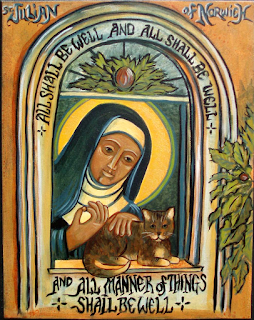
Julian of Norwich image here
Born in 1342 she lived a life of prayer and solitude as an anchoress. Confined to a simple cell attached to a church, she would have devoted herself to the life of spiritual contemplation and giving others counsel; nourished by the sacrament and food that was brought to her.
Like many mediaeval anchoresses, she would have been allowed to keep a cat - serving a practical purpose as a mouser but also a source of companionship. In stained glass windows and in icons, she is represented with a cat at her feet or in her arms.
We might speculate about why she entered this life: turning to it in grief, having lost family to the plague; or choosing it to avoid an unequal or loveless marriage, or the risk of death in childbirth.
What is certain is that far from being miserable in her life and choices, she delighted in the intimacy of God’s love for us and trusted that we are known and protected in that love whether in despair or joy. Far from having no stake in the future or in the lives of others, she had a vision for how love sustains the world, without end.
Her wisdom and insight flowed from an experience of divine love at a time of critical illness. At the age of 30 she found herself close to death. For three days, her life was in the balance. During that time, she glimpsed what she called ‘showings’ - visions, which she recorded after she recovered. She then devoted the rest of her life to meditating on them, pondering their meaning.
The result was her book - the first written in English by a woman - called ‘Revelations of Divine Love’. Her most famous saying ‘all shall be well and all manner of things shall be well’ was rooted in a compassionate and joyful theology - full of God’s mercy and forgiveness, and the motherly quality of love seen in Jesus. We are to live gladly, she says, because of this love.
Such love is infinite in its scope, yet Paul prays that the Ephesians might comprehend its length, height, depth and breadth. Endless love surpasses human knowledge. Yet Mother Julian finds a way to express the inexpressible; this endless love tenderly embraces us in our finitude; we are held in love, like a hazelnut resting in the palm of our hands.
Paul’s prayer focuses on our inner life, being filled with the fullness of God’s love: the Spirit strengthening us; Christ dwelling in our hearts. To be rooted and grounded in love in this way is not divorced from action.
Another woman, who was a spiritual guide and writer, and who also loved cats, was Evelyn Underhill. Buried a few miles away in Hampstead, she encouraged the unity of the active and contemplative life within Christianity. Like Paul and Mother Julian love was the chief virtue, expressed in how we treat one another.
She wrote: ‘Adoration is caring for God above all else. Charity is the outward swing of prayer toward the world… embracing and caring for all worldly interests in God’s name.’ She encouraged simple, regular habits of prayer; time spent in stillness. She also explored the ways in which God comes to us in the pressing tasks, demands and routine duties; she called it a “Sacrament of the Present Moment” - receiving God in ‘every sight and sound, joy, pain, opportunity and sacrifice.’
Over the coming weeks, our gospel readings will come from John 6: an extended meditation on Jesus as the bread of life, given to build up his body, the church; given out of love for the world. Today we are given a glimpse of the way God’s love, in him, creates abundance.
Elisha’s words invite us to know the life-giving justice of divine love. He himself is a prophet and a farmer - working with God in prayer, word and deed to bring life; to provide for the community. Together with the servant, he shared the first fruits - and all were satisfied. Faith and action are bound together - an outward swing of prayer as Underhill puts it, embracing the world’s needs in love.
In today’s portion of John 6, the large crowd needed to eat; but they were also drawn into a miracle of deepest needs being met. Yes, they were fed but they were nourished at the point of deeper need: for love, compassion, belonging, hope and companionship.
They become collaborators in bringing life out of death, freedom from oppression. When Jesus creates abundance it is more than sparking a wave of generosity. As David Ford puts it, the message is about: ‘the compassionate love of Jesus; the unique relationship of Jesus with God the Creator, who is free to generate this abundance from very little; and the rich symbolism of bread and eating, resonating with the Eucharist and much else.’
Jesus’ feeding miracles are showings or revelations of divine love, to borrow Mother Julian’s language. He gave bread because he is Bread. That bread gets inside us.
At the end of her text, Julian of Norwich writes: "From the time these things were first revealed I had often wanted to know what was our Lord's meaning. It was more than fifteen years after that I was answered in my spirit's understanding. 'You would know our Lord's meaning in this thing? Know it well.' Love was his meaning. Who showed it to you? Love. What did he show you? Love. Why did he show it? For love. Hold on to this and you will know and understand love more and more. But you will not know or learn anything else — ever."
Love is the meaning of the bread that breaks, falling over all things. Love is the meaning of the wafer of bread that gets inside us today. Love is the meaning.
When Jesus rejects the pressure to be made king - he withdraws before meeting the disciples on the water. In the face of darkness, winds and rough seas, he stirs up in them the desire to know who he is. May we like them confront their deepest hungers and fears in order that compassion swings from being an abstract concept to life-saving action.
A prayer by Bill Braviner (posted on X on 28 July)
Encourage us, Lord,
to make constant love
for one another
The hallmark of our lives.
Whether things
are going well or badly,
however we feel
we are journeying
on our path of life,
let your love for us
be the bedrock of our lives,
the heartbeat of all things,
today.
© Julie Gittoes 2024


