Showing posts with label Christ the King. Show all posts

Sunday, 6 December 2020

Heal the land, meet the need

 Christ the King: Ezekiel 34:11-16, 20-24 and Matthew 25:31-46

The refrain in this sermon is taken from a song by The Porters Gate called "The earth shall know' which can be found here.


Excellent Danish TV has been one of my lockdown discoveries including the political drama, Borgen, which runs over three series. So far. Netflix is planning a forth. 


The central character is the politician Birgitta Nyborg; the first woman Prime Minister. So yes, it’s about democracy, policy making, negotiations and election campaigns. But it is about far more than that. It intricately and intimately makes politics human; work, home life, relationships.


Writing in The Guardian, Sam Wollaston says: It is about journalism, women, values, having children, not having children. It is about you and me. Nyborg  is a fabulous character: strong, ambitious, confident, but also genuine and honest.


There is ambition and rivalry; compromise and spin; but it also explores the nature of power. It’s dynamic and relational; it’s sometimes costly and damaging; but it doesn’t always preclude honesty, principles and character.


Every episode begins with a quote: from  Machiavelli or Churchill, Lenin or Shakespeare. One line, from the pacifist thinker Bertrand Russell, says: much that passes as idealism is disguised love of power. Such an observation challenges our motivations and commitments; but the in the following episode, the quote was from Matthew’s Gospel takes us to the power of love:  love your enemies and pray for those who persecute you.


This is not mere idealism: they’re words spoken by the one who unveils the love of power; and embodies the power of love.


As we keep this feast of Christ the King, this is a challenging place to start. The risk of the work of reconciliation is that it begins by trying to understand the enemy; by seeking to establish some common ground. 


Love is about the exercise of justice and mercy: to strands, bound together.
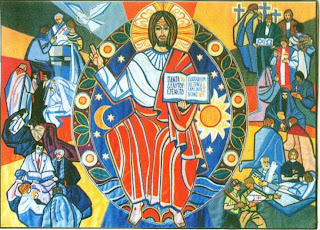


An image from an American tapestry found here


We’ve heard so much in the press this weekend about power gone wrong: about breaches of codes; and party whips.  But today redirects our attention to the fruit of power used well. Power that seeks to heal the land and meet the need; power that sets others free. 


Today we are reminded that every exercise of human power will be held to account under Christ’s kinship, which stands in contrast to world aspirations of status and markers of power.


Miriam spoke powerfully about the nature of God’s judgement last week; and today we learn that it is the practice of mercy that is the measure of that judgement. 


In our first reading, Ezekiel addresses the powerful with a vivid critique. 


The flock has been scattered as the fat sheep push and butt against the leaner ones. The poorest and most vulnerable of God’s people have not been protected or cared for by their rulers.


There will be judgement. The strong will be feed with justice. 


It’s an interesting phrase: suggesting a change in diet. 


Being fed with a portion of God’s desire for human beings.


A diet of justice is reflected in the practice of mercy. 


In Ezekiel, we see God’s desire to search and seek and rescue the lost; to feed and water; to bind up and strengthen. 


Their shepherd who will be both judge and show mercy is Son of David and Son of God: Jesus Christ, our Lord and King.


Today we hear his teaching on judgement in the face of oppression and injustice. 


This teaching is rooted in his own identification with Isaiah: Heal the land; meet the need; set the captives free


This teaching is the source of our hope.


Borgen makes politics human; but here, Jesus reveals God’s justice and mercy in the intimacy of human lives.


An image from a sixth-century mosaic in Ravenna found here


Sheep and goats: In the parable he tells, everyone is surprised by the judgement: the sheep didn’t realise that when they fed the hungry, there were feeding the king; the goats didn’t realise that when they neglected the sick, they were neglecting their Lord too. 


Feed the hungry

Give drink to the thirsty.

Shelter the homeless.

Clothe the naked.

Visit the sick.

Visit those in prison. 


It is a matter of justice that we show mercy; that those who have, care for those in need. 


There is no consideration here of social approval or status, of reward or of receiving a blessing.


Did you show compassion?


Yes, it is about who we are called to assist; the wounded we are called to respond to. 


It is also about who we are called to be; as Luke puts it in his Gospel, it’s the call to be a neighbour.


Heal the land

Meet the need

Set the captives free


The light and hope of such mercy has its origin in the mercy God shows to us in Jesus Christ. 


Jesus told this parable of sheep and goats just before he was anointed by an unknown woman. She pours oil on his head - marking him out as king. Yet as the perfume fills the room, we’re reminded that this king will love so radically and deeply that he will suffer and die. 


Our King is one who judges the power of exploitation, selfishness, dishonesty and abuse; from the cross justice reigns.

Our King is one who shows mercy not simply as judge, but as the one who is present in the midst of suffering and need; from the empty tomb, mercy reigns.


To show mercy is a willingness to enter into the life of another, irrespective of the pain or chaos; showing mercy means coming alongside in the intimacy of human life.


These practices of mercy are about meeting the need - bringing healing and freedom.


Christ on the Tube 

Part of an amazing series by Antonia Rolls (website)


Jesus on Tube: To live in this way is to be always ready for the judgment - no excuses, this is a warning.


Where do we see Jesus on the Tube? In the food bank queue? In this community of Barnet, can we work with others to bring hope to Hendon?


How we spend our money and use our time; the partnerships we form and the needs we respond to: all this is an expression of mercy.  It is to give without hesitation; to give in love; to support works of mercy. 


To heal the land, meet the need and set captives free. 


One Jesuit writer James Keenan writes: When we understand that our sins our forgiven by God’s mercy, then like all good Christians before us, we are called to initiate God and practise mercy for our neighbour in need, especially the most forgotten and those most shamed and most likely to be excluded.


As we meditate on the one who is the source of our hope - our crucified, risen and ascended Lord - we pray that we might be faithful in showing mercy: with confidence, courage and creativity.


Heal the land

Meet the need

Set the captives free.


© Julie Gittoes 2020


Sunday, 24 November 2019

Hope is power

Jeremiah 23:1-6, Colossians 1:11-20 and Luke 23:33-43


Finally, after months of trailers and ubiquitous adverts, The Crown is back for its third season: apparently, the first episode takes exactly one minute and 20 seconds to show us a corgi, which [according to one commentator] is one minutes and 19 seconds too long. Something she’ll forgive because of Olivia Colman.

The words from the lips of Colman’s Queen Elizabeth are:  “Old bat”, spoken as she inspects a new portrait of herself to be used on postage stamps. This austere profile, is designed to convey a sense of majesty, marked the queen’s transition from a young princess to a settled monarch. 

It's 1964, and in the words of Bob Dylan’s song of that same year: the times they are a-changin

A General Election is underway. Winston Churchill dies. There’s a a new Prime Minister. There are rumours of Russian interference and of a KGM spy at the heart of the establishment. Beneath the glamour and weight of responsibility  there are scandalous shadows of the Profumo Affair. There are discussions of trust and character, of fabrications and truth.

And in this drama, lavishly blending together fact and imagination, the complicated dynamics of power and privilege, service and duty are woven are played out. They casts light on the world we inhabit: the contradictions and struggles of times which are a-changin’. It could well be 2019 as much as 1964.

Today, as we celebrate Christ the King - the feast of title of this church - the images of thrones and crowns, royalty and power are cast in a different light. 

This feast emerged in the Roman Catholic Church in the wake of the devastation of the Great War: it was in a sense a warning about the ways in which human authority could be both seductive and destructive. It was an attempt to place at the heart of public life the principle that Jesus Christ is the only King.

In the words of our opening prayer: Christ’s kingship is about peace and unity; it’s about enthroning Christ as Lord of our lives; it’s about drawing the whole of creation into the life of worship.

Jeremiah has sharp words for those who are entrusted with positions of leadership. The prophet calls out behaviour which is self-serving; and promises instead to raise up a new king. The Lord of righteousness will come with wisdom and justice, ensuring safety of God’s people.

That Lord doesn’t reign from a throne or palace or parliament: instead our Lord reigns with us in human flesh. God is with us in Jesus reigning in a manger; ruling amidst the messiness of our lives, leading us into God’s kingdom of justice, mercy, compassion and peace.

Today we see the reign of love from the very depths of human sorrow and pain. 


Today we are invited to gaze upon the face of the one who is our Lord: like those in our gospel, we look, and see and respond. 

The inscription over Jesus’ cross is clear: This is the King of the Jews.

It’s an inscription which provokes challenge and questions; silence and indifference. 

Some stood by watching. They keep their distance. 

Some stood by, gambling: casting lists for his clothes.

Some looked on, scoffing: from the position of their own religious leadership, waiting for a sign; for the ultimate miracle.

Soldiers looked on, mocking him. If you are the king, they ask, use power in the way we understand; use it to save yourself;

A criminal looked on: deriding him. Crying out with that same questioning ‘if’; If you are God’s chosen - do something to set me free.

Three ‘ifs’ echoing the temptations of the wilderness: temptations to use power for selfish ends, to impress others or to collude with the ways of the world. 

But there’s another voice. The second criminal. And when he speaks, he sees a different kind of glory and power; he sees victory where there is shame; hope where there is loss.  

He speaks out: ‘Jesus, remember me when you come into your kingdom.’

For although our own mistakes and misdeeds are evident, God in Jesus comes to that place of humiliation and shame and brings the gift of mercy and forgiveness.

So often we are caught up in the regrets and stories of our past that we get stuck there.

Or we get so caught up in our own plans for the future, that we are ensnared by mere wishes.

What we do have is this present moment: and there, as he confronts death, this criminal teaches us what really matters. 

A sermon preached at the joint service for Christ the King - celebrating the feast of title at Christ Church. An amazing service - gathering to break bread in worship and break bread in fellowship - expressing what it means to be two  churches and one parish.

Today in the present moment we hear, those precious words of promise: the promise of paradise. This is a moment of hope.

We are invited to embrace this hope.

We embrace this hope as we take into our hands the body of Christ: in the wafer thin fragility of broken bread, we encounter the depth of love and the promise of new life.

As we hear in Colossians: this is what makes us strong; this is the source of our patience and joy. 

The one who is the image of the invisible God; the firstborn of all creation; show holds all things together. This one is with us.

This God has rescued us from the power of darkness; from all those things which distort power and which corrupt love. 

Jeremiah challenges us about the way we exercise leadership: in our homes and in our schools, in our churches and our workplaces, in public service and in our acts of charity.

We are called to bring people together rather than to scatter them; to enable them to flourish in safety rather than leaving them fearful.  

For us, as much as for Dylan, we can be sure that times they are a-changin’. The challenge and invitation is for us as Christians to be confidence and faithful in our witness - calling power to account, yes; but also reflecting the fullness of life and love God promises us now, though the power of the Spirit. 


Perhaps we can reclaim the new slogan adopted by the Guardian: change is possible; hope is power.

That hope is in Christ: so let us celebrate this feast. Rising to challenge of sharing the fullness of love; and the hope of peace and reconciliation. 

Change is possible; hope is power.

He is the head of the body, the church; he is the beginning, the firstborn from the dead, so that he might come to have first place in everything. For in him all the fullness of God was pleased to dwell, and through him God was pleased to reconcile to himself all things, whether on earth or in heaven, by making peace through the blood of his cross.


Change is possible. Christ is king. Hope is our power.

© Julie Gittoes 2019

Monday, 27 November 2017

Sheep and goats

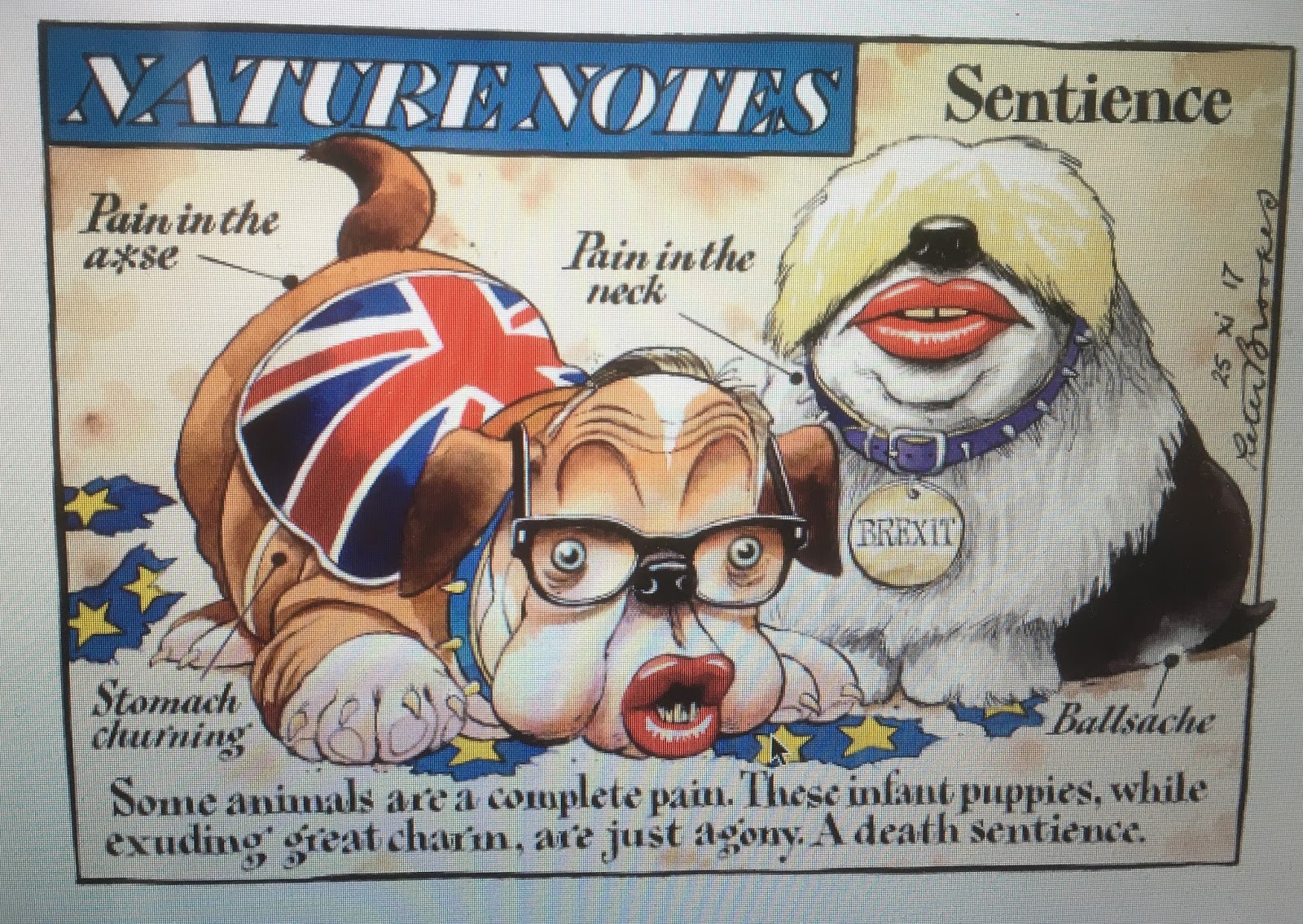
Yesterday we celebrated the Feast of Christ the King. As I was preparing to preach - including reading a Saturday paper - I was struck by the ways in which political cartoons seek to provoke and persuade in a world of turmoil.  I wondered if parables served a similar purpose - engaging our imaginations to challenge our attitudes or behaviours.  

In his commentary on Matthew, the theologian Stanley Hauerwas points out that there are those who ‘claim to need power to do good but in fact just need power’. Our shepherd-king reveals the fallacy of that; and uses the parable of sheep and goats to enable us to reflect on our place in God's Kingdom.  The texts were:  Ezekiel 34:11-6, 20-24; Ephesians 1:15-end; Matthew 25: 31-end

Political cartoonists have an uncanny knack of distilling complex news stories and political agendas into a single image. 


In The Telegraph, “Nature Notes” combined Brexit negotiations and animal sentience with caricatures of Boris Johnson and Michael Gove as ‘infant puppies’ which ‘whilst exuding great charm, are just agony’.


Meanwhile, The Guardian’s Martin Rowson depicts those same politicians in the Workhouse  of ‘Sovereign Penury” alongside Theresa May in leopardskin kitten-heels: the graffiti on the walls reads ‘Give up all hope’, ‘The wages of sin is stagnant’ and ‘Eternal Austerity’.


Cartoons provoke and persuade. To understand them, we need to interpret the exaggerated symbolism, alongside the captions and characters; we pay attention to the details, allusions and the use of irony. They make sense within the context of a wider narrative or set of situations. The same is true of parables - Jesus uses images and allusions to prompt us to think and act as God’s people.

What might your favourite cartoonist make of today’s parable: nations under judgement, acts of mercy and the division of the blessed and accursed. Who would “Nature Notes” depict as sheep and goats? How would Rowson express eternal life and eternal punishment alongside eternal austerity?

Such musing aren’t out of place. For we, like the disciples, live within the same matrix of earthly loyalties, international upheavals and domestic uncertainties. Like them, we need to learn how to live well in the face of change and adversity, by placing our trust in God’s faithfulness.


The story of the sheep and goats is the last in a series of parables which Jesus deployed in response to the disciples’ admiration of the grandeur of the Temple.  As Canon Paul reminded us, Jesus named the transience of worldly powers and impressive buildings; emboldening them - and us - to seek God’s kingdom.  

Parables - like cartoons - shed light on our motives, desires and the consequences of our action or inaction. They provoke and persuade us by engaging our imagination - to live without fear, bringing hope to others and acting with mercy.  To speak of sheep and goats reveals the impulses of our hearts, our priorities and divisions. 

To speak of sheep would evoke passages like those from the prophet Ezekiel: passages which depict God as the chief shepherd of the people: searching and seeking; rescuing and gathering; feeding and binding up; strengthening and judging. 


Ezekiel’s words resonate with the human condition. We live in a world where peoples are scattered; where greed, ambition and self-service distorts the responsibility of leadership. His words names our hopes - for a place of rest and safety in our life together. He also names the ways in which we can become divided amongst ourselves - the weak are bullied, the strong exploit their position. 

This is the backdrop to Jesus’ parable: a narrative of God’s faithfulness - of a love reaching out towards us, bringing us home. And that love isn’t abstract. Nor is it the cry of ancient prophets alone. This love is revealed in one who is heir of David; the shoot from the stock of Jesse; the one on whom the Spirt of the Lord shall rest. He is Emmanuel.


He taught the crowds on the mountainside and brought healing to those in sickness or distress.  Children have been blessed and the rich invited to store up heavenly treasure;  matters of divorce, taxation, hospitality and forgiveness have been debated.  

Now as we hear the parable of sheep and goats, our generation stands among the nations.  We face righteous judgement - standing before the loving gaze of one who is both shepherd and sheep; the king and the one in need.

This parable also sets before us a vision of God’s Kingdom which is marked by showing mercy, loving justice and walking with humility.  Jesus words hold leaders to account, but he also calls our attention to ordinary acts of feeding, clothing, welcoming, visiting and caring for others. 

Curiously, neither the sheep nor the goats know that in ministering - or failing to do so - that it was Jesus before their eyes. Perhaps our cartoonist would have given them expressions of surprise, shock, joy or embarrassment. Perhaps they too would have added the drama of hell fire versus heavenly bliss to spell out the seriousness of the situation. 


The consequences of our action or inaction having enduring impact - on ourselves and others; we can strengthen or scatter, bind up or wound. In this parable, the eyes of our hearts are enlightened. We know the hope to which we are called; the inheritance of faith and love we are to share. 

That’s because in these moments, we see and are seen at a level of authentic human engagement; it’s compassion which frees the host and the guest. In going beyond the realm of duty, we see God. In the least of these, we see the Imago Dei, the image of God. 

That likeness is embodied and enacted - in face to face intimacy as we counsel the distressed, comfort the anxious and sit with the broken hearted. 

This likeness is performed in participation with others in networks which feed, cloth and visit; using gifts to support economic transformation, sustainability and fair trade; in supporting and praying for those who work in immigration centres, prisons and shelters for the homeless or victims of domestic abuse. 

The dignity of the Imago Dei is restored as lives and systems are transformed.

Learning to live like this when the future is uncertain is to endure upheaval with our hearts fixed on the victory of the shepherd-king, Emmanuel.  

The disciples learn a tough lesson. And so do we. For the one who is God with us, is the least of these. He is stripped of clothing and agency; dignity is crushed, his face smeared with blood and spittle. Hail, king of the Jews!  


This king embraced the pain and suffering of humanity in his broken body; his outstretched arms reconciled us to God and each other. In him God’s power is at work - healing, forgiving, challenging, inspiring. As we hear in Ephesians, God’s power raised him from the dead. burst from the tomb, in the silence of the night, to renew our hope that life and death leads to risen life. 

Now the one who reigns above all rulers, authority and power,  pours out his Spirit on us that we might be united in a bond of peace. 


And the most remarkable thing is this: we are members of his body. 

We are ‘the fullness of him who fills all in all’. Our agency, our bodies, our breath, our wealth: all this can express the fullness of God’s love in unremarkable yet significant moments. 

Here we are fed by that fullness. Here we are called.

Bread broken. Fragments shared. Hands outstretched. Fullness tasted.
A body given that we might be that body.

Then we depart in peace with assurance, hope and challenge of today's communion motet*:

Christ conquers,
Christ reigns,

Christ commands. Alleluia!


* A setting of Christus Vincit by James MacMillan

© Julie Gittoes 2017