Saturday, 29 April 2023

Doubt as productive

16 April 2023 (Easter 2): Acts 2:14, 22-32, 1 Peter 1:3-9 and John 20:19-end


As human beings, we often seek certainty but also find ourselves living with doubts. 


There may be times in our lives when guidance and direction are important; or there might be moments when we need space to weigh the questions, trust our instincts. 


Some of us might be predisposed to ways of thinking and acting rooted in confidence and clarity; others of us may experience decision-paralysis or imposter-syndrome, being all too familiar with doubt.  


Perhaps we say to ourselves ‘I’m not sure’ or ‘I don’t know’ - on the threshold of changes in work or relationships, circumstances. It is rare to hear such phrases in public though.


Someone seeking to change that is Nicola Reindorp, the CEO of Crisis Action. In reflecting on the impact of her own doubtfulness on her career, she decided to explore it in conversation with neuroscientists, counsellors, economists and leaders. 


In doing so, she writes [here] that she ‘discovered another side to doubt that is productive and powerful, not the destructive doubt of paralysis and pain, but a productive form of questioning and discovery.’


In a way, her “rebranding” of doubt makes sense: she puts it at the heart of self-awareness and humility, seeing it as a prompt for curiosity and learning. Doubts enable us to interrogate our own biases driving not only innovation but also inclusion and diversity. 


Does it help us understand Thomas better? He was someone who elsewhere in John’s gospel speaks openly and directly about his thoughts. Questions don’t seem to phase him. So perhaps it shouldn’t surprise us that his faith and belief was also mediated openly, directly and indeed relationally. 
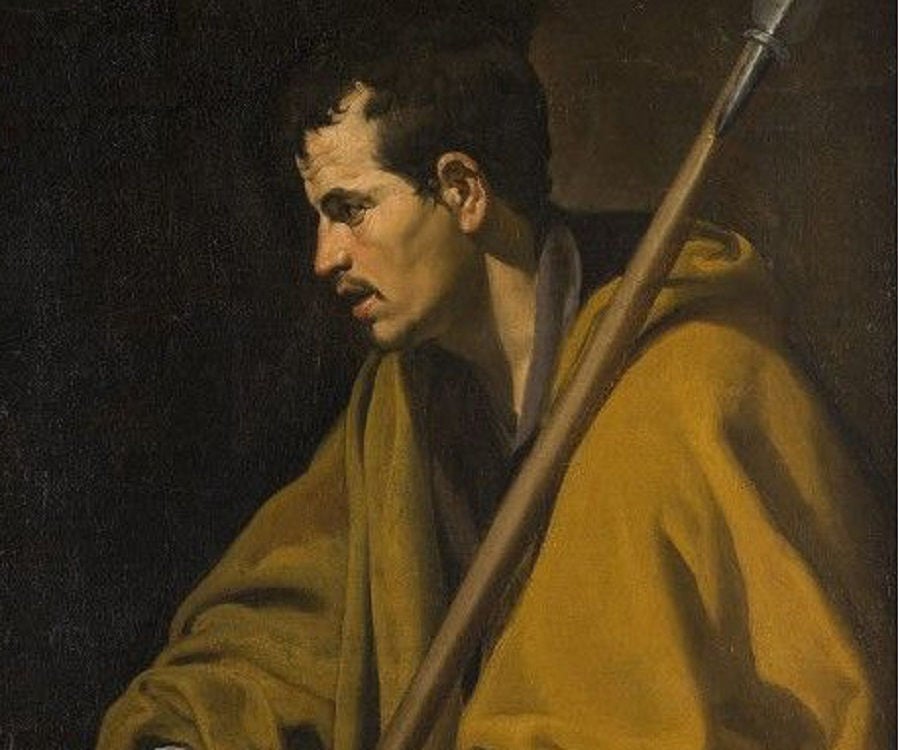


St Thomas - Diego Velázquez

As Rowan Williams puts it: ‘doubting Thomas is often thought of as demanding hard evidence - unless I touch the wounds - and yet it was his encounter with the person of Christ that sparked faith.’


Thomas's doubt leads to a desire for touch; but what he sees inspires his belief, his trust. His testimony opens up space for others to find new purpose, new life. 


A better nickname might be ‘inspiring Thomas’ after all!


Does such a rebranding sit alongside what we hear in our text?


The tomb was empty. The doors were locked. 


Rumours of resurrection were circulating as fears were pressing in.


Into that place of grief-stricken hearts and troubled minds the risen Lord breathes peace.


To the exhausted, troubled and anxious: peace.

To the fearful, questioning and grieving: peace.

To the curious, hopeful and courageous: peace.


The marks of the nails and the pierced  side are visible: the continuity of scars witnessing to the continued presence of the self-giving love of God. 


The one breathing peace was of the Father’s love begotten; breathing peace having been betrayed, denied and beaten.  


Those wounded hands took the sting out of death and now reach out to places of mistrust, pain, disappointment and guilt.


Those wounded hands also reach out with the balm of love to forgive and heal rather than condemn.


But Thomas was not there. 


His doubtfulness means the confidence or charism of the words of others was not enough. He needed to see, to touch, to feel the breath of peace.


Those are productive signs of questioning and discovery rather than a painful paralysis. 


He had to take that doubtfulness into the week of waiting, of talking, eating, praying. 


Did their joy give space for his questions? Did his curiosity deepen their joy? Did their peace soothe his hurt? Did his interrogation prompt deeper fellowship?


The tomb was empty. The doors were locked. 


Stories of resurrection filled the room, fears being dispelled.


Into that place of hearts warmed by conversation, fellowship and prayer another word of peace is spoken. 


There is no rebuke or condemnation - simply an invitation for Thomas to reach out, to touch, to see, to trust.


Doubt becomes worship: my Lord and my God!


Evidence and observation becomes unconditional acceptance.


That is not the end of the matter: all this is for our sake - the words, the stories, the testimony, the breath of peace.


All this is written to assure us that we are healed by the same words; that we might put our trust in the promise of renewed life; that we might know ourselves to be loved, forgiven, restored, made whole and blessed. 


More than that, in the power of the Spirit, the risen Jesus sends us to transmit that love and forgiveness. 


In problem broken bread and outpoured wine, our fragile and fallible bodies are nourished as we are called from penitence to restoration; as we allow love to seep into those locked places of fear. 


This new life is a gift but also a process. The Spirit is at work in us - confronting us those things we hide from and cultivating in us new hope and dignity.


This process is held within our community - the accountability we have to one another before God.  If doubts are about curiosity, self-awareness and humility - if it prompts our learning and the safe space to interrogate our own biases, questions and weakness - then they have their place. 


Together, faith and doubt can be productive: bearing those first fruits of healing, generosity, conviction; rejoicing with those who rejoice, weeping with those who weep.


Hand in hand it staves off those things that paralyse us or hidden growth and change; finding a deeper stability and ways forward that do not coerce, demand or control. 


This kind of questioning and discovery drives the processes of forgiveness: being honest with ourselves and knowing what sets others free; the changes that bring hope and liberation; letting go of habits which cause harm.


For the one who breathed peace was the one who endured the worst of humanity - shame, failure, selfishness and betrayal - and burnt it away in the refining fire of a crucible of love.


Perhaps Thomas and Peter strengthened each other in their faith and witness through the way they tested, challenged and encouraged one another. Certainly Peter’s words - in Acts and in his letter - speak of a liberating hope and new life, which is full of gladness, mercy and love. 


It is a message, as Willie Jennings puts it, that is ‘far more powerful than its messengers’; it is a remarkable message which draws our life from fear to peace. 


Faith and doubt, peace and forgiveness: worked out in prayer, fellowship and breaking of bread for the sake of the world.


As Rowan says: ‘Faith is not just ideas in your head, faith is not just feelings in your heart - faith is the whole of a new life, making a difference to your lives, to your neighbours, to your community, by the grace and the Spirit of God.’


© Julie Gittoes 2023

Love rising

 Easter Day 2023: Acts 10:34-43 and John 20:1-18

Mary Magdalene in the Garden by Sieger Koder

It was dark.


Exhausted. Unable to sleep.


Mary came to the tomb, alone. 


With oil? Or just to be there? At the grave. 


Close to love’s bruised, buried body. 


But something was disturbed and disturbing. 


The stone had been removed. 


It was no place to be alone. At twilight. 


She ran. Ran to beloved friends.


Questions troubled from her lips.


Listening. And then.


Peter and the other disciple ran.


One would outrun the other - first in this race.


He looked. Saw. Paused. 


At the threshold of what had been entombed. 


Peter went in and saw.


The other would follow him, see and believe.


But they went away, returned home.


And she? She stood weeping. Outside. 


She had to bend, twist her body, to look in. 


To gaze from twilight into darkness.


Emptiness announced an absence.


Just as tears make eyelids swell, announcing grief.


Grief in a world made strange.


Mind racing. Thinking the worst.


It was dawn.

Have we not felt it?


The grief and insomnia; the questions and tears.


Wanting to hold on. Waiting at grave sides.


Waiting in silence. Wanting answers.


The need to run to friends; the times we’ve walked alone.


The burning eyes; and racing mind. Until twilight turns to dawn.


For Mary, recognition dawns as dawn breaks.


She senses a real presence.


Her question repeats itself, dissolves in the air, resolves itself in her body language.


Love rises, breathes, speaks.


Her name. Her Teacher.


Her heart swells, beating a little faster. 


It’s not that it’s over; that it’s solved; that it’s unproblematic, uncomplicated, undone.


The pain, confusion, death and grief were real: but maybe, just maybe, their vice-like grip has softened.


Replaced by life.


Now the green-blade riseth, from the buried grain.

Wheat that in the dark earth many days has lain;

Love lives, that with the dead has been:

Love is come again like wheat that springeth green.


Love lives. 


Not only as the sleeping, quickening grain, but as the gardener.


The one whose hands are soiled with the earthiness of our hearts.


Even when they are wintry, grieving or in pain.


The one who brings us life when we can’t see it; who loves when we can’t accept it.


Or when there’s a risk to be taken, a change to be made.


The one who is with us when there are more questions than answers.


There when we rise, stumble or fall; when we stand alone, or together.


The one who feeds us with bread which earth has given and human hands have made.


Becoming for us the bread of life. 


Mary could not hold on to her Teacher, Lord and Friend.


Letting go allows her to tell her story of his story of good news.


A story that tells us that God in Christ does not leave us.


But rather lets go in order to relate to all peoples across time and space.


Letting go leads her deeper into a new community.


One that is truth seeking, sense making, peace building, bread breaking.


One that shares God’s desire for joining, forgiving, blessing.


In that way, Mary, along with Peter and the Beloved Disciple, love expands until it reaches beyond our human limits.


Until it echoes the pulse of God’s own life.


Each one of them spoke of this hope.


Hope that sees the world as God does: with no partiality but with judgement and mercy.


Seeing God’s light and life reflected in a band of colour: violets and oranges, blues and reds.


Those particular sites of love.


Hope that reaches goes beyond the grave.


We claim that promise in the face of tears and questions.


Love is come again. 


Not as a one-off miracle.


But as the beginning of a new order.


Death has been overcome; therefore all things are being made new.


This is the Spirit’s work. We share in it.


We persist and protest; dream and disrupt; nurse and nurture; create and care.


And sometimes we stand at the tomb ourselves.


And maybe find our questions, tears, losses and hurts folded with the clothes left behind by love’s risen body.


And then, maybe, rather than run, we stay; let go and live. 


Live so that love can rise in us - and show that God’s loving mercy is for others too.


© Julie Gittoes 2023

Saturday, 18 March 2023

Light Gatherers

 Mothering Sunday: 1 Samuel 1:20-end, Colossians 3:12-17 and John 19:25b-27 - Carol Ann Duffy's poem "The Light Gatherers" can be found here.


When you were small, your cupped palms

each held a candleworth under the skin, enough light to begin,

                             and as you grew,

light gathered in you, two clear raindrops

in your eyes,

                            warm pearls, shy,

in the lobes of your ears, even always

the light of a smile after your tears


So begins Carol Ann Duffy’s poem ‘The Light Gatherer’.


She describes kissed feet that glowed and a bowed head spotlit; when language came it glittered like a river; and sleep, when it came, had the whole moon for a night light


Mother and Child - Mary Cassatt 


Duffy is painting for us a picture of motherhood. 


It might not be universal. But being born is. 


She captures moments we cannot remember. 


The beginning of another human being. A spark of light and life.


When we were very small: the infancy of first breath and being held; the infancy of the awkward tenderness of cradling a newborn life. 


She captures childhood moments we cannot remember. And some that we do. 


Playing on our own; games with others. Learning. Falling.


The slow time of waiting, which goes too fast for adults.


We grow. We become more ourselves. Bound to others, to those who nurture us.


We remember them. As light gathers in us.


Duffy ends her poem with life opening out at the end of a tunnel of years. - through adolescence and into adulthood. 


We might see in Duffy’s poem a glimpse of how God sees us.


We are light gatherers - even when the light of a smile comes after our tears.


To be formed in the likeness of God is to be a child of light. 

Fragile, yet strong for others. 


Whole, when we feel broken.


Good, and forgiven forgivers.


Beloved, even when we don’t see it.


Our readings give us three pictures of what our life together is or could be like.


First, Hannah. Some of us, like her, will long for a child of our own.


All of us have experienced childhood.


Some of you have remained with children to nurse and wean them.


All of us have stood at a school gate: one side of it or another.


Part of the story of parent and child is that kind of letting go.


Letting go so that we can have the space and time to be who we are: called as human, blessed with personality and interests, taking that into work and relationships, to embrace or let go.


In all that, light gathers in us: the people who love us, care for us, teach us; those who make us laugh, bring us comfort, restore our confidence. 


Those who let go and never stop praying for us: holding us before God in love.


The second picture reminds us that parenting, nurture, motherhood and friendship exist within a wider network: a community.


John paints a picture that is perhaps shocking or surprising. 


God’s love made flesh in Jesus has been present at a wedding and late night conversations, in story telling and sharing bread. 


Now as his head bows on the cross, he looks at his own mother and closest friend and asks them to form a new household.


In their grief light gathers in them: just enough light to care for each other. 


Maybe carrying just a candleworth in their hands; enough warmth; even a light of a smile after their tears. 


This love made flesh is still at work: dead, buried and risen, and still rising in us. A love that doesn’t let us go.


Love like a night light: just enough to reassure us in the promises we make, the ripples of grief, the wild dreams of possibility and the small gestures of hope.


Image found here


As our third reading paints an image of life lived when we are looked on with love: a beloved community with enough light to begin and to grow.


In the smallness of our cupped palms there is light and love and joy: there is enough when we are fed with life in bread; when we are seen and blessed.


Light gathers in us when there is compassion and kindness; humility and patience. 


It gathers when we bear with one another: the patient work that mothers and friends, granddads and siblings, teachers and carers know. 


Light gatherers are to be clothed in love. 


Love which binds us together when it is hard; that breathes peace into broken hearts. Love which gives thanks; that calls out unhealthy habits; which forgives and allows that truth to take root. 


It’s a love that sings. 


With happiness, yes, of course; but a love that keeps on singing when we’re sorrowful. 


Whatever you do - in words and deeds - do it in Jesus’ name. In love.


Be the light, the love, the peace you want to see. Do it knowing there’s just enough in the palm of your hands; in the expanse of your hearts; your smiles, your tears, your embrace. 


Look around today:

Behold, your mothers.

Behold, your children.


You are God’s chosen ones. Light gatherers. Beloved. 

May God’s love dwell in you richly. Amen.


© Julie Gittoes 2023


Monday, 6 March 2023

Human life: more than getting to the top of the mountain

Sunday before Lent: Exodus 24:12-18, 2 Peter 1:16-21 and Matthew 17:1-9


Sir Edmund Hilary was one of the most famous explorers and mountaineers - receiving a coronation medal for his ascent of Everest 70 years ago. 


He was honest about some of the misery of high altitude climbing and the dangers that went with  it. He spoke of being sensible, prepared as well as the  compulsion and thrill . He saw adventure as something open to the ordinary, the mediocre and the fearful. 


Image of Sir Edmund Hilary

Perhaps the perspective of his experience says something about today’s readings. However challenging or modest the climb, you cannot stay at the summit forever. Mountaineers, hikers and walkers all have to descend; but as they do so, they bring with them what they have seen. Hilary said:  ‘Human life is far more important than just getting to the top of a mountain’. 


Today we are taken to the summit - to a place regarded as holy, where heaven touches earth. But we are also drawn into the reality of human life, touched by Jesus, before returning to the valley. 


Six days before he was led up a mountain by Jesus along with James and John, Peter had declared that Jesus was the Messiah, the Son of the living God. Peter had also challenged and resisted when Jesus explained that he must suffer, die and be raised to life. 


Now, echoing Moses' experience of waiting on a cloud covered mountain, the glory of God was revealed on the seventh day. Now, that inheritance of the law, given for instruction, is transformed in Christ. As Elijah too joins Moses, the legacy of the prophets, calling people back to ways of love, mercy and justice, is also transformed. 


This is a moment of glory, of dazzling brightness, a radiant darkness: something spectacular, overwhelming; a moment infused with the grandeur of God. 


No wonder Peter embraces this with eagerness - declaring that it is good to be there and longing to create dwelling places there. He kinda gets it - he is far more inspired by this experience of glory than Jesus' words of suffering and passion. 


Before he even gets all the words out, he’s stopped in his tracks. Now is a time to listen. 


Image of the transfiguration found here

Listen to the one who is beloved, the Lord who is the servant; listen to the beloved Son, the servant who is also Lord. 


Listen. For God comes to us in Jesus in humility and vulnerability, in flesh of our flesh. God comes to us and shares our human experience - the joys, adventures and wonder; the isolation, pain and sorrows.


It is good to be here, for this is the glory which assures us that the home of God is among mortals; that there will be a time when tears will be wiped away, and death will be no more. It is a glory which points towards a creation renewed. 


It is good to be here, but this is the glory of the one who both commands the waves and shares bread with the crowds, who sees the humanity of the widow and tax collector and restores the sick and overburdened.  


It is good to be here on the mountain top: to contemplate and gaze on glory; to inhabit the wonder of a world transfigured. But we cannot stay. We cannot confine, secure or domesticate the wild and unpredictable spirit of God’s presence. 


The disciples fell to the ground overcome by fear when they heard a voice telling them to listen to God’s beloved Son. 


It is then that the beloved Son reaches out and touches them; he says, do not be afraid. Jesus knows that there is something more important than getting to the top of the mountain.  He knows that that means descending to the valley where human life unfolds.


Jesus knows that Peter and the others will not only listen to him - his teaching, the stories, the debates - but they will also follow. They will walk this way of loving sacrifice, of costly generosity, of self-giving care. 


He knows their fear - that suffering is harder than glory. And he places his hand on their shoulder. He allows the warmth and weight of that to be felt. He is with them - quieting their hearts and stilling their minds.


Listen. Do not be afraid. He leads them back to the rhythms and routines of everyday life. He invites them to live out the commands to love God and neighbour - given for our instruction. To do that may not be spectacular; but that is the way of life we’re called to, step by step.


Today we do not climb out to a literal summit; but we do have the opportunity to draw near to the source of life. To extend our hands - to touch, taste and see how gracious the Lord is. To be fed, blessed, loved; to be strengthened and changed, to find reassurance in our fear. 


For here in our worship - in word and sacrament, music and fellowship - we glimpse a holy light. We might hear a reassuring word - human and divine; we might receive a hand on the shoulder, the courage to have no fear.


We stand beyond the moment when the disciples had to keep their silence about their vision. They were given a glimpse of glorious majesty before he suffered on the cross. But  Christ has been raised from the dead.  It is good to be here. To be attentive to the glory - to be attentive to this ‘as to a lamp in dark places until the day dawns and the morning start arises in our hearts’, as Peter puts it. 


It is a light which confirms a prophetic message; which opens us up to the breath and movement of the Spirit in us. A Spirit which nurtures acts of faithful listening in goodness and self-control, in kindness and patience, in generosity and mutual affection. 


Such ways of living and loving are kindled as we come to the Eucharist, our summit and source, in cross-light. But human life is more than getting to the top of the mountain, we go out into the world and see God’s light reflected in a band of colour. We out to bring a touch of love which dispels fear; a word of comfort that restores hope.


© Julie Gittoes 2023